

Taking Flight with Solar Energy: The Benefits of Solar Panels in Aircraft
Aviation accounts for approximately 2.5 percent of global CO₂ emissions and roughly 4 percent of total climate forcing when contractions from condensation trails are included. Despite being a relatively modest share of the global total, this represents the hardest-to-decarbonise segment of the transport sector, because the energy density of jet fuel is approximately 43 megajoules...
Read More
IATA Warns of Slowing SAF Production as Airlines Push Toward Net-Zero
On December 9, 2025, IATA revealed that 2025 SAF output is projected to reach 1.9 million tonnes — roughly double 2024’s output but far below what is needed for meaningful decarbonization. The 1.9 Mt of Sustainable Aviation Fuel will account for only 0.6% of total global jet fuel consumption this year and projections for 2026...
Read More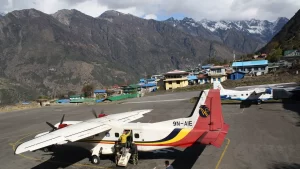
Environmental Impact of Lukla Airport: Balancing Tourism and Sustainability in the Himalayas
With an impressive airstrip situated 2,900 meters above sea level, Lukla Airport (LUA) is the highest functioning airport in Everest: one of the hiher ones might have had the epithet of rightly being called the most dangerous airport had it been able to survive the impossible test of posterity. Although harsh geographic circumstances and the...
Read More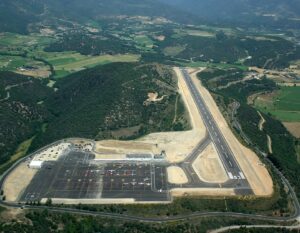
Andorra: The Largest Country Without An Airport
It might come as a surprise that there is an airport named after the largest country in the world without an airport- Andorra – but it is located outside the borders of this nation. The Andorra–La Seu d’Urgell Airport (LEU) is located in Catalonia, Spain. Andorra Airlines, a carrier headquartered in Barcelona is one of...
Read More
Can A Helicopter Fly To The Top Of Mount Everest?
The highest ever recorded bird strike (i.e., a collision of a bird and an aircraft) occurred over the West African coast when an Air Ivory Coast aircraft struck a vulture at a staggering height of 37,000 feet – an altitude which is almost 8,000 ft greater than the height of Mount Everest...
Read More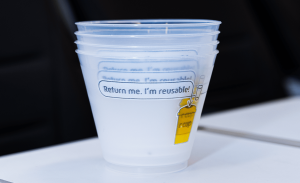
Top 5: Airlines using reusable cups on board
Air travel is one of the most convenient and popular modes of transportation, but sometimes conveniences also generate a significant amount of waste. Such is the case for paper cups that are used by various airlines. To help reduce such waste and protect our environment, some airlines are using reusable cups while flying. This small...
Read More
Nepal’s $10 Billion Nijgadh Airport Could Destroy 586,000 Trees. Does It Need to Be Built?
Nepal already has three international airports: Tribhuvan International Airport, Pokhara International Airport, and Gautam Buddha International Airport. With problems existing in Pokhara International Airport, and virtually no international flights running, do we really need Nijgadh International Airport as well? Nepal has a list of many failed airports already. The Dharan Airport’s scam is something that...
Read More
Bird Strike Prevention: Technologies and Prevention Strategies
Bird strikes, or collisions between birds and aircraft, began when what is now referred to as “mechanical birds” tread upon the space of birds. The deadliest bird strike on a fixed-wing aircraft was recorded on October 4, 1960, and this incident involving a Lockheed L-188 Electra took the lives of 62 passengers on board. In...
Read More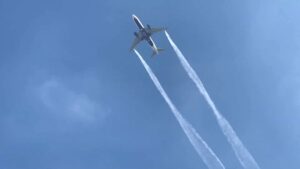
Fuel Dumping: What Is It and How Bad is it for the Environment?
Sometimes, the wispy white trails that follow an aircraft on its flight aren’t contrails but fuel that has been dumped by aircraft. This is also known as fuel jettison. Fuel dumping is a last-resort maneuver whereby a plane releases fuel in mid-air. This may seem environmentally unfriendly, but it is a critical safety measure in...
Read More- 1
- 2