

Aviation accounts for approximately 2.5 percent of global CO₂ emissions and roughly 4 percent of total climate forcing when contractions from condensation trails are included. Despite being a relatively modest share of the global total, this represents the hardest-to-decarbonise segment of the transport sector, because the energy density of jet fuel is approximately 43 megajoules per kilogram, a figure no battery chemistry currently approaches at commercially viable weight.
Solar technology can generate electricity directly from sunlight to power onboard electrical systems, potentially supplement propulsion in specialised designs, and offer the long-term prospect of extended flight ranges for unmanned aerial vehicles and high-altitude platforms without any fuel whatsoever. Solar Impulse 2 circumnavigated the Earth across 17 legs and 40,000 kilometres in 2015–2016 without consuming a single litre of fuel, landing in Abu Dhabi on July 26, 2016, and setting eight FAI world records in the process.
What the headline obscures is that Solar Impulse 2 cruised at 50 to 100 kilometres per hour, took over 23 days of actual flight time to complete the journey, and required its pilots to sleep in 20-minute increments with autopilot engaged over ocean crossings. This is a performance envelope that commercial aviation, which moves 4.99 billion passengers at 900 km/h per year, cannot remotely occupy.
IATA’s net zero roadmap commits the airline industry to net zero carbon by 2050, but identifies sustainable aviation fuel (SAF), hydrogen propulsion, and carbon offsetting as the primary decarbonisation pathways. The roadmap does not have solar integration into commercial aircraft.
The reason is unambiguous: the surface area of a Boeing 737’s wings is approximately 125 square meters, which at peak solar irradiance of 1,000 watts per square meter and a conversion efficiency of 25 percent produces roughly 31 kilowatts of power — less than 1 percent of the 26,000 kilowatts required to sustain cruise flight.
Solar panels cannot propel a commercial airliner. What they can do, however, is meaningfully reduce onboard electrical system loads, power UAV and high-altitude platform missions indefinitely, and potentially transform the economics of aviation infrastructure through solar-powered ground operations.
Solar Impulse 2 The Aircraft That Changed the Conversation and Its Abrupt End In 2026
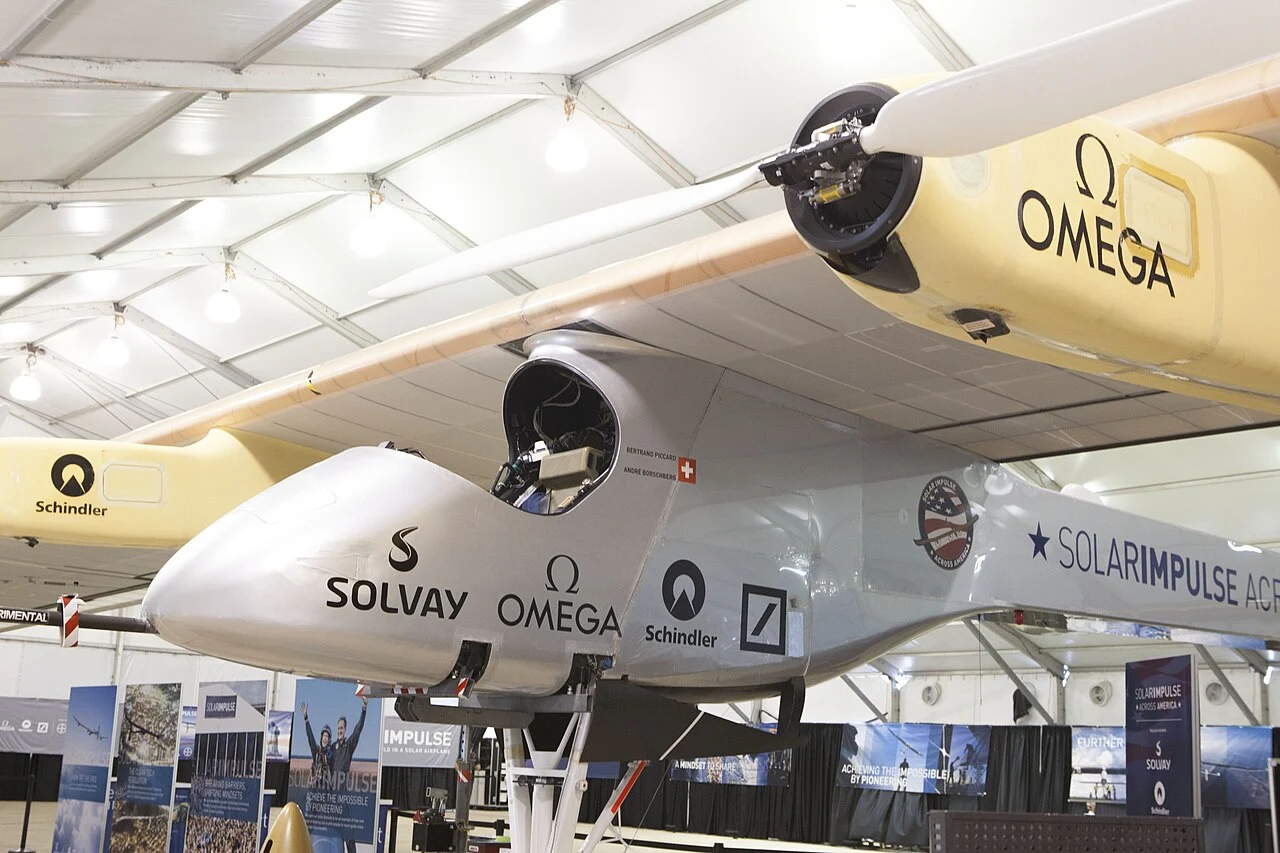
The Solar Impulse 2 (Si2) remains the most important demonstration aircraft in the history of solar-powered flight, and its story. Designed by Bertrand Piccard and André Borschberg, Si2 was a single-seat carbon-fibre aircraft with a wingspan of 72 metres (making it wider than a Boeing 747) weighing only 2,300 kilograms and equipped with 17,248 monocrystalline silicon solar cells integrated into its wings, fuselage, and horizontal stabiliser.
The World Air Sports Federation confirmed that the aircraft set multiple FAI records still standing as of its 10th anniversary in March 2025, including the longest non-stop solo flight in aviation history — 117 hours and 52 minutes from Nagoya, Japan, to Kalaeloa, Hawaii — and the first solar-powered crossing of the Atlantic Ocean, covering 5,851.3 km from New York to Seville, Spain.
The aircraft had been sold by the Solar Impulse Foundation to Skydweller Aero in 2019 for an undisclosed sum. Skydweller’s plan was to convert Si2 into a fully autonomous, uncrewed high-altitude platform capable of flying indefinitely for persistent maritime surveillance and communications relay missions.
The aircraft crashed into the Gulf of Mexico on May 4, 2026, during an autonomous test flight with no injuries or fatalities. Skydweller’s programme — developing autonomous solar-powered platforms for the U.S. Navy and commercial satellite ground station replacement missions — continues on next-generation designs, but the loss of Si2 marked the end of the most iconic solar aircraft ever built.
Why Solar Cannot Propel a Commercial Aircraft and What It Can Do Instead
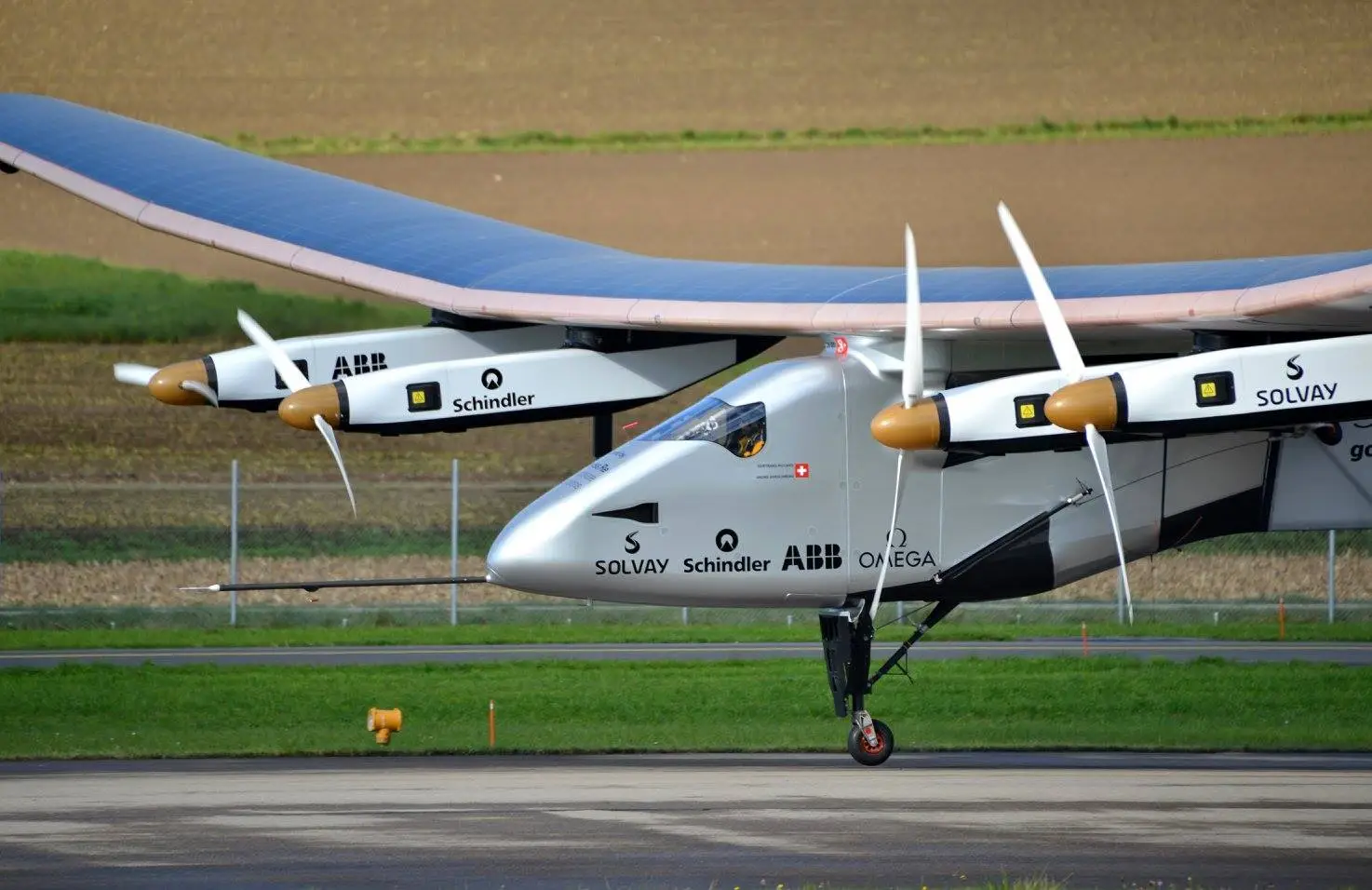
Understanding where solar panels genuinely contribute to aviation requires a clear-eyed assessment of both their current capability and their fundamental physical constraints. Modern solar panels are increasingly lightweight and efficient and that integrating them into aircraft designs can reduce the weight of conventional power systems. However, there’s a catch.
A contemporary high-efficiency monocrystalline silicon solar cell converts approximately 20 to 22 percent of incident solar energy into electricity; perovskite-silicon tandem cells achieved 34.6 percent efficiency under laboratory conditions by mid-2024, with LONGi holding the world record, per the American Ceramic Society’s March 2025 review. Even at 34.6 percent, the power generated from a commercial aircraft’s wing surface remains insufficient by an order of magnitude for propulsion.
The genuine commercial aviation applications for solar panels fall into three categories. First, onboard auxiliary power: solar cells integrated into fuselage and wing surfaces can power cabin lighting, in-flight entertainment, galley equipment, and air conditioning systems, reducing the load on engine-driven generators and thereby marginally improving fuel consumption.
Second, ground infrastructure: solar-powered airport terminals, hangars, and ground vehicles represent a more immediately scalable solar aviation contribution.
Third, extended-endurance unmanned platforms: this is the sector where solar propulsion is already commercially operational and technically unconstrained by the energy density limitations that defeat its commercial aviation application.

UAVs, HAPS, And the Missions Solar Aviation Already Owns
The category of aviation where solar power has already won — definitively and commercially — is the unmanned aerial vehicle (UAV) and High-Altitude Pseudo-Satellite (HAPS) sector, where the endurance advantage of solar propulsion over any fossil-fuel alternative is absolute and mission-defining.
NASA’s Pathfinder Plus, Centurion, and Helios programmes demonstrated solar-powered stratospheric flight above 96,000 feet as early as 2001, establishing the technical feasibility of indefinite solar-powered loitering at altitudes above weather systems. The Helios prototype, which set an altitude record of 96,863 feet in 2001, was powered entirely by 62,000 solar cells across its 247-foot wingspan with no onboard fuel whatsoever.
Techxplore’s April 2024 report on JKU’s perovskite solar cell breakthrough confirmed that flexible quasi-2D perovskite solar cells have achieved an unprecedented specific power output of 44 watts per gram — a power density that makes them transformative for UAV applications where every gram of added system weight directly reduces payload or range.
NASA’s Mars helicopter Ingenuity, which completed 72 flights on the Martian surface before its rotor was damaged in January 2024, demonstrated solar-powered autonomous aviation on another planet entirely.
Perovskite Solar Cells the Material That Could Reshape Aviation’s Solar Future
The most consequential development in solar technology for aviation since the silicon cell is the emergence of perovskite as a commercially viable photovoltaic material, and its trajectory from laboratory curiosity to production reality is moving faster than any previous solar technology generation.
A foundational 2018 review of perovskite solar cell challenges documented the technology’s rise from 3.8 percent efficiency in 2009 to 23.3 percent in laboratory conditions within a decade. This is a rate of improvement that has outpaced silicon’s entire 40-year development trajectory.
In February 2026, it was confirmed that flexible perovskite cells achieve specific power densities of 23 to 30 watts per gram — representing a 10 to 15 times improvement over conventional silicon arrays at 0.5 to 2 watts per gram — while maintaining over 92 percent efficiency retention under electron irradiation conditions comparable to low Earth orbit.
For aviation specifically, the combination of flexibility, ultra-low weight, and high-power density that perovskite cells offer directly addresses the two properties that have historically limited solar integration in aircraft:
- the rigid, heavy glass substrates of conventional silicon cells
- their insufficient power-to-weight ratio for meaningful flight energy contribution.
PMC’s July 2025 review of flexible perovskite solar cells confirmed devices utilizing high-quality perovskite films have exceeded 24 percent power conversion efficiency with roll-to-roll manufacturing compatibility.
The remaining barrier is durability: outdoor stability tests showed performance loss rates of 7 to 8 percent per month under field conditions for current minimodules, with the most durable specimen retaining 78 percent initial efficiency after one year. While this is a lifespan insufficient for commercial aviation’s 20-plus year airframe service lives, we have reasons to be optimistic as figures are improving rapidly with each successive generation.

.jpg)

Leave a Reply