China has developed a new beyond-visual-range (BVR) air-to-air missile called the PL-16 — and defense analysts across the Indo-Pacific believe it could challenge the United States’ most advanced equivalent, the Lockheed Martin AIM-260 Joint Advanced Tactical Missile (JATM). Analysts say the PL-16, as described in leaked presentations from a Chinese military aviation seminar in mid-2025, features a range estimated between 200 and 300 kilometers (km), a variable-thrust rocket motor, and a compact airframe optimized for internal carriage on China’s Chengdu J-20 stealth fighter. The implications, experts warn, could prove significant in any conflict over Taiwan or the South China Sea.
Beijing has not officially confirmed the PL-16’s existence, development status, or specifications. Despite the uncertainty, the missile’s reported design philosophy is clear: China wants a weapon that is smaller, faster to produce, and capable of fitting more units inside its fifth-generation fighters — while retaining or even improving on the impressive range of its predecessor, the PL-15.
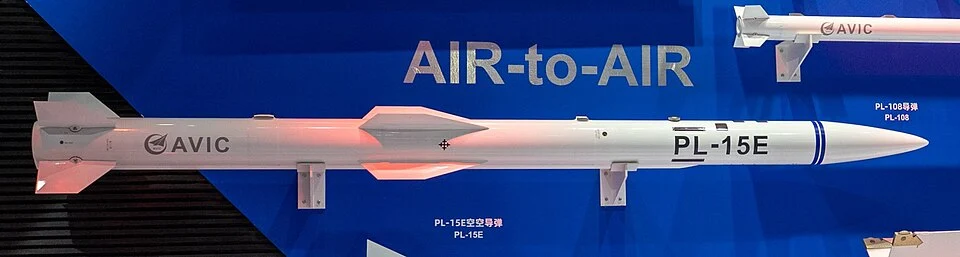
What The PL-16 Is And Why It Matters For Indo-Pacific Air Power
The PL-16 is China’s next-generation long-range air-to-air missile, designed to succeed the PL-15 as the primary BVR weapon of the People’s Liberation Army Air Force (PLAAF). It reportedly features an AESA (Active Electronically Scanned Array) radar seeker, a two-way datalink, and folding control surfaces for internal carriage aboard stealth fighters such as the J-20, J-35, and future J-36/J-50 aircraft.
A variable-thrust solid rocket motor allows thrust to be continuously adjusted throughout the flight, improving fuel management and maximizing kinematic performance — particularly during the terminal phase — thereby increasing effective range compared to dual-pulse rocket motors. This propulsion architecture is a significant departure from previous Chinese BVR missiles and gives the PL-16 a technological edge that analysts are watching closely.
The PL-16’s name follows a Chinese military tradition. The “PL” prefix stands for “Pi Li,” which is Chinese for “thunderbolt.” That tradition of naming has continued through a lineage of increasingly capable missiles, each extending range and lethality beyond the previous generation.
PL-16 Specifications
While Beijing has not published official figures, a body of leaked and expert-assessed information has emerged. A post to the image-sharing platform Imgur.com says the Chinese missiles would be four meters long, 203 millimeters in diameter and 200 kilograms.
Military analysts estimate the PL-16 can engage targets in excess of 200 kilometers in optimal conditions, with some reports suggesting forward hemisphere reach near 280 kilometers when launched at high altitude.
The missile’s engagement range is estimated to reach 280 km when launched from high altitude (11,500 meters) in the forward hemisphere. It can reportedly strike targets up to 140 km in the rear hemisphere and around 200 km at lateral angles (90° to 270°), aligning its performance with that of the U.S.-developed AIM-260 and Russia’s R-37M.
Key reported specifications of the PL-16 include:
- Range: Estimated 200–300 km (forward hemisphere); some sources cite over 300 km
- Propulsion: Variable-thrust solid rocket motor (upgrade over the PL-15’s dual-pulse motor)
- Seeker: AESA radar, reportedly with anti-jamming capability
- Guidance: Two-way datalink for mid-course updates, inertial navigation, and satellite corrections Dimensions: Approximately 4 meters long, 203 mm diameter, ~200 kg
- Control surfaces: Folding fins for internal carriage aboard stealth fighters
- Speed: Likely exceeds Mach 4, consistent with other modern BVR missiles
The presentation states that the PL-16 has a range exceeding 300 kilometers, and earlier Chinese research from 2014 suggested that variable-thrust solid rocket motors could enable missiles of similar dimensions to reach approximately 320 km.
How The PL-16 Compares To Its Predecessor, The PL-15
To understand the PL-16, it is essential to understand the PL-15 — the missile it is designed to succeed. The PL-15 uses a dual-pulsed solid-fuel rocket motor capable of a burnout speed greater than Mach 5 and a range of more than 200 kilometers. During its terminal phase, the second pulse of its motor ignites, providing additional energy and speed to increase kill probability at long distances.
The PL-16’s predecessor, the PL-15, can fly 200 kilometers, twice as far as the earlier PL-12 and more than three times the maximum distance of the oldest model, PL-11, according to the leaked presentation slides. This generational leap in range illustrates the pace of China’s missile development.
The PL-16 missile, while smaller in dimension, features a compressed airframe, folded fins, and a high-performance dual pulse motor to deliver equal or better performance compared to the regular PL-15. This is a key engineering achievement — China has managed to shrink the weapon while maintaining, or even improving, its lethality.
A possible transition is emerging in which the PL-15 remains in service with 4.5-generation fighters while the PL-16 is progressively introduced as the standard BVR missile for more advanced aircraft. The PL-15 could also be promoted as a competitive export product.
The PL-15 In Real Combat
The PL-15’s proven combat record is directly relevant to understanding the threat posed by the PL-16. On 7 May 2025, the PL-15/15E was deployed in combat during the 2025 India–Pakistan strikes by Pakistan Air Force (PAF), marking what analysts believe to be the missile’s first combat deployment.
What tipped the scales, according to Reuters, was an Indian intelligence failure on the effective range of the PL-15. Indian aircrews believed they were outside engagement distance — roughly 150 km, a figure associated with an export-limited variant — but they were not.
Pakistani officials claimed the PL-15 that shot down Indian Dassault Rafale aircraft was launched from about 200 km away, with Indian officials claiming even farther distance — making it one of the longest-range air-to-air kills on record.
In an analysis published by The National, defense experts described the combat debut as a watershed moment for Chinese military technology. Tim Ripley, editor of the Defence Eye website, said: “We’ve now seen Chinese weapons in action and the big question mark over the Chinese military build-up has been is their stuff actually any good? This suggests that it is.”
The PL-16, as the PL-15’s successor, carries this combat pedigree forward. If the PL-15’s first combat use produced some of the longest-range air-to-air kills ever recorded, analysts believe the PL-16 — with its greater range and more advanced propulsion — could extend that envelope even further.
What Experts Say About The PL-16’s Threat To US And Allied Forces
Defense analysts have offered a range of assessments on the PL-16’s strategic implications. Malcolm Davis, a senior analyst for defense strategy and national security with the Australian Strategic Policy Institute (ASPI), provided the clearest picture of the missile’s intended targets and strategic purpose.
Davis said the PL-16 is designed to hit airborne early warning and control platforms, refueling tankers, and reconnaissance aircraft, so “the likelihood of a kill, even at very long range is very high.”
Davis went further in explaining the People’s Liberation Army Air Force (PLAAF) strategy behind the missile’s development. As reported by Defense News, Davis stated: “The People’s Liberation Army Air Force’s strategy here is clear — take out the key combat enablers for the U.S. Air Force and the U.S. Navy, as well as allied forces, and the U.S. and its allies can no longer project naval air power.”
He also framed the PL-16 within the broader missile competition between China and the US. Davis added:
“The JATM was a response to the PL-15, so there is an interesting race between China and the U.S. on beyond-visual-range air-to-air missiles underway. The key challenge is how quickly the U.S. can get JATM into production, because the Chinese will be moving very fast with PL-16 production.”
Enrico Cau, an associate researcher at the Taiwan Strategy Research Association think tank, offered a more cautious assessment. As quoted by Defense News, Cau said:
“I’m pretty sure [PL-16] is going to be a headache for bigger bombers, B-52 and the likes, if in range, but I am not quite sure about other smaller, nimbler, faster platforms.”
Defence Security Asia reported that the missile’s alleged propulsion breakthrough could fundamentally alter long-range aerial combat economics, as it reduces the traditional energy-loss penalties suffered by conventional solid-rocket missiles operating at extreme distances against manoeuvring fighter aircraft or retreating high-value airborne assets.
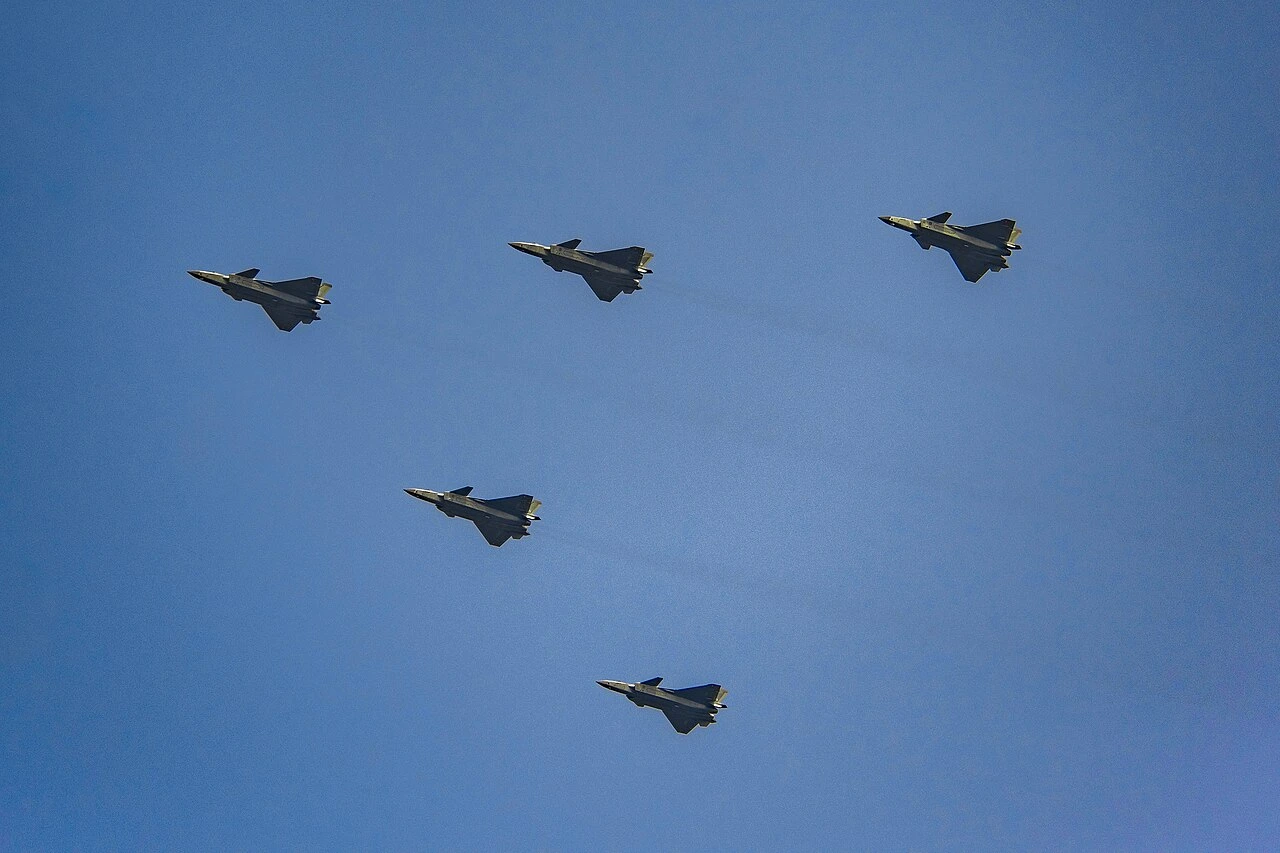
The J-20 Stealth Fighter and the PL-16
One of the PL-16’s most strategically significant features is its compact size — and what that means for how many missiles the J-20 can carry internally. A staggered arrangement of six PL-15s is possible with modified rail launchers and folded control surfaces. A thinner profile missile, designated PL-16, was also reportedly under development in 2020 to allow additional internal carriage.
Huang Chung-ting, associate research fellow with the Institute for National Defense and Security Research in Taipei, explained the tactical significance of this capacity. As quoted in Defense News, Huang said:
“This means a J-20 can engage not only one or two more targets but also has a greater capacity to remain in the combat zone after the initial attack, rather than having to retreat after running out of missiles.”
That dimensional reduction could allow the J-20 stealth fighter to internally carry six PL-16 missiles instead of four PL-15s while preserving low radar cross-section characteristics critical for survivability against advanced enemy sensor networks.
Expanded missile carriage could strengthen Chinese saturation-attack capability because stealth formations equipped with six internally carried missiles each would dramatically increase the number of simultaneous beyond-visual-range engagements launched during opening combat phases.
The PL-16 is also compatible with the Shenyang J-35 carrier-based stealth fighter, which China is introducing for its naval aviation force. The PL-16 could be compatible with fifth-generation Chinese fighter jets, including the J-20A and the carrier-capable J-35. This means the PL-16’s reach could extend far beyond land-based operations to include Chinese carrier strike groups operating in the Pacific.
The US AIM-260 JATM
The AIM-260 Joint Advanced Tactical Missile (JATM), developed by Lockheed Martin, is America’s primary response to China’s BVR missile advances. The AIM-260 program began in 2017 in response to long-range missiles developed by potential adversaries, specifically the Chinese PL-15.
The AIM-260 will eventually replace the AIM-120 AMRAAM, in service since 1993, and will exceed its range of about 160 km. The Air Force said the new weapon “will have increased range over existing air-to-air weapons and will be effective in a variety of threat scenarios.”
Range figures are classified. Aviation Week’s Steve Trimble noted that restricted airspace charts at Eglin show a JATM test range circle roughly double the size of the AMRAAM’s. Defense analysts put the range at least 100 miles, with some reporting a design requirement of at least 120 miles — far enough to outreach the Chinese PL-15.
Key reported features of the AIM-260 JATM include:
- Developer: Lockheed Martin Missiles and Fire Control, Orlando
- Program start: 2017 (Special Access Program)
- Range: Classified; analysts estimate over 200 km, possibly 250 km or more
- Propulsion: Advanced; details remain classified
- Seeker: Multi-mode, reportedly combining active radar with additional classified guidance modes Platforms: F-22 Raptor, F-35 Lightning II, F/A-18 Super Hornet (in testing)
- Speed: Likely above Mach 4
The world got its clearest look at the AIM-260 on May 15, 2026, when the first confirmed public photographs were published by The Aviationist. Photographer Jonathan Tweedy captured a VX-31 F/A-18F Super Hornet departing Eglin Air Force Base with an AIM-260 mounted externally. About an hour later, the aircraft returned — without the missile — strongly suggesting a live-fire or separation test was conducted over Gulf of Mexico test airspace.
Despite years of development, the JATM has faced delays. On October 15, 2025, Air & Space Forces Magazine was told by a top service official that JATM is not yet operational, citing issues with “integration” of the weapon on USAF’s fifth generation fighters, the F-22 and F-35. Another official disputed those comments and said the program is “progressing well,” though he acknowledged it has missed its intended IOC date.
The Race For Production
The speed of production is emerging as a critical variable in the US-China missile competition. Lockheed Martin’s AIM-260 Joint Advanced Tactical Missile is set to surge toward operational deployment after securing a major funding boost in the Trump administration’s latest defense budget proposal. Newly released documents show the program jumping from $894 million in FY2026 to $2.9 billion in FY2027, a sharp escalation that signals the Pentagon is fast-tracking production of its next-generation air-to-air weapon.
The U.S. Air Force requested $368 million for first-time production, plus $300 million on its annual “Unfunded Priorities List,” while the Navy asked for $301 million. Analysts at Melius Research said in 2024 the AIM-260 could become a $30 billion program depending on quantities produced.
The United States has also moved to arm its closest Indo-Pacific ally with the JATM. The United States approved a $3.16 billion sale of up to 450 AIM-260 JATM missiles to Australia to extend allied air combat reach. The January 2026 congressional notification clears Australia to move toward acquiring the AIM-260A Joint Advanced Tactical Missile, including test vehicles and full support infrastructure. The package combines $2.61 billion in missiles with $550 million in sustainment, training, and integration systems.

By avoiding ramjet complexity, China may additionally gain industrial-production advantages because advanced solid-fuel rocket motors are generally easier to manufacture, store, transport, and sustain during large-scale wartime missile consumption scenarios. The strategic consequence is that China could theoretically field larger inventories of advanced long-range missiles while maintaining acceptable cost efficiency, thereby strengthening saturation-attack potential.
How China Plans to Use The PL-16 In Combat
Analysts believe China has a specific, deliberate targeting doctrine planned around the PL-16. Rather than targeting enemy fighters directly in a classic air-to-air duel, the PL-16 appears designed to destroy the US military’s combat support architecture.
A missile capable of threatening those support platforms from 300 km distances could force coalition aircraft to operate substantially farther from contested zones, reducing sortie tempo, persistence, and sensor coverage during major regional contingencies. That displacement effect could become especially consequential during a Taiwan Strait crisis because American and allied aircraft would require significantly longer transit times while consuming greater fuel reserves before reaching operational combat zones.
China’s investment in ultra-long-range air combat therefore appears designed primarily to disrupt the logistical architecture enabling sustained Western expeditionary operations rather than focusing exclusively on tactical dogfighting superiority.
Malcolm Davis of ASPI said: “What matters at those long ranges is maneuverability in the terminal phase and guidance.” The PL-16’s variable-thrust motor is specifically intended to maintain speed and maneuverability precisely in that terminal phase — the moment when older missiles typically lose energy.
The missile also complements Beijing’s broader anti-access ecosystem involving long-range surface-to-air missiles, anti ship ballistic missiles, cyber warfare capabilities, and increasingly sophisticated space-based surveillance infrastructure.
Experts Urge Caution on Unverified Claims About PL-16
Despite the volume of reporting, significant uncertainty remains around the PL-16’s real-world capabilities. Huang Chung ting, of the Institute for National Defense and Security Research in Taipei, offered a critical note of caution. As quoted by Defense News, Huang said: “China may indeed be developing a new air-to-air weapon that saves more [aircraft] bay space and allows the J-20 to carry more missiles — this general direction has a certain degree of credibility.” He added that information online does not yet confirm the PL-16’s specs, including its range and propulsion type, nor whether it has been put into mass production.
With no confirmation from Beijing about the PL-16’s development, analysts and media outlets are relying largely on leaked, sometimes second-hand information including presentation slides shown at a Chinese military aviation seminar.
Key limitations acknowledged by analysts include: official performance data remains unconfirmed, and combat use has not been publicly verified.
While Beijing has yet to officially confirm the missile’s induction, emerging visuals and expert commentary suggest the PL 16 may already be in limited operational service. In January 2026, imagery circulated online purportedly showing a J-20 launching what analysts identified as the PL-16 — the first such public visual of the weapon in action, according to TheDefenseWatch.
The PL-17 And China’s Broader BVR Missile Family
The PL-16 does not operate in isolation. China is developing an entire family of long-range air-to-air weapons, each designed for different engagement scenarios. Military analysts also highlight that the PL-16 will not replace the larger PL-17, which remains China’s most extended-range air-to-air missile, capable of reaching targets 350 to 430 km away. The PL-17 shares design characteristics with the HQ-22 ground-based air defense missile.
The PL-21 is another weapon in China’s arsenal, reportedly featuring a ramjet propulsion system. The PL-21 is estimated to have a range of 300–400 kilometers and features a ramjet propulsion system for extended engagement capabilities. These advanced air-to-air weapons indicate China’s focus on long-range air superiority, aiming to keep U.S. and allied aircraft at bay before they can get within striking distance.
Together, the PL-15, PL-16, PL-17, and PL-21 form a layered BVR architecture that gives the PLAAF multiple weapon options across different ranges and target categories. The PL-16 occupies the critical middle tier — compact enough for six-round internal carriage, yet powerful enough to threaten the high-value support aircraft that US airpower depends upon.
Taiwan, The South China Sea, And the Strategic Context
The development of the PL-16 cannot be separated from the geopolitical flashpoints it is intended to influence. It is unclear whether Washington would jump into any war with Beijing over Taiwan, a decades-old flashpoint, or in the South China Sea where American treaty ally the Philippines is wrangling for control of tiny islets with the Chinese. The U.S. military maintains bases in nearby Guam, Hawaii, and Japan in case of an Indo-Pacific conflict.
The strategic consequence of China’s missile development is that it could force coalition aircraft to operate substantially farther from contested zones, reducing sortie tempo, persistence, and sensor coverage during major regional contingencies.
In parallel, the J-20 fleet is expanding rapidly. If the present tempo continues, China’s J-20 inventory may exceed 500 units by 2026 and approach 1,000 by 2030 — potentially surpassing the combined numbers of F-22s and F-35As in U.S. Air Force service. A larger J-20 fleet armed with six PL-16 missiles each would represent a formidable collective missile volume in any large-scale conflict.
By extending engagement ranges, improving survivability against electronic attack, and integrating seamlessly with stealth aircraft and networked sensors, the AIM-260 helps ensure that U.S. and allied forces retain air superiority against the most capable adversaries. Washington is counting on the JATM to answer China’s growing missile inventory — but speed of deployment will determine whether that advantage holds.
What The PL-16 Means for US Allies in the Region
The PL-16’s strategic implications extend well beyond the US-China bilateral competition. Australia, Japan, South Korea, and the Philippines all operate aircraft that could face the PL-16 in a potential regional conflict.
Australia is set to acquire up to 450 AIM-260A JATM air-to-air missiles in a $3.16 billion U.S. sale, giving the RAAF a major boost in long-range air-combat capability and allied interoperability in the Indo-Pacific. The Australian government has explicitly acknowledged the changing missile threat environment in the region as a driver for this acquisition.
The AIM-260 is positioned as the primary air-to-air weapon for frontline U.S. forces, creating a tiered capability structure within allied air combat operations. AMRAAM will remain widely used by allied forces while JATM serves as the cutting-edge frontline weapon.
Japan joined this trend by accelerating its counter-drone and air defense investments. A report by Defense News noted that Japan is now fielding interceptor drones in response to the growing aerial threat from China. This reflects a broader regional recognition that China’s missile and airpower investments are changing the strategic calculus.

PL-16 is in An Arms Race with Unclear Limits
The emergence of the PL-16 signals that the US-China air-to-air missile competition is entering a new phase. China is not simply matching the United States — it is developing weapons that compress stealth aircraft payloads, extend combat persistence, and target the enabling infrastructure that makes US power projection possible.
Davis captured the core dynamic: “The JATM was a response to the PL-15, so there is an interesting race between China and the U.S. on beyond-visual-range air-to-air missiles underway.” The PL-16 has now extended that race into a new generation. The central question is no longer whether China can develop credible long-range BVR missiles — the PL-15’s combat debut against Indian Rafales answered that. The question is whether the United States can field the AIM-260 JATM at scale, and fast enough to stay ahead of China’s production tempo.
The PLAAF hopes that with the introduction of the PL-16, the conventional arsenal of China’s air forces will be competitive in comparison to Western peers. Based on the assessments of analysts from ASPI, the Taiwan Strategy Research Association, and the Institute for National Defense and Security Research, they may be right — with the critical caveat that full performance data for the PL-16 remains unconfirmed, and the missile’s effectiveness against small, nimble, fast-moving platforms is still very much an open question.