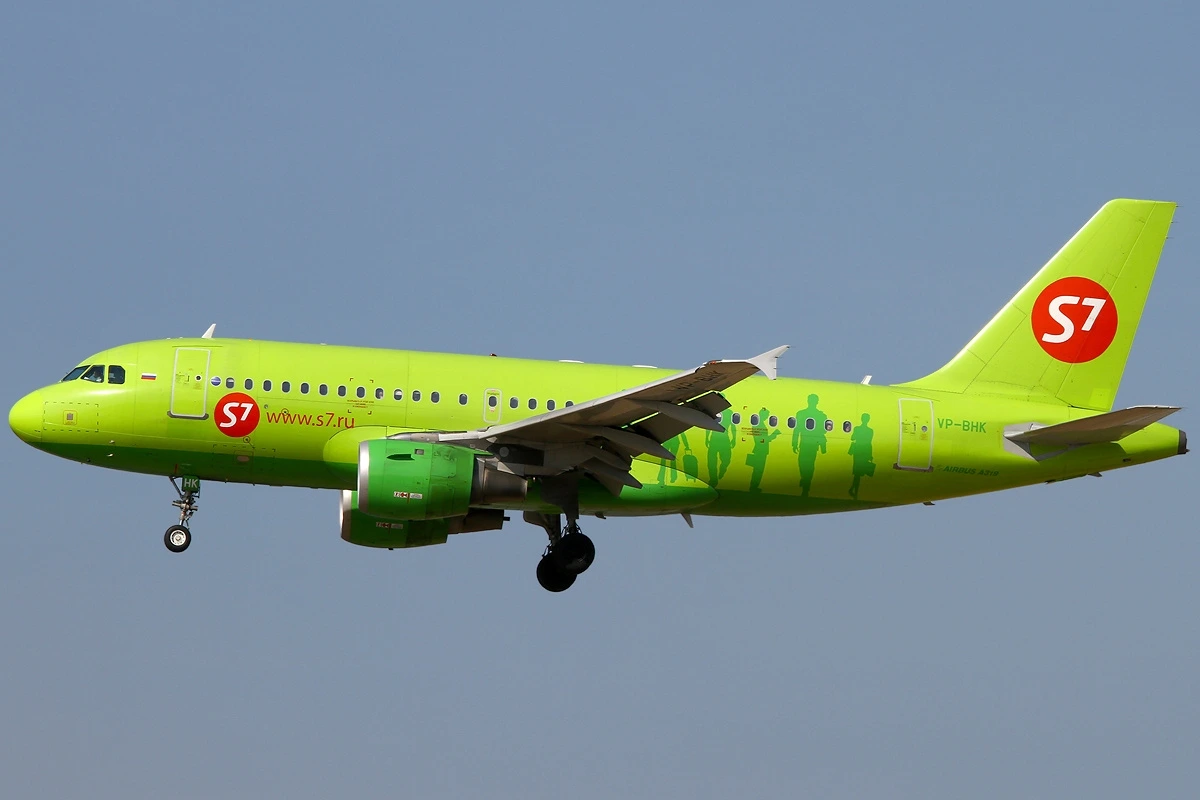
S7 Airlines (S7), Russia’s second-largest carrier, has banned its first officers from performing landings at all but four airports across its network, in an unusual measure triggered by a series of hard landing incidents that have caused physical damage to aircraft. The restriction, issued by the airline’s Deputy General Director for Flight Operations, took effect on June 1, 2026 and is currently set to remain in force until October 1, 2026.
The directive, first reported by Russian aviation Telegram channel Aviatorschina and subsequently flagged by aeroTELEGRAPH, targets a problem that sits at the intersection of two pressures unique to Russian aviation in 2026: a degraded fleet that cannot easily absorb maintenance events, and a pilot corps whose proficiency is increasingly difficult to sustain under sanctions. Under the new rules, first officers may only land aircraft at four stations — Moscow Domodedovo Airport (DME), Tolmachevo Airport (OVB) in Novosibirsk, Irkutsk International Airport (IKT) (except Runway 12), and Vladivostok International Airport (VVO). At every other airport on the S7 network, the captain must perform the landing.
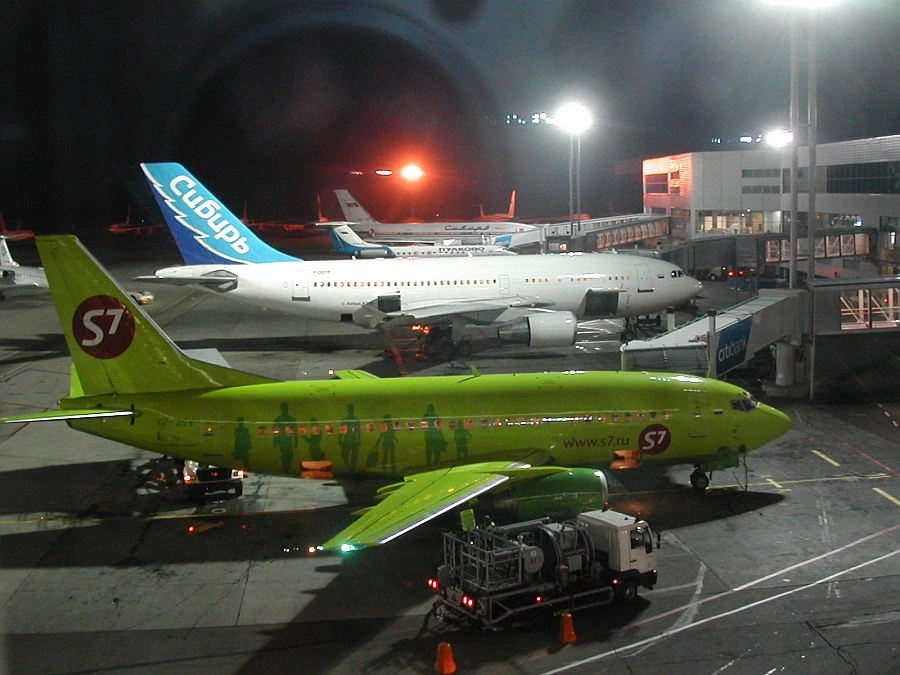
S7 Airlines and Why Does This Policy Matter?
S7 Airlines, whose legal name is JSC Siberia Airlines, is headquartered in Ob, Novosibirsk Oblast, Russia, with offices in Moscow. The airline was founded in 1957 as the Tolmachevo united squadron, privatised in 1994, and rebranded as S7 Airlines in 2005. It joined the oneworld global airline alliance in 2010, making it the first Russian carrier to do so.
The airline’s oneworld membership has been suspended since April 2022, following Russia’s invasion of Ukraine. S7 is also currently banned from flying into EU airspace, along with all other Russian carriers, as part of the sweeping sanctions imposed on Russia after the invasion. The carrier operates out of two primary hubs — Moscow Domodedovo Airport (DME) and Tolmachevo Airport (OVB) in Novosibirsk — and serves an extensive domestic network within Russia.
The policy matters because it departs from universal airline standard operating procedures. In commercial aviation, captains and first officers alternate flying duties on each segment, with both pilots sharing takeoffs and landings to maintain proficiency. Restricting first officers from landing at most airports for four months is, by any measure, an exceptional and operationally significant step.

What Is a Hard Landing and Why Does It Ground an Aircraft?
A hard landing, sometimes called a heavy landing, is defined by aviation safety authority SKYbrary as a landing in which the manufacturer’s touchdown limitation — expressed either as a rate of descent or as a g-loading value — has been exceeded. The standard hard landing threshold for commercial aircraft is a touchdown g-loading of 2.6, or a touchdown rate of descent exceeding 600 feet per minute.
After a hard landing, airlines are required to conduct a manufacturer-defined structural inspection before the aircraft can return to service. Inspectors look for specific damage types triggered by the excessive force of impact:
- Wrinkled wing skin or fuel leakage along riveted seams
- Spar web damage, including in landing gear attachment points
- Bulkhead stress fractures and nacelle attachment compromise
- Firewall skin deformation and wing and fuselage stringer damage
- Landing gear structural assessment, including hydraulic struts and brake systems
For an airline with constrained access to spare parts, each mandatory hard landing inspection carries an elevated risk of forcing an aircraft out of service for an extended period. S7 reportedly stated that the measure is intended to ensure “stable flight operations and reduce the risk of delays caused by additional maintenance inspections required after landings with elevated vertical loads.”

The Scope and Exemptions of S7’s First Officer Landing Ban
The ban covers the vast majority of S7’s domestic network. First officers may perform landings only at the four designated hub stations. At all other airports, the captain is required to handle the landing.
The restriction is not absolute. S7 has carved out exceptions for training and qualification scenarios. First officers undergoing line training with instructors, or completing aircraft qualification checks, may still perform landings as part of formally established training programmes.
At the same time, the airline has expanded its monitoring of landing performance. Pilot instructors have reportedly been instructed to conduct regular reviews of flight data monitoring information to identify trends associated with higher landing loads. When concerning patterns are detected, a more detailed analysis of previous flights may be ordered. Writing in One Mile at a Time, aviation commentator Ben Schlappig observed:
“I have a really hard time making sense of this policy. Obviously experience matters, but whether captain or first officer, it’s rare to see a plane have such a hard landing that the aircraft is damaged. So one wonders, is the root issue here a lack of pilot experience or skill, or is it the aircraft being in such bad condition that they’re basically falling apart if a landing isn’t perfect? Neither is terribly reassuring.”

Russia’s Fleet Crisis Behind the Policy
The broader context for S7’s unusual restriction is Russia’s aviation industry, which has been under severe stress since Western sanctions were imposed following Russia’s invasion of Ukraine in February 2022. Those sanctions cut Russian carriers off from new aircraft deliveries, certified spare parts, and direct manufacturer support from Boeing and Airbus.
S7 has been among the hardest-hit carriers. In October 2023, spare parts shortages reduced the number of operational Airbus aircraft in S7’s fleet to approximately 13 — or 20% of its Airbus fleet at the time. The situation worsened further when, in July 2024, the head of Russia’s Federal Air Transport Agency confirmed that S7 would be forced to decommission its entire Airbus A320neo and A321neo fleet. The reason was an inability to service the Pratt & Whitney PW1000G engines that power those aircraft due to sanctions.
At the time of the first officer ban, roughly one-third of S7’s overall fleet is grounded because the aircraft can no longer fly. A hard landing inspection, which can remove a jet from service for days or longer, is therefore not merely an inconvenience — it is an operational crisis when parts to fix any discovered damage may be unavailable.
A Bloomberg investigation published in 2026 found that China had exported at least $961 million worth of aircraft parts to Russia from March 2022 to February 2026 — more than quadruple the amount from the same period before the invasion — as Russian carriers built grey-market supply chains through India, Turkey, the UAE, and Kazakhstan to keep their Western-built fleets airworthy.
S7’s Parallel Tightening of Cockpit Procedures
The first officer landing ban is not S7’s only recent move to tighten cockpit discipline. Earlier reports from Russia, noted by Russian tourism portal Tourdom and cited by Simple Flying, indicated that S7 had already tightened rules governing the use of personal electronic devices by flight crews. Pilots and cabin crew members faced increased restrictions on mobile phones and other devices during flight operations as part of broader efforts to strengthen safety standards and procedural discipline.
This pattern of incremental procedural tightening reflects a carrier trying to maintain operational reliability without access to the training infrastructure, technical support, and manufacturer resources that normally underpin safety management at a Western airline. The measures suggest S7’s management is aware of systemic vulnerabilities and is responding with procedural controls where material solutions are unavailable.
These actions also align with a broader Russian aviation strategy. A Bloomberg investigation found that S7 Technics — the airline’s maintenance arm — expanded its engine overhaul plant at Sheremetyevo Airport for Airbus A320s and Boeing 737s in 2025 and completed repairs on 100 engines in that year alone. According to Bloomberg, the number of aviation engineers in Russia has reportedly increased by at least 30% since 2022.
What Does Restricting Landings Do to First Officers?
Aviation professionals and analysts have raised significant concerns about the long-term implications of the ban for pilot development. In commercial aviation, first officers routinely alternate flying duties with captains. Restricting landing opportunities for several months reduces hands-on experience, particularly for less experienced pilots building toward command qualifications.
Ben Schlappig of One Mile at a Time argued that, over the long term, concentrating pilots on a limited number of airports could negatively affect training and experience-building. He noted that pilots benefit from operating into a wide variety of airports and weather conditions rather than repeatedly flying to the same handful of destinations.
The irony of this constraint is real: if hard landings are partly attributable to inexperience, limiting first officers to the same four airports will further narrow the range of conditions they experience during a critical phase of their career development. The new policy also highlights the growing role of flight data monitoring systems.
Modern airliners continuously record thousands of flight parameters, enabling airlines to identify trends before they become safety issues. S7’s expanded use of this data for landing performance analysis may be the most durable element of its response, even if the landing restriction itself is only temporary.
Historical Context of S7’s Flight 778 And The Airline’s Safety Record
The context of S7’s relationship with landing safety carries historical weight. On July 9, 2006, S7 Airlines Flight 778, an Airbus A310 carrying 193 passengers and 10 crew, suffered a catastrophic landing accident at Irkutsk International Airport (IKT). The jet failed to decelerate on landing, overran the runway, and crashed into a concrete barricade. 125 people died.
The investigation into that accident revealed that the aircraft had flown with a malfunctioning engine reverser — a pattern of deferred defect management that investigators found was technically compliant with Russian regulations at the time but contributed materially to the outcome. The aircraft had been maintained in part by cannibalising functioning components from one engine to fix another.
That the current first officer ban specifically exempts Runway 12 at Irkutsk International Airport (IKT) — the same airport where Flight 778 ended — adds a layer of historical resonance to the policy, though S7 has not publicly explained the reason for that specific exemption.
Sanctions and Survival of the Wider Russian Aviation Industry
S7’s situation reflects a systemic challenge facing all Russian carriers. At the start of 2022, Russia operated between 1,500 and 1,800 Western-built aircraft. That number has dropped as sanctions cut off legal supply chains. Airlines have been sourcing parts through grey-market channels or harvesting them from grounded aircraft — both approaches that carry inherent safety and certification risks.
Russia has attempted to compensate through domestic aircraft production, but results have been limited. A campaign to deliver 127 new domestically built aircraft between 2023 and 2025 had yielded only 13 deliveries to civil airlines as of January 2026. The UK added S7 Airlines to its Russia sanctions list in February 2025, citing the carrier’s role in supporting the Russian government through its operation in the transport sector and its receipt of financing from Russia’s National Wealth Fund.
Despite these pressures, Russian airlines — including S7 — have broadly maintained domestic passenger volumes. The strong domestic travel market has allowed carriers to sustain seat supply, even as international operations have collapsed and the fleet has deteriorated. The social and economic consequences of a broad domestic air network failure would be severe in a country of Russia’s geographic scale, which gives the government strong incentive to keep airlines operating by whatever means available.

Does The Rule Solve the Problem or Defer It?
The core ambiguity of S7’s policy is whether it addresses the symptom — hard landings — or the cause. If the root cause is pilot inexperience or a skill deficit among first officers at smaller airports with challenging runways, limiting their landing rights may reduce incidents in the short term but will slow the development of the very proficiency that would prevent them in the future.
If the root cause is a degraded fleet that cannot absorb anything less than a textbook touchdown, restricting first officers without addressing the fleet condition merely transfers risk rather than eliminating it.
The policy also raises questions about what happens after October 1, 2026. If the ban is lifted without any change in the underlying fleet condition or training infrastructure, the same pressures that created the hard landing problem will likely reassert themselves.