The Lockheed L-1649 Starliner was the final and most advanced aircraft in the Lockheed Constellation family. It entered commercial service on 1 June 1957, when Trans World Airlines (TWA) operated the inaugural flight from New York Idlewild Airport — now John F. Kennedy International Airport (JFK) — to London and Frankfurt. Developed in direct response to the Douglas DC-7C Seven Seas, the Starliner was designed to give airlines the ability to fly nonstop from California to Europe for the first time in history.
The aircraft was built at Lockheed’s plant in Burbank, California, between 1956 and 1958. Development had begun years earlier, when TWA formally requested a long-range aircraft to compete with the Douglas DC-7C on transatlantic services. Lockheed responded with the L-1649A, which retained the fuselage of the proven L-1049G Super Constellation but mated it to an entirely new, thinner-profile wing spanning 150 feet. The prototype — constructor number 1001, registration N60968 — completed its maiden flight on 10 October 1956 at 4:15 p.m. from Lockheed Air Terminal in Burbank, with test pilots Herman R. Salmon and Roy W. Wimmer at the controls.
How The Starliner Came to Be
During the early 1950s, the Lockheed Super Constellation and the Douglas DC-6B dominated the world’s long-haul air routes. In 1954, Douglas began design work on the DC-7C Seven Seas, an aircraft intended for nonstop transatlantic operations year-round. Lockheed needed a direct rival to remain competitive.
Lockheed’s first response was the L-1449, which would have used powerful Pratt & Whitney PT2G-3 turboprop engines and a new 150-foot wing. TWA placed an order for 25 aircraft in December 1954. However, Pratt & Whitney abandoned the PT2 project in March 1955, citing expected unreliability and high operating costs. Lockheed then proposed the L-1549 with Allison turboprops, but that design was also dropped for the same reasons.
With both turboprop options gone, Lockheed and TWA settled on a piston-engine solution. They retained the new 150-foot wing designed for the turboprop variants and fitted it to the L-1049G fuselage, paired with four Wright R-3350 988 TC18-EA-2 turbocompound radial engines. In April 1955, Lockheed tried to cancel the programme entirely, but Howard Hughes, who then controlled TWA, refused to allow it. The result was the L-1649A Starliner.
Technical Features That Set the Starliner Apart
The Starliner’s most defining technical achievement was its wing. The new design had a span of 150 feet — 27 feet more than earlier Super Constellations — with integral fuel tanks extending all the way to the wingtips. This gave the aircraft an aspect ratio of 12:1, the highest of any piston-engine airliner, which translated directly into improved range and fuel efficiency.
The key technical specifications of the L-1649A were:
- Powerplant: Four Wright R-3350 988 TC18-EA-2 Duplex-Cyclone 18-cylinder air-cooled radial piston engines, each producing 3,400 hp at takeoff
- Wing span: 150 ft (45.72 m)
- Fuel capacity: Approximately 9,600 US gallons (36,340 litres), held in integral wing tanks
- Maximum takeoff weight: Approximately 156,000 lb (70,760 kg)
- Maximum speed: 377 mph (607 km/h)
- Cruise speed: Approximately 290–300 mph (467–483 km/h)
- Range: 4,290 to 5,370 nautical miles depending on payload
- Service ceiling: 23,700 feet
- Passenger capacity: 58 to 99 passengers depending on cabin configuration
- Flight crew: Five to six
Lockheed also moved the inboard engines further outboard on the new wing, adding more than 400 kg of extra sound insulation. The result was a notably quieter cabin than earlier Constellation variants. Passengers seated towards the front of the aircraft would sometimes hear the sound of wind rather than the engines — an unusual quality for a piston-engine airliner of the era.
The aircraft received FAA type certification under TCDS 4A17. The first production L-1649A, constructor number 1002, registered N7301C, was delivered to TWA and entered revenue service on 1 June 1957.
TWA’s “Jetstreams”: The Starliner’s Launch Operator and Primary User
Trans World Airlines was the Starliner’s launch customer and largest operator, taking delivery of 29 aircraft. TWA marketed its Starliners under the brand name “Jetstreams” — a name chosen to evoke speed and modernity, even though the aircraft was piston-powered. TWA’s marketing even depicted the Starliner without propellers in some promotional artwork, drawing protests from rival airlines that called the campaign deceptive.
The Starliner gave TWA a strategic weapon on the transatlantic market. By July 1958, TWA operated 60 flights per week from Europe to New York, and 30 of those were Starliners. The airline operated seven nonstop Starliner flights per week from Paris, five from London, four from Frankfurt, and two each from Madrid, Lisbon, and Geneva, with additional services from Zurich and Rome.
One of the most remarkable demonstrations of the type’s capability came in September 1957. TWA Chief Pilot Bob Buck captained the first nonstop flight from Los Angeles to London, covering 5,420 miles in 18 hours and 32 minutes at an average speed of 292 mph. Buck later wrote an extensive magazine article documenting the experience. By 1959, TWA’s entire transatlantic schedule was flown exclusively by Jetstream Starliners.
Three Starliners per week also flew the polar route from Europe to California, sometimes nonstop. In a particularly notable flight on 2 October 1957, TWA’s inaugural polar flight — Polar Flight 801 — flew westbound from London to San Francisco. Strong headwinds extended the crossing to a marathon 23 hours and 19 minutes, setting a world record for the longest piston-engine airliner flight at the time.
Boeing 707 jets replaced the last TWA transatlantic passenger L-1649 in October 1961. By December 1962, Boeing 707s and Convair 880s had fully displaced Starliners from TWA’s domestic scheduled services as well.
Air France and Lufthansa Were the Other Starliner Operators
Beyond TWA, only two other airlines purchased the Starliner new: Air France (AF) and Lufthansa (LH). Together, they accounted for 14 of the 44 aircraft produced.
Air France bought 10 Starliners and was the only airline to market the aircraft under its own name, calling it the “Super Starliner”. Air France operated transatlantic Starliner services from August 1957, and in summer 1959 scheduled 22 nonstop flights per week from Paris Orly Airport (ORY) to New York Idlewild (JFK). Four of those continued to Mexico City. Air France also operated the only scheduled Starliner service into Asia, flying twice weekly from Paris via Anchorage to Tokyo from April 1958.
This polar routing was required because Air France was not permitted to fly directly to the US West Coast. The Paris–Anchorage–Tokyo routing was scheduled for 30 hours and 45 minutes — nearly 12 hours faster than the same journey via India on the older L-1049G. Air France withdrew its Starliners from major routes by 1960 when the Boeing 707 took over.
Lufthansa was the last airline to purchase Starliners new. Its four aircraft were marketed under the name “Super Stars” and flew transatlantic routes to New York from Frankfurt (FRA), Düsseldorf (DUS), and Paris. Lufthansa’s Starliners were even delivered nonstop from the Lockheed factory in Burbank directly to Hamburg — a demonstration of the aircraft’s extraordinary range. Lufthansa retired its Super Stars from passenger service in 1960 after the Boeing 707 took over its transatlantic routes, and Lockheed later converted two of the Lufthansa airframes to freighters.
Several other airlines placed orders but did not ultimately operate the aircraft. Linee Aeree Italiane (LAI) of Italy ordered four Starliners but cancelled when it merged with Alitalia in October 1957. Alitalia had already committed to the DC-7C and had no interest in the Starliner. Those four aircraft were delivered to TWA instead. Brazilian carrier Varig also initially ordered two Starliners but switched the order to L-1049G Super Constellations for fleet standardisation.
The Starliner vs. the Douglas DC-7C
The commercial rivalry between the Starliner and the Douglas DC-7C Seven Seas was the defining contest of the final piston-engine era. Both aircraft used the same Wright R-3350 EA-2 turbocompound radial engines producing 3,400 hp each. Both featured new longer-span wings with integral fuel tanks and revised tail assemblies. Yet the two aircraft were quite different in their strengths.
The DC-7C entered service a full year before the Starliner, beginning operations in June 1956. It ended up selling 121 airframes, compared to only 44 Starliners. The DC-7C was slightly faster than the Starliner — a fact that disappointed TWA management, who had hoped the Starliner would outpace its Douglas rival. The Starliner proved to be slightly slower than the DC-7C, though the gap was not large.
Where the Starliner excelled was range. With its 150-foot wing, 12:1 aspect ratio, and 9,600-gallon fuel capacity, the Starliner had the greatest range of any piston-engine airliner ever built — over 7,000 miles in no-allowance terms. This allowed TWA to offer nonstop service to all major European cities from the US West Coast and to launch polar routes that the DC-7C could not reliably match. The Starliner’s quieter cabin, owing to its extra soundproofing and the engines being positioned further from the fuselage, also made it more popular with passengers.
The Starliner was also considerably more expensive. Each aircraft cost $3,000,000 USD — significantly more than the DC-7C, which was priced at approximately $1.34 million by 1958. The higher price, combined with its later entry into service, meant that fewer airlines could justify the investment. The Starliner entered service less than two years before the Boeing 707 jets began arriving in airline fleets, leaving it almost no time to recoup its acquisition cost.
A comparative analysis published in Flight magazine in June 1955 noted that both aircraft were effectively the result of the same philosophy — taking a proven fuselage and grafting a new, longer wing onto it to achieve greater range. “Both represent the policy of ‘stretching’ of a basic design carried to what must be the ultimate degree,” the analysis stated. Yet the Starliner’s wing was more ambitious in execution, achieving a higher aspect ratio and superior long-range performance at the cost of higher wing loading and faster approach speeds.
The Passenger Experience Aboard the Starliner
The Starliner represented the height of air travel comfort in the piston-engine era. Passengers occupied a pressurised fuselage with a cabin length of 22.35 metres and a maximum width of 3.28 metres. The aircraft’s new wing reduced turbulence sensitivity compared to earlier Constellations, and the extensive soundproofing made the Starliner unusually quiet for a propeller-driven airliner. Passengers in forward cabin sections sometimes reported hearing the sound of wind more than the engines.
Typical long-haul configurations accommodated between 58 and 99 passengers, with multiple seating classes on mainline operator flights. TWA offered fully reclining seats on some transatlantic configurations. Charter operators such as World Airways configured the aircraft in high-density all-economy layouts seating up to 109 passengers in five-abreast rows.
Recollections from passengers of the era reflect the aircraft’s reputation. In the comments section of This Day in Aviation, one reader wrote: “Best flight I ever had was on a TWA Jetstream from Idlewild to San Francisco in 1958. Best service – super smooth. For a 14 year old, sold me on an aviation career.” Another recalled a 1957 TWA Starliner flight from Columbus, Ohio, to San Francisco: “A piece of cake flight, smooth, no turbulence, great food, and very comfortable seats.” These recollections underscore the aircraft’s reputation for a refined passenger experience that matched its extraordinary range.
The first inaugural Starliner crossing also produced a memorable eyewitness account. The Los Angeles Times reported that as the prototype lifted off from Lockheed Air Terminal in Burbank on 10 October 1956: “The ground shook as the big Connie climbed gracefully away. Its wings glistened in the late-afternoon sunlight like long, slender knife blades.”
Accidents and Safety Record of the Lockheed L-1649 Starliner
The Starliner’s operational safety record was broadly comparable to other piston-engine airliners of the era, though two fatal accidents stand out in the aircraft’s history.
On 26 June 1959, TWA Flight 891 crashed shortly after takeoff from Milan Malpensa Airport (MXP), Italy. All 68 passengers and crew on board were killed. The aircraft was a Lockheed L-1649A registered N7313C, operating a flight from Athens to Paris Orly via Rome and Milan. Twelve minutes after takeoff, the flight crew reported climbing through 10,000 feet. A few minutes later, the aircraft suffered structural failure and broke up in mid-air. An Italian inquiry board announced in November 1960 that a lightning strike had caused the accident.
The board’s finding stated: “The breaking-up in flight was due to the explosion of the fuel vapors contained in tank number 7, followed immediately by either an explosion of pressure or a further explosion in tank #6.”
Flight 891 was the worst air accident of 1959 and the first fatal crash involving a Lockheed Starliner.
On 10 May 1961, Air France Flight 406 — named “De Grasse” — broke up in flight after an empennage failure over the Sahara Desert, killing all 78 passengers and crew. Investigators believed the most likely cause was an explosive device, though this was never conclusively confirmed.
Of the nine hull losses recorded in the Starliner’s operational history, aviation analysts note that only two involved factors directly attributable to aircraft design or weather interaction. The majority of losses occurred during secondary cargo and charter operations, in an era when structural fatigue science and weather detection technology were far less mature than today.
The Jet Age Marked the Starliner Era
The Starliner’s window of front-line service was extraordinarily brief. The Boeing 707 entered commercial service in October 1958, less than 18 months after the Starliner had begun carrying passengers. The Starliner flew first-line services for fewer than three years before the jets displaced it.
TWA replaced its last transatlantic passenger Starliner with Boeing 707s in October 1961. Domestic Starliner passenger services ended in December 1962. Air France completed its withdrawal by 1960, and Lufthansa finished retiring its passenger fleet in January 1963. In the early 1960s, Lockheed converted twelve former TWA Starliners to freighters, which carried cargo across the Atlantic until 1964 and within the United States until 1967. The final chapter in TWA’s Starliner story came on 7 April 1967, when the airline became one of the first all-jet carriers in the United States. On that day, ground-service personnel placed a booklet on every passenger seat across the TWA system titled “Props Are For Boats.”
Secondary operators kept the type flying in limited roles through the 1970s. Alaska Airlines used two Starliners for Military Air Transport Service (MATS) charter operations in the 1960s. South African Airways leased a single L-1649A to operate the Johannesburg–Perth route in 1965, replacing Douglas DC-7Bs on a route where sanctions had limited jet acquisition. A small number of Starliners served in cargo and charter roles in Alaska through the 1970s. By the early 1980s, all commercial Starliner operations had ceased.
The brevity of the Starliner’s career also reflected its commercial limitations. Lockheed could find only three buyers for the type worldwide, and the programme was a financial loss for the manufacturer. In the words of the Lockheed Constellation Survivors project: “Sadly, this superb aircraft was developed too late and was quickly overshadowed by the early jets with only forty-four being produced.”
Four of the Lockheed L-1649 Starliner Survive
Of the 44 Starliners produced, four complete airframes have survived into the present day. The others were scrapped during the mass retirements of the 1960s and 1970s.
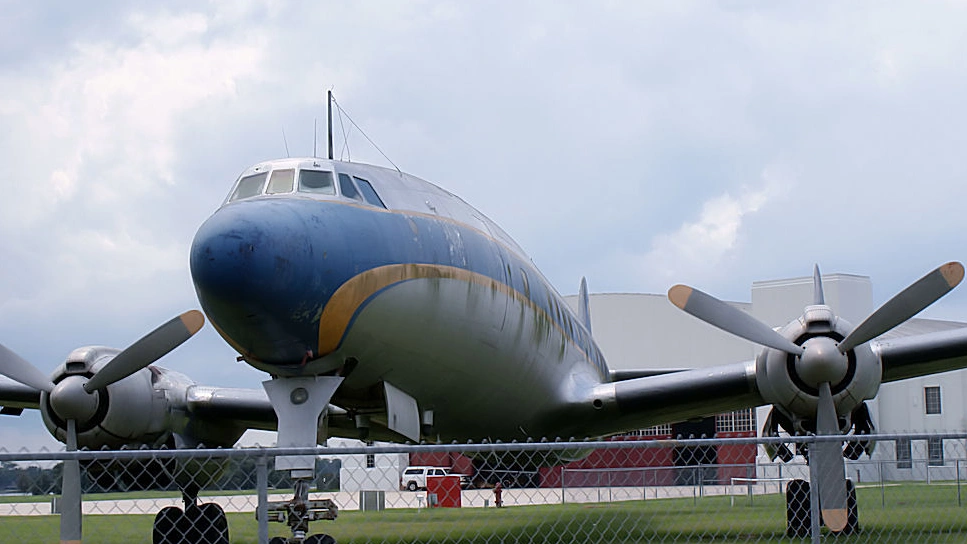
N8083H (c/n 1038) is today the most publicly visible survivor. Originally delivered to TWA in 1958, it was purchased by the Lufthansa Berlin Foundation in December 2007, restored in period TWA livery, and moved to John F. Kennedy International Airport (JFK) in October 2018. It now serves as the cocktail lounge named “Connie” at the TWA Hotel, adjacent to Eero Saarinen’s iconic former TWA Flight Center. Guests can sip martinis in a 1960s first-class setting inside the aircraft’s original fuselage.
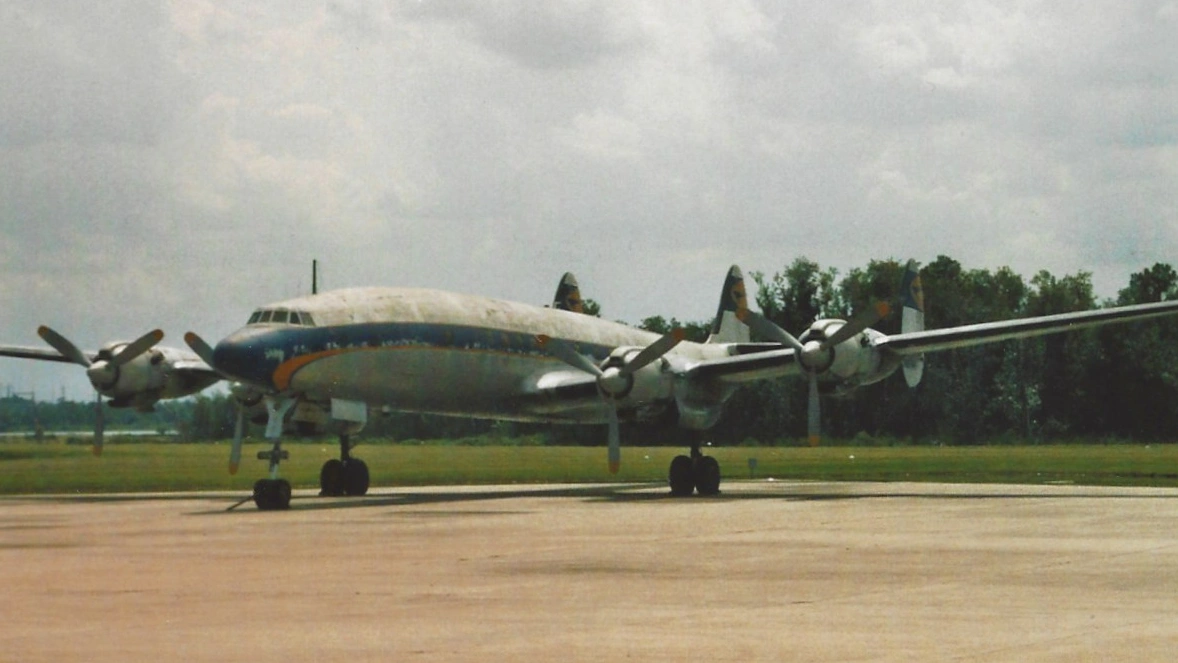
N7316C (c/n 1018) was the subject of one of the most ambitious aviation restoration projects in history. Lufthansa purchased the aircraft in December 2007 with the goal of returning it to airworthy condition as a tribute to the airline’s historical fleet. Restoration work began in April 2008 but costs escalated dramatically. After approximately $150–200 million was spent on the project, Lufthansa announced in March 2018 that it was ending restoration efforts in the United States. The airframe was disassembled, shipped to Bremen, Germany in 2019, and relocated to Paderborn in 2021. Work has since continued with the goal of static display rather than flight, including reassembly at Hamburg with functional flight controls and lighting.
N974R (c/n 1040) was donated to the Fantasy of Flight Museum in Polk City, Florida, and is currently stored at that facility.
ZS-DVJ (c/n 1042) has a fuselage now on display at the South African Airways Museum in Rand, South Africa (HLA), with reassembly completed in 2019.
The Starliner’s cultural legacy also lives on through its association with the golden age of transatlantic travel. The distinctive triple-tail silhouette of the Constellation family — including the Starliner — has been cited by design historians as an influence on automotive styling, particularly the tailfin designs of American cars from the late 1950s. Manufacturers including Cadillac drew visual inspiration from the elegant profile of the Constellation line.
.jpg)
