
One of the most iconic pictures in all of space science and aviation is the photograph of Antonov An-225, one of the biggest aircraft ever constructed, taking the Buran space shuttle into the skies. One can also think of the photograph of the first untethered spacewalk. When the first American who flew to space compared his spacewalk (albeit tethered) as “feeling like a million dollars”, one might wonder how much the moment capturing his spacewalk should be worth.
Space Elevators Explained: Cost, Construction, and Launch Potential
Space Shuttle was NASA’s first foray into building a reusable spacecraft. The Space Shuttle was also cardinal in building the International Space Station. The Shuttle has boosted more than 1.36 million kilograms (3 million pounds) of cargo into orbit, and has the most reliable launch record of any spacecraft. More than 600 crew members, including Eileen Collions, the first woman to fly on the space shuttle, have flown on this record-breaking spacecraft. STS-80 stayed in orbit for 17.5 days – the longest for any shuttle. It is one thing to take the space shuttle over the boundaries of the Earth’s surface. But how does it make its way back? We know that when the In other words, how does the space shuttle land?
Re-entry to the Earth: the most heated part of the Space Shuttle landing
While on its orbit, the space shuttle travels at a speed of approximately 28,160 kilometers per hour (17,500 mph). The equatorial diameter of the Earth’s 12,760 kilometers- a distance that the Space Shuttle would cover more than two times in a second. One has to halt this aircraft at the end of the Kennedy Space Center (KSC)’s Shuttle Landing Facility (SLF), which has a runway length of 15,000 feet (4,572 meters) long, [ and a 1,000-foot (304.8-meter) overrun on each end. If the Space Shuttle were to graze over the landing facility at the speed it has during its orbit, it would take less almost half a second to pass the runway. [The A380, for example, which is the largest passenger aircraft in the world, even at its fastest, would take more than 13 seconds.] So, how does something as racy as the Space Shuttle perform a landing? Let’s find out.
Design materials in the Space Shuttle that make landing safe/possible
One might know how some meteroids headed to the Earth generally burn up before impacting the surface of the Earth. When entering the Earth, these astronomical objects that are also referred to as meteors experience so much drag after they enter the Earth’s surface that they burn. The story of meteors gives us some cues as to how much heat resistance any object from space (such as the Shuttle Shuttle) headed to the Earth might need if it were to survive. So, the Space Shuttle is fitted with various materials to deal with this phenomenon:
| Material | Where it is applied |
| Reinforced carbon-carbon (RCC) | Wing surfaces and underside |
| White Nomex blankets |
|
| High-temperature black surface insulation tiles |
|
| Low-temperature white surface tiles (around 20,000 in number) | Remaining areas |

When the Space Shuttle hits air molecules during its entry ot the Earth, friction/ air resistance can take temperatures as high as 3000 degrees F, or 1650 degrees C, necessitating the aforementioned materials.
To perform a landing of the Space Shuttle, it needs to slow down 17,000 miles an hour. However, its orbital maneuvering engines (OEM) aren’t quite capable of decelerating the Space Shuttle so much. After all, the OEMs produce less than 1% thrust of the main engine that helped the Space Shuttle to launch. But the Space Shuttle doesn’t need to decelerate on its own volition: if it slows down by just 225 miles an hour, it can fall into the atmosphere, where air resistance can kick in and slow the Shuttle down.
Slowing the Shuttle for landing
Space Shuttle begins its entry into the Earth’s atmosphere at an altitude of about 400,000 feet (121,920 meters). [The definition of where space begins and Earth’s atmosphere is contentious. The FAI sets the boundary of the space to be around 100 kilometers, approximately 320,000 ft. You can read our guide below for details:
When the Space Shuttle is at an altitude of nearly 45,000 feet (13,716 meters), its maneuvers enable it to “intercept the landing approach corridor at the desired altitude and velocity”.
Before its entry to Earth, the crew of the Space Shuttle closes the cargo bay doors. One way to increase the air resistance on the Space Shuttle could be to land on the Earth’s atmosphere backwards- a greater surface area (of the Shuttle) would mean a greater resistance force. However, if the Shuttle were to approach the Earth’s atmosphere pointing its back, the resistance would be great enough to melt it away. Instead, the angle of attack: the angle between where the speed of the Space Shuttle is taking it versus where it is pointed. You can read more about the angle of attack in greater depth in our guide below:
So, during the entry, the Space Shuttle is pitched up with an angle of attack of 40 degrees: it is essentially tail first. The crew activates the Reverse Control System (RCS) to do so. The crew then fires the OMS engines that slows the shuttle down during its entry to Earth, in a process known as deorbit burn. Approximately half an hour later, the Space Shuttle reaches the upper atmosphere. (RCS) thrusters to pitch the orbiter over so that the bottom of the orbiter faces the atmosphere (about 40 degrees), and they are moving nose first again. The crew also burn leftover fuel from the forward RCS. This is a safety procedure that is enacted as this area experiences the highest heat during re-entry.

During the re-entry, there is a sonic boom that can be observed by across the width of Florida. After re-entry, the Space Shuttle experiences ionization blackout i.e., an inability to perform radio communication because of the fervid, ionized gases in the atmosphere that engulf the Space Shuttle. The blackout lasts for about 12 minutes. Here is how NASA reports the technical aspects of the inclination angle of the communications:
“…space shuttles carrying most communication satellites usually have a low-inclination orbit – a launch azimuth of about 90 degrees – which places the vehicle in an orbit that has a 28.5-degree inclination to the equator. That means that as it circles the Earth, the orbiter’s ground track ascends to approximately 28.5 degrees above the equator (28.5 degrees north latitude) and 28.5 degrees below the equator (28.5 degrees south latitude) – a relatively narrow band of the globe. “
Reentry is also associated with “reentry flames” – streaks of gas where temperatures are so high that electrons break away from their atoms and molecules, giving off an orange hue. This state of matter is called plasma – the fourth state of matter typically associated with lightning, neon signs, and perhaps most glaringly, with the Sun.
But the wings of the Shuttle might lift it further instead of descending
After the Space Shuttle has touched the surface of the Earth, there’s a slight problem it might have to encounter: the lift generated by the dual delta wings.
Wings are an essential component of any aircraft that help it to take off, but in the case of the Space Shuttle, it might, instead of helping the Space Shuttle land, propel it further up the sky: Dense air has the capability of generating so much lift that the Challenger might shoot off the atmosphere.

In order to circumvent this problem, one might pitch further up, but that would only risk overheating. So to control the Space Shuttle’s speed, its bank angle is changed: a steeper back angle helps in reducing the Shuttle’s lift, helping it to descend faster. On the other hand, a shallow bank angle results in a greater upward lift, and the Shuttle doesn’t descend as fast. The Kennedy Space Center’s landing site is engulfed by the Atlantic Ocean: imprecise timing of descent to the landing site risks the possibility of the Shuttle sinking in the ocean. Before approaching the landing area, the Space Shuttle makes a series of S-shaped banking turns to slow itself down.
When the Shuttle is at a height of 150,000 feet (45,700 m) and approximately 140 miles (225 km) away from the landing site, the commander picks up radio signals from the Tactical Air Navigation System in the runway, reports howstuffworks.com:
“…. when the orbiter is about away from the landing site and. At 25 miles (40 km) out, the shuttle’s landing computers give up control to the commander. The commander flies the shuttle around an imaginary cylinder (18,000 feet or 5,500 m in diameter) to line the orbiter up with the runway and drop the altitude. During the final approach, the commander steepens the angle of descent to minus 20 degrees (almost seven times steeper than the descent of a commercial airliner).”
Details of the runway
| width | 300 feet (91.4 meters) [almost the of a football field]
Note: 50-foot (15.2-meter) asphalt shoulders on each side. |
| Thickness of the KSC concrete runway | 16 inches (40.6 centimeters) in the center, and 15 inches (38.1 centimeters) on the sides |
| Slope | 24 inches (61 centimeters) from the center line to the edge to facilitate drainage |
| Parking apron | 550-foot by 490-foot (167.6-meter by 149.3-meter) |


Unlike conventional aircraft, the Space Shuttle has an unpowered flight during re-entry. This means that the absence of a go-around capability renders the high-speed glide of this orbiter to be executed to perfection. For an aircraft like the Shuttle that has a touchdown speed of 213 to 226 miles (343 to 364 kilometers) per hour, the presence of a Foreign Object Debris (FOD) [defined by the FAA as ‘any object, live or not, located in an inappropriate location in the airport environment that has the capacity to injure airport or air carrier personnel and damage aircraft’] might be fatal.
Workers at the runway facility check for FOD (including birds) up to about 15 minutes before landing. Bird strike has the ability to damage the outer surface of the Space Shuttle, and has led to numerous air accidents in the past. Bird strikes are of particular concern at landing facilities such as the Kennedy Space Center “is a national wildlife refuge that provides a home to more than 330 native and migratory species of birds”, says NASA. It further syas that the employees of the Shuttle Landing facility (SLF) “use special pyrotechnic and noise-making devices, as well as selective grass cutting, to discourage birds around the runway”.
Use of the landing aids
Let’s take a look at the landing aids at the SLF
| Landing Aid | Useful when the shuttle is at an altitude of | Properties |
| Tactical Air Navigation (TACAN) | 145,000 feet (44,196 meters) | provides range and bearing measurements to the Space Shuttle |
| Microwave Scanning Beam Landing System (MSBLS) | 18,000 to 20,000 feet (5,486 to 6,096 meters) | precise guidance signals on
|
| Precision Approach Path Indicator (PAPI) lights | Where the runway is visible | shows pilots if they are on the correct outer glide slope |
| Ball-Bar Light System | Provides inner glide slope information |

MSBLS and TACAN are automatic systems that update the orbiter’s onboard navigation systems, says NASA:
“ The MSBLS also provides an autoland capability that can electronically acquire and guide the orbiter to a completely “hands off ” landing. So far, shuttle mission commanders have taken control of the orbiter for all final approach and landing maneuvers during subsonic flight, usually about 22 miles (35 kilometers) from the touchdown point. ….Touchdown nominally is 2,500 to 2,700 feet (762 to 823 meters) beyond the runway threshold. For night lights, the SLF has 16 powerful xenon lights, each of which produces up to 1 billion candlepower (1 billion candela).”
Landing with the drag chutes
The Space Shuttle maintains its alignment with the help of the rudder control. The two main landing gears make contact with the runway after touching down. When the speed of the Space Shuttle has fallen to 185 knots (343 kilometers per hour), its nose pitches down. This is when the drag parachute with dimensions 40-foot (12.2 meter)-diameter is extended with the help of a mortar-deployed, 9-foot (2.7 meter)-diameter pilot chute. The nose gear tyres make contact with the runway when the speed has further fallen by 25 knots. The drag parachute chute unfurls and inflates fully, rapidly decelerating the vehicle. When the Space Shuttle has been decelerated to 30 knots (56 kilometers per hour), the drag parachute disconnects from the orbiter, and the Space Shuttle is brought to a halt after braking.
Airports for Space Shuttle landing
113 Shuttle missions were completed between 1981 and February 2003. The landings took place at various airports, one of which we touched upon above. Let’s take a look at the other ones
Edwards Air Force Base
49 Space Shuttle Missions have landed at the Edward Air Force Base (EAFB)- the second highest number of landings. Kennedy Space Center has seen 61. The first six shuttle missions [ spanning from April 1981 – April 1983] were planned to terminate at this air force base. However, the landing for the STS-3, owing to the inclement weather conditions, took place at Northrup Strip at White Sands, N.M. Only one landing has been completed in Northrup.


EAFB’s relatively stable, predictable weather, along with its diverse “choice of concrete and spacious dry lake bed runways” was why the first Shuttle missions landed here but KSC saves about “five days of processing time for its next mission”. NASA further says that A KSC landing “eliminates exposing the orbiter, a national resource, to the uncertainties and potential dangers of a cross-country ferry trip atop one of NASA’s two modified Boeing 747 Shuttle Carrier Aircraft” .
Here are a few historical dates foe landings in the KSC:
- June 1983: the first scheduled end-of-mission landing (STS-7). This was later moved to EAFB[ due to marginal weather conditions at KSC]
- Feb. 11, 1984: the first landing (Mission 41-B)
How does the space shuttle takeoff?
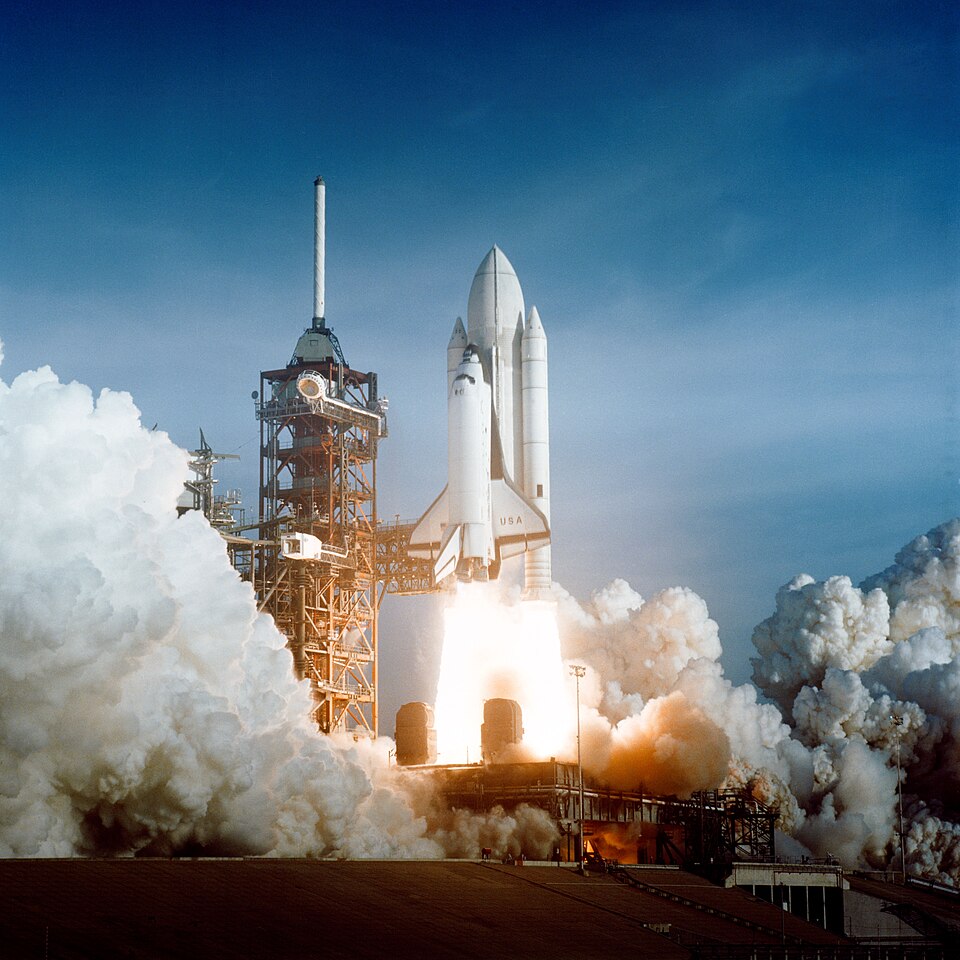
Unlike the landing of the Space Shuttle, which is primarily about playing around with the atmospheric forces that bring the aircraft to halt, takeoff of the Space Shuttle is really expensive. The boosters on the side of the Space Shuttle burn 1.1 million pounds (500,000 kilograms) of solid fuel in two minutes. The shuttle’s three main engines require an additional 1.6 million pounds (725,000 kilograms ) liquid fuel for the shuttle’s three main engines. Such an extraordinary amount of fuel propels the Space Shuttle at a speed that is greater than the escape velocity of the Earth, and sends it into orbit.