Over the years, many aircraft disappearances have baffled the world of aviation. The most obvious, and perhaps the most harrowing of them was the disppearance of Malaysian Airlines MH 370. Another noteworthy incident is the disappearance of Uruguayan Airlines Flight 571, which was later discovered, only to leave the world in bewilderment, for the case of cannibalism of the triumphant spirit of the survivors to eke out a life in the most frigid, unimaginable circumstances. The disappearance of a Douglas DC-4 Skymaster in 1950 led to the largest consecrated efforts by the US and Canada to find an aircraft that vanished in the skies.
Designed in the 1940s, the four-engine aircraft Douglas C-54 Skymaster was a military version of the civilian airliner Douglas DC-4 and saw heavy deployment during World War II, the Korean War, and the Berlin airlift. Hill Aerospace Museum claims that the aircraft “accumulated over a million miles transporting cargo across the North Atlantic during World War II, with a total of 79,642 ocean crossings”.
Skymaster could carry fifty troops, was used (for troop and cargo transportation) well beyond the end of the Great War until it was retired in 1975. Carriers such as Australian National Airways (ANA), Qantas(QF) [the airline which is an acronym of Queensland and Northern Territory Aerial Services Limited], Trans-Atlantic Airlines (TAA), and ANSETT-ANA.
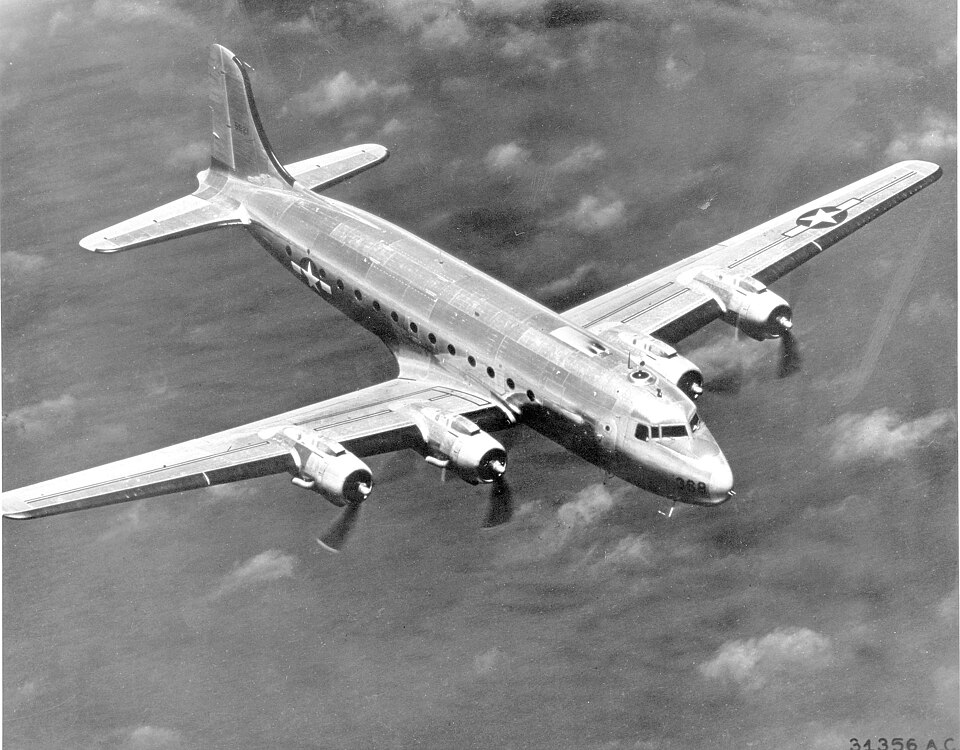
During the Berlin Airlift of 1948 alone, more than 300 aircraft of this type were deployed. Skymaster also served as the main airlift during the Korean War. Despite having been manufactured only between 1942 and 1947, 1164 of these were made:
- 655 at Orchard Place/Douglas Field
- 515 in Santa Monica, California
Douglas Aircraft Company’s C-54 Skymaster played a multitude of roles: as an air-sea rescuer, a medical transporter, a missile tracker, a scientific research aide, one of the first planes to transport the president of the United States, among others. The aircraft’s versatility, the numerous accidents it was involved in, and a couple of vanishing acts have made it an iconic aircraft of US history.
The origins of the Douglas C-54 Skymaster
In the middle of 1939, the major carriers in the United States (United Air Lines, American, and Eastern) and Douglas Aircraft Company felt that there was a need for a lighter variant of the DC-4: an aircraft with a similar capacity but structurally simpler. The engineering team decided not to redesign the DC-4, but came up with a new model altogether. Initial plans had it that the new DC-4 would have:
- A weight that was one-quarter less than the DC-4
- A design gross weight of 50,000 lbs
- Internal diameter of 118 inches
- Wing area: 1457 square feet
- Accommodation: “40 passengers by day-ten rows with two seats on each side of a central aisle or 28 passengers by night”
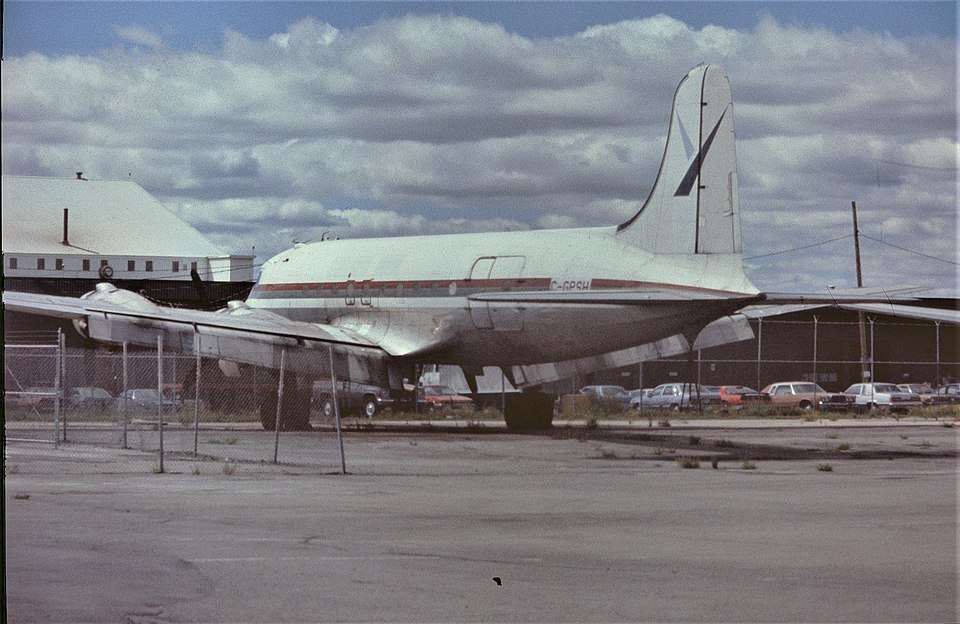
The aircraft was going to have a fuselage of a circular cross-section. According to René J Francillon, the author of “McDonnell Douglas aircraft since 1920”, the following changes were also made:
- retained the tricycle landing gear of its Douglas predecessors, a design regarded as one of the most successful features of the earlier four-engine transports.
- The landing gear was modified, however, with the main gear units retracting forward into the inner engine nacelles.
- new wings featuring a constant taper along both the leading and trailing edges.
- The wing center section followed the typical Douglas/Northrop structural arrangement and used three spars for additional strength.
- The outer wing panels used a simpler single-spar construction, creating a different structural arrangement from the center section.
When it was initially offered to the operators, one could choose either of the following power-plants:
- Four 1,050 hp Pratt & Whitney Twin Wasp SIC3-G fourteen-cylinder radials
- Four 1,000 hp Wright SGR-1820-G205A Cyclone nine-cylinder radials or.
The engines were later changed to four 1,450 hp Pratt & Whitney Twin Wasp (R-2000) 2SD1-G fourteen-cylinder radials (after talk with the aforementioned airlines).

Douglas aircraft received military orders for aircraft (from France, Britain, and the US Armed Forces). While Douglas stated that the production of its civil aircraft wouldn’t come in the way of delivering military planes, production of this new aircraft was taken over by the US Army Air Force.
In his book, Francillion notes that “No DC-4 or C-54 prototype was built, and the first production aircraft, s/n 3050, serial 41-20137, was completed as a C-54-DO in February 1942” . This aircraft that was stylized militarily, first took to the skies on 14th February from Clover Field. John F. Martin was at the helm of aircraft operations.

Douglas C-54 Skymaster design and variants
The civilian aircraft Douglas DC-4 was first converted into the C-4, an aircraft type whose only 24 units were produced. Later came the C-54A, the first military variant, a heavy-lift aircraft type that had a more robust floor and an increased fuel capacity. The following table gives us a general idea of the other C-54 variants:
| Variant | Number produced | Notes |
| C-54B | 220 | Increased fuel capacity compared to the C-54 |
| C-54D | 380 | Same as C-54B but with R-2000-11 engines |
| C-54E | 125 | Changes to the fuel tanks and provision for swift transition from passenger to cargo |
| C-54 G | 400 orders placed, only 162 of which were completed* | Same as C-54E but with a different version of the R-2000 engine. |
* the rest were cancelled following the end of World War II.
According to marchfield.org, fourteen sub-variants of the Skymaster were produced, a few of which include the following:
- C-54M: a C-54E stripped out “to serve as a coal-carrier during the Berlin Airlift
- EC-54U: an electronic counter-measures platform
- JC-54D: modified for missile nose cone recovery and at least 14 sub-variants built for the US Navy.
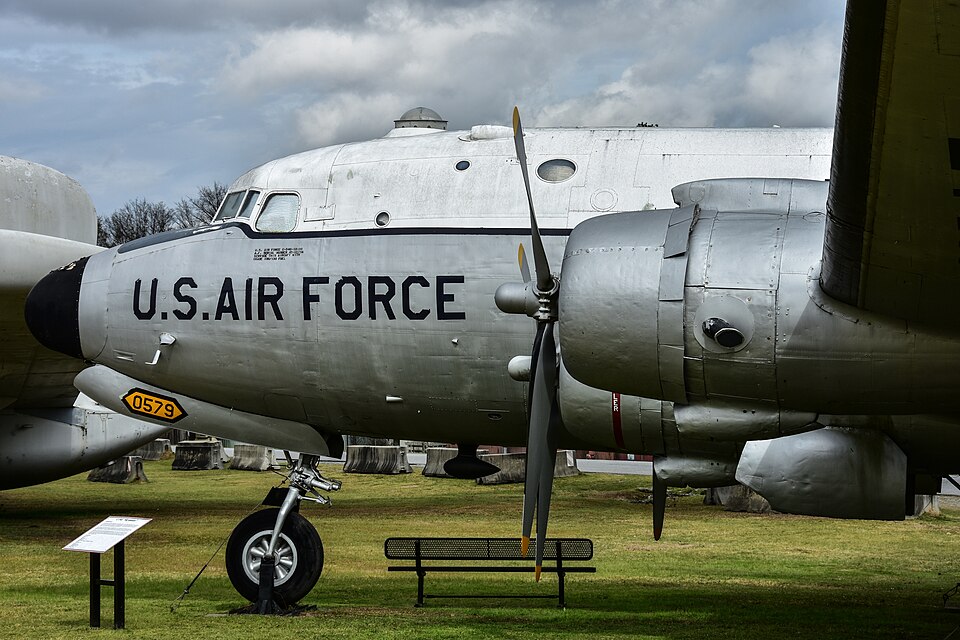
C-53C variant of the Skymaster
When the C-54C was introduced it became “the first aircraft purpose-built to fly the President of the United States”, which was heavily modified in line. The plane was designated “VC” and was dubbed “The Flying White House”. One of its unofficial nicknames was “Sacred Cow”, which was “a reference to the high security surrounding the aircraft and its special status”.
The evolution of the C-54C as a presidential aircraft began after Franklin D. Roosevelt became the first sitting US president to travel by air. In 1943, Roosevelt flew aboard the Navy-owned, civilian-operated Boeing 314 Clipper Dixie Clipper while traveling to the Casablanca Conference.
The flight prompted Gen. Henry “Hap” Arnold, commander of the US Army Air Forces, to seek a dedicated military aircraft for presidential travel. His initial choice was the Consolidated C-87, a transport derivative of the B-24 bomber, which was intended to carry the president using an Army Air Forces aircraft and crew.
The Secret Service, however, raised concerns about the C-87’s safety. As a result, the US Army Air Forces turned to Douglas Aircraft Company to develop a military transport specifically modified to meet the unique requirements of presidential travel. This decision ultimately led to the development of the Douglas VC-54C, which became an important milestone in the evolution of dedicated presidential aircraft.
Here are a few notes on the technical aspects of the C-54C variant of the Skymaster:
- The fuselage of a C-54A fuselage was amalgamated to the wings of a C-54B. [This gave the C-54 C a greater fuel capacity].
- The unpressurized cabin had a rectangular bulletproof window. [Note: Rectangular windows were later found to be the reasons behind the early crashes of the first jetliner in the world – the deHavilland Comet]
- Featured an executive conference room
- An electric refrigerator in the galley
- A private lavatory next to the president’s seat
- A fold-down bed concealed behind the sofa.
In addition, the Sacred Cow also had a “battery-powered elevator was installed at the rear of the aircraft which allowed President Roosevelt to board the aircraft easily while in his wheelchair”.

Here are the specifications of The Flying White House [with serial number: 42-107451 and displayed as 42-72252 in the National Museum of the US Air Force]:
| Crew | Seven (plus 15 passengers) |
| Weight | 80,000 lbs. (loaded) |
| Maximum speed | 300 mph |
| Service Ceiling | 22,300 feet |
| Engines | 4 X Pratt and Whitney R-2000 engines |
| Power | 1,450 hp each |
| Range | 3,900 miles |
During the Second World War, USAF (United States Air Force) deployed thirteen variants of the Skymaster: 1,084 Skymasters were used during the war.
Use of the C-54 Skymaster during Second World War and other missions
During World War II, the Skymaster flew almost a million miles a month, conducting almost 20 round trips everyday. Remember that even the Concorde, the second supersonic airliner in the world, took almost three hours to cross the pond. Skymaster helped for support missions in the Pacific Theater, where “they participated in operations between India and China that required flights of supplies over the Himalayan Mountains”.
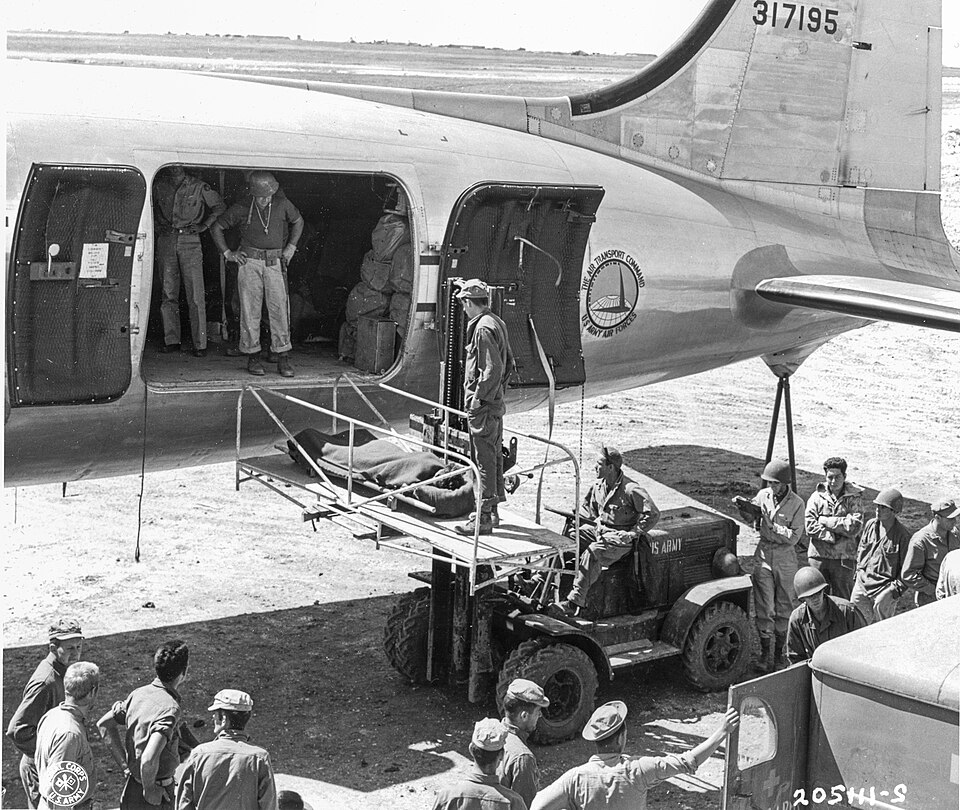
By June 1945, Skymaster was serving in VRE-1, the first casualty evacuation squadron ever formed, as it helped evacuate the wounded from the Battle of Okinawa. The first Navy nurse to land at Okinawa, Jane Kendeigh, attend to, and took care of, the wounded in the flights. The campaign for Okinawa, which took place in parallel to the Battle of Okinawa, 16,599 casualties were evacuated through aircraft by Army Air Forces, the Navy, and – approximately 60% of them flown out by VRE-1. In comparison, Skymaster helped deliver 66,000 patients to the US during the Korean War. According to Wendover Airfield, five Douglas C-54 Skymasters provided essential air logistics support to the operations of the atomic mission.
The contribution of Douglas C-54 Skymaster during Berlin Airlift
Following the end of World War II, tensions between the Soviet Union and the Western Allies over the administration of Germany escalated into a major crisis. On June 24, 1948, the Soviet Union imposed a blockade on West Berlin, cutting off the city’s road and rail connections and making ground access for the Western Allies virtually impossible.
With more than two million people in the city dependent on outside supplies, the Allies determined that essential goods would have to be delivered by air. Estimates indicated that each Berliner required around 1,700 calories of food per day, creating an enormous logistical challenge for the emerging airlift.
Daily requirements included hundreds of tons of flour and wheat, along with cereal, meat and fish, fats, potatoes, sugar, coffee, powdered milk, vegetables, salt and cheese. In total, approximately 1,534 tons of food had to reach the city every day simply to sustain its population.
The challenge extended beyond food. Berlin also required fuel and coal to keep homes heated and essential infrastructure operating, adding another 3,475 tons of coal and gasoline to the daily airlift requirement. Together, these demands demonstrated the extraordinary scale of the operation that would become known as the Berlin Airlift.

So, it was decided that all essentials would be airlifted to Berlin. At the zenith of this episode, that has been known as the Berlin Airlift, two planes dropped supplies each minute. By the end of the airlift (that took place on 30 September 1949), 2,326,406 tons had been supplied to Berlin: much of which included food, medicine, and coal. During the airlift, 101 aviators lost their lives. According to the 20th Air Force, the Berlin airlift “saved nearly 2.4 million Germans from the Soviet-controlled East Berlin in the late 1940s”.
Douglas C-54 Skymaster was a workhorse of the Berlin airlift, as it has been said that every 45 seconds this aircraft type delivered supplies to this great city of Germany. The Air & Space Forces magazine recalled that people who served in the World War II transitioned to the four-engined C-54s, “using mock air corridors, which were laid out across Montana’s landscape to simulate the approach to Berlin.”
Lieutenant Gail S. Halvorsen, a Utah native, became one of the most recognizable figures of the Berlin Airlift after he began dropping candy attached to small parachutes for children in the city. His initiative became known as Operation Little Vittles and earned him the nickname “Candy Bomber.”
Halvorsen’s efforts unfolded alongside a massive C-54 operation that kept West Berlin supplied during the Soviet blockade. According to aviation author Francillon, the airlift reached its peak with 204 C-54s and 22 R5Ds operating between Rhein-Main and Tempelhof in the US sector, as well as Fassberg and Gatow in the British sector. Another 110 Skymasters were either undergoing maintenance or being prepared for operations.
The scale of the operation reached a remarkable high on Easter Sunday, April 16, 1949. On that day, American and British aircraft completed 1,398 flights and delivered 12,941 tons of supplies to Berlin, with C-54s accounting for the majority of the aircraft involved.
Coal represented a significant portion of the supplies transported during the airlift, creating additional challenges for the aircraft. To handle the heavy loads more effectively, 38 C-54Es operated by the Military Air Transport Service were specially modified into C-54Ms designed specifically for transporting coal.
Post World War operations and the retirement of Douglas C-54 Skymaster
The last C-54 was delivered in January 1946. On domestic routes in te US, Skymaster was operated by its three original sponsors:
- American Airlines (AA) on the New York-Chicago route, beginning operations on February 1946, and later on the New York – Los Angeles route.
- United Air Lines
- Eastern Air Lines
- Braniff’s in 1949-50
- Pan America and Australian National Airways on Trans-Pacific routes
..among others. Skymaster was also used in JATO (Jet Assist Take Off) flights out of La Paz, Bolivia. Air Congo also used the aircraft to carry out-sized cargo loads, thanks largely to Sabena’s engineering department, which attached a swing-tail to a Skymaster.
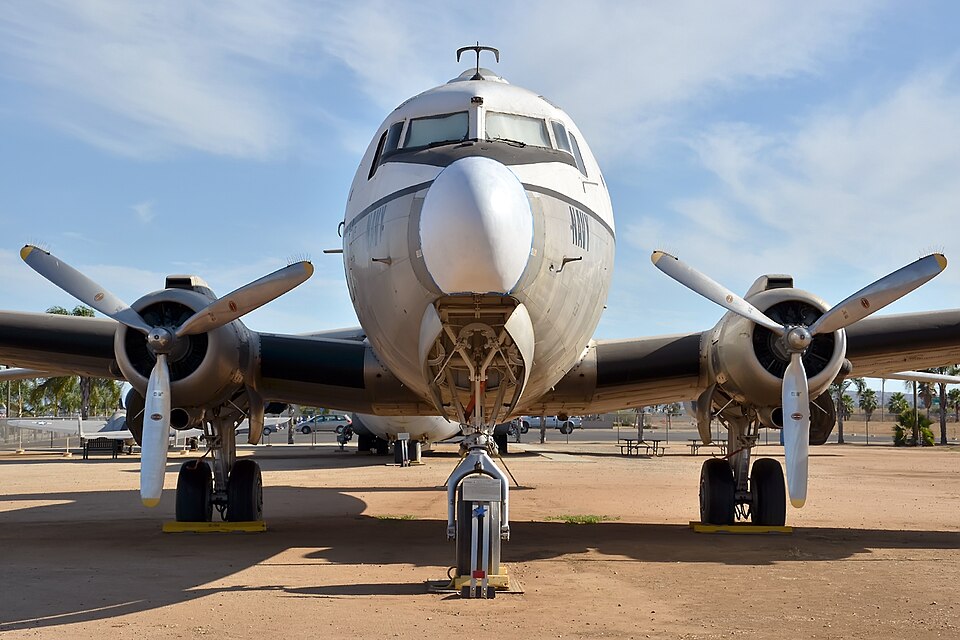
C-54 Skymaster was operated by the USAF service until the 1970s, Later, Skymaster was designed for long-range trans-ocean transport. After the end of World War II, Douglas developed a pressurized version of C-54E Skymaster military transport known as XC-112, an aircraft with larger windows (rectangular) , longer, and powered by much more powerful four 2,100 hp Pratt and Whitney R-2800-34 radial engines. [After necessary testing, the aircraft entered service as DC-6.]
Conclusion
During its services, two Skymasters vanished, without a trace. On 26 January 1950, a Douglas C-54 Skymaster operated by the US Marina Corps (serial number: 42-72469) disappeared as it was headed to Montana from Alaska. According to the Aviation Safety Network, the plane, which had 44 people aboard, “took Amber Airway No.2 over Canada, but failed to arrive at its destination. Last radio contact was at 17:09 near Snag, YT”.
In a similar vein, a Skymaster registered N4726V and operated by Facilities Management Corp. suffered a similar fate after the pilot reported “a bad fire in the no. 2 engine and stated that a ditching might become necessary”, with the probable cause being reported as “In-flight No.2 engine fire for an undetermined cause, resulting in ditching at sea.” These two extraordinary disappearances can’t be said to have brought the downfall of the Skymaster. Perhaps the development of pressurized aircraft did.


,_Montreal_-_Dorval,_August_1987._(5535161783).jpg)


.jpg)

.jpg)

_US_Navy_(11084486276).jpg)