How do we make sense of Bark Air, the airline which is “the world’s first air travel experience designed specifically for dogs first, and their human companions second”? All the non-human passengers are VIPS i.e., Very Important Pup,s that get first-class experience and are pampered in “a positively luxurious, curated experience”.

Aviation already has a special airline dedicated to a sumptuous “white paw experience”. The name “White Paw Experience” wouldn’t have been as beautiful maybe, nor would “Dog Air” have been as suggestive as “Bark Air”. The airline is a subsidiary of a company named BARK, which provides subscription services to dogs.
But what are the other ways in which airlines are named? Let’s have a look:
The most common way: Geography
Philippe Malavai and Christophe Benaroya, authors of “Aerospace Marketing Management”, have suggested that around three-fifth of all airlines are either geographic or have a national origin. [We might get into some discussion about how countries themselves are named, although that would be beyond the scope of this article.]
One of the biggest reasons behind christening airlines name this way is the fact that almost all airlines, in their starting months/years of operation have a small fleet, and their potential passengers: people from the regions after which the airline is named. Malavai and Benaroya argued this held truer for carriers in Asia, China, and the Middle East, whilst also applying to airlines in China and the USA.

Almost all national carriers are named after their respective nations (or geographical entities lodged within the nations):
| Flag Carrier | Country |
| British Airways | Britain |
| Qatar Airways | Qatar |
| Nepal Airlines* | Nepal |
| Air New Zealand | New Zealand |
| KLM** | Netherlands |
| Qantas*** | Australia |
| Pakistan International Airlines**** | Pakistan |
Some nations that have a monarch also have the word “Royal” prefixed to their names. Notable examples would be Royal Jordonian (from Jordan), Royal Brunei Airlines, Royal Air Maroc (Morocco), etc.
*This flag carrier of Nepal was previously called Royal Nepal Airlines. The prefix was dropped after the nation mothballed its monarchial rule. Nepal is also home to Himalaya airlines, a carrier named after the staggering mountain range that the nation is blessed with. After all, eight of the ten tallest peaks of the Himalayas (and the world) lie in this nation.
** The carrier started as Koninklijke Luchtvaart Maatschappij voor Nederland en Koloniën (Royal Dutch Airlines for the Netherlands and Colonies.
*** The Australian flag carrier started as Queensland and Northern Territory Aerial Services Limited.
**** Pakistan itself is an acronym of “Punjab, Afghanistan, Kashmir, and so forth, the resulting word in the Urdu language meaning “Land of the Pure”, said Vanity Fair.
The name of certain airlines might be acronym-ized, and this shouldn’t take away from the fact that such acronyms contain the names of the nations from which these carriers belong. JAL, which unfurls as Japan Airlines, is a prominent example. Scandinavian Airlines System is abbreviated as SAS and is one of the leading carriers from Scandinavia – the region encompassing Norway, Sweden, Denmark, and Finland.
Names of airlines might also be based on the region where the airlines operate from. A few examples would be:
| Shanghai Airlines | Shanghai, China |
| Alaska Airlines | Alaska, US |
| Riyadh Air | Riyadh, Saudi Arabia |
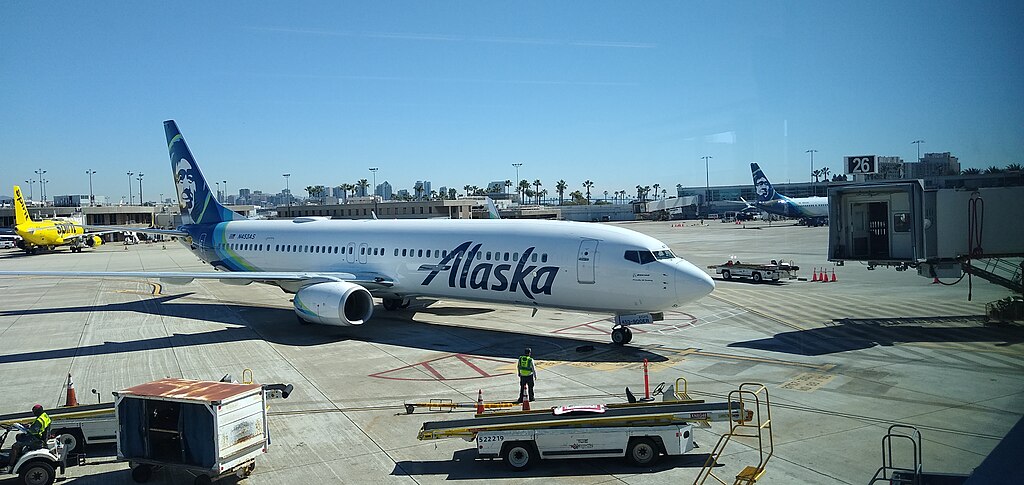
Photo: Mertbiol |Wikimedia commons
There are a few other references, such as the name of a mountain or a river, within a particular region, that also determines the name of airlines. According to opodo.co.uk, Delta Airlines, one of the three big airlines of the US, has its origins in a geographical region within the US:
“The name Delta refers to the Mississippi Delta, the area where Delta Air Lines has its origins.”
Quasi-religious/ mythological names
Eos Airlines, Inc. was an American all-business class airline that was founded in 2004 but ended operations in 2008, after the carrier announced its plans to file bankruptcy on its website on 26 April 2008. The airlines’ slogan was “eos – Uncrowded. Uncompromising. UNAIRLINE”. The airline was named eponymously after the Greek goddess of dawn – Eos.
A Nepalese carrier named Yeti Airlines gets its name from the (quasi-?)mythological figure called Yeti, a figure that is purported to inhabit the Himalayas. Yeti Airlines offers its services to the Everest region, which houses the Tengboche Monastery, which is said to harbor a skull of this creature. [It was Yeti Airlines that was involved in a devastating crash in Pokhara a few years ago].
There is another carrier in Nepal called Shree Airlines- “Shree” referring to an epithet given to a respectable figure. The Lord Krishna is known as “Shree Krishna”, and this prefix is also attached to the name of a particular nation that was in ancient times called “Lanka”, and is now known as “Shree Lanka”. Shree can be thought of an untranslatable word, and can be loosely interpreted as “venerated”.
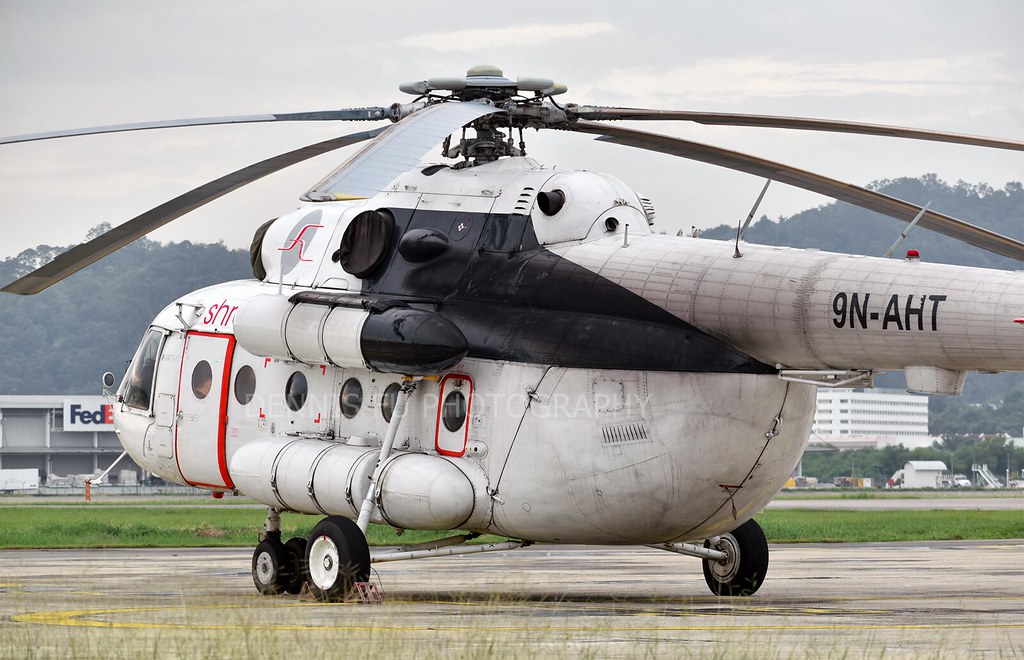
Photo: Shree Airlines
Pegasus Airlines from Turkey has its name based on a winged horse in Greek Mythology – Pegasus. The mythical names isn’t limited to airlines only. Hawaiian Airlines’ first Airbus A330 was named “Makali’i”, and according to CN Traveler, the name “comes from a constellation integral to navigation and from which old mythology says the Hawaiian people came to Earth“.
Evoking emotions that aren’t always innocuous
When an airline is named Virgin, what is one to make of it. Perhaps, it draws memories of the flirtatious pin-up models that were painted in the aircraft operated in the times of World War? After all, the nose art in Virgin’s Dreamliner or the A340s might suggest so, albeit mildly.
Some say that the airline chose to name itself so because the founders were figurative virgins in the field of airline business, with ATQ news saying that one of the founders Richard Branson has “described the “V” in the current logo as an expressive tick, representing the Virgin seal of approval. “

Had the idea of Smokers Express- an airline that flirted with the possibility of allowing smoking on air- but got the approval from the FAA, modern aviation might have been quite different. The airline was established by two Florida smokers as a members-only club, which required $25 per person to join. The Independent reported that “5,000 people from 18 countries – a third of them non-smokers” had joined the club before the founders had purchased any aircraft for their fleet, with one of the founders being quoted as saying:
“For too long smokers have been pushed to the back of the bus.We will also change the system’s filters every week, not every six months…The air on my planes will be cleaner than on non-smoking planes…We will offer free cigarettes as a matter of course.”
The novation behind this idea of an aircraft where one could smoke was stomped over by aviation regulation. As far back as 2003, Christopher Hitchens had revealed that Pakistan International Airlines allowed passengers to smoke, though drinking alcohol was not permitted.
Immortalizing the Founders
Ryanair, perhaps the most (in)famous budget carrier in the world, is named after its founder Tony Ryan.
Tony initially founded Guinness Peat Aviation, an aircraft leasing company. In 1984, he partnered with Christopher Ryan to form Ryanair.
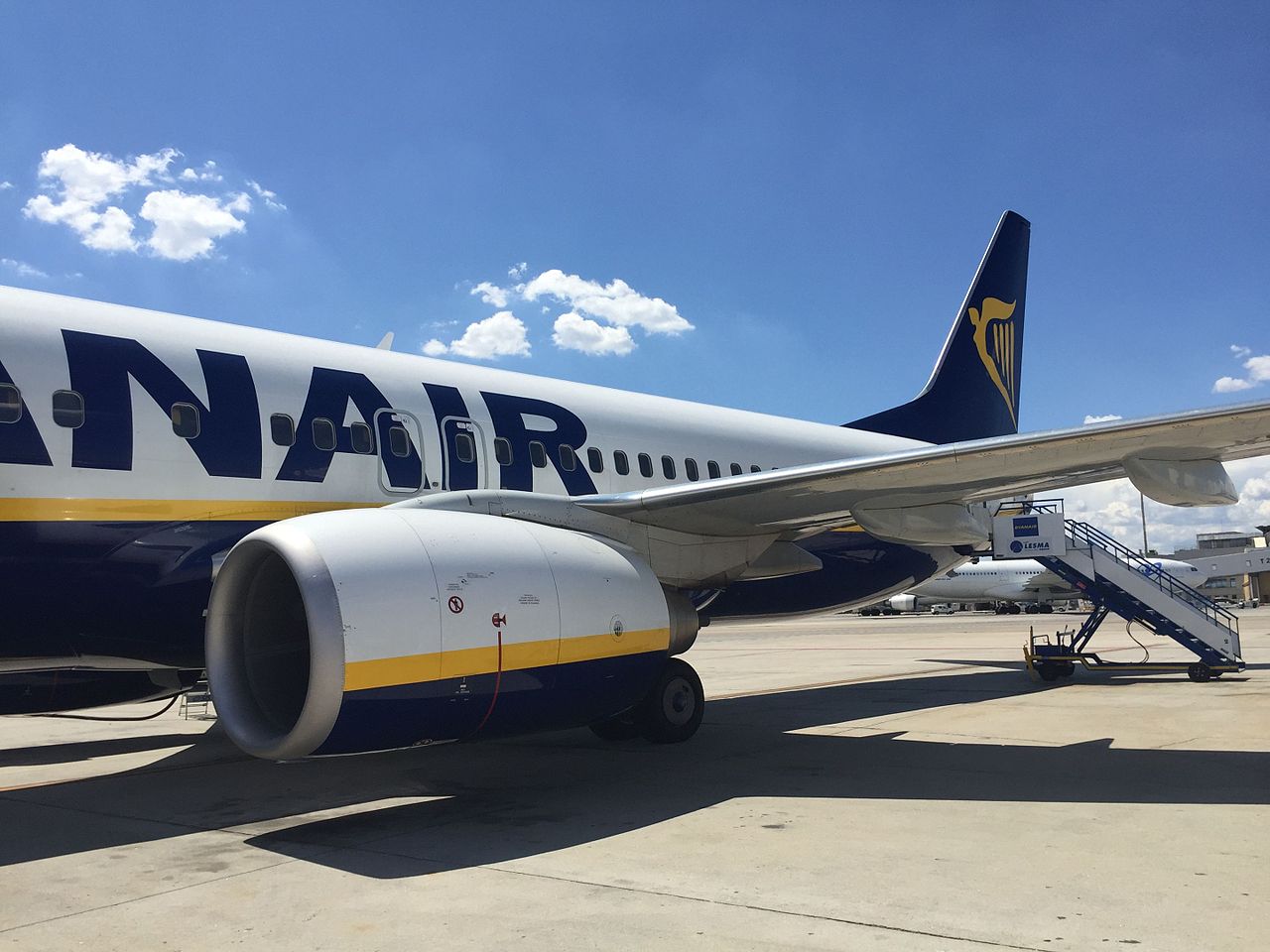
Photo: Benoît Prieur via Wikimedia Commons
Air India, the flag carrier of India, was founded by J.R.D Tata and was known as Tata Air. J.R.D Tata was the first person to pilot tata Air’s first plane that offered air travel service. Although Air India once topped the list of all airlines in the world, it has fallen from its grace- the crash of Air India Flight 171 is the lastest example. Tata Group is supposed to take over the group pretty soon.
Let’s have a look at other airline names kept after their founders:
| Airline | Founder |
| Hughes Airwest | part of Hughes Tool Company and later rebranded after Howard Hughes |
| Braniff International Airways | Tom and Paul Braniff |
| Morris Air | June Morris |
Minimalist or Trendy word names
There’s an Australian carrier by the name of Jetstar, while Fastjet is Zimbabwe-based carrier. A Canadian carrier is named Flair, an Indian carrier by the name of GoAir was rebranded to Go First, the Russian flag carrier that operated the first-ever supersonic airliner in the world – the Tupolev Tu-144- is called Aeroflot (an amalgamation of the word “aero” and “flot”, which translates as “fleet”), Southwest Airlines was named so because they initially operated in the Southwest region of the US.
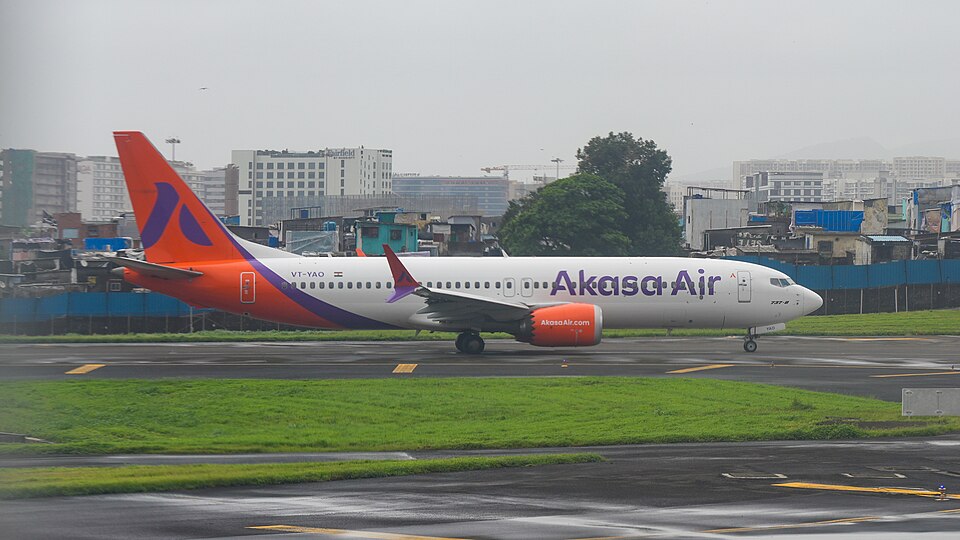
Other names of airlines that have a minimalistic tone include:
- Wings Air (Indonesia)
- Akasa Air (India), the word Akasa can be very loosely translated as “sky”
- Eagle Airlines, a now-defunct carrier from New Zealand.
There’s a Kenyan low-cost carrier called Jambojet: “Jambo” is Swahili word for ‘hello’, and when this all-turboprop and former Boeing 737 operator, calls itself “jambojet”, one can catch a sense of irony in its naming.
Final Touches
In 1962, Transportes Aéreos Militares Ecuatorianos (TAME) was the flag carrier of Ecuador. The name has a continental, South American ring to it. And so does Aerolíneas Argentinas. Whether the airline named LEVEL, an IAG low-cost airline designed to appeal to Gen Z travelers, has a post-2000 ring to it or not is subjective. It was the great bard Shakespeare, who asked “What’s in a name?” and rather rhetorically replied “A rose by any other name would smell as sweet”. But Virgin Airlines would have felt less Virgin-ish if wasn’t named so, and what if Bark Air was named “Meow”?