What does (the Second World) war comprise of? If we are to study R.N. Currey’s war poems, we know that elements such as “unplumbable courage”, “numb endurance”, “blind sacrifice”, and “high skill in homicide” are its quintessential elements. The world of aviation had sprung to life a few decades before the Second World War, the very conflict that was to immortalize the world of aviation by its imperishable nose art.
“Bombing” had becme increasingly aereal in the Second of these great wars. After all, the Soviet Union had produced more than 36,000 Ilyusih Il, and the Germans had produced more than 33,000 Messerschmitt Bf-109. In addition to being the most-produced planes in the war, these two aircraft also rank among the most-produced planes ever.
But which were the heaviest bombers used in World War II? Let’s find out.
5. Petlyakov Pe-8
Initially spearheaded by Tupolev
The Petlyakov Pe-8, deployed by the Soviet Air Forces, was the only four-engine heavy aircraft designed by the USSR – the nation that first produced a supersonic airliner- the Tupolev Tu-144. Alexei Tupolev, the man behind the Tupolev Series of aircraft (including the Tupolev Tu-104), was assigned the task of developing a better (and a heavier, one payload of more than 4,400 lbs (2,000 kg), at that) bomber than the Tupolev TB-3 series of bombers, and he did come up with TB-7. This bomber had to be modified as it encountered a few problems. The changes in the aircraft included:
- reconfigured control system
- Revision of the defensive and offensive armament
- An expansion of the bomb’s weaponry so that ot could accommodate single 5,000-kilogram (11,000 lb) FAB-5000 bomb

| Maximum take-off weight | 70,550 lbs |
| Payload | 11,000 lbs |
| Notable mission | “morale raids” against Germany and that included a bombing campaign over Berlin that began on August 8, 1941, and extended into early September”, as reported by The National Interest |
As the aircraft’s design was headed by Vladimir Petlyakov, the aircraft was named after him following his death in 1942. Even after revisions, the aircraft encountered multiple problems, such as the fact that the crew had to navigate it in hostile skies the guidance systems that we see in modern aviation. Pilots had to rely on stars and maps, and this rather archaic method posed a few risks. In addition, the exhaust plume of the engines equipped on the Pe-8s (ASh-82) lacked flame-dampening exhausts. This made the aircraft susceptible to the reconnoitering enemy aircraft.
Only 93 of these were built, and a year prior to the end of World War II, manufacturing of the aircraft stopped. It was deployed after the World War, on cargo missions, with an aircraft registered CCCP-N395 crashing on June 7, 1947, after two of its engines flaming out. Reports assessed that the probable cause of the crash was probably down to the flight engineer, who “made a mistake by handling the fuel system, causing both right engines to stop while the captain was attempting a go around.”
4. Heinkel He 177 Greif
The only long-range heavy aircraft bomber used by the Luftwaffe
| Maximum take-off weight | 72,750 lbs |
| Payload | 13,230 lbs |
| Notable Missions |
|
One Heinkel He177 Greif (Griffin) was modified to carry the planned German atomic bomb – neither this German plane nor the bomb it was supposed to carry ever materialized. Nonetheless, more than 1200 of these aircraft were produced. The aircraft took to the skies on November 1939, only a few months after the beginning of World War.

However, the design team “was not permitted sufficient time to solve the problem before the aircraft was pressed into service”, said rafmuseum.org. This urgency even led to the aircraft earning monikers such as Luftwaffenfeuerzeug (translation: Air Force Lighter), and Reichsfeuerzeug (translation: Reich’s lighter) – both of which highlighted the aircraft catching fire in flight due to problems (structural and mechanical).
A few years after the aircraft was deployed in various battles, even Adolf Hitler reprimanded the aircraft’s state to his military staff on Feb. 1, 1943, with defensemedianetwork.com quoting the Führer’s angst to the chief of staff of the Luftwaffe, Generaloberst (Colonel General) Hans Jeschonnek:
“I have to say again and again: I consider the whole 177 model a mistake because it was demonstrated already during the Great War that the problem of installing two engines on one shaft is extremely difficult to solve, and has led to constant difficulties.”
All in all, close to 1,200 Heinkel He177 Greifs were made, and the project was disbanded following the end of the war.
3. Avro Lancaster
The bomber with the highest payload
| Maximum take-off weight | 72,000 lbs |
| Payload | 22,000 lbs |
| Roles it played |
|
The Avro Lancaster was produced on a massive industrial scale during World War II, with 7,377 aircraft ultimately built. Supporting such a large fleet required an extensive manufacturing network spanning multiple factories and companies.
According to the Royal Air Force Museum, six major manufacturers produced the bombers across 10 factories in Britain and Canada. At the peak of production, more than 1.1 million men and women were employed across a network of over 920 companies, while the Lancaster also required more service personnel for flying and maintenance than any other British aircraft of its time.

In addition to a pilot, who was responsible for the flight operations, and a flight engineer, who would oversee instrumentation and perform vigilance and checklists, five other people would be needed to operate the Lancaster:
| A navigator | To oversee targets and navigation |
| A radioman | To control radio activity and communications |
| A bombardier | Who would release bombs |
| Two Gunners | To operate the forward and rear guns |
The aircraft had a wingspan of 102 feet and four Rolls-Royce Merlin V-12 engines. According to the Imperial War Museum, the aircraft was also deployed in the attack on the Ruhr valley in 1943, which is now known as the Dam Busters Raid, “when 19 Lancasters were adapted to carry Upkeep, the famous Bouncing Bomb”.
2. Consolidated B-32 Dominator
More complex than any other aircraft in history

| Maximum take-off weight (MToW) | 101,000 lbs |
| Payload | 20,000 lbs |
Only 118 Consolidated B-32 Dominators were made. The story of this aircraft, which first entered service in 1942, was similar to Peltyakov Pe-8 and the Heinkel He177 Greif in some ways. Like Germany had done with the He177, Boeing had rushed to ready the Dominator for service, and this haste led to a myriad of minor and major technical issues- the most pronounced of which were engine cooling problems that resulted in a fiery accident (of a prototype) in early 1943.
For a bomber that was developed as a backup for a larger bomber, this might/might not have been ideal. Only a few of these were ever deployed in combat. Like Peltyakov Pe-8, the aircraft had an underwhelming production number, and the project was disbanded after the end of the war. No surviving Dominators exist.
National Interest reported that “a B-32 reconnaissance mission over Japan was attacked by Japanese fighters after the war had ended, resulting in the final American combat death of WWII.” For observers, the aircraft’s beginning itself had a few negative undertones:
Officially designated the XB-32, the prototype mega-bomber borrowed the efficient Davis airfoil wing and distinctive double tail of the layout of the earlier B-24 Liberator. Its chubby, cigar-shaped fuselage sported a multi-paned “birdcage” nose and flight deck that looked decidedly antiquated. Later versions of the bomber that would become known as the Dominator flew with a host of improvements including revised defensive weaponry, more modern nose and cockpit glass, and a strikingly tall single vertical tail..
The consolidated B-32 Dominator ended after World War, as interest in the heaviest bomber of World War, was too great to ignore. The last aircraft of this type was scrapped in 1949,
1. Boeing B-29 Superfortress
Dropping Fat Man and Little Boy
“Never before in the history of warfare has so much been expected of a single weapon.”, was the famous pronouncement of General LeMay, as he save us a glimpse into the heavy load of expectations surrounding the B-29 superfortress, the very aircraft for which the Consolidated B-32 Dominators were acting as a second fiddle to. The project to bring the B-29 Superfortress into fruition cost $3.2 billion- the most expensive program of the war.
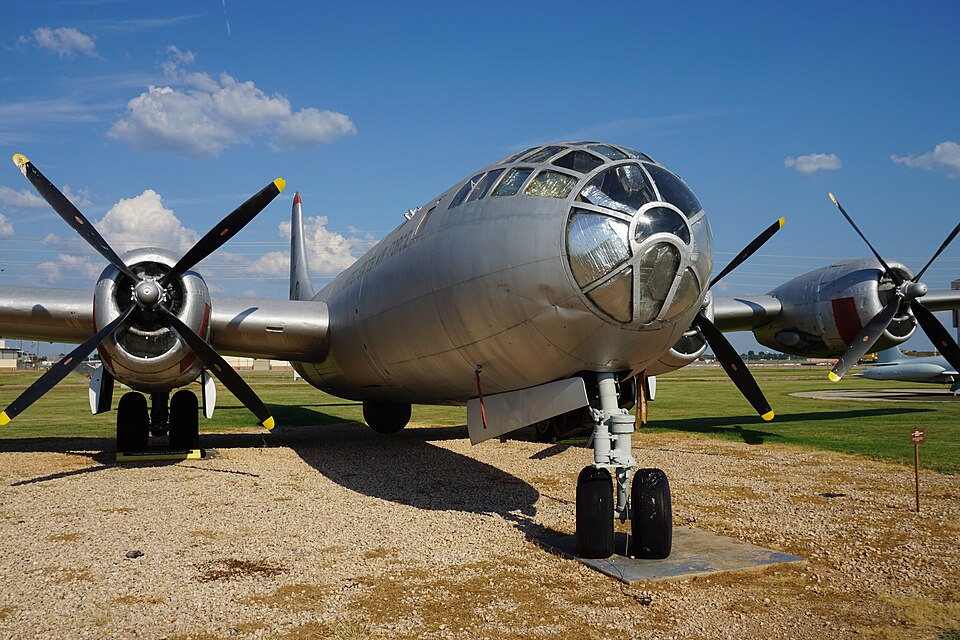
| Maximum take-off weight | 140,000 lbs |
| Payload | 20,000 lbs |
The B-29s have a distinction of being the only aircraft in history to drop nuclear bombs, as they razed Hiroshima and Nagasaki. But the most potent of its destruction was not caused by Fat man and Little Boy. Instead, the B-29 lay waste the city of Tokyo:
“ An armada of 334 B-29 bombers followed from bases in the Mariana Islands, with 279 of them dropping 1,665 tons of incendiaries, including a half-million cylinders of napalm and white phosphorus….The firebombings continued until the end of the war, with an estimated 300,000–330,000 Japanese civilians killed and at least 8 million left homeless, and with an estimated 40 percent of Japan’s urban areas destroyed; 60 percent of Tokyo itself went up in flames.”

The origin of the heaviest bomber used in World War II dates back to 1940 when the USAAF wanted manufacturers to come up with a bomber with the following capabilities:
- speed of 400 mph
- a range of more than 5,300 miles
- bomb load weighing 2,000 lbs. for at least 5,650 miles
The contract was awarded to Boeing, and along came the B-29, the bomber that dropped the coup de grâce to WWII.Curtis LeMay, who was incharge of dropping the atomic bombs later said, “Killing Japanese didn’t bother me very much at that time. It was getting the war over that bothered me.”


.jpg)
_Squadron.jpg)

.jpg)
