Many female pilots have broken several aviation records. One of them is Evelyn Bryan Johnson, a colonel in the Civil Air Patrol, who was nicknamed “Mama Bird”. She logged 57,635.4 flying hours, equivalent to almost seven years of flight time. She also trained more pilots than anyone in history.
Evelyn followed the footsteps of Raymonde de Laroche, the first female to get a pilot’s license (incidentally on Women’s Day). Laroche was also instrumental in shaping, as the firsts often are, in shaping Amelia Earhart, “The Face of Female Aviation” who inturn was the source of inspiration for Ann Baumgartner, the first American woman to pilot a US Army Air Force (on America’s first jet aircraft) the Bell YP-59A.
One person shaping another, shaping another, and another, has been the way of human endeavors. In this article, we will touch upon the top five military pilots who made history and broke records.
5. Sabiha Gökçen
Story behind the World’s First Female Combat Pilot
On the 22nd of March 1913 in Bursa Hüdavendigâr Vilayet, Ottoman Empire, Sabiha Gökçen was born. Although she would be orphaned at a young age, she would, in 1936, became the world’s first female fighter pilot. Eleven years prior to this distinction, she was adopted by Mustafa Kemal Atatürk, who is the founder of modern Turkey (and the nation’s first president). It was Mustafa who accepted Sabiha ‘s request to pursue aviation.
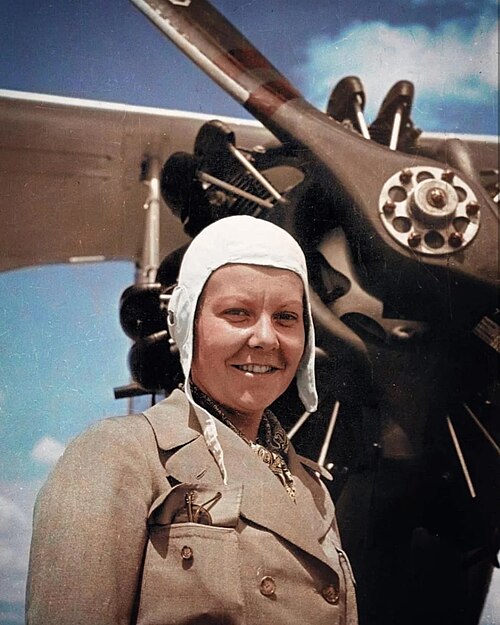
Sahiba enrolled in the Turkish aviation league in 1935 and was later sent to the Soviet Union for advanced glider and parachute training. For this record-making achievement, she trained at Eskişehir Military Aviation School, completed her military pilot training, and flew combat aircraft. A year later, Sabiha participated in Combat Operations during the Dersim Rebellion. She also accompanied Mustafa on international flights as a symbol of modern Turkish womanhood and represented Turkey abroad at aviation events. Sabiha became an instructor pilot and military educator, training new generations of pilots in Turkey.
| Aircraft flown | Breguet 19, Curtiss-Wright CW-22, Potez 25, Vultee V-11 (A-19) |
| Rank | First Lieutenant |
Finally, Sabiha was globally recognised for her dedication and selfless service in the military. She was awarded a gold medal by the Turkish Aeronautical Association and honored for her lifelong contributions to Turkish Aviation. Her awards and medals include:
- Romanian Army Aviation Badge
- Commemorative medals
- Gold medal awarded by THK
She has an airport (Istanbul Sabiha Gökçen International Airport) and a metro (M4 Kadıköy-Sabiha Gökçen Havalimanı Metro Hattı) named after her. She was also selected by the United States Air Force as the only female pilot for the poster of “The 20 Greatest Aviators in History”.
4. Eileen Collins
The first woman to pilot a space shuttle
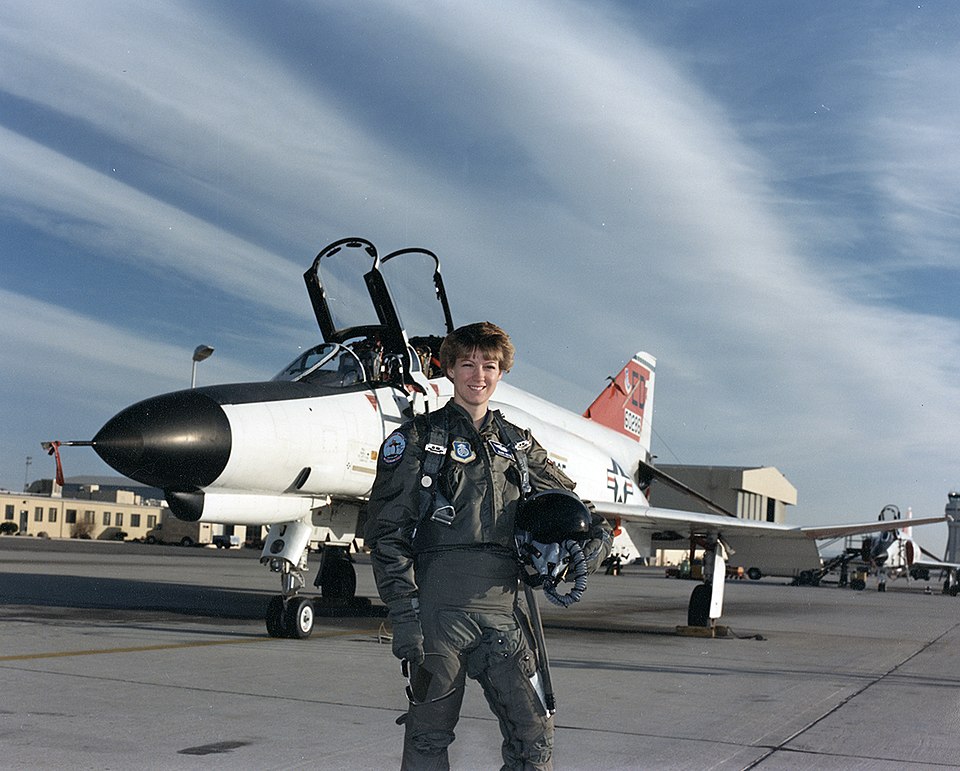
Eileen Collins started her military journey with aircraft such as the Northrop’s T-38 supersonic jet and the Lockheed’s C-141 strategic airlifter. Her piloting journey had started with Cessna. Her precociousness as a child is summed up in an anecdote when she inquired with NASA about the qualifications needed to become an astronaut. The largest space agency in the world replied that space missions were exclusively carried out by men. Upon learning about this. Collins replied, “Well, times have certainly changed.” Time did change, but it took Eileen to show that women could pilot space capsules, as she holds great distinctions, such as being:
- The first woman to pilot a space shuttle
- The first female commander in shuttle history (she was a part of STS-63, STS-94, STS-93, STS-114).
3. Valentina Tereshkova
In space, for nearly three days, on her own
Valentina Treshkova was, and still is, the youngest woman to space. Her record of crossing the 100 km barrier of space has stood for almost half a century.
She is also the only female astronaut/cosmonaut (a term that refers to astronauts from the Soviet Union) to have completed a solo space journey. During her mission to space, she “logged more flight time than the combined times of all American astronauts who had flown before that date.”
Valentina Tereshkova made history on June 16, 1963, when she launched aboard Vostok 6 and became the first woman to travel into space. Her mission lasted 70.8 hours, during which the spacecraft completed 48 orbits of Earth.
Following the flight, Tereshkova received the prestigious Hero of the Soviet Union title. She never returned to space, instead taking on a public role as a representative of the Soviet Union and later receiving the United Nations Gold Medal of Peace.
It is a testament to how Tereshkova was shaped by the Russian Revolution, which aimed at the equality of men and women in the sphere of work as well. The nation even had the idea of a “New Soviet Woman”, who wouldn’t simply be confined to domestic chores but stand on equal footing with their male counterparts.

Here are a few snippets on her evolution:
| 1966 – 1991 | an active member in the U.S.S.R. Supreme Soviet |
| 1968 | directed the Soviet Women’s Committee |
| 1974 – 1991 | member of the Supreme Soviet Presidium |
| 1997 | retired from the Russian Air Force (as a major general) |
The initial plans of the Soviet Union were to launch two female cosmonauts into space in late 1962. However, plans were later revised, and it was agreed upon that Valeri Bykovsky, a male cosmonaut would take charge of the Vostok 5, while the Vostok 6 capsule would be piloted by Tereshkova, who would have a call sign ‘Chaika’ or ‘seagull’ on this mission.
2. Jacqueline Cochran
The (female) pilot with the highest number of speed records
Often dubbed “Speed Queen”, Jacqueline Cochran held a number of distinctions, which included:
- The prestigious 1938 Bendix Trophy Race flying Alexander de Seversky’s P-35 pursuit plane.
- The first woman to fly a bomber across the Atlantic.
- The first woman to break the sound barrier
- “held more speed, altitude, and distance records than any pilot, male or female”.
According to the National Air and Space Museum, Jacqueline held a number of positions in aviation, including:
- A six-time recipient of the Harmon Trophy in the Aviatrix category and a one-time recipient in the National category.
- Two-time president of the Ninety-Nines – a women’s flying organization
- First female president of the Fédération Aéronatique Nationale (FAI, the official keeper of aviation records).
- overseeing training at over 100 bases and the missions of over 1,000 women pilots
- A consultant for the Air Force and National Aeronautics and Space Administration (NASA)
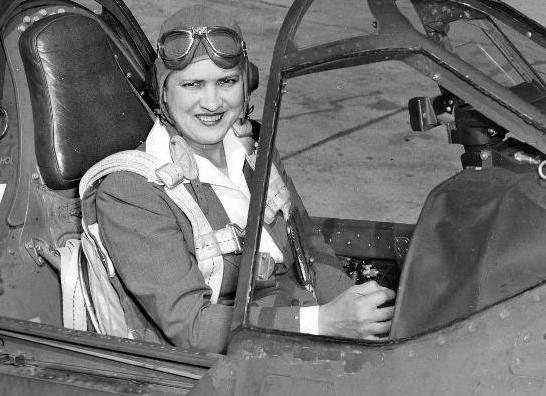
Col. Jackie Cochran’s story from rags to riches (one of the very that makes up the enviable German word “elementargedanken”) has been rather poetically summed up, in her own words, as one from “sawdust to stardust”.
Cochran’s legacy was marked by a clear tension between her efforts to expand opportunities for women in aviation and her reservations about how far that role should extend. Although she had helped establish and lead the WASP, she ultimately supported disbanding the organization if it could not be integrated into the military on terms she considered appropriate.
1. Lydia Litvyak
A Russian ace, the first female ace
Lydia Litvyak was only 21 when her aircraft was shot down by the Germans during World War II. Born in Moscow in 1921, she performed her first solo flight at 15, and by the time that Russia and Germany were at loggerheads during the Second World War, she had already trained 45 pilots. She is the first female fighter pilot to shoot down an enemy aircraft and has earned the moniker of being a “fighter ace”. It has been estimated that she had 12 solo kills and four shared over 168 missions.

It has been noted in some circles that Lydia was known as the ‘White Rose of Stalingrad’. This, however, might be a mistaken notion based on the spurious claim that Lydia had painted a rose (or a white lily, depending upon sources) on her earlier Yak-1. Some believe that Lydia was not killed but rather captured by Germans, after the crash of her aircraft.