The story of the Tupolev Tu-104, USSR’s first jetliner, goes hand in hand with its arch, or should we say, its only rival (albeit, only initially), the deHavilland Comet. In May 1952, Britain had introduced the de Havilland DH106 Comet – the world’s first jetliner – into passenger service. Amidst the elan, tragedy followed. A Comet operated by the British Overseas Airways Corporation (BOAC) had broken up in the air.

Official investigation of the crash of the Comet G-ALYV on May 2, 1953, said that “the accident was caused by structural failure of the airframe during flight through thundersquall”. In other words. a failure of the system of pressurisation had resulted in the crash. It was also recommended that “consideration should be given to the desirability of modifying the flying control system of the Comet aircraft in order to give the pilot a positive ‘feel’ of the airloads exerted in the control surfaces”. Two others tragedies involving the Comets were in line the next year: the first production Comet, G-ALYP, and a Comet registered G-ALYY (“Yoke Yoke”) crashed into the mediterranean. Comets were grounded. And enter the world of jetliner: the Tupolev Tu-104, which would turn out to be a stepping stone in the USSR’s aviation history.
This aircraft had been shown on the Soviet Aviation Day flypast at Tushino in August 1955, and was set to be the only passenger jetliner in service for a brief period of time.
Stepping into the Stepping Stone: the origins
The fifth Soviet five-year (economic) plan had achieved great results: 2.4 million tonne kilometres (mtk) of freight and 9.8 million passengers carried by Aeroflot. The sixth plan (1956 to 1960) was in sight, and targets were more ambitious: 44.8 million passengers and almost 6 million tonne kilometers of cargo. During those times, Aeroflot’s was using the following piston aircraft for passenger transport:
- Ilyushin II-12
- Ilyushin Il-14*
- Lisunov Li-2 (the Soviet equivalent of the Douglas DC-3)
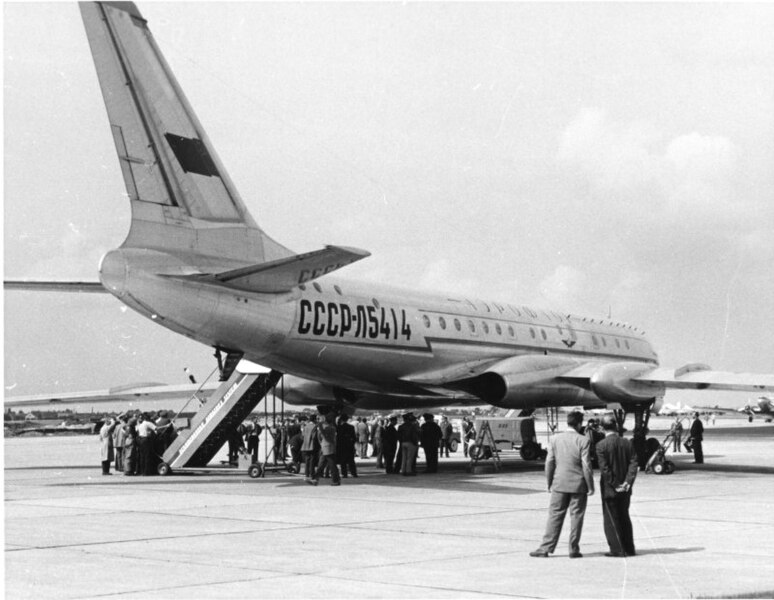
Andrei Tupolev, the man after whom USSR’s supersonic airliner- the Tupolev Tu-144 was named, began work on the Tu-I04 in 1953, after Tupolev approached the government with a proposal, said writers Yefim Gordon, E. Gordon, Vladimir Rigmant, in their book “OKB Tupolev: A History of the Design Bureau and Its Aircraft”:
“… for a twinjet airliner based on his Tu-16 bomber. Soon afterwards he submitted a report to the Communist Party Central Committee stressing the advantages that this would entail – a high cruising speed (twice than of Aeroflot’s Lisunov Li-2P and N’yushin IL-12 airliners), the ability to fly at high altitude without the discomfort of turbulence, and the ability to carry large payloads or large numbers of passengers in comfort. For the first time in the USSR there was talk of building large numbers of high-speed airliners for the GVF. “
On 11th June, 1954 the Council of Ministers of the USSR issued a directive to the Tupolev OKB “to produce a long-range high-speed passenger aircraft tentatively designated Tu-16P”. The designation ‘104’ was later adopted (Note that all passenger planes in the USSR have a number 4 at the end. This might be akin to how Boeing use the number 7 in their aircraft.)
Tupolev, and Dmitri Markov, the Head of the programme, thought that Tu-16 was would be a good basis for the development of Tu-104. After all, the project was ambitious, and to meet the deadlines, starting from a new model from the scratch would probably have meant that the targets for the sixth economic plan wouldn’t be met. Also, the bomber aircraft that was the Tu-16 had first taken to the skies in April 1952, and the designers had plenty of experience on the type.
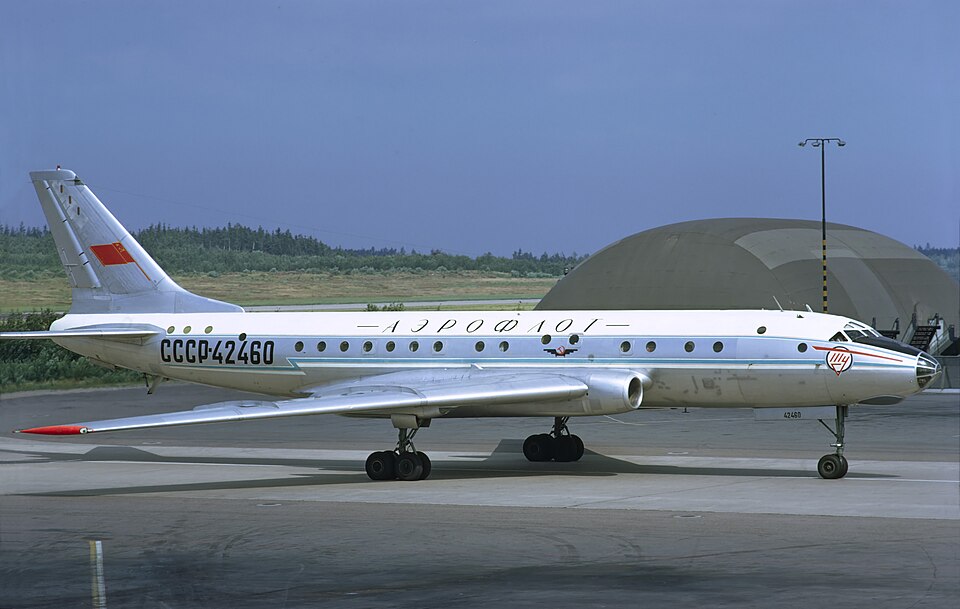
Aircraft such as the Tu-70, Tu-95, etc. all had pressurization built into the system. So it was assessed that the problems encountered by the Comet wouldn’t plague the Tu-104. Further, the makers also decided to use circular windows. After all, “It was metal fatigue, exacerbated by the squarish window design”, reported the Plane and Pilot magazine about the crash of the Comets.
It isn’t really known if the designers of the circular windows of the Tu-104s were aware about this, though. Nonetheless, the makers also decided to use (or slightly modify) the instruments and controls (hydraulics and electrical) as well as engines, undercarriage, and wings, from the Tu-16. They would need a new fuselage, however.
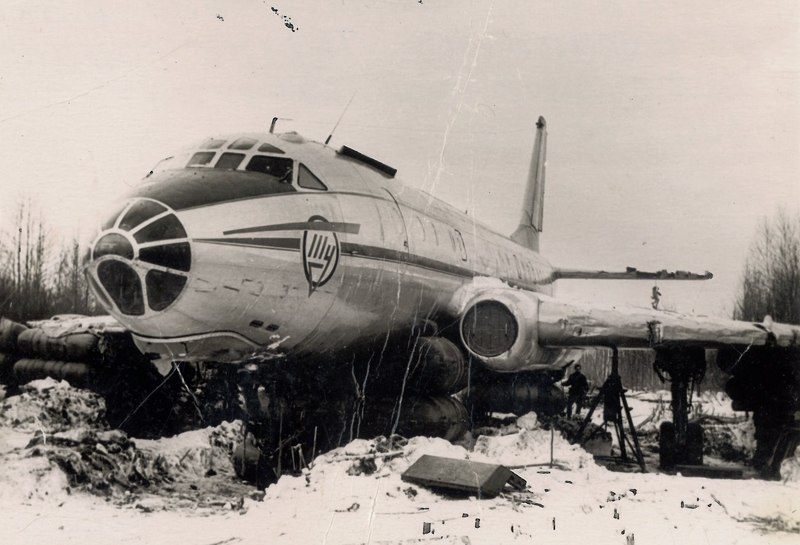
Here’s how the plane was to look initially:
| Cross-section (of the semi-monocoque fuselage) | 3.2m/10.5 feet |
| Wing sweep | 35° |
| Engines | Mikulin AM-3s |
| Thrust | 8,700kg/19,1801b |
| Service life | 25,000 flight hours; 12,000 cycles |
| Pressurised to | 2,500m/8,202 feet atmosphere when the aircraft was at a height of 10,000m/32,810 feet |
The first Tu-104 prototypes incorporated several features that were later removed or changed before the aircraft entered regular production. According to authors Paul Duffy and Andrei Kandalov, designers were particularly concerned about the possibility of a cockpit window breaking during flight.
To protect the flight crew in such an event, oxygen masks were provided, while the first two prototypes also featured a hermetically sealed partition separating the cockpit from the passenger cabin. As testing progressed and confidence in the aircraft’s structure and flight performance increased, engineers decided that this additional barrier was no longer necessary for production aircraft.
The Tu-104 also introduced an important piece of technology to Soviet aviation. It became the first Soviet aircraft equipped with a “Panoramic Radio Location Station,” the Soviet designation for an omnidirectional radar system.
1955: the year that the first Tu-104 was completed
By early 1955, the first Tu-104 was ready, with ground tests being completed by the middle of the year. On the 17th June, 1955, Yuri Alasheev was was at the helm of this aircraft as it took to the skies. All requirements of the aircraft were met, barring the length of the take-off run. The installation of AM-3M engines meant that the problem was resolved. However, to ensure the smoothest flight possible, two changes followed:
- Rear limits were pushed forward to tighten the limits placed by the center of gravity. This would help the Tu-104 avoid getting into high angles of attack.
- The angle of the horizontal stabiliser was increased.
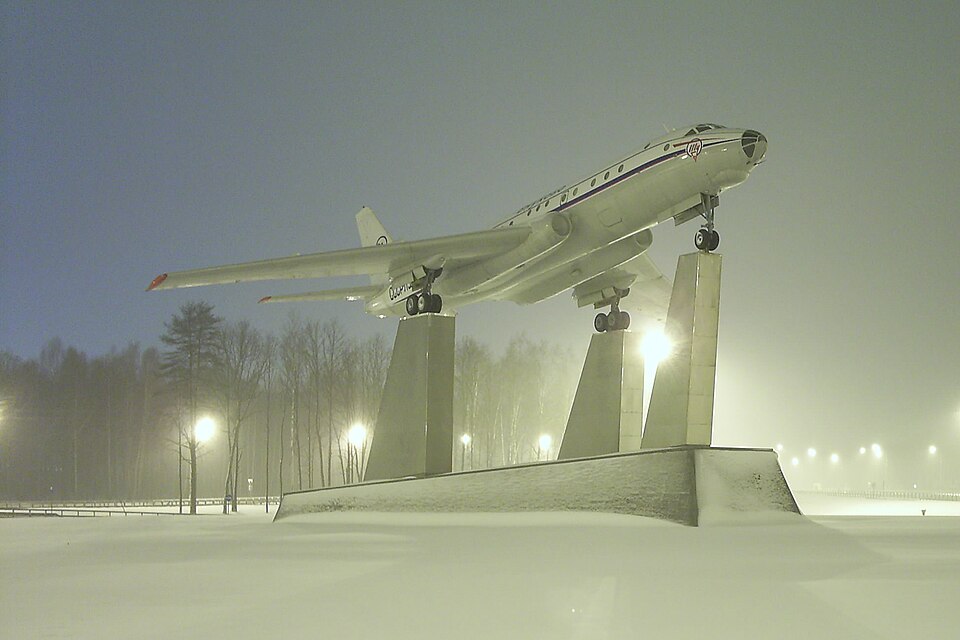
Here are a few important milestones of the Tu-104
| 5th November 1955 | The first flight of the first pre-production Tu-104* |
| May 1956 | Ready for service trials |
| August 1956 | The first example of the pilot batch was ready |
*Test pilot V. F. Kovalyov was at the helm
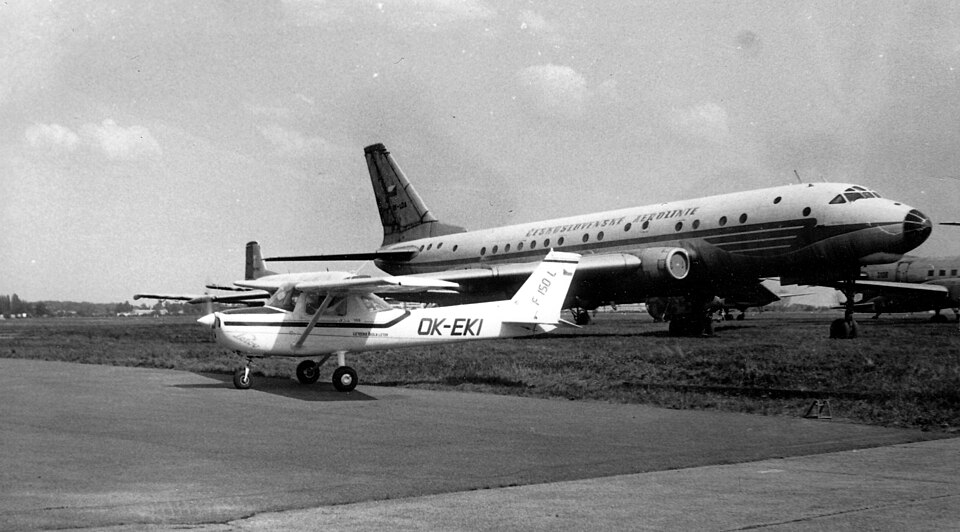
After the Tu-104 had arrived in London (on March 22, 1956) as it carried I. A. Serov (the then head of the KGB) and a few distinguished diplomatic from the USSR, it supposedly “created a furore in the aviation and social community on the other side of the ‘Iron Curtain”. Tupolev is quoted to have said that the Tu-144 had put “an end to the myth that Soviet civil aviation continued to lag behind that of the West”. Stalin’s sixth year plan saw 201 Tu-104s being produced, twelve of which were delivered to USSR’s state carrier in the first year of this plan. This meant that Aeroflot had catching up to do. After all the Li-2s and the Il-12 and Il-14s it was operating were rather archaic compared to the Tu-104, and therefore had to “to upgrade many airports and to train controllers, flight crew and technical staff to operate, fly and maintain a totally new product”.
Introduction of a few variants and setting a few records onboard the Tupolev Tu-104
The first domestic flight of Tu-104 was registered on 15th September 1956, as this flight captained by Ye. R Barabash took off from Moscow and landed in Irkutsk***. Less than a month later, B. R Boogayev spearheaded the Tu-104 on its first international flight (to Prague). One
*** At that time: Apart from Irkutsk, only airports in Omsk, Novosibirsk, and Sverdlovsk were able to handle the Tu-104 on its transcontinental route from Moscow to Khabarovsk.
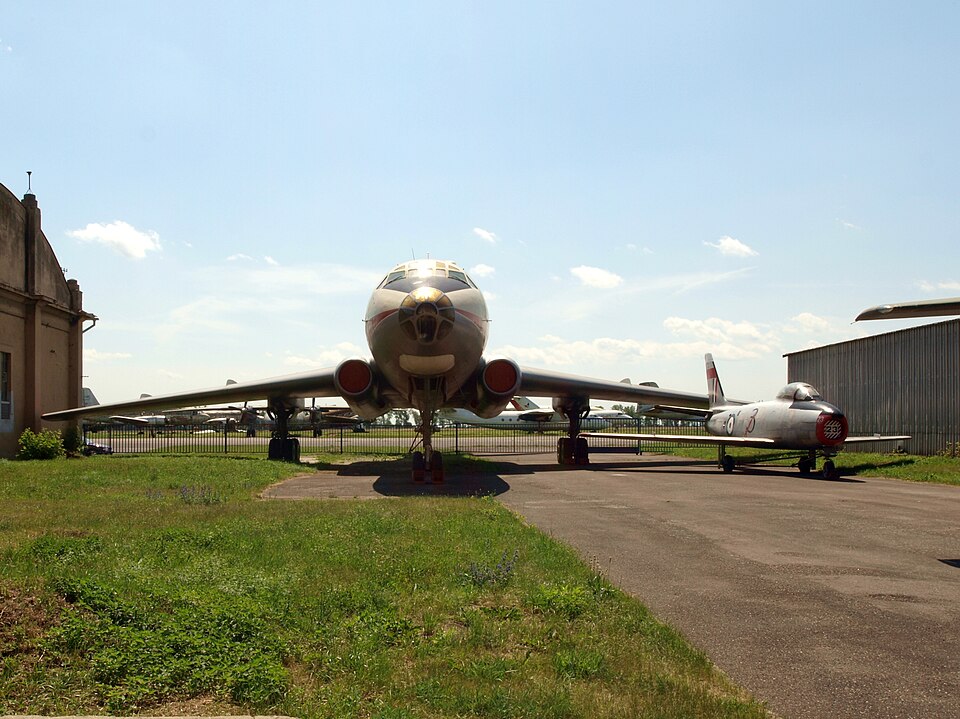
After operations, it was discovered that the Tu-104 was “too small, and even rearranging it to accommodate seventy proved inadequate”. As a result, a few variants were introduced. The first of these was the Tu-10A, which has the following specifications:
- RD-3M engines, which were an improved version of the AM-3
- Power:9,700kp/21,3851b
- Service Life: 1,500 hours
A few of the other variants include:
- Tu-104B: Fuselage was increased by 1.2m/3.94 feet. It could accommodate 100 passengers in standard configuration while all ‘tourist class’ could accommodate 115.
- 104E: Passenger capacity of 122.
Given that the Tu-104 was the only jetliner on the horizon, it isn’t too difficult to imagine the aircraft set many records. Some of these records included the following:
| Date | Record | Aircraft type | Record holder |
| September 1957 | the first jetliner to cover a 2,000km/1,243-mile closed circuit | Tu-104 | Pilot Yuri Alasheev |
| September 21, 1957 | l,000km/621 miles with ten tonne load flown at average speed of 970.821kph/603.268mph. | Tu-104 | Yuri Alasheev |
| 14th August 1959 | altitude of 12,896 metres/42,311 feet with a twenty-five-tonne load. | Tu-104B | Pilot Yuri Alasheev |
| 1 August 1959 | 100km/62.1 miles with fifteentonne load covered at 1,015.816kph/631.259mph | Tu-104B | Pilot Valentin Kovaliov |
In the year the first two records listed above were set, A. N. Tupolev (as Designer General) received the Lenin prize. Several specialists in the OKB and a few of Tupolev’s deputies were also bestowed with the prize named after the founding father of the nation. It is said that “over 400 other workers in the OKB and experimental factory received various government awards”.
All in all
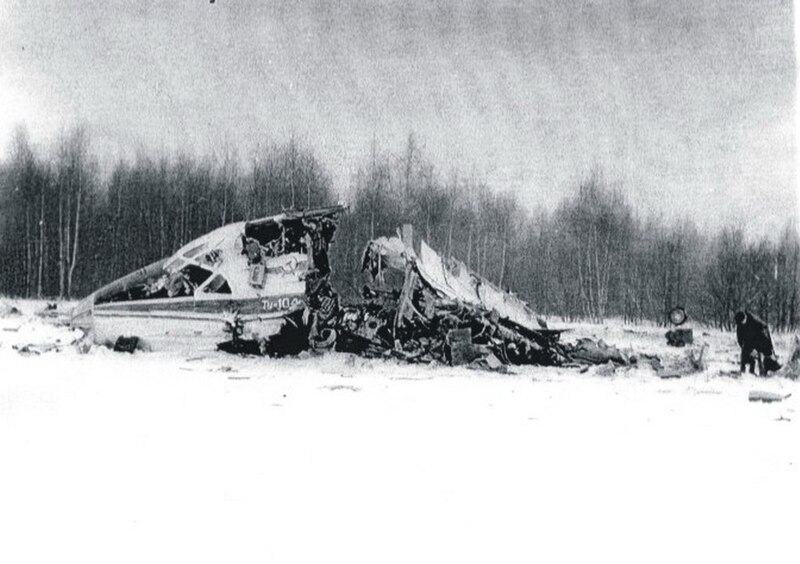
The last flight of the Tupolev Tu-104 took place on November 11, 1986, as SSSR-42322 was flown from Sheremetyevo to the Aeroflot museum at Ulyanovsk. This aircraft, despite being a veritable steppingstone in USSR’s aviation history, was rife with many accidents, though. Estimates have it that more than 900 people lost their lives in accidents involving the Tu-104: the first of the major accidents included the 1958 Aeroflot Тu-104 Kanash crash that took the lives of all 80 people onboard, and the crash of a Tupolev Tu-104B, registered CCCP-42486, that led to the demise of all 122 on the fatal flight. A crash of the Tu-104A on 7 February 1981near Pushkin Airport in Leningrad led to the death of all 50 people on board, including 28 high-ranking Soviet military personnel.

The Tu-104 was a remarkable aircraft. An aircraft that held glorious records, and connected the distant parts of the USSR. While there might have been a chasm between the highest-ranked officers and the lower ones in the USSR, Andrei Tupolev, the designer of the Tu-104, “made a point of meeting and knowing all the first Aeroflot pilots to operate the – 104”. Such brushes of grace will forever be tied to the Tu-104, and so will the fact that in 1960, one-third of all passenger flights in the USSR were made on the Tu-104, and that this aircraft clocked 2 million flight hours in 600,000 flights made over its 23 years of operation.


_%E2%80%93_Tu-104_(OK-LDA)_%2B_Cessna_150_(OK-EKI).jpg)


