The momentous occasion of Ed White performing the first American spacewalk was captured by the co-pilot of Gemini 4, James A. McDivitt. The caption of the photo should befittingly be Ed White’s joyous words while performing the “extra-vehicular activity,” (aka Space walking): “I feel like a million dollars”. Ed also commented that coming back to his space vehicle after the end of the spacewalk was the saddest moment in his life. When you hear Adrienne Rich, pay homage to the extraordinary exploration of space made possible by Hubble Space Telescope in her poems:
…there is something
more desirable: the ex-stasis of galaxies
so out from us there’s no vocabularybut mathematics and optics
equations letting sight pierce through timeinto liberations, lacerations of light and dust
exposed like a body’s cavity, violet green livid and venous, gorgeous—beyond good and evil as ever stained into dream
beyond remorse, disillusion
… one gets a picture of why Ed might have felt like a million dollars. Ed might also not have experienced the million-dollar feeling had it not been for Alexi Leonov, a cosmonaut from Russia who had cemented his name in history books as the first person to spacewalk. According to the Smithsonian National Air and Space Museum, initial plans had it that White would simply “stand up in the seat and stick his body out of the spacecraft”, but the fact that the USSR had done a spacewalk prompted the US to keep up with the Jonasses.
For Ed, “flying was not merely a hobby, fascination or job. Flying was his birthright“. It might as well be argued that it was White who allowed the possibility of the future generations to claim that “spacewalking” would be a birthright. Ed, who piloted aircraft that trained John Glen, the first American to orbit the Earth; trained Ham (the first hominid in Spac) to deal with weightlessness and extensive hours of spaceflight, was tragically killed (along with fellow astronauts Gus Grissom and Roger Chaffee), when a fire broke out during a training session for the Apollo 1 mission. Here’s his story.
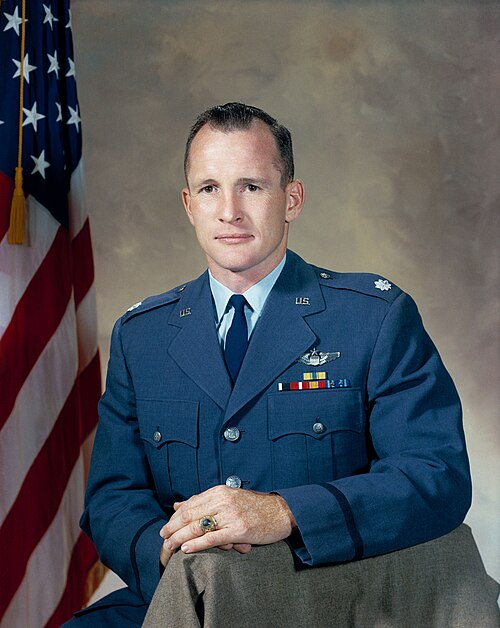
The difficulty of an untethered spacewalk can be assessed from the fact that the untethered spacewalk was first successfully completed almost two decades after Ed’s momentous spacewalk on June 3, 1965. Ed had spacewalked for 23 minutes – a length that was almost double of Alexi Leonov. The current record for the highest amount of time spent on spacewalking belongs to James Voss and Susan Helms, who spacewalked for close to nine hours on March 12, 2001.
Ed White, the first American spacewalker was among the “second group of astronauts”
On April 9, 1959, NASA introduced its first seven astronauts to the world known as “The Mercury 7”. The most famous of this crop of seven astronauts was Alan Shepard, who became the first American in space in 1961 (on the Mercury-Redstone 3 mission) and later walked on the Moon during Apollo 14.
On Sept. 17, 1962, NASA announced its second group of astronauts, who would “fly the two-seat Gemini spacecraft designed to test techniques for the Apollo Moon landing program”. The astronauts who were colloquially called the “second group of astronauts: included:
- Charles “Pete” Conrad
- Frank Borman
- Neil A. Armstrong
- John W. Young
- Elliot See
- James A. McDivitt
- James A. Lovell
- Edward H. White
- Thomas P. Stafford
The Gemini IV mission, which allowed Ed White to spacewalk, had a patriotic distinction for the USA, too. Before Gemini IV, U.S. Flag hadn’t been donned on a spacesuit, and the tradition of putting on the American flag on spacesuits began. White (the pilot of Gemini IV) and McDivitt (the command pilot) purchased the flags they wore themselves.
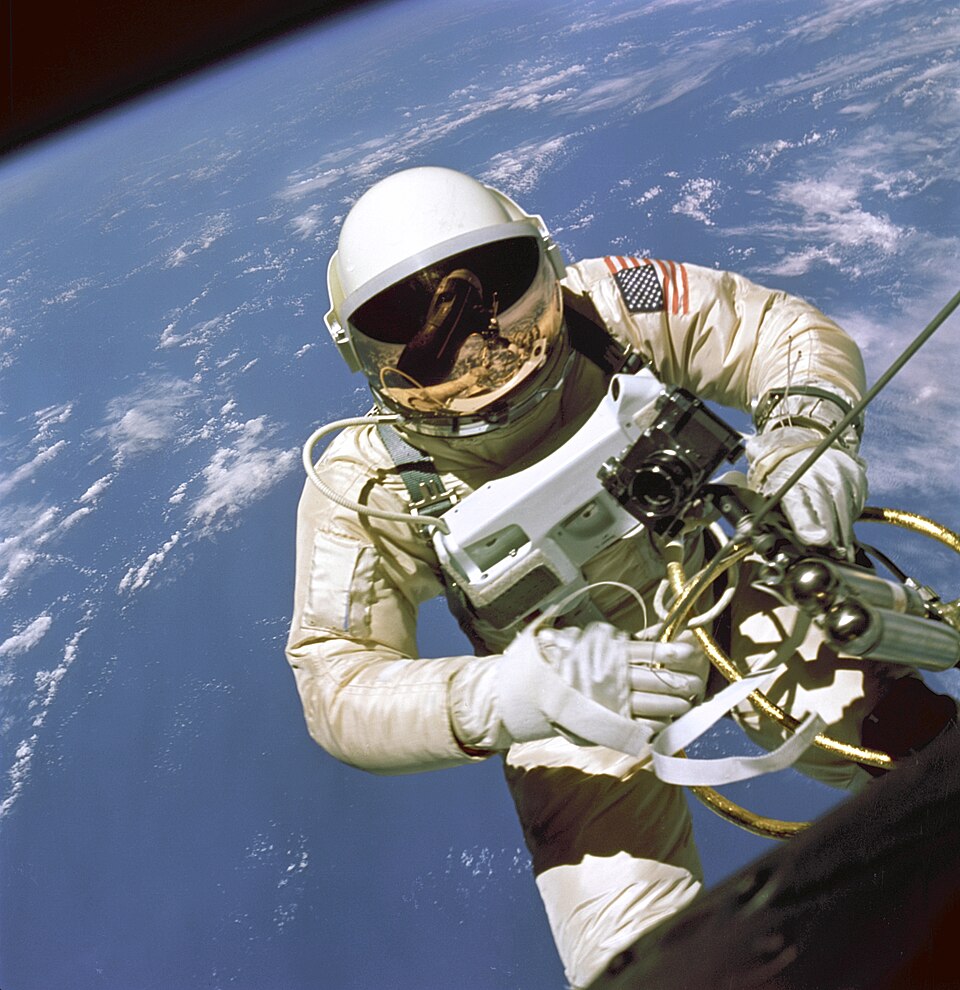
Here’s a caption of the photograph above where Ed performs a spacewalk during the third revolution of the GT-4 spacecraft:
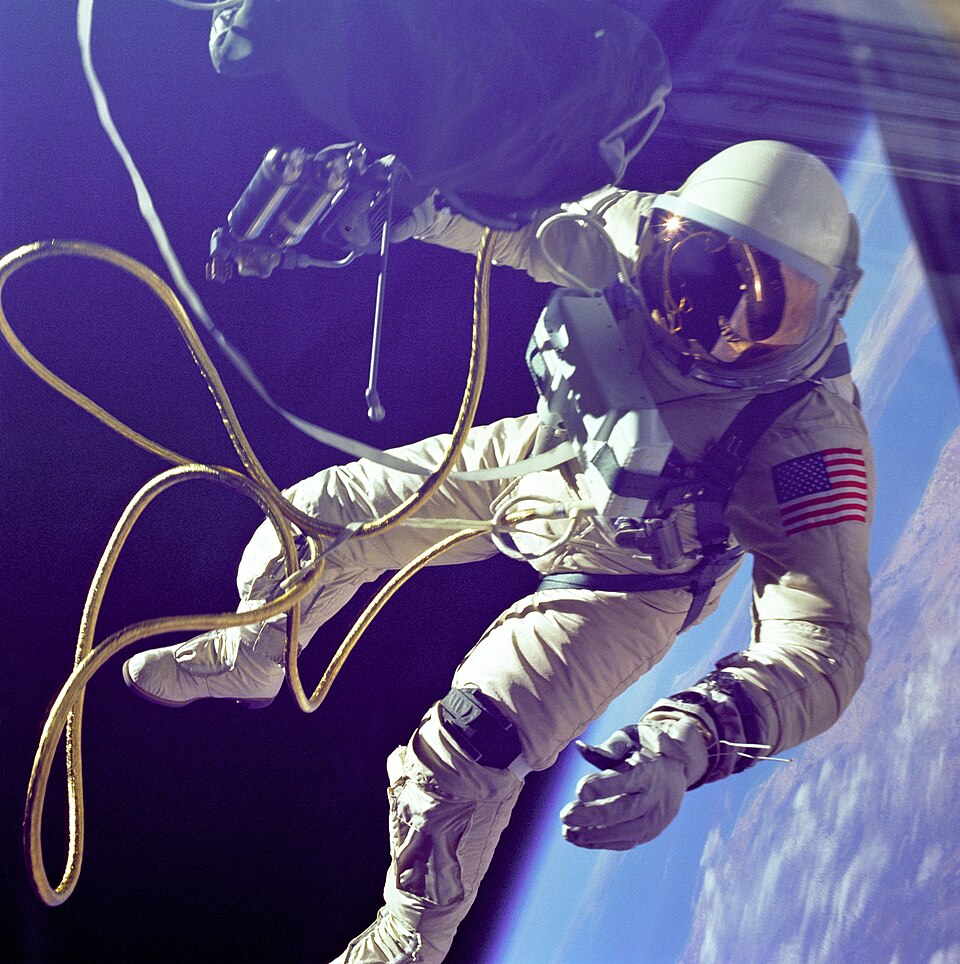
“Astronaut Edward H. White II, pilot for the Gemini-Titan 4 (GT-4) spaceflight,. White wears a specially designed spacesuit. His face is shaded by a gold-plated visor to protect him from unfiltered rays of the sun. In his right hand he carries a Hand-Held Self-Maneuvering Unit (HHSMU) that gives him control over his movements in space. White also wears an emergency oxygen chest pack; and he carries a camera mounted on the HHSMU for taking pictures of the sky, Earth and the GT-4 spacecraft. He is secured to the spacecraft by a 25-feet umbilical line and a 23-feet tether line. Both lines are wrapped together in gold tape to form one cord. ”
Ed carried three pieces of religious jewelry:
- A St. Christopher Medal (Saint Christopher is one of the fourteen helpers who is believed to allow safe traveling)
- A Star of David
- A gold cross
Ed White’s journey to spacewalking
Ed White had “flying” in his genes. He was the son of Edward Higgins White Sr, someone who started his military career by flying U.S. Army balloons, served in the United States Air Force, and retired as a major general in the United States Air Force. Ed was only twelve when his father allowed him to take control of a North American Aviation T-6 Texan. Ed’s penchant for flying was encapsulated in his words recalling the event, “It felt like the most natural thing in the world to do.”
After graduating from West Point, Ed joined the U.S. Air Force. He later pursued Aeronautical Engineering at the University of Michigan- the same university that bestowed him with an honorary doctorate in astronautical science after his spacewalk. Ed was also an attendant of the U.S. Air Force Test Pilot School.

He later became a pilot who helped prepare people (and animals) for the weightlessness experienced in Space.
Later, White was selected as the second group of astronauts. Compared to the Mercury seven astronauts, the second group of astronatus were perceived to have had a higher level of formal education. Ed White was described as “a man who, when asked an intelligent question, will answer thoughtfully and to the point, but will rarely volunteer information“.
The Spacecraft that allowed Ed White to Spacewalk
Gemini 4, which had a launch weight of 3,570 kg (7,880 lb), traversed in space for a little over four days covering distance of 2,590,600 kilometers. This made it a spacecraft that had spent the longest time in space. Before Gemini 4, the maximim time a spacecraft had spent in space had been 34 hours.
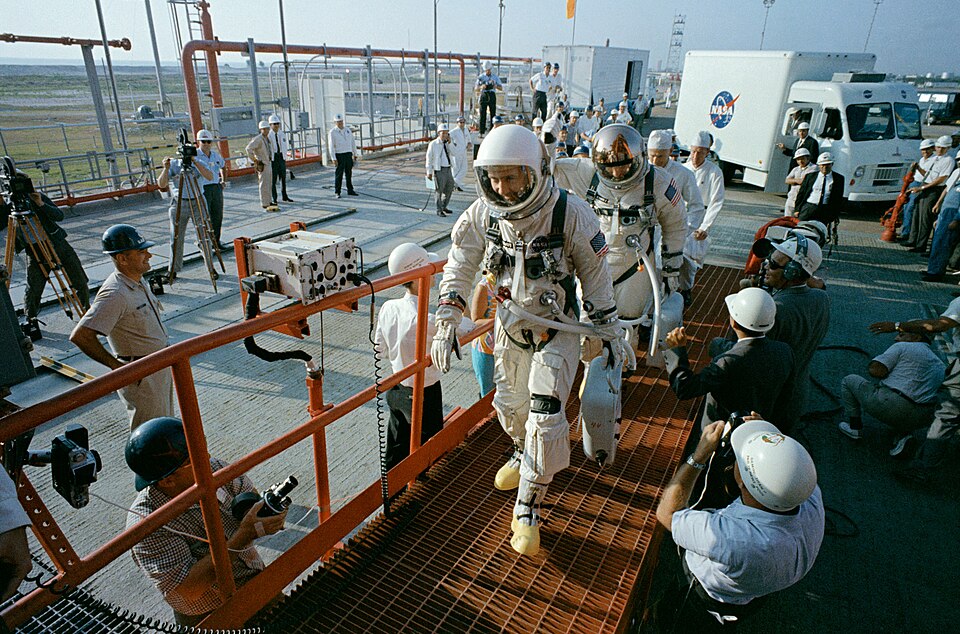
During his spacewalk, Ed was attached to the Gemini 4 capsule by a 25 foot umbilical cord. He initially used a gas-powered gun held in his hand to maneuver himself during the tethered spacewalk, but after the first three minutes (of the 23 minutes spent spacewalking), it ran out. After the first three minutes (of the 23 minutes spent spacewalking), the gas powered gun held in his hand to maneuver himself during the tethered spacewalk ran out. After this, “White moved around by twisting his body and pulling on the cord”.
The Tragic Death of the First American to Walk in Space
Apollo 1, the first crewed mission of the Apollo program (Apollo was supposed to take US to the moon and it did), caught fire during a rehearsal test on 27th January, 1967. All crew (Virgil “Gus” Grissom, Ed White, and Roger Chaffee) were on board. Apollo 1 was scheduled to launch Feb. 21, 1967.
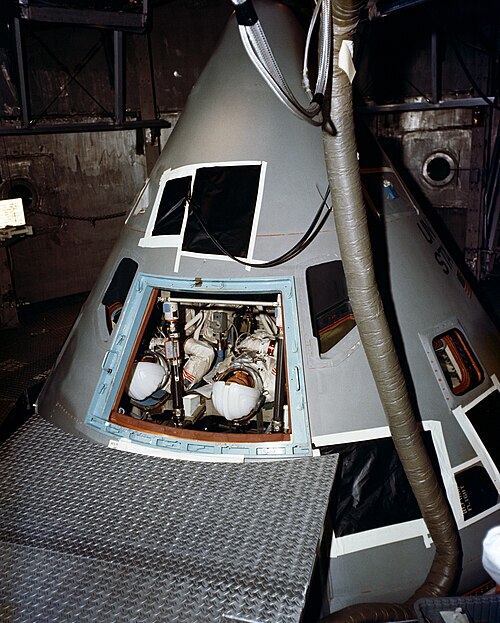
During the rehearsal carried out in an environment of pure oxygen, a spark ignited in the capsule. The pure oxygen environment made the capsule extraordinarily flammable, and investigators discovered that more than half of Ed’s body had scars from the burn. The fire also melted much of the astronauts’ spacesuits. While the autopsy report cited “carbon monoxide poisoning leading to a cardiac arrest” as the cause of the death, NASA flight director Gene Kranz believed that the team at NASA working on the Apollo 1 mission was to blame for the mishap.
Impact and Legacy of the First American Spacewalk
A multiple accolades followed Ed White’s spacewalk. These included:
- NASA Exceptional Service Medal by then-president of the United States of America, Mr. Lyndon B. Johnson
- The US Postal Office issued a postage stamp commemorating Ed White’s first American spacewalk in 1967. The image showcases the Gemini IV spacecraft and White’s space suit. The design covered over two stamps, the first in US history.
- As Ed was “Edward Higgins White the Second.”, a star, was nicknamed “Dnoces” after him [“Dnoces is “Second,” spelled backward.
- Ed White received the “Congressional Space Medal of Honor” posthumously.
Ed’s saddest moment was when he was called back to the capsule after spacewalking.
Frequently Asked Questions
Who were the first three Americans to go to Space?
All the first three Americans to go to space were a part of the Mercury 7:
- Alan Shepard on May 5, 1961 [only behind Yuri Gagarin who went to space on April 12, 1961] Later on, Shepard also made it to the Moon (at the age of 47). Back then, he was the oldest person to complete a moonwalk.
- Virgil Grissom (on Liberty Bell 7) in July 1961. [Note: During re-entry to the Earth Liberty 7 splashed into the Atlantic and was only recovered in 1998].
- John Glen on February 20, 1962.
Who was the first to enter Space in the 1950s?
No human beings entered space in the 1950s. The exploration of animals into Space, however, began in the 1940s. Fruit flies made it to Space in 1947, making them the first organisms from planet Earth in space. In 1949, a monkey named Albert II made it to space, becoming the first monkey to do so. Later, Laika, a dog, made it to space, too.
What happened in 1965 in Space?
In 1965, a spacecraft named Mariner 4 flew past the planet Mars, giving the first close-up pictures of the Martian surface. The spacecraft also took the first pictures of a planet other than the Earth from Space.
Who was the first man to walk in Space in 1965?
As stated above, Alexei Leonov, a Soviet Cosmonaut, was the first man to walk in space. Had the Soviets not disbanded their lunar program, Alexei could have been the first person from the USSR to walk on the Moon. Alexei’s words as he reminisced about his spacewalk were:
“You just can’t comprehend it. Only out there can you feel the greatness – the huge size of all that surrounds us“.
Was John Glen the first American in Space?
John Glen was the third American (and the fifth person, overall) in space. He was, however, the first American to circle the Earth, as he orbited our speck three times. The space capsule on which he orbited was so small that it earned Glen the title “man in a can.”
Who were America’s first three astronauts?
America’s first crop of astronauts was dubbed “the Mercury 7”. The “first three astronauts” might refer to the three American astronauts who first made it to space.
Who was the first woman to walk in Space?
The first woman to walk in Space was Svetlana Yevgenyevna Savitskaya. On the momentous occasion of her spacewalk, she also became the first woman to go to space on two occasions. Svetlana held several world records such as:
- The highest extra-vehicular duration in space by a woman
- The greatest payload in powered airplanes.
- Plenty of other records to climb to various altitudes.
Who was the first American astronaut to float in Space?
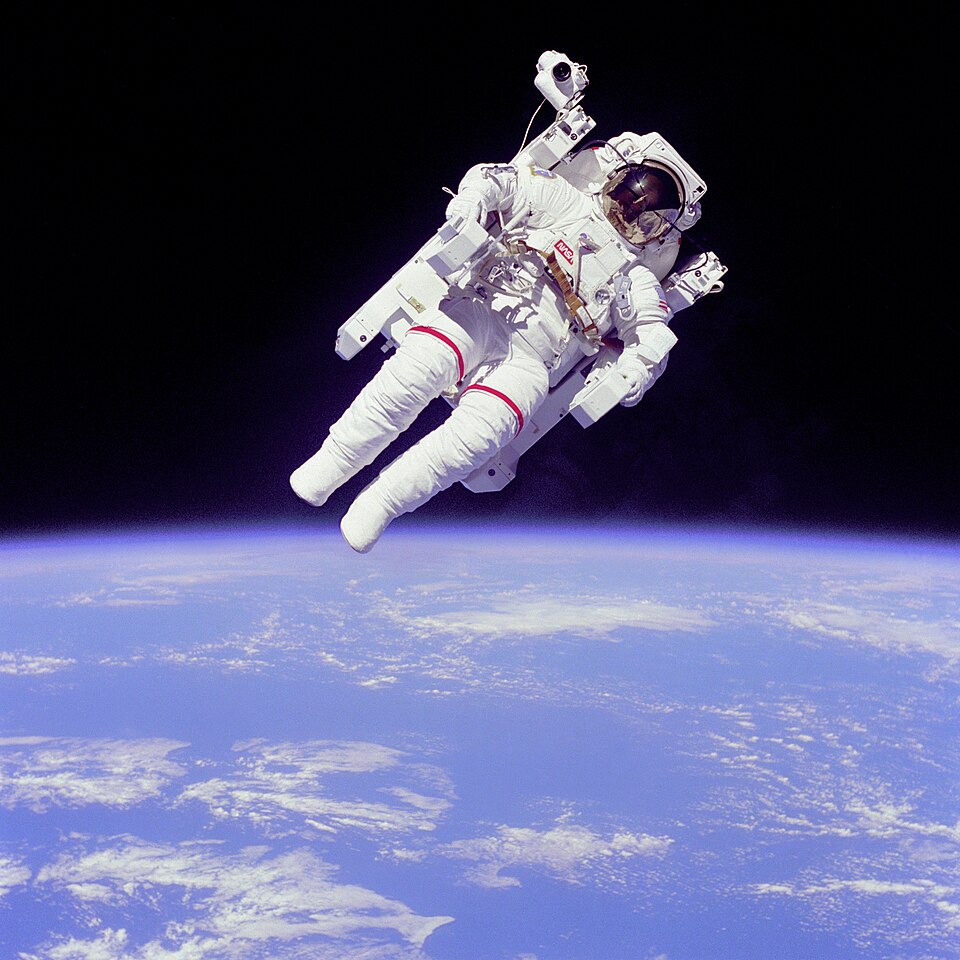
The iconic photograph of Bruce McCandless II (the first person to carry an untethered spaceflight) floating about in Space led John McCain to say: “The iconic photo of Bruce soaring effortlessly in space has inspired generations of Americans to believe that there is no limit to the human potential.”
Who was the first to walk on the Moon?
Neil Armstrong, the first person to the moon said, “That’s one small step for a man, one giant leap for humanity.” However, Neil wanted to say “That’s one small step for ‘a’ man”. NASA puts all his words at once:
“Houston, Tranquility Base here, the Eagle has landed.” “That’s one small step for [a] man, one giant leap for mankind.” “Magnificent desolation.”
A crater on the Moon that has been named “Armstrong” in Neil’s honor.