Ingenuity, a tiny helicopter with a mass of 1.8 kg (about 4 lbs) — weighing just 680 grams under Mars’s lighter gravity — made it to the surface of Mars, not only survived the frigidness of -85 degrees and the violent dust on the Martian surface, it fared surprisingly well on the planet that is 297 million kilometers away. It is a given that this helicopter isn’t as big as the Airbus H125 that landed at the top of Everest, nor is it the case that its pilots need to don helmets. It is something that is off-the-shelf parts such as batteries from a cordless drill and bits from an Android smartphone.
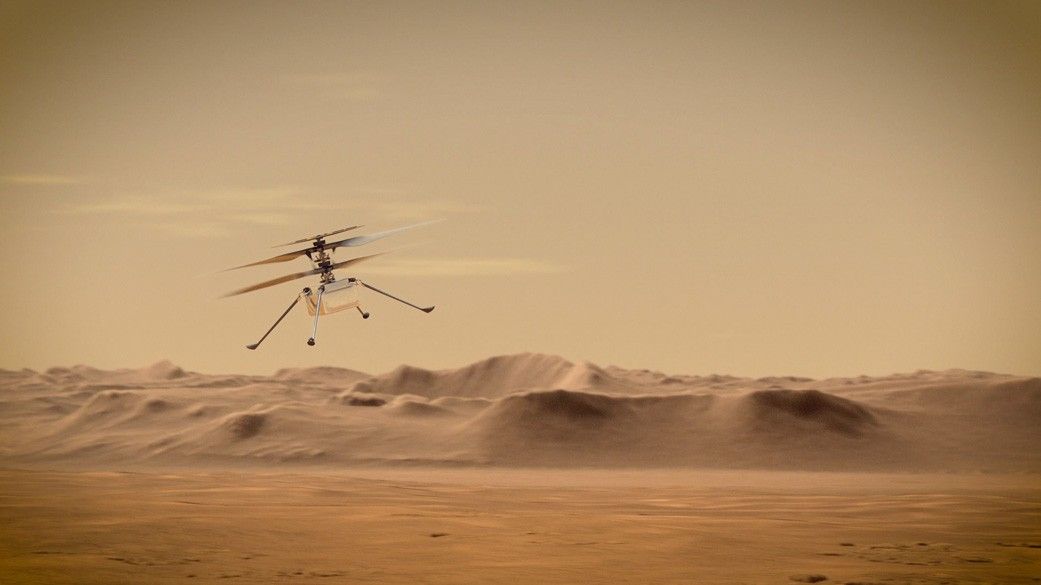
There are other astonishing facts about it though- it was designed for a 30-day mission but was deployed on its mission to Mars for more than a thousand days. Initially, Kenneth Farley, the project scientist of the Mars 2020 Perseverance mission was even sceptic (to downright dismissive) about this chopper, and was quoted to have said:
” I’ve personally been opposed to it… Spending 30 days working on a technology demonstration does not further the goals directly from the science point of view. In short, they thought it was a waste of time.”

Ingenuity isn’t the most expensive helicopter either
The highest-flying helicopter to date, Ingenuity, isn’t the most expensive helicopter either. While the CH-53K King Sea Stallion helicopter once had a unit price of $130 million, Ingenuity cost a mere 80 million – a figure which is less than the budget of the movie The Martian.
Ingenuity did not fly to Mars though.
Perseverance, which is a car-sized Mars rover designed to explore the Martian surface, landed on the Red Planet on February 18th, 2021. Attached to Perseverance was Ingenuity, which was affectionately known as Ginny by some scientists in NASA. Ingenuity’s initial mission was rather straightforward: “To demonstrate that the flight on mars was possible”.
However, there were scientific challenges that need to be dealt with:
- The atmosphere on the Martian surface was merely 1% of that on the Earth
- This necessitated ultra-light blades that could make over 2,400 rotations per minute to generate enough lift. Even NASA claimed that helicopters on the Earth average a rate of 400-500 revolutions per minute.
57 Martian days after rigorously checking Ingenuity’s systems, running up the engine, and testing navigation, its blades spun and took off on the Martian surface, 120 years after the Wright brothers on Earth. In a month’s time, Ingenuity completed five flights. The 56 million kilometers distance between the Earth and Mars also means that there’s at least a six-minute round trip communications time delay. Ingenuity’s maximum flight time was mere two minutes. All the time of the flight, the scientists didn’t really have a real-time update of her flight.
However, more expectations followed and Ingenuity’s mission goals were extended
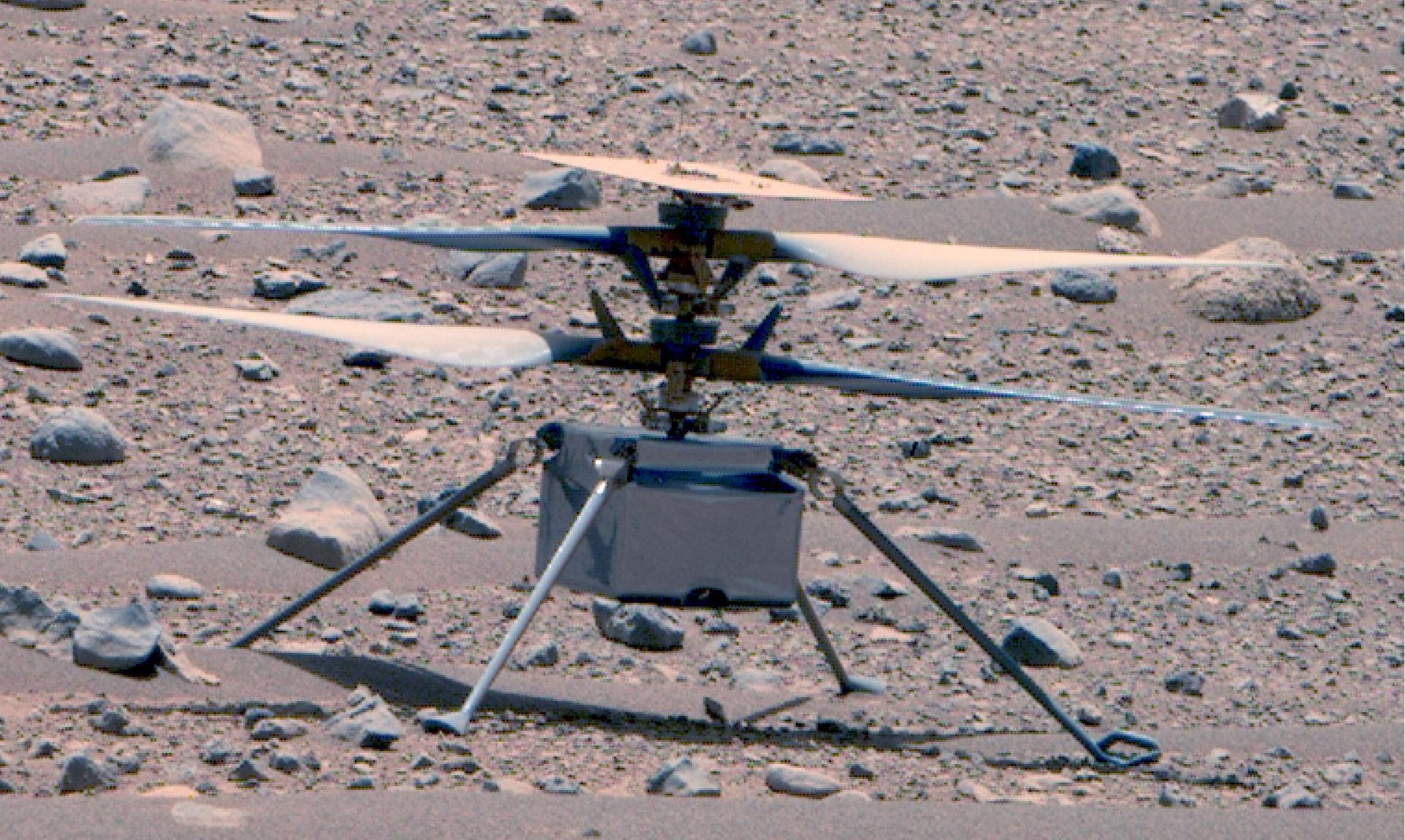
After Ingenuity’s success, NASA wanted Ingenuity to embark on a new mission: to assist the rover Perseverance in the search for evidence of ancient life on Mars. However, new mission capabilities also beckoned new problems. By the time Ingenuity had completed its initial mission, all of its flights had been carefully planned: all flights had started from an area selected and had been analyzed by both satellites and the Perseverance Rover itself. All the flights had been simulated thousands of times and had also been carried out in the wind tunnel of the Jet Propulsion laboratory. But Ingenuity had been assigned to unchartered waters.
Ingenuity’s operations were fairly simple: a pilot on JPL would specify a route and off it would fly. However, JPL first needed to identify the location of this helicopter. Ordinarily, GPS would have the done the trick but the fact that there are only seven satellites around Mars (instead of the 24 satellites on Earth that support full coverage), Ingenuity couldn’t use this method.
One could identify Ingenuity’s location by the use of its cameras: it had a forward-facing 13 megapixel camera, and another that is pointed to the ground that took takes 30 black and white images per second. Computers would then analyze the images taken and identify features on the surface, giving scientists an idea where Ingenuity was located.
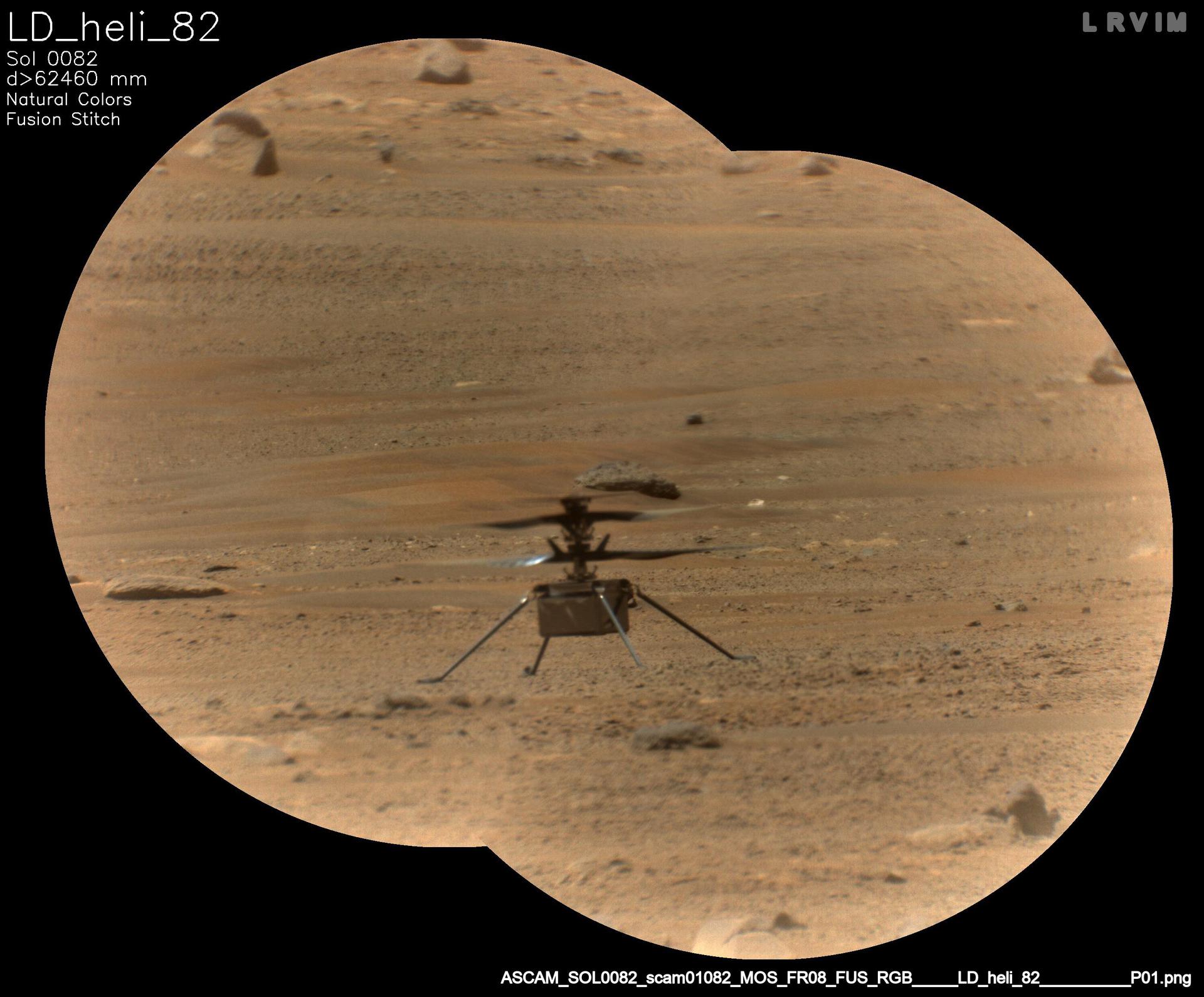
Image:NASA
However, one has to note that this method isn’t 100% reliable.
Wobbling 54 seconds into flight
54 seconds into Ingenuity’s sixth flight (the first in unchartered territory), it started to wobble wildly, tilting 20 degrees at a time, blaring emergency alarms. However, Ingenuity detected the problem and was able to make an emergency landing. Unlike the Earth where one might need a heliport to land, the Martian surface is devoid of designated landing sports.
JPL discovered the error, corrected it, and Ingenuity was able to continue flying a dozen times. However, another problem was discovered on the 19th flight, as a dust storm brewing near the Jezero crater in Mars. This led to a cancelation of the flight. Winds gusted up to 20 meters per second and the storm lasted almost a week. While the storm wasn’t ble to snuff Ingenuity, it led to two problems:
- Dust clothed Ingenuity’s solar panels, thereby reducing power by 18%.
- It clogged the mechanical components.
The solution to the first of these problems was to adjust flight durations, while to get around the second problem, scientists had to wiggle the servos until being de-clogged.
Problems faced by Ingenuity on Mars were unlike the ones faced by any chopper on the Earth
A fraction of the atmosphere present on the Earth means that Mars has a major heat retention problem. If a human being were upright on Mars’ equator, one would measure a temperature of 23°C on the feet, and 0°C on the head. And this is during the warmest time of the day. Temperature gradients during various times of the day are worse: there are highs of around 27°C during the day and lows of -133°C at night.
Such big temperature swings cause expansion and contraction of Ingenuity’s key electrical components. Also, the insides of the batteries of Ingenuity has a liquid electrolyte solution, which might freeze and lead to Ingenuity stopping to work completely. To counter this, all such compenents (that are sensitive the cold) are kept inside a warm box equipped with resistance heaters that run during the night.
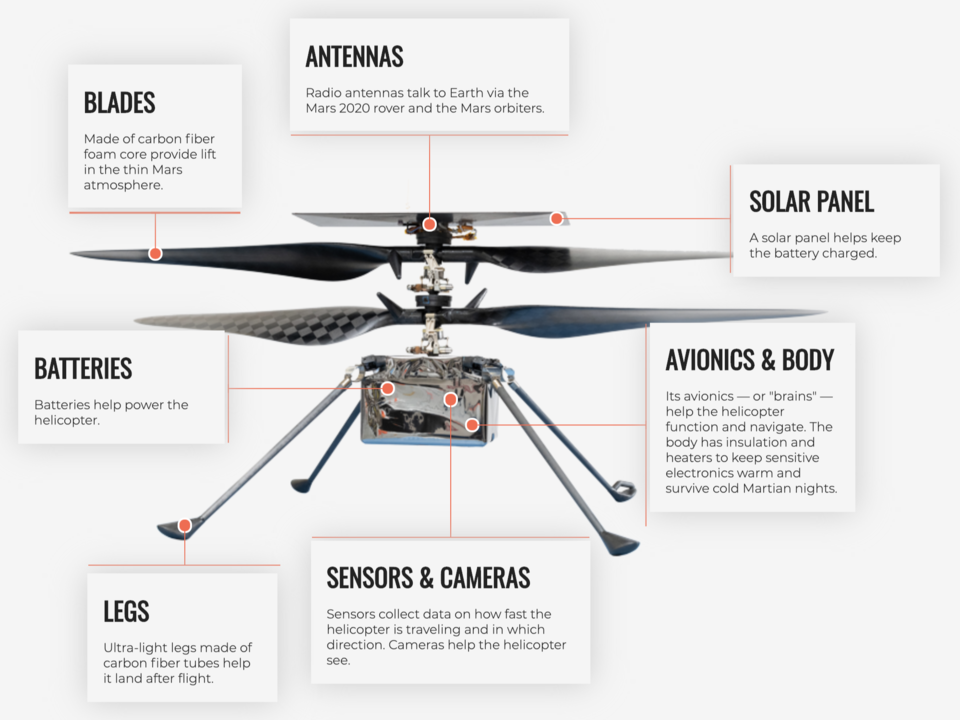
Photo: NASA | Wikimedia Commons
You might spend 25 or 30% of your battery flying and the other 60 to 75% is all just staying warm at night. The problem is, the colder it gets, the harder the heaters have to work. And if they can’t keep up, and the batteries cool too much, they become less efficient. So they supply even less power to the heaters. Performance can continue to degrade in a vicious death spiral.
You would find Ingenuity’s parts in an ordinary phone
One of the more integral parts of the Ingenuity was its inclinometer (accelerometers that allow us to tell the initial attitude of the vehicle in roll and pitch) – something that allowed scientists to know its physical orientation in 3D space before flight. It is the same part that is essential for getting the right heading.
Another major part of Ingenuity is its processor. One might be stumped to know that Ingenuity’s processor is the same as the one used in a Samsung Galaxy S5. Some of its sensors are from a Google Pixel 3. The inertial measurement unit, or IMU of Ingenuity is the same as the one used in Google Pixel 3. However, the IMU, just like the off-the-shelf parts of Ingenuity, were more vulnerable to cosmic rays than they’d be on the earth as the Red Planet has a flimsier atmosphere.
Over the next 41 flights of Ingenuity, it helped capture images of the craters where Perseverance couldn’t make it to. Some of the other daring feats achieved by Ingenuity include:
- Conducting aerodynamic tests
- Flying higher (from an initial goal of a 10-meter altitude, they go up to 24 meters)
- Flying at 2 meters per second to as much as 10 meters per second.
- A voyage to Nuretva Vallis, a river delta in Jezero Crater
Ingenuity finally gave up after the 71st flight
10 seconds (into its 71st flight) after taking to the Martian skies, Ingenuity had to make an emergency landing. This was due to the fact that after flying over the dunes on the Martian surface that day, there just weren’t enough rocks or landmarks for Ingenuity’s camera to identify its location. In the absence of those references, it quickly lost track of her position.
Scientists checked Ingenuity for structural damage but found none. They attempted another flight – a relatively simple one where it would fly straight up to scan the surroundings and then come straight back down. On its way back down, it encountered the same problems it did on Flight 71, albeit this time the problems couldn’t be solved. Perseverance captured the image of Ingenuity’s crash site.
Conducting the first air-crash investigation in a planet outside the Earth
Ingenuity’s blades were scattered around the crash site. When a helicopter’s blades crash on the ground, they create a spray of sorts. However, at the crash site of Ingenuity, no blade strike spots were detected. Ingenuity’s first pilot, Håvard Grip of JPL shared his perspective on the uniqueness of conducting an air crash investigation on a planet so far out:
“When running an accident investigation from 100 million miles away, you don’t have any black boxes or eyewitnesses..While multiple scenarios are viable with the available data, we have one we believe is most likely: Lack of surface texture gave the navigation system too little information to work with.”
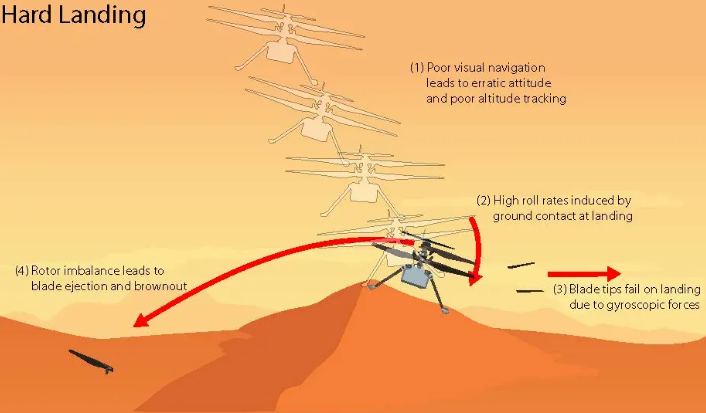
NASA’s investigation into Ingenuity’s crash, supported by photographs taken after its 72nd flight, found that navigation errors caused the helicopter to reach excessive horizontal speeds during touchdown. The most likely scenario was that Ingenuity struck the sloped surface of a sand ripple at an angle, creating a sudden pitch and roll motion.
The impact transmitted force through the helicopter and generated a precession torque that placed excessive loads on the rapidly spinning rotor blades. All four blades snapped at their weakest point, roughly one-third of the distance from the tip, where the reinforcement tapered down. The damaged rotor system then produced severe vibrations, eventually tearing the remainder of one blade from its root and creating an excessive power demand that caused Ingenuity to lose communications.
Despite the crash, several major components remained intact, including the landing gear, avionics, servos and swash plates.
Does Ingenuity have a successor?
The first thing they’re changing on The next generation of Mars helicopter is called Chopper. The first change they are making on this chopper is the rotor blades. Chopper’s blades look fairly similar to those of ingenuity. However, there are a couple of key differences:
- Blades have been reinforced so that they are able to withstand the torques caused by hard landings.
- There will be six rotors instead of two, meaning that it will be able to carry a scientific payload of its own.
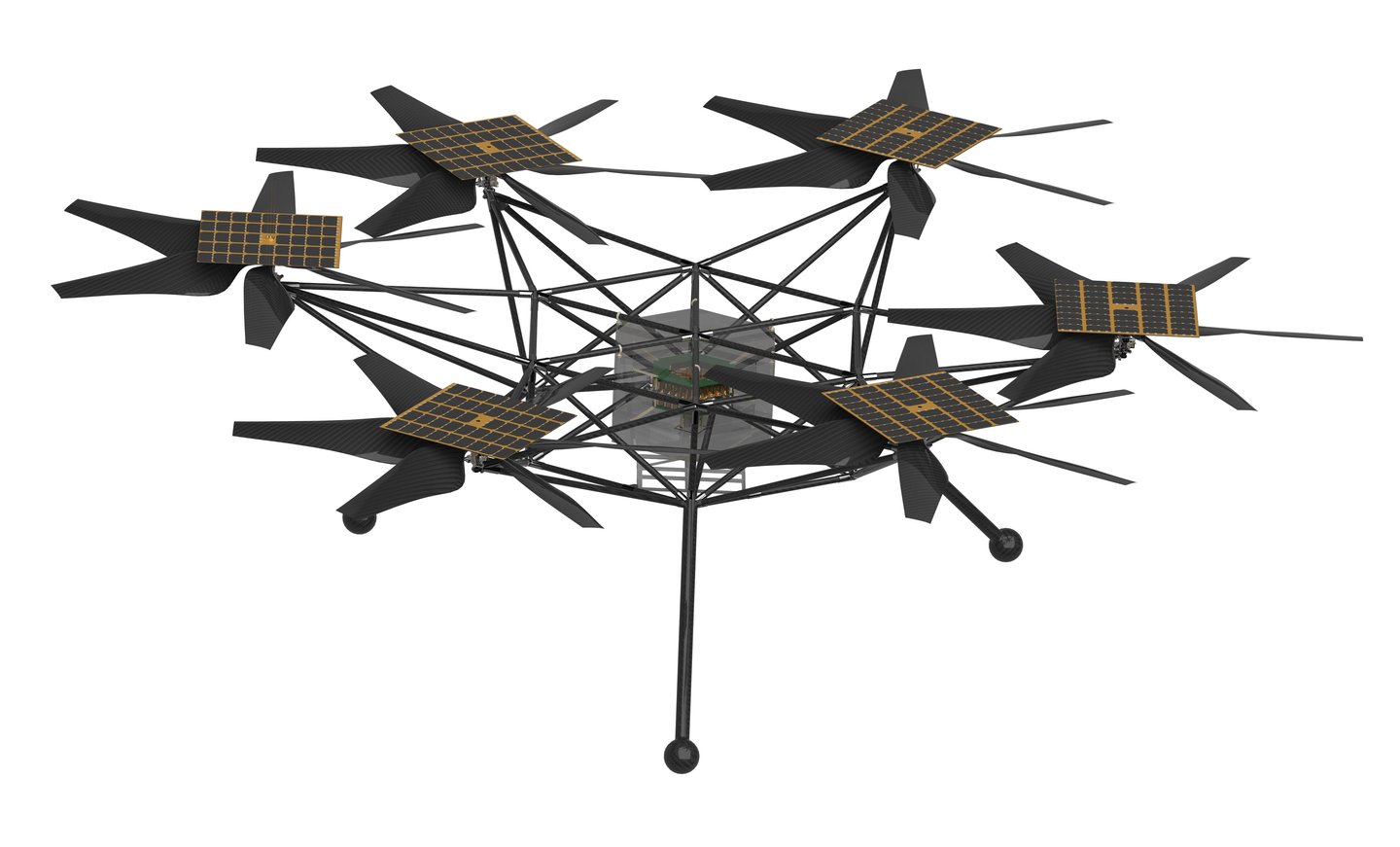
NASA has already developed a very lightweight radio that can communicate directly to orbit. Chopper can carry about five kilograms of science payload and bring it anywhere on the planet on Mars. It can also fly three kilometers per solar day on Mars in a matter of minutes. Ingenuity still sits on the surface of Mars. On its underside is a tiny scrap, one square centimeter of muslin fabric that was taken from the lower left wing of the first airplane, the Wright Flyer.
Even the carcasses of Ingenuity has its own value
Although Ingenuity’s flying days are over, the helicopter continues to contribute to scientific research from its resting place on Mars. It now serves as a stationary weather station, collecting daily temperature data and capturing images of its surroundings.
Teddy Tzanetos, Ingenuity’s project manager, believes the helicopter’s achievements could help pave the way for future fleets of aircraft operating on Mars and potentially other worlds. Its 72 successful flights demonstrated that powered flight is possible in the thin Martian atmosphere and provided valuable experience that could shape future aerial exploration missions. NASA says Ingenuity’s legacy is expected to influence space exploration for decades to come.