When Charles Bukowski, in one of his poems, wrote:
“I see a bright
portion
under the overhead lightthat shades into
darkness
and then into darker
darkness
and I can’t see beyond that.”
He wasn’t really writing about a black hole. But when you see, not simply “the overhead light” but a sphere of an all-encompassing light, leak itself out into an abyss – as is the case in the picture below – one can correlate that perhaps he was writing about one.
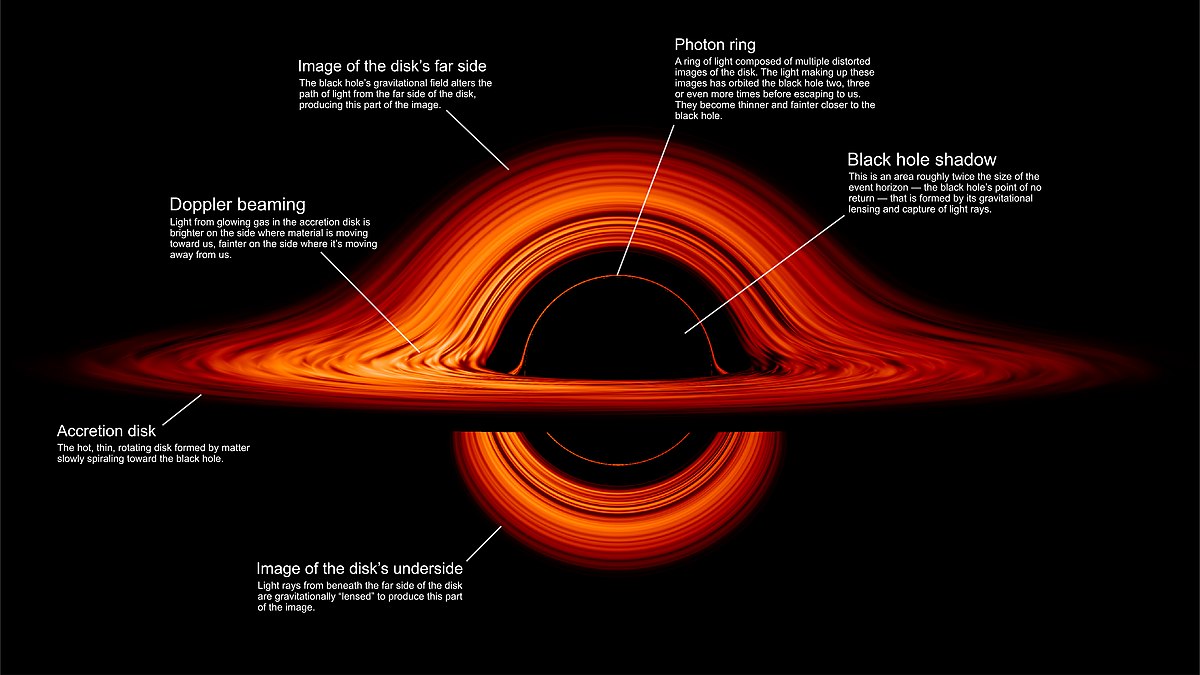

Black holes have been dubbed to be amongst the most destructive objects in the universe – at least as of now. The central singularity of a black hole tends to consume it all, irrespective of being an asteroid, planet, or star. All objects are at a risk of being torn apart by its extreme gravitational field. If an object approaches it, and crosses what is known its “Event Horizon”, it’ll disappear, forever into the hunger of a Black Hole. One might call it a particular hunger that (instead of satiating) only grows with the eating. But can this guzzler of stars and galaxies be destroyed?
There’s no rock we throw that can damage the black hole
No rock we throw at a black hole would hurt it. Anything hurled up to the singularity of the black hole will never re-emerge, add to the black hole’s mass, expand its radius in the process, and make it more potent. Neither would hurling another black hole at it work, either. Two black holes would simply merge, creating a larger black hole, and release gravitational waves in the process.
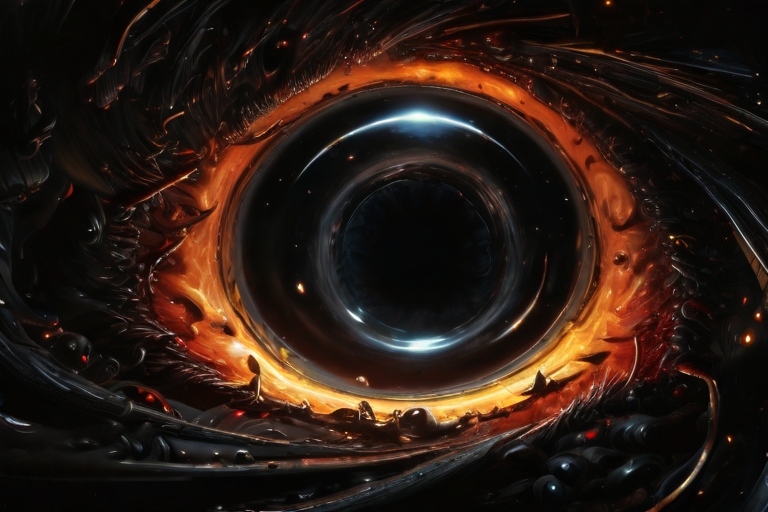
If one were to take the words (perhaps science?) of Sir Roger Penrose, the universe will, in the days to come, consist entirely of black holes. Yes, it will be a very distant future when everything will have coalesced into a black hole (everything would be gorged up by black holes, and all black holes would have been merged). But there’s a way to destroy it. Technically, there’s specific “way”, nor is there a destruction (like the desecration of aircraft you saw in the Russia-Ukraine War) in the general sense of the word. The “way” to destroy it is to “wait”, and the destruction will have come after the inevitability of the “evaporation,” of Black Holes.
Hawking Radiation – the destroyer of Black Holes as we know it
Stephen Hawking, who in the BBC Reith Lectures, famously said, “In space no one can hear you scream; and in a black hole, no one can see you disappear“, theorized a process that could lead a black hole to gradually lose mass. This process, which is known as Hawking radiation, is based on what physicists call “quantum fluctuations of the vacuum“.
According to the laws of quantum mechanics, a given point in spacetime “fluctuates between multiple possible energy states”. These fluctuations are driven by the continuous creation and destruction of virtual particle pairs
[Note: A virtual particle pair consists of a particle and its oppositely charged antiparticle]
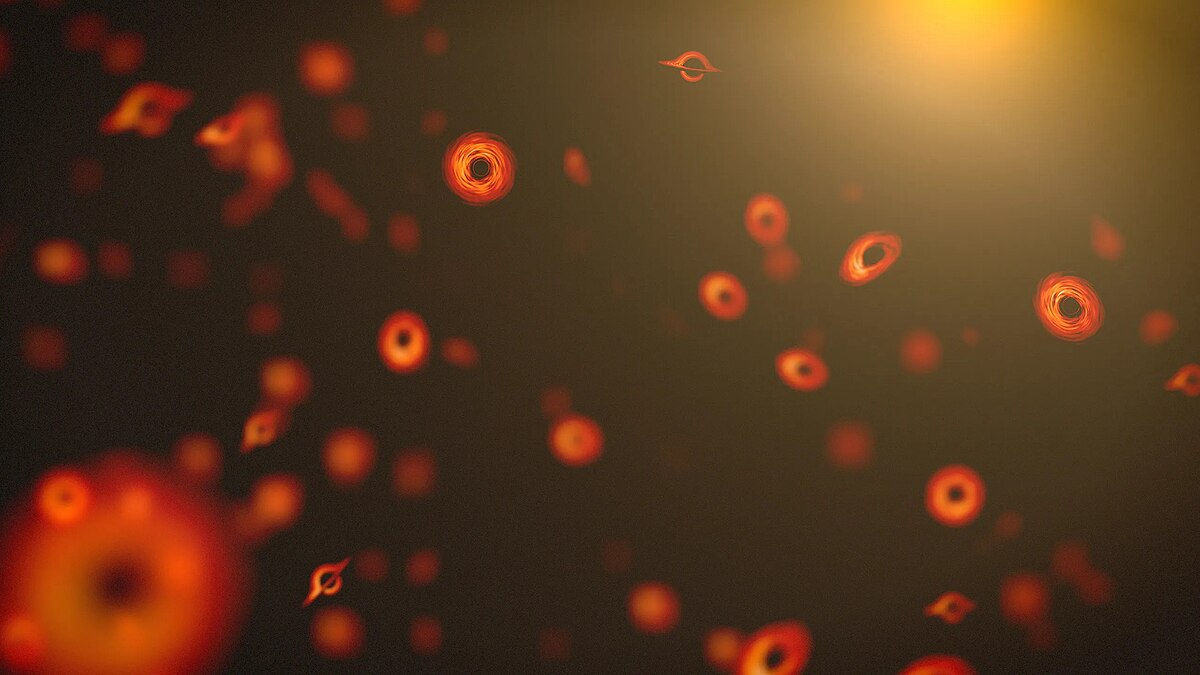
Photo: NASA’s Goddard Space Flight Center | Wikimedia Commons
.jpg)
In ordinary circumstances (or ordinary spacetime), the particle and antiparticle collide and annihilate each other. But the pair behaves quite differently while on the edge of a black hole’s event horizon. If they’re positioned just right, one of the particles could escape the black hole’s pull while its counterpart falls in. It would then annihilate another oppositely charged particle within the event horizon of the black hole, reducing the black hole’s mass.
Anyone outside the event horizon, however, would perceive that the black hole had emitted the escaped particle. Of course, a black hole ingesting the surrounding matter and energy would mean that it would put on weight and it would be a lot meatier despite radiating. Nonetheless, a black hole will evaporate particle by particle, at an excruciatingly slow rate, Cornell University reported.
The Hawking radiation itself would consist of fiercely energetic particles, antiparticles, and gamma rays. Such radiation is invisible to the human eye, so optically the evaporating black hole might look like a dud. However, it is also possible that the Hawking radiation, rather than emerging directly, might power a hadronic fireball that would degrade the radiation into particles and gamma rays of less extreme energy, possibly making the evaporating black hole visible to the eye. Whatever the case, you would not want to go near an evaporating mini black hole, which would be a source of lethal gamma rays and energetic particles, even if it didn’t look like much visually.

Photo: ESO/L. Calçada/M.Kornmesser | Wikimedia Commons
.jpg)
A branch of physics, called black hole thermodynamics, gives us the answer to how quickly a black hole radiates matter.
What thermodynamics reveals about when a Black Hole is destroyed
Much in the way energy emission by any matter (such as a star) helps measure its temperature, Black hole thermodynamics suggests that we can similarly define the “temperature” of a black hole. The theory also claims that there is an inverse relationship between the mass of a black hole, and its temperature.
The universe’s largest black holes would give off temperatures that are, at least to all practical purposes zero – approximately of the order of 10 to the -17th power Kelvin. A Balck Hole having m mass of the asteroid Vesta i.e., approximately 2.6 × 10²⁰ kg, would have a temperature close to 200 degrees Celsius, and therefore, would release significant Hawking Radiation. Logically, it follows that the smaller the Black Hole is the more prominent is its Hawking Radiation, and the quicker it will burn out.
A Black Hole will be destroyed in a time that is way monger than the age of the universe
If we were to envisage a non-accreting black hole that had the same mass as our Sun (approximately 2×1030), it would take 1067 years to fully evaporate. After having shed off all its mass (through Hawking Radiation) and be stripped to 230 metric tons, the Black Hole will only have one more second to live. In that final second, its event horizon becomes increasingly tiny, until finally releasing all of its energy back into the universe. Priyamvada Natarajan, a researcher of Black Holes at Yale University, said that in the final tenth of a second of a black hole’s life, “you will have a huge flash of light and energy…It’s almost like a million nuclear fusion bombs going off in a very tiny region of space.”
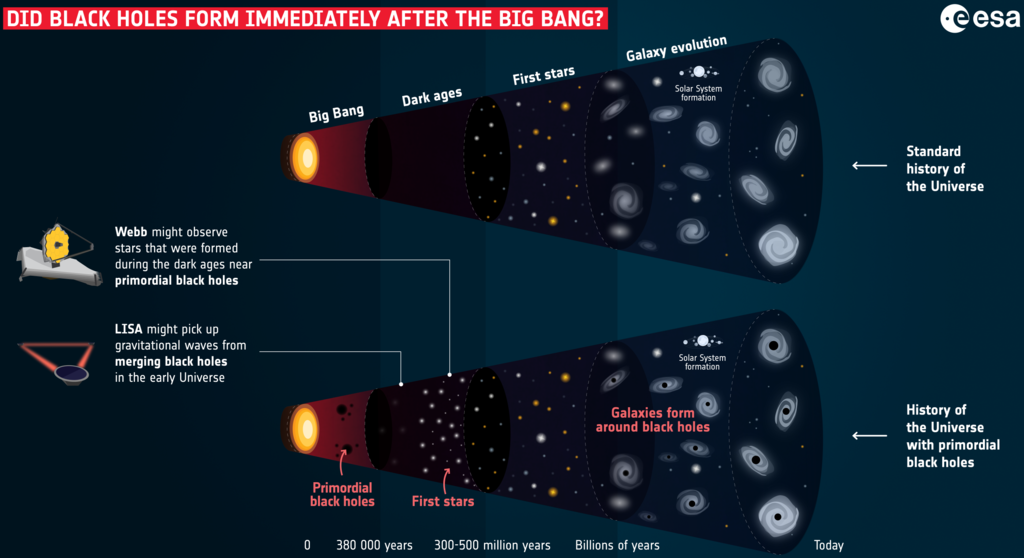

Formation of the universe without (above) and with (below) primordial black holes
Hawking Radiation has never been directly observed, though the scientist (while delivering his Reith Lectures) believed that the observation would have merited him a Nobel Prize. Nonetheless, physicists (cosmologists) theorize that certain gamma ray flashes detected in the sky are actually traces of the last moments of small, primordial black holes formed at the dawn of time.