While the sky might be the limit for the imagination of human beings, mechanical objects, like helicopters, are subject to altitude constraints. A helicopter has landed at the top of Mount Everest. A helicopter has even flown on the surface of the planet Mars. The helicopter eventually crashed, and this prompted the first-ever aircraft accident on a planet other than the Earth. The fact that helicopters often embark on more difficult missions (such as rescue in the mountains and seas) than airplanes is also one reason why helicopters don’t have as good a safety record as planes.
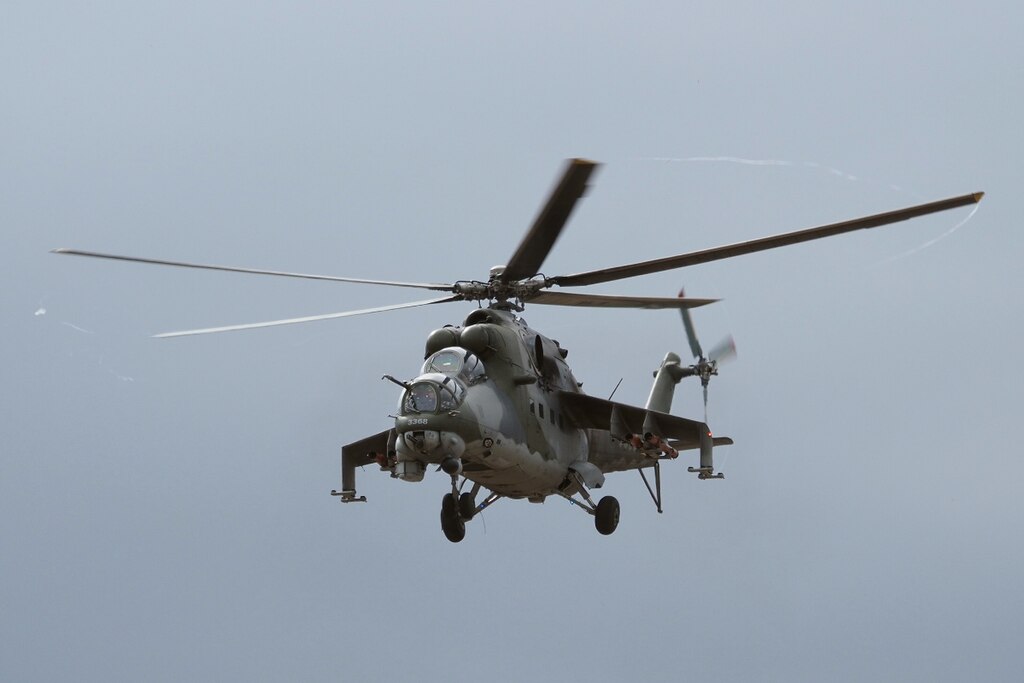
Photo: Boevaya mashina|Wikimedia commons
When a helicopter climbed to an altitude that was almost 10,000 ft more than the height of Mount Everest, it experienced an autorotation (which is defined by Skybrary as “a condition of helicopter flight during which the main rotor of a helicopter is driven only by aerodynamic forces with no power from the engine“). At its highest point, the temperature experienced by the chopper was less than -60 degrees. Therefore, it would be safe to say that how high a helicopter can fly depends on a myriad of factors: the engine power, the aerodynamics involved, the altitude constraints on a helicopter’s performance, the sheer skill of the pilot, among other factors.
The Science behind how high a helicopter can fly
Fixed-wing aircraft generate lift (from its wings) using forward motion. On the other hand, helicopters fly using rotor blades without the chopper being hurled forwards. The same principles are also used by convertiplanes, machines can take-off vertically, hover, and land like a rotorcraft while “flying purely as a fixed-wing aircraft, especially in its higher speed ranges”.
When wings of an airplane are propelled forward (along with the planes they are attached to), they generate lift: a helicopter’s wings generate lift by deflecting air downward. In technical terms, the lift generated by a helicopter is referred to as total rotor thrust (TRT). However there’s a catch: just as the helicopter’s blades are rotating to generate lift, in the absence of any other forces, a helicopter’s body will also try to spin (like the blades). This is where the tail rotor comes into play. The tail rotor produces thrust in a sideways direction, thereby counteracting “the engine’s desire to spin the body“.
The property of the helicopter to be able to ascend vertically makes it indispensable in search and rescue operations in the mountains, surveillance, and transportation to remote locations, such as regions that lie weeks of walk away from the most dangerous airport in the world, the Lukla Airport.

However, air, the medium helicopters push against, becomes thinner with altitude. An attenuated air results in an attenuated ability of the rotors to generate lift. A general rule of thumb has it that the higher a helicopter goes, the harder it has to work to stay aloft. At a certain point, the helicopter’s capacity to generate lift matches the downward force of gravity, and it goes no higher.
Understanding a helicopter’s maximum operating altitude
In aviation, the maximum height any aircraft, such as a helicopter, can reach is often expressed in two ways: service ceiling and absolute ceiling. According to the aviation dictionary compiled by Ernest G. Gentle, a service ceiling is defined as “ The altitude at which the maximum rate of climb has a defined value approximating to the lowest practicable for a service operation”
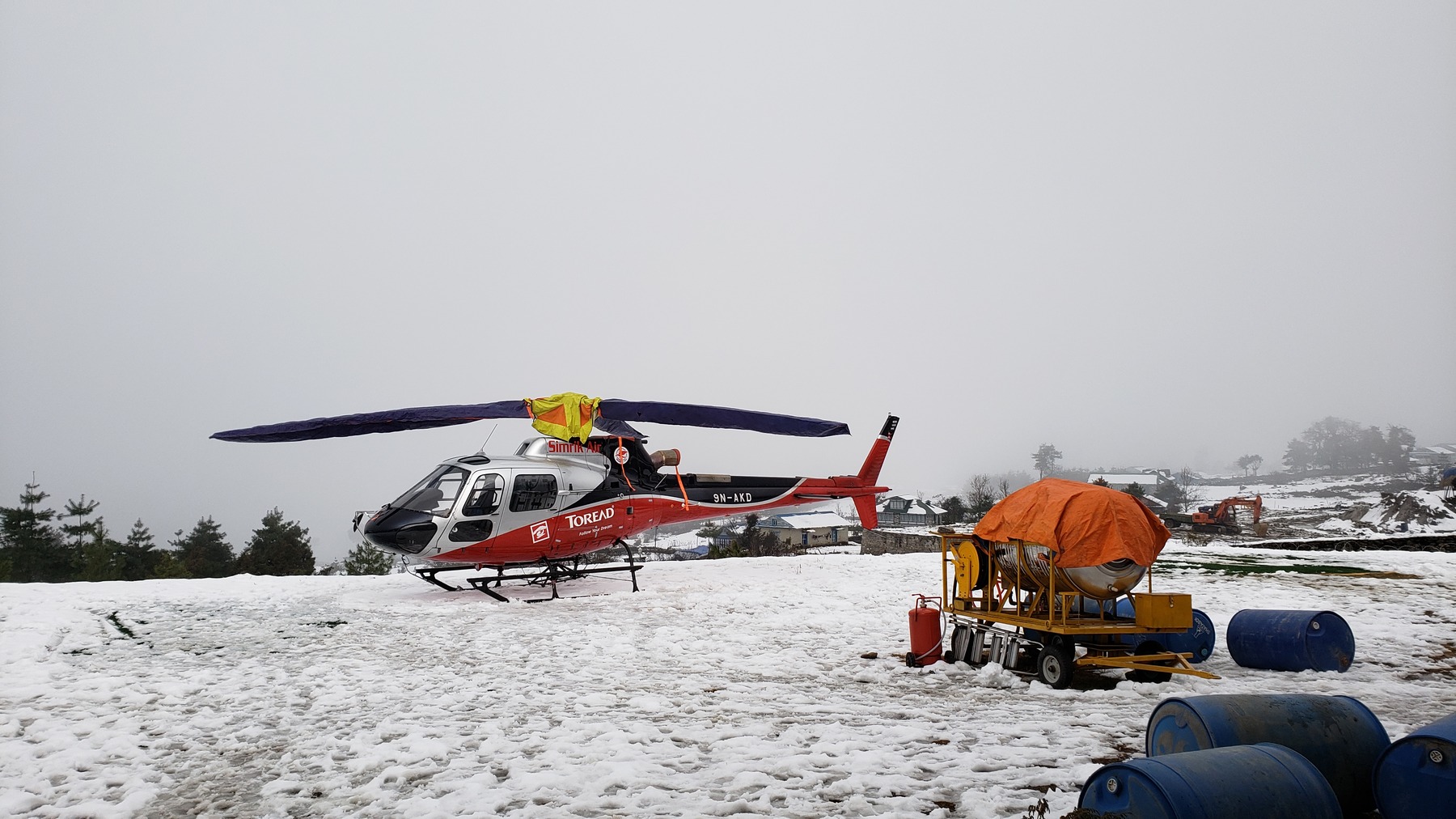
Photo: Surendra Paudel, a helicopter pilot in Simrik Air | aviospace.org
In more general terms, the service ceiling is the altitude at which the helicopter can still climb at a rate of around 100 feet per minute. Aerocorner.com defined it as “the altitude at which its climb rate becomes so slow that it has effectively ‘topped out’.”.
The absolute ceiling, on the other hand, is defined as : “The maximum height above sea level at which a given airplane would be able to maintain horizontal flight under standard air conditions.”
Simply put, the altitude ceiling is the theoretical maximum height, the point at which the aircraft can no longer climb.

Photo: Chhutin Sherpa | aviospace.org
For most commercial helicopters, the service ceiling hovers between 10,000 and 15,000 feet (3,000 to 4,500 meters). But some specialized models, built for high-altitude performance, can soar higher. The Eurocopter AS350B3, for example, has been used in rescues on Everest has a maximum operating altitude of 23,000 ft. Let’s compare the service ceiling of some helicopters available in the market:
| Helicopter | Service Ceiling |
| Eurocopter/ Airbus A350B3 | 23,000 ft |
| Aerospatiale LAMA SA-315B | 17,715 ft |
| Mil Mi-26 | 15,100 ft |
| Airbus H160 | 20,000 ft |
| Robinson R66 | 14,000 ft |
While the aforementioned altitudes are modest, the altitudes are nothing compared to a historic helicopter flight in 1972.
In 1972, a helicopter flew 40,820 ft, setting a record for how high a helicopter can fly
On June 21, 1972, French test pilot Jean Boulet took an Aérospatiale SA 315B Lama to an altitude of 40,820 feet (12,442 meters). As the chopper hovered above Istres airfield in France, this record altitude achieved by a helicopter was ratified by Fédération Aéronautique Internationale aka World Air Sports Federation (FAI).

Photo: Chris Lofting | Wikimedia Commons
Boulet was trained as a fighter pilot in the USA and joined the organization that was to later become the Aerospatiale group in 1947. According to FAI, Boulet’s career highlights included “first flights of SE3000, SE3101, Alouette, Frelon and Puma, and he made 8000 hours of helicopter flights in his working life, and 9000 hours flying in total“. Although Boulet died on 13 February 2011, his record has survived his posterity, atleast until now.
But we have to note that during this record-setting flight, his engine failed. During the flight, the Aérospatiale SA 315B Lama’s engine flamed out and Boulet had to execute an autorotation—an unpowered descent using the helicopter’s own momentum to maintain control.
An unrecognized altitude record higher than Boulet’s?
Some publications have it that Frederic North has broken Jean Boulet’s record of the highest altitude achieved on a helicopter. Wrightexperience.com claims that Frédéric North, a French helicopter pilot, reached an altitude of 42,500 feet (or 12,954 meters) on August 23, 2002. The chopper he used for this highest altitude flight was the AS350B2, which flew over Marignane, France. However, this record isn’t recognized by the FAI. What’s interesting is that the B2’s service ceiling is merely 15,000 ft – almost three times smaller than the altitude it purportedly climbed.
The Everest Question: Can a helicopter land at the top of the tallest mountain?
Everest looms at 29,032 feet. This is an altitude which is greater than the maximum operating altitude of all helicopters that have operated in the Everst region.
Despite this, Didier Delsalle, an Airbus test pilot. landed a Eurocopter AS350 B3, on Everest’s summit. This is the highest helicopter landing ever recorded. On 14th May, 2005, he stayed at the top of Everest for just over three minutes before descending, only to find that he couldn’t get hold of the video evidence for the flight. So, Delsalle landed on the top of Everest the next day, again*.
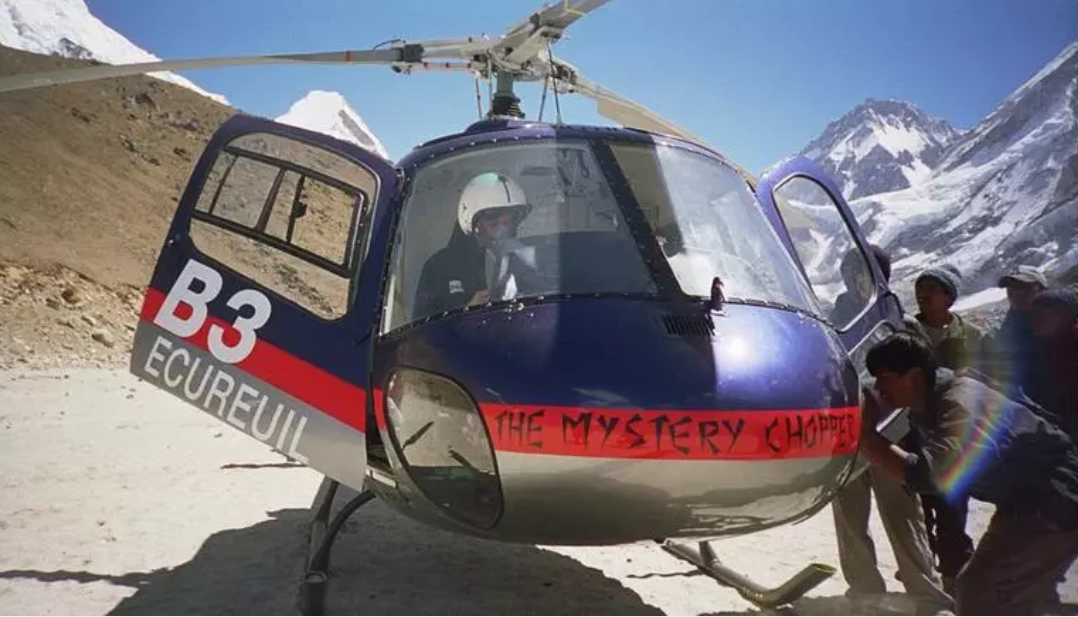
Photo: Airbus
However, one has to note that Didier got rid of all the non-essentials in the aircraft such as the unnecessary seats to make the aircraft as light as possible. He also remarked (in an interview with Vertical Magazine) that if you ever hoped to replicate his work, you need to “keep your brain in quite good shape to fly a helicopter in these kinds of conditions”.
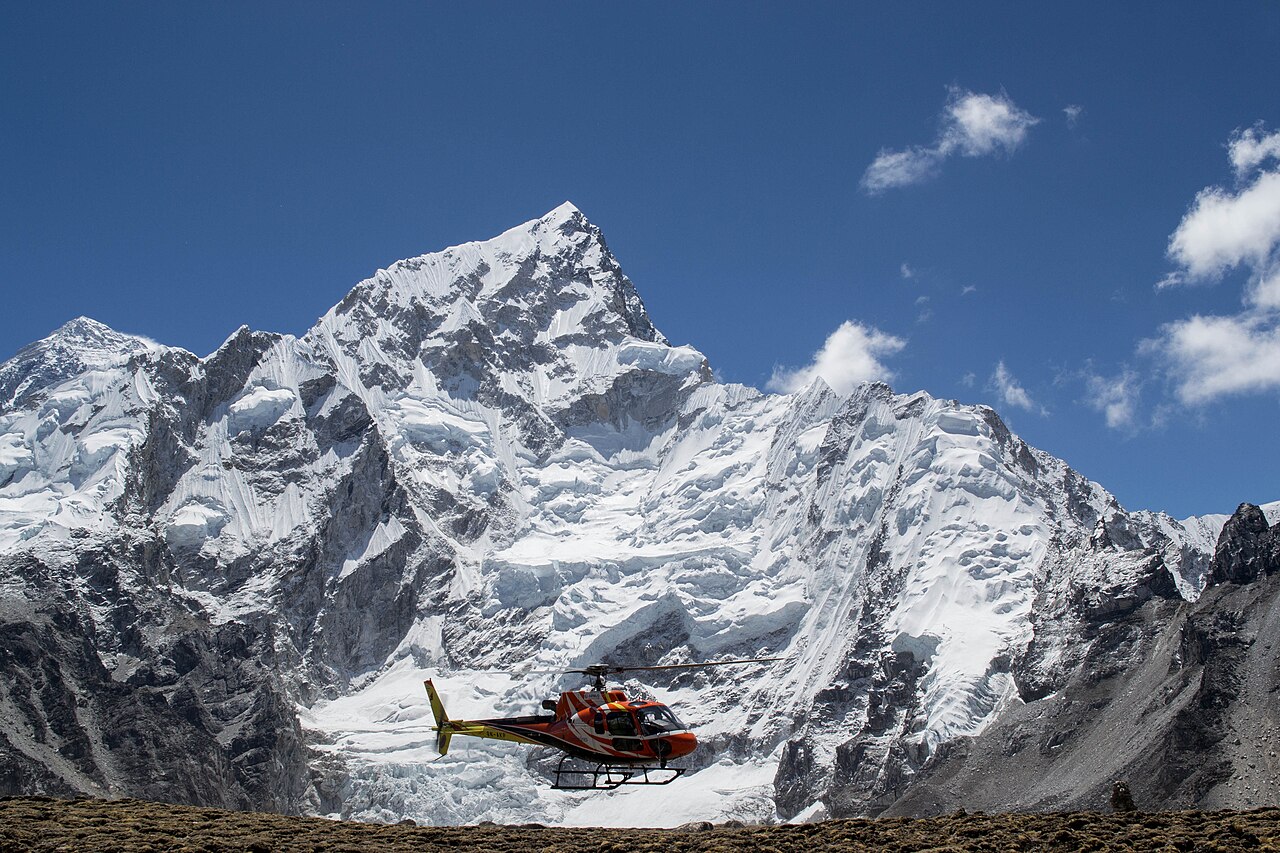
Didier Delsalle chose to fly to the top of Everest to show how flexible a chopper’s altitude range can be. This was also a great marketing strategy by Airbus, which wanted the AS350 to be used in mountainous regions. The helicopter operators, which operate in the Everest region, all use the AS350 for their operations to and from the Lukla region.
In addition to the record for the highest landing, Delsalle has also various other records:
| Record | Record time | Date |
| Record of highest take-off, 8,848 m (29,030 ft) | N/A | 14th May, 2005 |
| Speed record of ascension to 3,000 m (9,843 ft) | 2 min 21 sec, | April 14, 2005 |
| Speed record of ascension to 6,000 m (19,690 ft), | 5 min 06 sec | April 14, 2005 |
| Speed record of ascension to 9,000 m (29,530 ft) | 9 min 26 sec | April 14, 2005 |
*Delsalle was eventually able to retrieve the recordings of his maiden flight to the top of Mount Everest.
A few engineering constraints that limit a helicopter’s altitude
The fact that some helicopters reach 40,000 feet while others struggle past 10,000 boils down to engineering. High-altitude helicopters are designed with powerful engines, optimized rotor systems, and lightweight frames. The SA 315B Lama, for instance, combined a lightweight Alouette II airframe with the powerful Turbomeca Artouste engine, making it ideal for high-altitude missions. The highest recue ever conducted on the mountains took place at an altitude of 7,800 meters. An Italian helicopter pilot Captain Maurizio commented on the mission:
“7,000m is the upper limit of a helicopter’s certification…(The altitude )changes everything. It changes the way we fly, it changes the way the machine flies, it changes all the instruments – there are a lot of things to think about.”
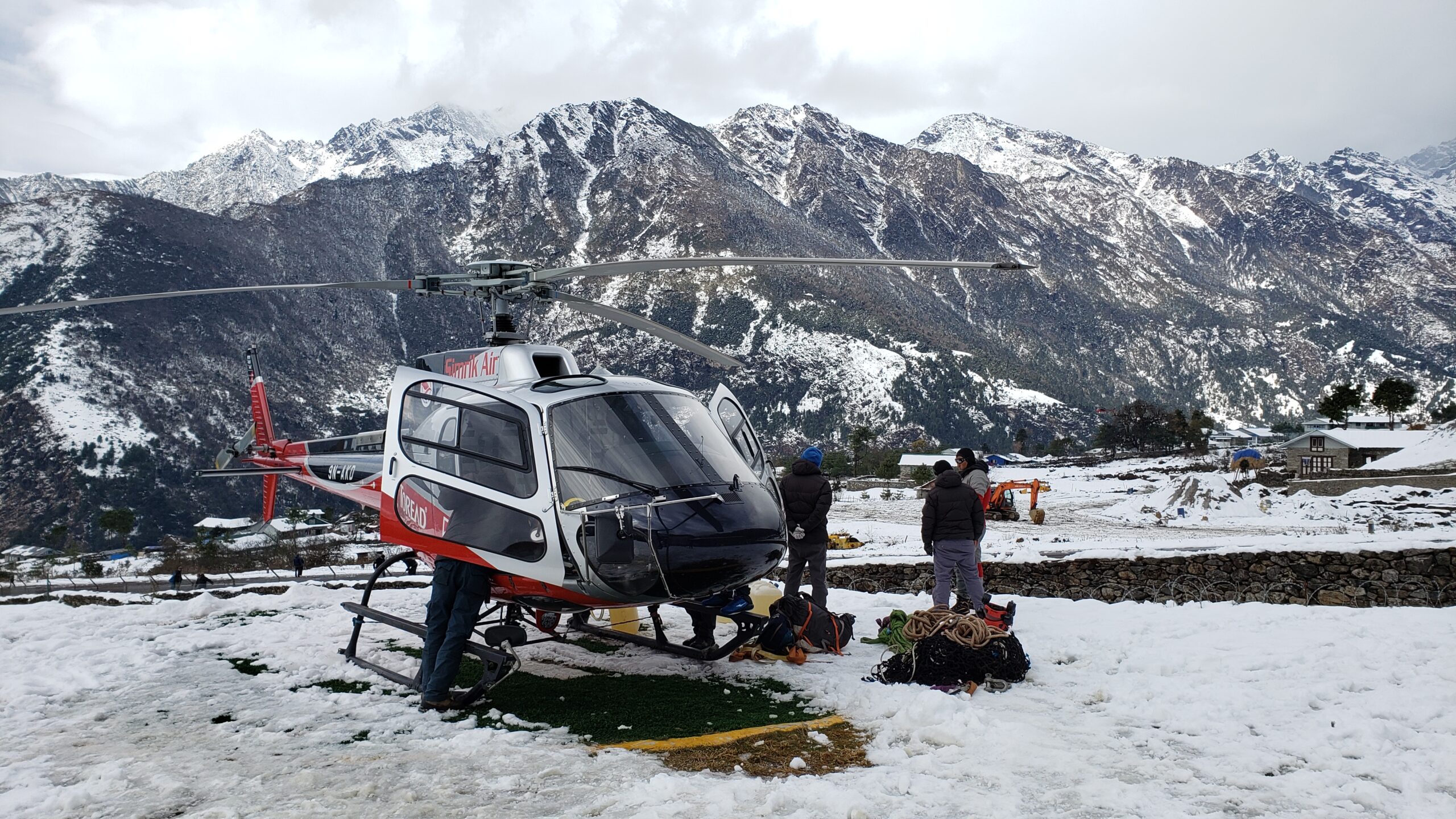
Here are the details of the highest rescue performed by a helicopter
| Rescue Pilot | Maurizio Follini |
| Helicopter | Eurocopter A-Star AS350 B3 |
| Date | May 21, 2013 |
| Rescuee | Sudarshan Gautam (a double amputee) |
| Altitude of Rescue: | 7,800 meters (25,590 feet) on Mount Everest |
However, a Nepali rescue pilot, Surendra Paudel, said that he doesn’t take his AS350 above an altitude of 7,000 meters, not even for rescue. After all, the helicopter isn’t certified to fly above this altitude. He says flirting with the theoretical limits of helicopters isn’t something one should do, especially in the Himalayas, where the unpredictability of the weather makes helicopter operations difficult. While performing rescue missions, Surenda gets rid of the non-essentials of the helicopter such as the extra seats to make the chopper lighter- a technique that was deployed by Delsalle when he landed his AS350B3 at the top of Everest.
Engine performance at altitude is another limiting factor. Most helicopters use turboshaft engines, which rely on air intake to function. As altitude increases, the air supply diminishes, reducing power output. Some helicopters compensate with larger compressors, while others use supercharged engines to maintain performance.
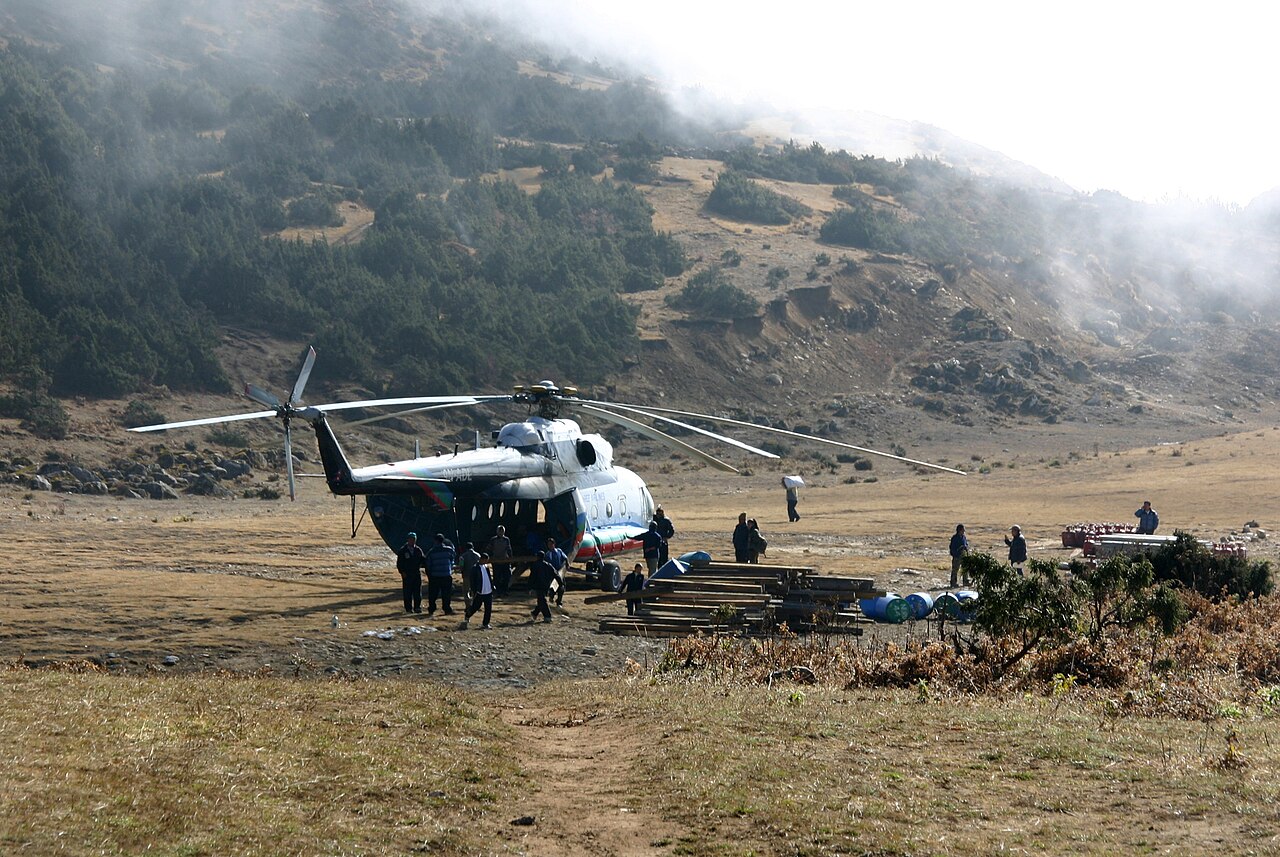
Photo: Gerd Eichmann | Wikimedia Commons
There are other types machines known as convertiplanes, which historically have had a much higher operating altitude than helicopters. Here are a few examples:
| Aircraft Type | Service Ceiling |
| Bell XV-15 VTOL | 29,035ft (8849.868 m) [the same as the height of Everest] |
| Bell Boeing V-22 Osprey | 25,000 ft (7620 meters) [comparable to the altitude of the highest recue performed in the Everest region] |
| Boeing MQ-18 Hummingbird (A160) | 26,247ft(8,000.085) |
| Lockheed AH-56 Cheyenne** | 25,997ft(7, 923.885) |
**Lockheed AH-56 Cheyenne is the sole exception on this list, as it wasn’t a convertiplane but a chopper that was deployed in the Vietnam War. The project a few years after this helicopter took to the skies.
The limit of a human body also limits how high a helicopter can fly
A machine may be capable of flying to Everest, or landing above it. But its pilot must be, too. The human body is not built for high altitude. Above 10,000 feet, hypoxia, a medical condition onset by the lack of oxygen, sets in. This can impair judgment, reflexes, and decision-making. At extreme altitudes, pilots require supplemental oxygen, pressurized cabins, or both. Pilots who fly even fixed-wing aircraft to STOL operations prepare physically for their journeys. Nepali pilot Captain Sanjib Kunwar, who flies to Lukla on a regular basis with Sita Air maintains that his physical fitness is of paramount importance for his duties to and from the most dangerous airport in the world- Lukla.
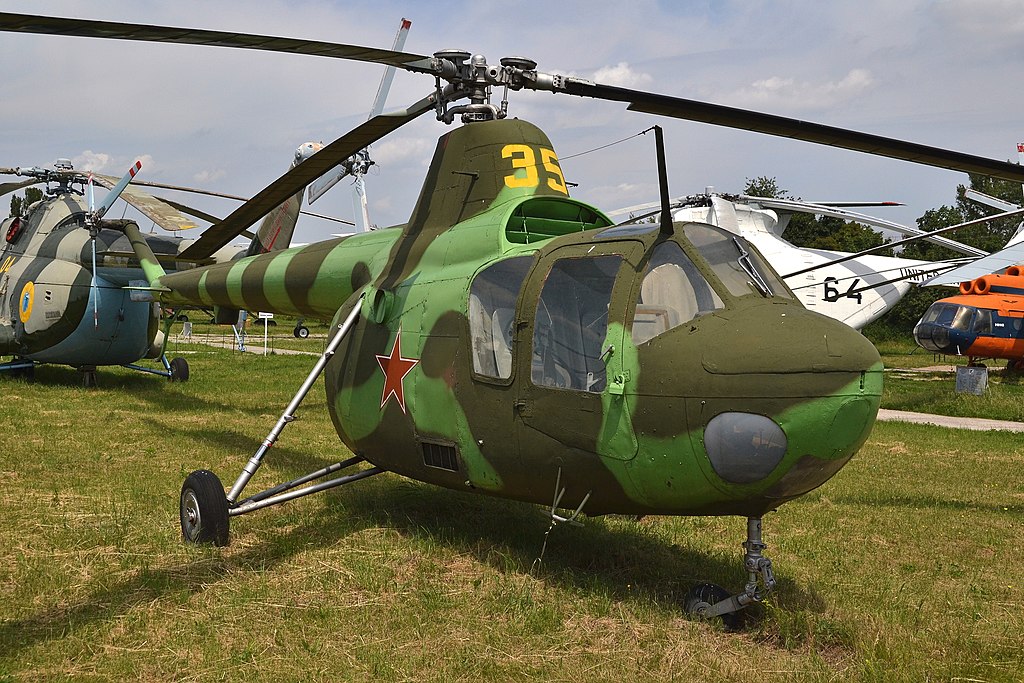
Photo: Mosbatho|Wikimedia commons
When flying a helicopter too high (as was the case when Delsalle took his chopper to the top of Everest), the chopper might fog up from the inside. The temperature at the top of Everest can be as low as -35 degrees, and with ambient air so cold, a pilot’s normal breath can god up the glasses of a helicopter, and render it invisble for the pilot to see what is happening outside. This is one of the reasons why Delsalle kept the window of his chopper open while landing at the top of Everest. But there’s only so long one can keep the windows open when the air is so frigid.
What happens when a helicopter flies too high?
When a chopper flies too high, as was the case with the highest flight recorded by FAI, the helicopter will run into a few problems. One of them is the absence of air that helps the helicopter generate lift. According to aerocorner.com, when the aircraft exceeds its operational limits, it can be fatal:
“ As a pilot approaches the maximum operating envelope, they typically experience extreme turbulence. The helicopter begins to vibrate or rattle. When the helicopter surpasses its maximum operating envelope, the helicopter becomes incredibly unstable. It is likely to pitch upward and roll to the left. The blades may also stall, causing the helicopter to become powerless.“
Can helicopters fly over the clouds?
How high a cloud is placed above the ground depends upon a lot of factors such as location. Here’s a table (by the National Oceanic and Atmospheric Administration) to explain things better:
| Level | Tropical Region | Temperate Region | Polar Region |
| High Clouds | 20,000-60,000 feet (6-18 km) | 16,500-45,000 Feet (5-14 km) | 10,000-25,000 feet (3-8 km) |
| Mid Clouds | 6,500-25,000 feet (2-8 km) | 6,500-23,000 feet (2-7 km) | 6,500-13,000 feet (2-4 km) |
| Low Clouds | Surface-6,500 feet (0-2 km) | Surface-6,500 feet (0-2 km) | Surface-6,500 feet (0-2 km) |
As low clouds can exist as low as 6,500 feet (about 2 km), which is more than three times lower than the service ceiling of the AS350B3, it goes without saying that helicopters can fly above low clouds easily. Mid clouds in the tropical regions can exist at 25,000ft- an altitude which is 4,000 ft lower than the height of Mount Everest, where a helicopter has landed.
The Future: Higher, Faster, Further Choppers?
NASA’s Ingenuity helicopter, now operating on Mars, has already demonstrated that helicopters can fly in atmospheres far thinner than Earth’s. But that chopper was specifically designed to cater to the atmosphere of Mars. One might wonder if the future of high-altitude flight does not belong to traditional helicopters at all? For now, though, the limit stands. 40,820 feet. We should keep an eye out on our old maxim: “Records are meant to be broken”.


.jpg)


