


Pakistan sits on the Central Asian Flyway, the migratory corridor that funnels birds between Siberia and South Asia, and that geography collides directly with the country’s busiest runways. Between 2018 and 2022 alone, Pakistan’s Civil Aviation Authority (CAA) recorded 622 bird strike incidents nationwide, an average of well over one every three days, according to figures reported by The Express Tribune. The problem has only intensified since: in the first nine months of 2025 alone, Pakistani media reported 90 bird strike incidents nationwide, and by mid-2025, 38 Pakistan International Airlines (PK) aircraft had already collided with birds that year.
Wildlife hazard specialists describe the country’s exposure in stark terms. Dr Sameera Arshad, a bird strike management consultant and aviation ornithologist, told the World Bird Strike Association’s 2021 virtual conference that Pakistan’s airports sit inside one of the world’s richest and most varied bird habitats, a diversity that makes generic, one-size-fits-all mitigation plans ineffective at any single airfield.

The Scale of Bird Strikes in Pakistan: National CAA Data
Pakistan’s bird strike record stretches back decades, and researchers have tried repeatedly to put a number on the toll. A study cited by CABI Digital Library notes that fatal bird strike accidents worldwide between 1912 and 2010 killed 276 people and destroyed 108 civil aircraft.
CAA data reviewed by The Express Tribune in 2022 found 622 bird strike incidents across the country between January 2018 and May 2022, with 142 incidents in 2021 alone. A follow-up CAA dataset, again reported by The Express Tribune in 2025, showed the pattern continuing: 198 incidents at Lahore between 2018 and 2022, 57 PIA flights affected nationwide in 2022 alone, and 38 PIA aircraft struck by birds in just the first six months of 2024.
Seasonality is one of the clearest patterns in the data. Around 60 percent of Pakistan’s bird strikes occur during the monsoon months of June through September, when standing water and lush vegetation around runways draw larger bird populations. That timing lines up with global research: studies cited in the Bacha Khan International Airport survey confirm that strike risk is highest at low altitude and tapers off with height, since roughly three-quarters of collisions worldwide happen at or below 500 feet during takeoff and landing.
Lahore’s Allama Iqbal International Airport Is Pakistan’s Bird Strike Hotspot
No Pakistani airport appears more often in bird strike data than Allama Iqbal International Airport (LHE) in Lahore. CAA figures show 198 recorded incidents at the airport between 2018 and 2022, more than any other airfield in the country, followed by Karachi’s Jinnah International Airport with 192 and Islamabad International Airport with 100 over the same period.
Former Director of Civil Aviation Lahore, Zakawat Hassan, explained why the airport struggles more than most. He said the facility’s roughly 2,000 acres of green cover, thick with tall trees, gives birds abundant nesting space, and added that “rats, rabbits, insects and stagnant water attract birds,” while unresolved development within the mandated 13-kilometre buffer zone keeps drawing them back.
That buffer zone is not a local invention. Under Annex 14 of the International Civil Aviation Organization (ICAO), states must identify and remedy any bird attractant, including garbage, crop residue, and standing water, within 13 kilometres of an aerodrome. Enforcement inside that radius in Lahore remains inconsistent: butcher shops, high-rise buildings, and open dumping sites continue to operate well within the zone even as officials acknowledge the risk.
Authorities have responded with targeted crackdowns. Lahore’s Environment Protection Agency reported closing 106 chicken shops, eliminating 72 pigeon traps and cages, shutting 76 solid waste sites, and destroying more than 1,800 cattle nests near the airport, cutting bird disturbance incidents in the area by roughly 40 percent, Pakistan Today reported. Officials have also designated an 8-kilometre no-bird zone around the airport, though the same reporting notes that nesting restrictions inside it are not always fully enforced.

Fatal and Near-Fatal Incidents Tied to Bird Strikes in Pakistan
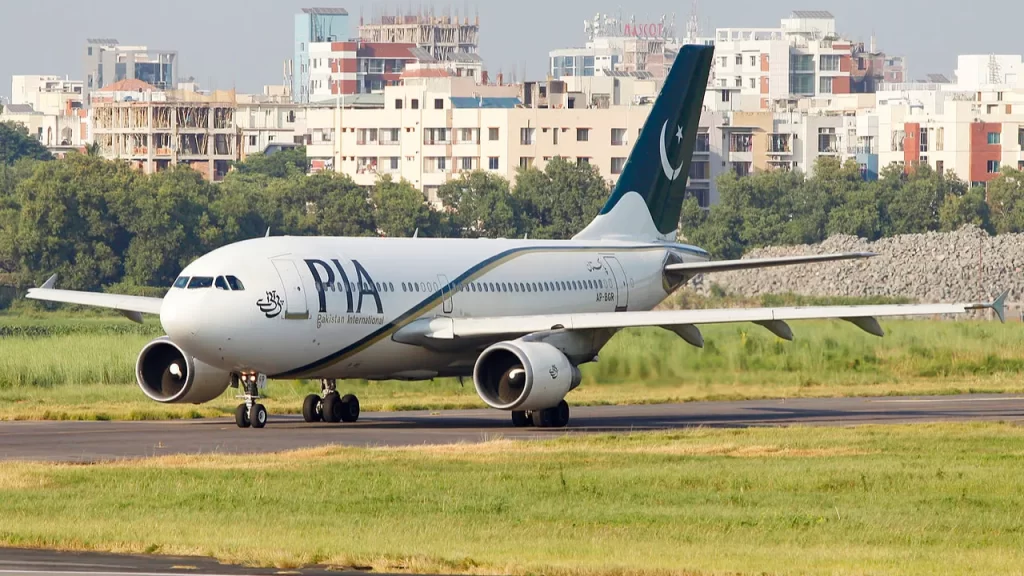
Pakistan’s aviation history includes several accidents in which bird strikes have been implicated, though investigators have not always confirmed the mechanism with the same certainty reporters assumed at the time. On June 25, 2013, a PIA Airbus A310 carrying 240 passengers suffered a bird strike to one of its two engines.
A more severe case came on November 28, 2010, when a Russian-built Ilyushin Il-76 cargo aircraft operated by the Georgian carrier Sun Way crashed shortly after departing Karachi’s Jinnah International Airport, killing all eight people on board and four more on the ground.
Aviation Ornithologist Dr Sameera Arshad’s 2021 presentation to the World Bird Strike Association placed Pakistan’s toll inside the global ledger, noting that bird and other wildlife strikes have destroyed 204 civil aircraft and killed 342 people worldwide between 1912 and 2019, alongside 412 military aircraft losses and 193 further deaths. Locally, the Pakistan Air Force has also logged bird strike damage to fighter aircraft going back to at least 1967, when a Martin B-57 Canberra ingested a bird mid-mission.
More recent incidents show the hazard has not eased. AeroInside’s safety log for PIA records repeated bird ingestion events on the airline’s Boeing 777 and 747 fleets on domestic sectors such as Karachi-Lahore, alongside strikes on its ATR-42 turboprops flying regional routes through Quetta and Multan, underlining that the risk spans both PIA’s long-haul jets and its short-hop domestic fleet alike.

Why Peshawar’s Bacha Khan International Airport (PEW) Attracts Birds
Bacha Khan International Airport (PEW) in Peshawar offers one of the most detailed case studies of why Pakistani airports draw birds in the first place. A 2022 study published in Eco. Env. & Cons. surveyed the airport’s premises and surrounding land and found an average of 30 bird species inside the wider 30-acre survey zone each month, and 15 species within the airport’s own 7.5-acre core, for a combined average of 849 individual birds recorded monthly.
The black kite dominated both zones, making up close to 17 percent of birds recorded just outside the airport and more than 21 percent of those recorded inside it, a pattern researchers linked to the abundance of tree cover, construction debris, and food waste nearby. The study’s authors calculated a Shannon diversity index of 3.024 for the site, a figure indicating high species diversity and, by extension, a high background risk of collision.
The researchers pointed to four attractants driving bird presence at Peshawar and, by extension, at most Pakistani airports:
- Tree vegetation, which provides feeding and nesting habitat for numerous species
- Grasses left uncut near runways, which sustain the insects birds feed on
- Airport fencing, which offers birds a place to perch and rest
- Nearby buildings and construction, which create shelter and nesting cavities
The same research noted that the airport’s own crackers-based deterrent system, run by airport security staff, has not kept pace with more modern tools such as avian radar and acoustic deterrents already used elsewhere.

Eid-ul-Azha and the Seasonal Surge in Bird Activity
Pakistan’s aviation authorities face a distinctive, recurring seasonal risk tied to the Islamic festival of Eid-ul-Azha, when millions of households conduct ritual animal sacrifice. Writing in The Express Tribune ahead of the 2026 festival, a contributor warned that improperly disposed offal, blood, hides, and carcasses left in open plots, drains, and roadsides draw large concentrations of kites, crows, vultures, and stray scavengers into the air over populated areas and flying corridors.
The Pakistan Air Force treats the surge as a direct operational threat, since its aircraft continue running training sorties and readiness patrols throughout the holiday. The same warning noted that even a small bird strike during a high-speed military sortie can cause severe structural damage, and that bird ingestion into an engine can trigger compressor damage or complete engine failure.
Peer-reviewed research backs up the concern with hard numbers. The Bacha Khan International Airport study explicitly recorded that populations of crow and kite species increased during the days surrounding Eid-ul-Azha, tracking the same carcass-driven attraction pattern described anecdotally in Lahore and other cities. Researchers have urged district administrations to intensify garbage collection specifically around the festival period as a targeted, time-limited mitigation measure.

Countermeasures: Runway Closures, No-Bird Zones, and ICAO Standards
Pakistan’s most visible recent intervention came in mid-2026, when the Pakistan Airports Authority (PAA) announced it would close both runways at Lahore’s Allama Iqbal International Airport for three hours every morning from July 5 to September 15, precisely the monsoon window when bird activity peaks. The authority explained its reasoning plainly: “During the monsoon season, bird activity in and around the airport, particularly below 3,000 feet, increases significantly.”
The closures run from 5 a.m. to 8 a.m. daily, with scheduled commercial flights continuing outside that window and emergency landings still permitted if required. The PAA also instructed airlines to carry extra fuel to cover possible ground or airborne holding delays caused by the restriction, and it issued a formal Notice to Airmen (NOTAM) to inform operators of the change.
Beyond Lahore, Pakistan’s regulatory framework already leans on international standards. The Aircraft (Removal of Danger to Safety) Ordinance of 1965 gives authorities the power to control bird-attracting land use near airfields, and Pakistan ratified the Chicago Convention establishing ICAO on November 6, 1947, obligating it to report bird strikes through ICAO’s Bird Strike Information System. Site-specific wildlife hazard assessments, of the kind Dr Arshad’s 2021 presentation recommends, remain the internationally preferred method, since the presentation stresses that no two airfields share identical bird hazard profiles.




.jpg)
.jpg)
.jpg)
_JP290231.jpg)

Leave a Reply