F-22’s $60,000-Per-Gallon Coating Adds to Operating Costs That Can Reach $85,000 Per Flight Hour

The Lockheed Martin F-22 Raptor and the Boeing B-52 Stratofortress are both frontline aircraft in the United States Air Force (USAF) inventory in 2026. Their missions, speeds, and roles are entirely different, and so is the chemistry of what coats their outer skin. The F-22’s surface is covered with Radar-Absorbent Material (RAM) — a multi-layer chemical composite engineered to absorb incoming radar waves rather than scatter them back to an enemy receiver. The B-52’s exterior receives two coats of conventional military-grade polyurethane paint, applied primarily to protect its aluminium and steel structure from weather and corrosion.

That difference in surface treatment drives one of the most significant cost gaps in military aviation. According to WION News, the F-22’s total operating cost reaches approximately $85,000 per flight hour, and roughly one-third of all maintenance activity on the aircraft is dedicated to repairing and re-curing its exterior stealth skin. The B-52, by contrast, can have surface scratches touched up by ground crews with standard brushes in normal airfield conditions, with no climate-controlled environment required.
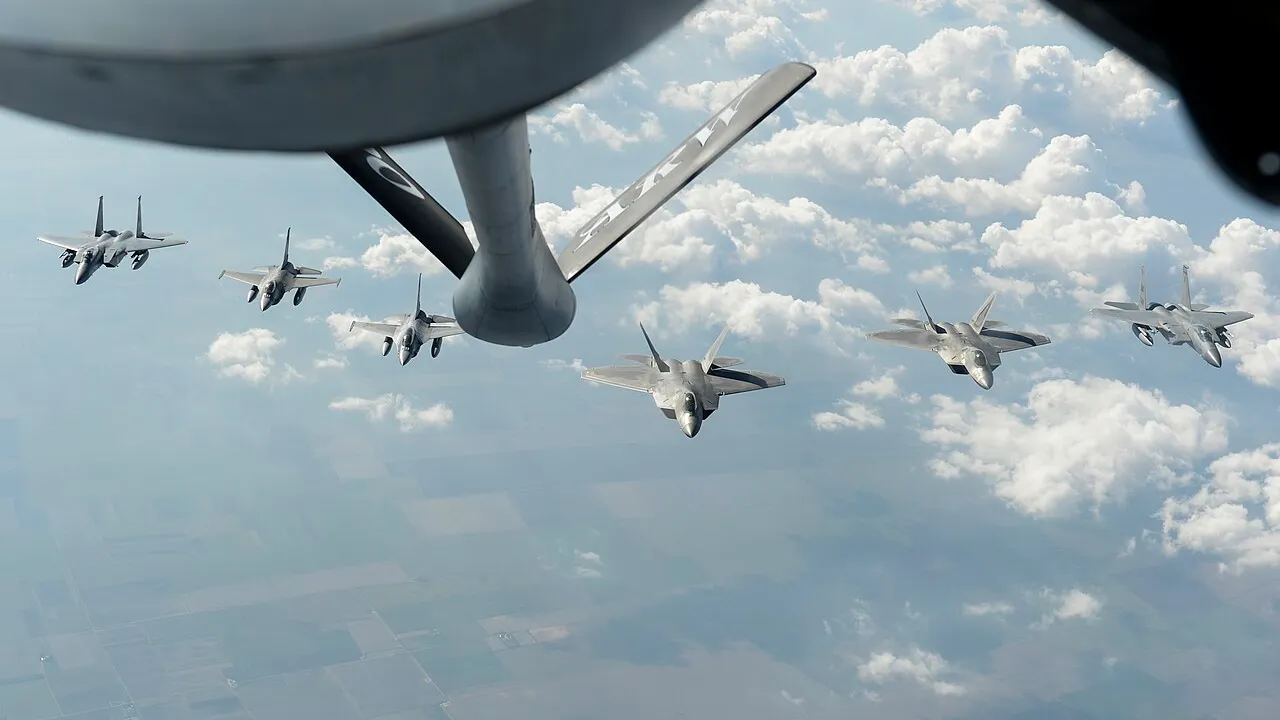
Photo: U.S. Air Force photo by Senior Airman Dawn Weber

What The F-22’s RAM Coating Is and Why It Is So Hard to Maintain

The F-22 Raptor achieves low observability through a combination of airframe shaping and RAM coatings applied in multiple layers across its outer mold line. These coatings absorb incoming radar energy rather than reflecting it, which dramatically reduces the aircraft’s radar cross-section. According to The War Zone, the aircraft’s outer surface is a mosaic of radar-absorbent coatings, radar-transparent structures, and radar-defeating composite panels that together allow the Raptor to remain aerodynamically efficient while largely invisible to fire control radars.

The problem is that these coatings begin to degrade almost immediately after they are applied. Friction from high-speed flight, crushing G-forces, and exposure to weather all accelerate the degradation of the stealth skin. High-speed maneuvering physically tears or rips sections of the RAM coating. Even minor surface damage increases the aircraft’s radar signature, reducing its combat effectiveness. A USAF maintainer quoted in a USAF news item stated:

“When the pilot flies he’ll bank real hard sometimes, which can tear or rip the radar absorbent material. If there are a lot of damages, the aircraft is easier to detect, so we try to keep those damages to a minimum.”

The application and repair process for RAM is also chemically demanding. Low observable (LO) maintainers at Tyndall Air Force Base apply the boot layer of RAM first, followed by additional topcoats. One of the biggest obstacles is controlling environmental conditions. A USAF sergeant quoted by The War Zone explained:

“When working with low observable material, everything deals with chemicals, and a lot of chemicals are required to stay within a certain temperature and humidity range to get the best bond. Here in Florida, we have a tremendous level of humidity.”

Even lightning within five miles of the base halts LO restoration work on the flight line.
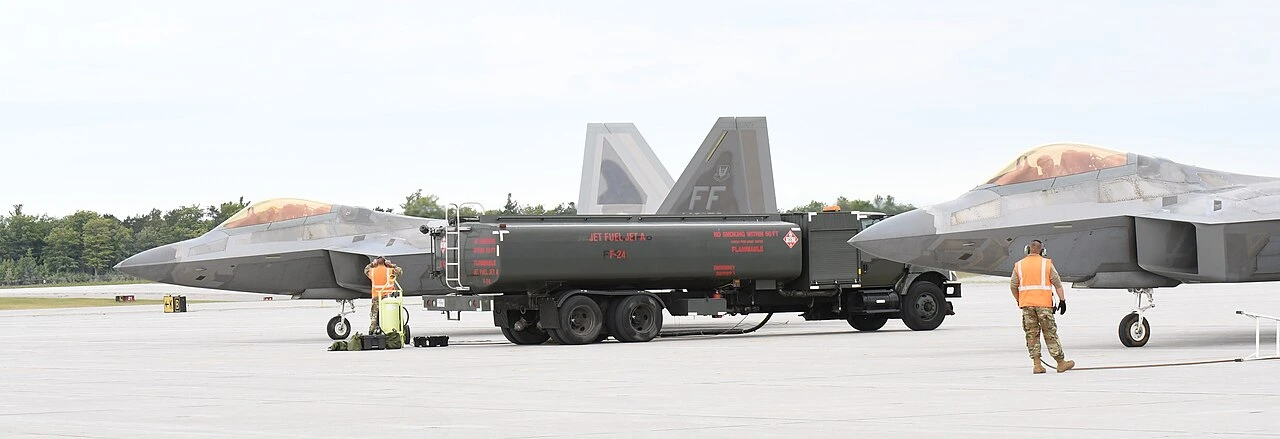
Photo: US Army

Supercruise Makes the Coating Problem Worse

The F-22 is the world’s only operational fighter capable of sustained supersonic flight without afterburners — a capability known as supercruise. The USAF defined the F-22’s supercruise requirement as “the ability to cruise at speeds of one and a half times the speed of sound or greater without the use of afterburner for extended periods in combat configuration.” In practice, the aircraft exceeds Mach 1.5 in military power and reaches above Mach 2 with afterburners engaged.

This speed generates intense kinetic heating along the airframe’s leading edges. Standard military finishes instantly blister under these conditions, which is why the F-22 requires highly engineered, heat-resistant chemical composites rather than conventional paint. The Pratt & Whitney F119-PW-100 engines that power the Raptor each produce 35,000 lbf of thrust, and even the afterburner vanes themselves are coated with ceramic RAM to maintain stealth of the exhaust.

The afterburner plume of a non-supercruise fighter reflects radar signals and creates a significant infrared signature. Supercruise is particularly valuable for stealth aircraft precisely because it eliminates the infrared and radar signature produced by the afterburner. However, sustaining those speeds without afterburners keeps the airframe at high temperatures for extended periods, placing continuous thermal stress on the RAM coating across the aircraft’s skin.
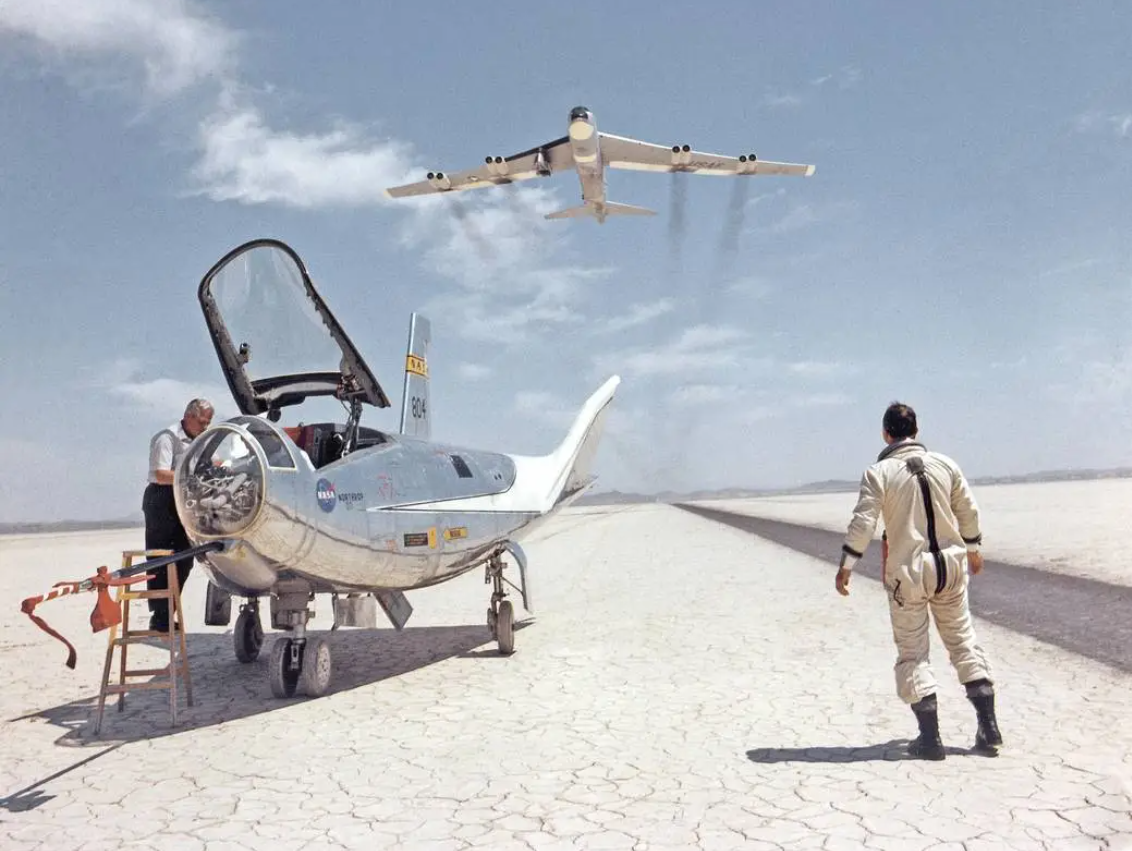
Photo: Samuel King Jr. | Wikimedia Commons

30 Maintenance Hours for Every Hour Flown

The maintenance burden imposed by the F-22’s stealth coating is documented across multiple defence analyses. Simple Flying reported that in the early years of F-22 service, the aircraft required more than 30 maintenance hours for every single flight hour, a ratio that far exceeds any conventional fighter. The same source noted that reliability improvements have reduced this ratio somewhat, but the aircraft still demands intensive inspections and servicing after every flight due to stealth requirements and advanced systems.

The breakdown of what drives this ratio includes:

  • Weekly outer mold line inspections — LO maintainers check each jet’s signature against detection thresholds. A high signature means reduced stealth capability and the aircraft cannot fly combat-coded missions until it is repaired.
  • RAM removal and reapplication for access panels — Any time maintenance personnel need to access systems beneath the skin, the RAM coating must be peeled back and then re-bonded after the repair is complete.
  • Climate-controlled hangar curing — The chemical bonding of RAM requires precise temperature and humidity control. Standard open-air maintenance bays are not suitable.
  • Small-batch specialist parts — Because the F-22 production line closed in 2011 after only 187 operational aircraft were built, RAM materials and airframe components are manufactured in limited quantities, increasing cost per unit.
  • Post-flight skin inspection — Technicians inspect leading edges, weapons bay doors, and all panel seams after each sortie to identify RAM damage before it compromises the aircraft’s radar signature.

FlyAJetFighter.com posited that in 2020, maintenance costs for the F-22 fleet amounted to more than $1.6 billion — a figure that, divided across approximately 150 aircraft in operational service, equates to roughly $10–11 million per aircraft per year in maintenance alone, before accounting for fuel, crew, or logistics.

Photo: USAF

What The B-52’s Paint Actually Is

The Boeing B-52H Stratofortress (the only variant still in USAF service) operates with a fundamentally different surface treatment philosophy. The aircraft carries no stealth requirement and makes no attempt to reduce its radar cross-section through surface coatings. The B-52 receives just two layers of conventional military polyurethane paint. This coating is engineered strictly for weatherproofing and protection against environmental corrosion.

The properties of conventional polyurethane military paint make it:

  • Highly durable — Standard polyurethane topcoats applied to military aircraft are designed to withstand years of exposure to moisture, salt air, temperature cycling, and ultraviolet radiation without significant degradation.
  • Easily repairable — Surface scratches and chipping can be touched up by ground crews at any airfield using standard brushes and pre-mixed paint, requiring no controlled environment.
  • Depot-cycle aligned — The B-52 undergoes extensive mechanical overhauls approximately every four years. Its exterior paint is replenished as part of those scheduled depot visits rather than requiring continuous attention between cycles.
  • Non-chemically reactive — Unlike RAM, polyurethane paint does not involve exotic chemical compounds that degrade under heat or humidity constraints.

B-52 was designed before radar cross-section reduction became a formal engineering discipline. Its mission — delivering massive payloads from standoff distances or operating in permissive airspace — does not require it to penetrate contested environments defended by modern integrated air defences. That role is assigned to the Northrop Grumman B-2 Spirit and, in due course, the B-21 Raider.

Photo: USAF

The Operating Cost Gap Between F-22 and B-52

The coating difference is the most visible illustration of a broader operational cost gap between the two aircraft. Bolt Flight’s analysis placed the F-22 Raptor cost per flight hour at $80,000 to $85,000 in 2026, with most defence analyses citing $85,325 as the most widely referenced figure. The B-52H, by comparison, costs approximately $69,708 per flight hour.

The B-52’s hourly costs are driven primarily by fuel — its eight Pratt & Whitney TF33 turbofan engines consume approximately 2,400 US gallons of jet fuel per hour during cruise at 509 mph. The B-52’s costs are not low in absolute terms, but the composition of those costs is entirely different from the F-22’s. The F-22’s operating cost is driven by maintenance complexity, specialty materials, and the stealth coating lifecycle — not fuel consumption.

The contrast with the B-2A Spirit stealth bomber adds further context. B-2 costs $169,313 per flight hour — more than twice the B-52 — because it carries stealth coatings similar in concept (though not identical in specification) to the F-22’s RAM. The B-2 also requires 119 maintenance hours per flight hour and a $5 million climate-controlled hangar at every base that operates it. The B-52, by contrast, operates from standard military hangars and requires 53 maintenance hours per flight hour — still high by commercial aviation standards, but dramatically lower than either stealth aircraft.

NB-52B cruise overhead NASA research pilot Bill Dana.
Photo: NASA

Why The F-22’s Coating Costs More Than The F-35’s

The F-22’s stealth maintenance burden also exceeds that of the Lockheed Martin F-35A Lightning II (LN), its fifth-generation counterpart. F-35A costs roughly $42,000 per flight hour — approximately half the F-22’s rate. The cost difference between the two stealth fighters stems from the timeline of their development. The F-22 was the first operational aircraft designed entirely around low-observability. Many of its RAM materials and LO features were developed before engineers fully understood how to optimise stealth for long-term maintenance.

The F-35 benefited directly from the lessons learned operating the F-22. Its stealth coatings are more durable, easier to apply, and faster to repair. F-22’s mission-capability rate had fallen to roughly 40% in fiscal year 2024, meaning fewer than half of all Raptors were available for operations at any given time — a direct consequence of the labour-intensive stealth maintenance model. The F-35, produced in far larger numbers (more than 1,300 aircraft globally by 2025), also benefits from economies of scale in parts production and maintenance training.
Photo: Rob Shenk | Wikimedia Commons

The B-52’s Operational Future and Why Paint Is the Least of Its Costs

While the F-22 battles coating degradation, the B-52 faces a different set of sustainment challenges — none of which involve its exterior paint. The aircraft’s primary cost problem in 2026 is its eight ageing Pratt & Whitney TF33 engines, which burn approximately 2,400 US gallons of jet fuel per hour and are no longer in active production.

The USAF awarded Rolls-Royce a $2.6 billion contract in 2021 to supply 650 F130 turbofan engines as replacements, a programme expected to cut fuel consumption by approximately 30% and extend the B-52’s service life well into the 2050s.

As recently as March 2026, B-52 bombers were deployed to strike ballistic missile sites and command-and-control posts inside Iran. The aircraft has now flown combat missions in every major US-led conflict from Vietnam through the 2026 Iran campaign. Its durability in this role stems not from stealth — it has none — but from its ability to carry up to 70,000 pounds of ordnance and deliver standoff weapons from ranges that keep it outside defended airspace.

Simple Flying’s bomber comparison described the complementary force structure that explains why both aircraft remain in service simultaneously: stealth bombers penetrate the most heavily defended airspace on day one of a conflict; the B-52 excels at persistence, mass, flexibility, and visible strategic signalling once that airspace has been suppressed. Neither aircraft can do what the other does, and neither’s paint budget reflects anything other than the demands of its specific mission.

Leave a Comment

Your email address will not be published. Required fields are marked *

Scroll to Top