Boeing is sending its first production Boeing 777-9 on an 11-hour, 14-minute test flight toward the North Pole. The aircraft, registered N20080 and designated WH128, departs from Snohomish County Airport (PAE), Everett, Washington, on a route that will carry it as far north as 85°N — approximately 300 nautical miles (556 km) from the geographic North Pole. This marks one of the most extensive flight profiles ever flown by a production-standard aircraft in the 777X program.
N20080 is not a prototype. Boeing built it for Lufthansa (LH) — the airline’s confirmed launch customer — with a fully installed passenger cabin rather than engineering test hardware. The flight is part of Boeing’s ongoing certification effort, which must be completed before the U.S. Federal Aviation Administration (FAA) clears the 777-9 for commercial service. Boeing targets first deliveries in early 2027.
What Makes N20080 Different from Boeing’s Other Test Aircraft
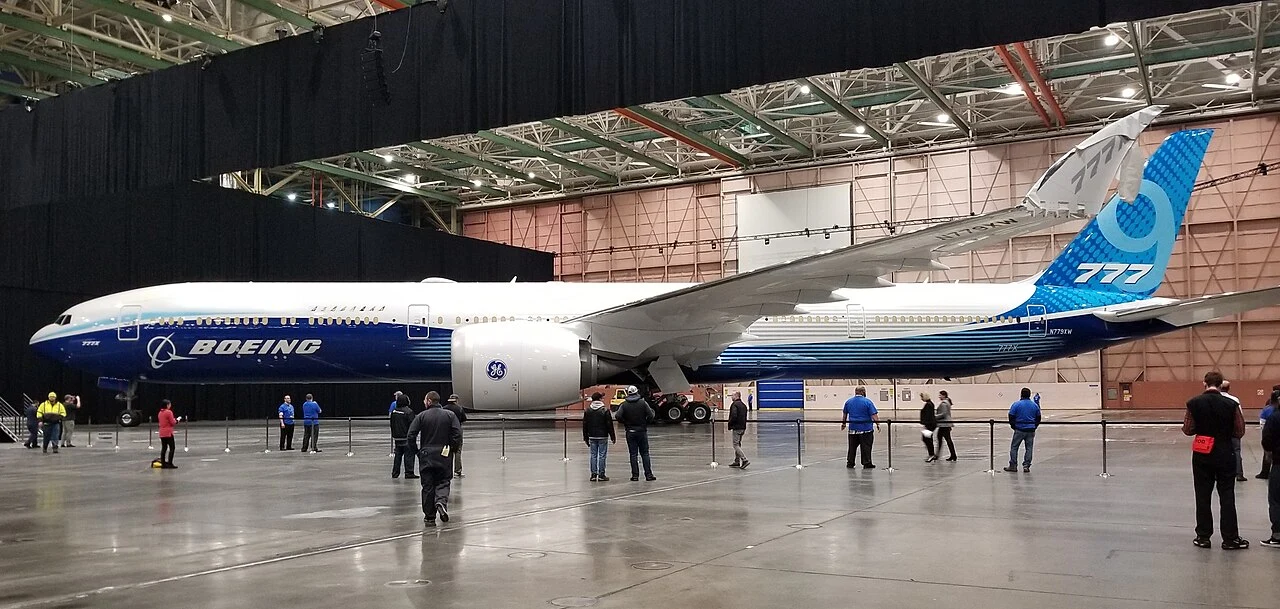
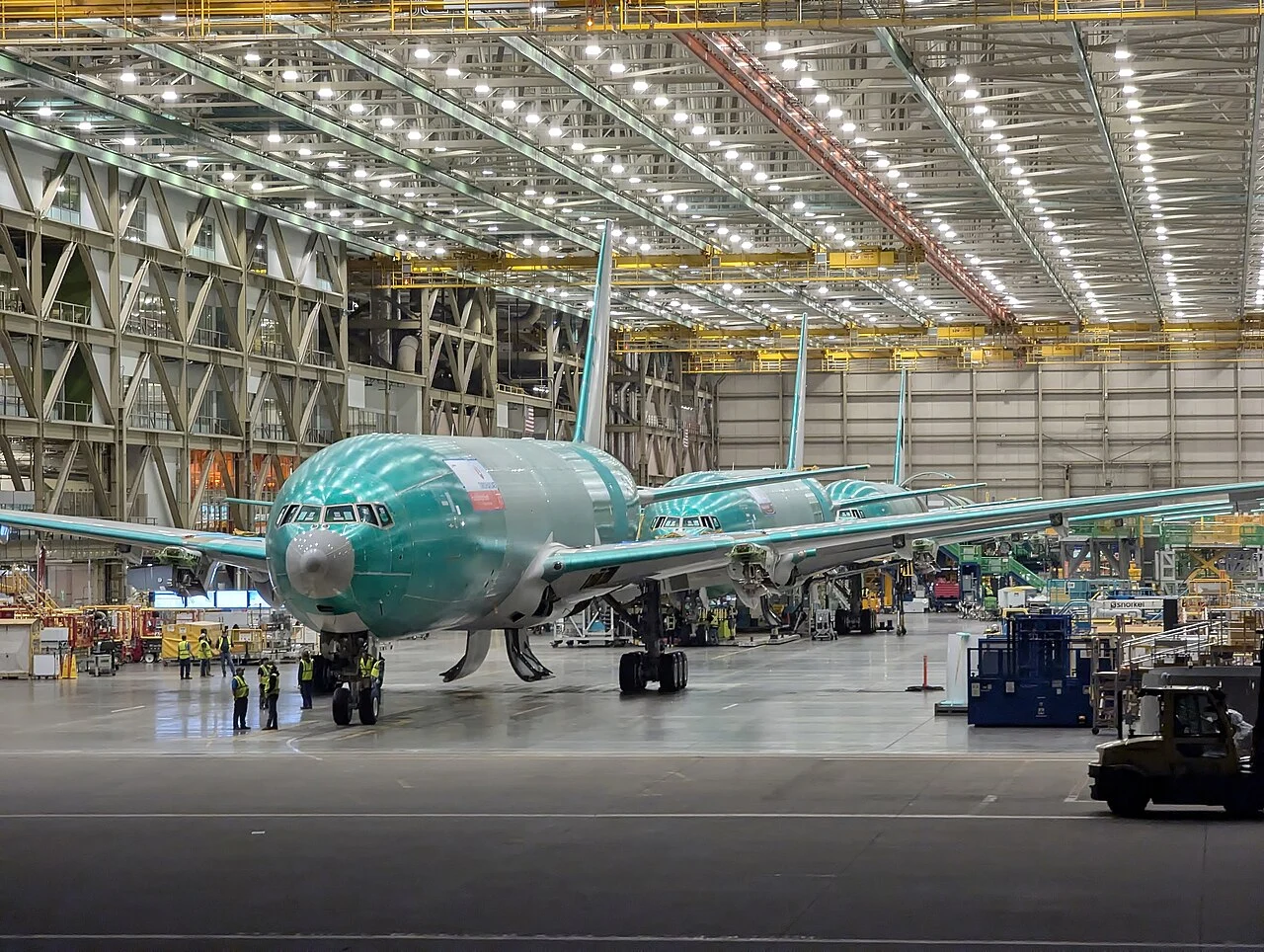
N20080, designated WH128 with serial number 1781, is the sixth 777-9 airframe to have flown but the first produced to customer delivery standard. Boeing’s earlier 777X test aircraft (WH001 through WH005) were engineering prototypes, designed primarily to gather developmental and certification data. N20080 instead carries Lufthansa’s actual passenger cabin configuration, including premium seating, economy class, and advanced in-flight entertainment systems.
This distinction carries significance in regulatory terms. Certification programs typically shift from dedicated engineering aircraft toward production examples as they approach final validation. Production airplanes allow manufacturers to confirm that installed systems in airline-standard configurations perform as required, which is a separate validation layer from what prototype testing provides. Boeing stated that future testing on N20080 will emphasize cabin systems and connectivity alongside broader certification work, Simple Flying reported.
N20080 completed its maiden flight on May 7, 2026, departing Snohomish County Airport at 20:40 UTC on a three-hour sortie over Washington and Oregon, reaching 39,000 feet and 492 knots. Boeing test pilots Captain Ted Grady and Captain Jake Miller flew that first mission. The aircraft subsequently entered Boeing’s ongoing validation activities, of which this North Pole profile is the most demanding to date.
Why is Boeing Flying to The North Pole?
Flying to 85°N is not symbolic. It is a rigorous technical evaluation that commercial aircraft designers consider essential for any widebody intended to operate across polar air routes. Flights at very high northern latitudes differ from conventional long-haul operations because the operating environment changes significantly as aircraft approach the polar region. The following conditions make polar operations technically distinct:
- Navigation: Near the poles, the Earth’s magnetic field lines converge and magnetic variation increases sharply, making magnetic references unreliable. Modern aircraft like the 777-9 instead use inertial reference systems and true-heading calculations. On the 777 family, the switch from magnetic to true heading occurs automatically above 78°N, as confirmed by Boeing’s own operational guidance cited in Boeing Aero magazine.
- Communications: Aircraft operating in the polar region rely on High Frequency (HF) radio and satellite datalink systems because conventional VHF communication infrastructure does not exist in remote Arctic areas. Datalink clearances are obtained before entering the polar zone, after which crews make regular position reports for potentially hours without voice contact.
- Temperature extremes: Arctic air at high altitude subjects engines, fuels, and hydraulic systems to sustained exposure to extreme cold. The GE9X engines powering the 777-9 must demonstrate consistent performance across these conditions.
- Extended duration: An 11-hour, 14-minute profile gives engineers a sustained window to observe the behavior of cabin systems, fuel consumption rates, and avionics performance under real-world conditions that a shorter test could not replicate.
Polar route testing allows engineers to evaluate aircraft systems under extreme cold and at high latitudes, where navigation behaves differently and magnetic references become less reliable. For a widebody designed to operate ultra-long-haul routes crossing polar regions between Europe, North America, and Asia, this kind of validation is essential.
Airlines operating between Europe and East Asia routinely use polar routes. The FAA defines the North Polar area of operations as the area north of 78° north latitude. An aircraft that cannot demonstrate polar-environment competence cannot serve the trans-Pacific and transpolar routes that underpin the 777-9’s commercial case.

Key Specifications of the Boeing 777-9
The 777-9 is the world’s largest twin-engine commercial aircraft. Below are its defining technical characteristics:
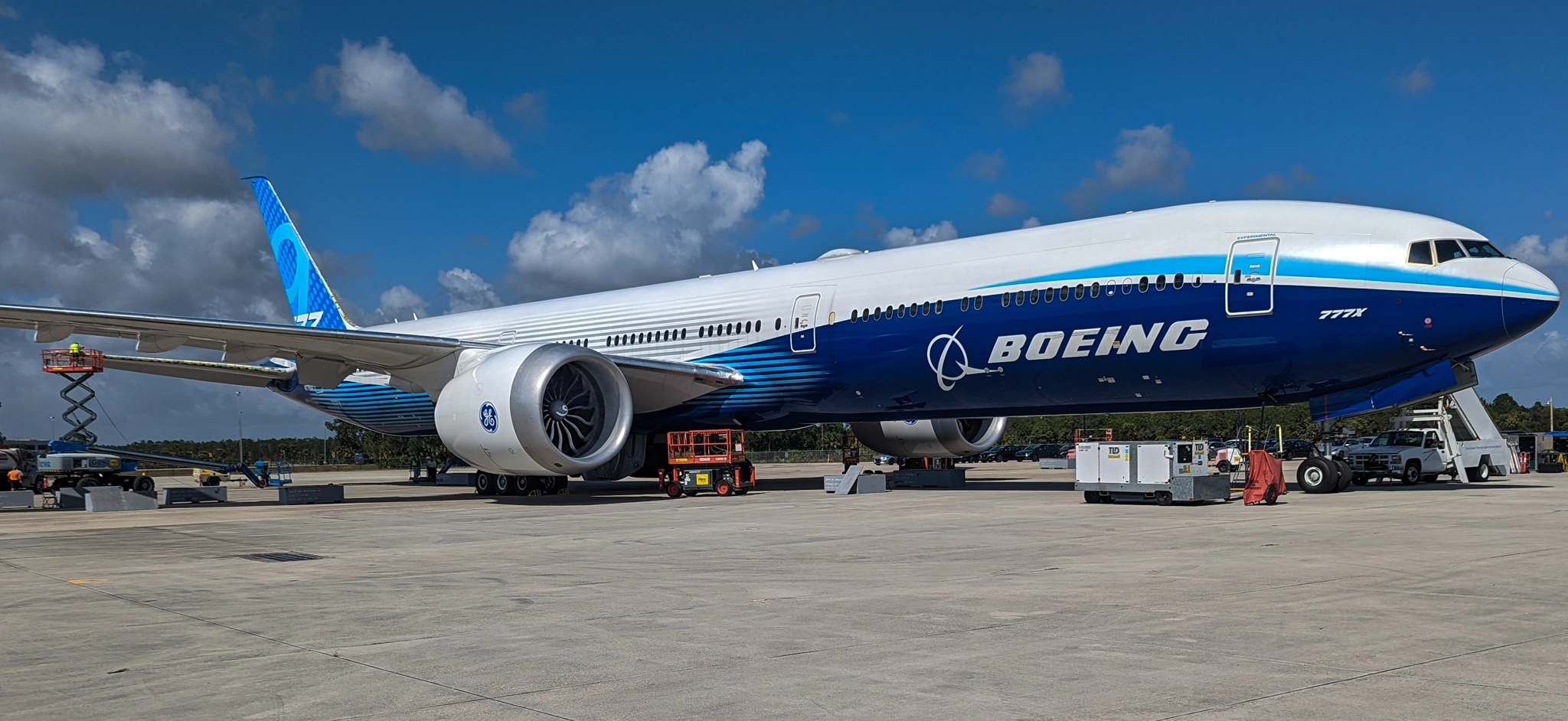
- Length: 76.7 meters (251 ft 9 in) — the longest twin-engine commercial jet ever built
- Wingspan (unfolded): Extends to accommodate ICAO aerodrome code E requirements via hydraulically folding wingtips
- Wingspan (folded for gate): 64.8 meters, allowing standard airport gate usage
- Engines: Two General Electric GE9X-105B1A turbofans, each producing approximately 105,000 lb of thrust — the largest commercial jet engine ever built, with a 134-inch fan diameter
- Capacity: Up to 426 passengers in a typical three-class configuration
- Range: Exceeding 7,285 nautical miles
- Cabin altitude: 6,000 feet — lower than the standard 8,000 feet of older widebodies, reducing passenger fatigue
- Wings: All-composite construction with folding wingtips, a commercial aviation first
- Fuel efficiency: Approximately 20–25% lower fuel consumption compared with previous-generation widebodies of comparable size, per Boeing’s product documentation
Boeing positions the 777-9 as the successor to both the Boeing 747 and the 777-300ER, and as the primary competitor to the Airbus A350-1000 in the ultra-long-haul widebody market.
The 777X Certification Journey: From 2020 To 2026
The 777-9 first flew on January 25, 2020. Since then, the program has accumulated more than 4,700 flight-test hours across a dedicated test fleet of five aircraft. However, repeated setbacks have extended the path to certification well beyond original plans.
Boeing rolled out the 777-9 in March 2019 and originally targeted entry into service in 2020. A series of obstacles have pushed that target back repeatedly:
- GE9X engine issues (2019–2020): A compressor anomaly delayed the maiden flight from its original mid-2019 target to January 2020.
- 737 MAX certification reforms (2020 onward): Following the 737 MAX accidents of 2018 and 2019, the FAA applied heightened scrutiny across all Boeing certification programs, adding rigor and time to the review process.
- GE9X combustor durability concerns (2022): A technical issue with one of the test fleet’s GE9X engines led Boeing to pause the program while GE Aerospace investigated.
- Thrust link cracks (2024): In August 2024, Boeing grounded its 777X test fleet after a routine inspection following a test flight in Hawaii revealed damage to the structural link between the engine and the wing. Cracks appeared in the same component across multiple aircraft, grounding the fleet for approximately five months.
- $4.9 billion charge (October 2025): Boeing recorded a $4.9 billion pre-tax charge in October 2025 and pushed the first delivery timeline from 2026 into 2027.
- GE9X mid-seal durability issue (2026): GE Aerospace has been analyzing a potential durability issue involving a seal in the GE9X engine.
The extended timeline has pushed the 777X program toward 13 to 14 years from formal launch to commercial service entry — significantly longer than the Boeing 787 (7.5 years) or the Airbus A380 (under 7 years).
Boeing 777-9’s FAA Certification Progress
Boeing has cleared important regulatory milestones in the weeks preceding this North Pole test. The FAA issued Type Inspection Authorization (TIA) Phase 4B approval in early June 2026. This phase unlocks the largest remaining block of FAA-supervised flight testing.
Boeing Commercial Airplanes President and CEO Stephanie Pope announced the TIA Phase 4B approval on June 6, 2026, while attending the IATA Annual General Meeting in Rio de Janeiro. Speaking with ATW, Pope said: “
This authorization unlocks the largest remaining portion of our flight test with the FAA that we can now go execute. 4B is a significantly larger piece, focusing on systems like avionics, stability and control testing, and human factors assessments.”
Phase 4B follows Phase 4A, which the FAA granted on March 17, 2026. The TIA process consists of five distinct phases. Phases 4A and 4B together account for roughly the same volume of tests as the earlier Phase 3, which began in November 2025. TIA Phase 5 is expected to involve a limited series of tests and will be followed by Extended Operations (ETOPS) and systems Functionality and Reliability (F&R) validation, which require a delivery-ready aircraft.
The FAA has split the TIA process into five stages — an unusual regulatory step reflecting stricter oversight protocols implemented after the 737 MAX grounding. Leeham News, citing Pope, noted that the FAA’s decision to grant the authorization in stages reflects a fundamentally more hands-on posture toward Boeing’s programs:
“There’re five TIAs that we have to work through. 4B is the last with what I’d say is a significant amount of work, predominantly focused on systems like avionics. We just got the approvals to go complete that work, which is a big milestone.”

ETOPS is the Final Regulatory Hurdle for the 777-9
The North Pole test flight connects directly to one of the most important remaining certification requirements: ETOPS — Extended-range Twin-engine Operational Performance Standards. ETOPS certification is essential for the 777-9 to operate the long-haul oceanic and polar routes that form the foundation of its commercial mission.
Boeing CEO Kelly Ortberg addressed ETOPS status on May 27 at the Bernstein Strategic Decisions Conference in New York. He confirmed that ETOPS is the “final tests” Boeing has planned for the program. In a subsequent clarification, Ortberg stated in Aviation Week:
“We do not plan on making any deliveries pre-ETOPS completion. Customers for this airplane want an ETOPS configuration, so we’ve just got a lot of work to do between now and the end of the year.”
The 777-9 is expected to pursue an ETOPS-330 rating — the same level held by the 787 and the 777-300ER. ETOPS-330 allows a twin-engine aircraft to fly up to five and a half hours away from a diversion airport, covering trans-Pacific, trans-Indian Ocean, and South Atlantic operations. Boeing and GE Aerospace have also agreed on a corrective action plan for the GE9X midseal issue as a prerequisite for beginning ETOPS testing.
Mike Stengel, partner at consultancy AeroDynamic Advisory, noted that an ETOPS gap could affect some operators more than others. Speaking to FlightGlobal, Stengel said: “If it’s Emirates as first customer and first deployment is on routes to Europe, then it’s probably fine since that’s mostly overland.” He noted, however, that other widebody jets — the 777, 787, and Airbus A350 — all entered service with their ETOPS approvals already in hand.
Lufthansa’s 777-9 Order and Fleet Strategy
Lufthansa (LH) holds 20 firm orders for the 777-9. The German carrier became the first confirmed launch customer in January 2025, when Boeing CFO Brian West named Lufthansa on a January 28 earnings call, ending earlier speculation that Emirates might claim the position. Lufthansa plans to use the 777-9 to replace its aging Boeing 747-400 fleet, which now averages 26 years of age.
In March 2026, Lufthansa Group CEO Carsten Spohr expressed renewed confidence in the delivery timeline. He stated that discussions with Boeing indicated the first aircraft should arrive in the first quarter of 2027 and enter commercial service shortly after. Spohr also confirmed he planned to visit Boeing’s production facilities in Seattle to review program progress.
Simple Flying later reported that Spohr said:
“After our conversation with Boeing [on March 6], that these aircraft will arrive in the first quarter and be deployed in the summer… I’m even more optimistic that they will be delivered in 2027… in the winter, two to four 747-400s will be removed from the fleet.”
Lufthansa’s 777-9 will debut the airline’s new Allegris cabin concept. The cabin’s centerpiece is a Suite Plus in First Class, featuring ceiling-high walls and a fully closing door. Originally planned to launch on the 777-9, Allegris was introduced on Lufthansa’s Airbus A350 fleet ahead of schedule due to the 777-9’s delays. The 777-9 will also feature a lower cabin altitude of 6,000 feet, larger windows, and higher ceilings — all reducing passenger fatigue on long-haul flights. Lufthansa’s new first class will include throne seats and beds up to 220 cm long.
Lufthansa has also prepared contingency plans in case of further delays. In an interview with Simple Flying, Spohr revealed that Lufthansa’s Airbus A340-300s will remain in service through 2027 as a capacity buffer: “In the case that the 777X is further delayed, the Airbus A340-300 will continue to fly in 2027.” This gives the airline operational flexibility while awaiting Boeing’s deliveries.

What Happens After the North Pole Flight
The North Pole mission for N20080 is one element of a certification effort that Boeing must complete across multiple aircraft and multiple testing phases before the first 777-9 reaches an airline. The immediate steps ahead include:
- Completion of TIA Phase 4B: Boeing must complete the balance of Phase 4B flight testing, which covers avionics, stability and control, and human factors evaluations with FAA personnel directly on board.
- TIA Phase 5: Phase 5 is expected to involve a limited series of tests involving final software updates before Boeing moves into the closing stages.
- Functionality and Reliability (F&R) testing: This requires delivery-ready aircraft and validates overall system reliability under representative operating conditions.
- ETOPS testing and approval: ETOPS validation will extend into 2027. Boeing has confirmed it will not deliver any 777-9 before ETOPS approval is secured.
- EASA certification: European Aviation Safety Agency certification — required before Lufthansa can operate the type in European airspace — also remains part of the path to service entry, though Boeing has not publicly confirmed its timeline relative to FAA certification.
FAA Administrator Bryan Bedford stated in May 2026 that the FAA expects to certify the 737 MAX 7 and 737 MAX 10 by end of 2026, with 777X certification following in early 2027. Boeing’s stated target of completing flight testing by end of 2026, combined with ETOPS work extending into 2027, is broadly consistent with that timeline — though analysts have noted that any additional technical finding during the remaining testing phases could affect the schedule.