Emirates (EK), has slashed 16% of its June 2026 flight programme in a single scheduling update, removing nearly one in six services originally planned for the summer month, Simple Flying reported as it cited “the world submit schedule changes to Cirium Diio, OAG, and other platforms“.
The reductions span six continents and touch 47 airports — representing 34% of Emirates’ total passenger network. The daily seat offering has fallen from 237 departures to 200, with 480,000 departing seats removed in a single week — equivalent to 16,000 seats per day throughout June. For an airline that moved 55.6 million customers and operated nearly 180,580 flights in 2025, the scale of this revision shows the fragility of the recovery from the regional conflict.
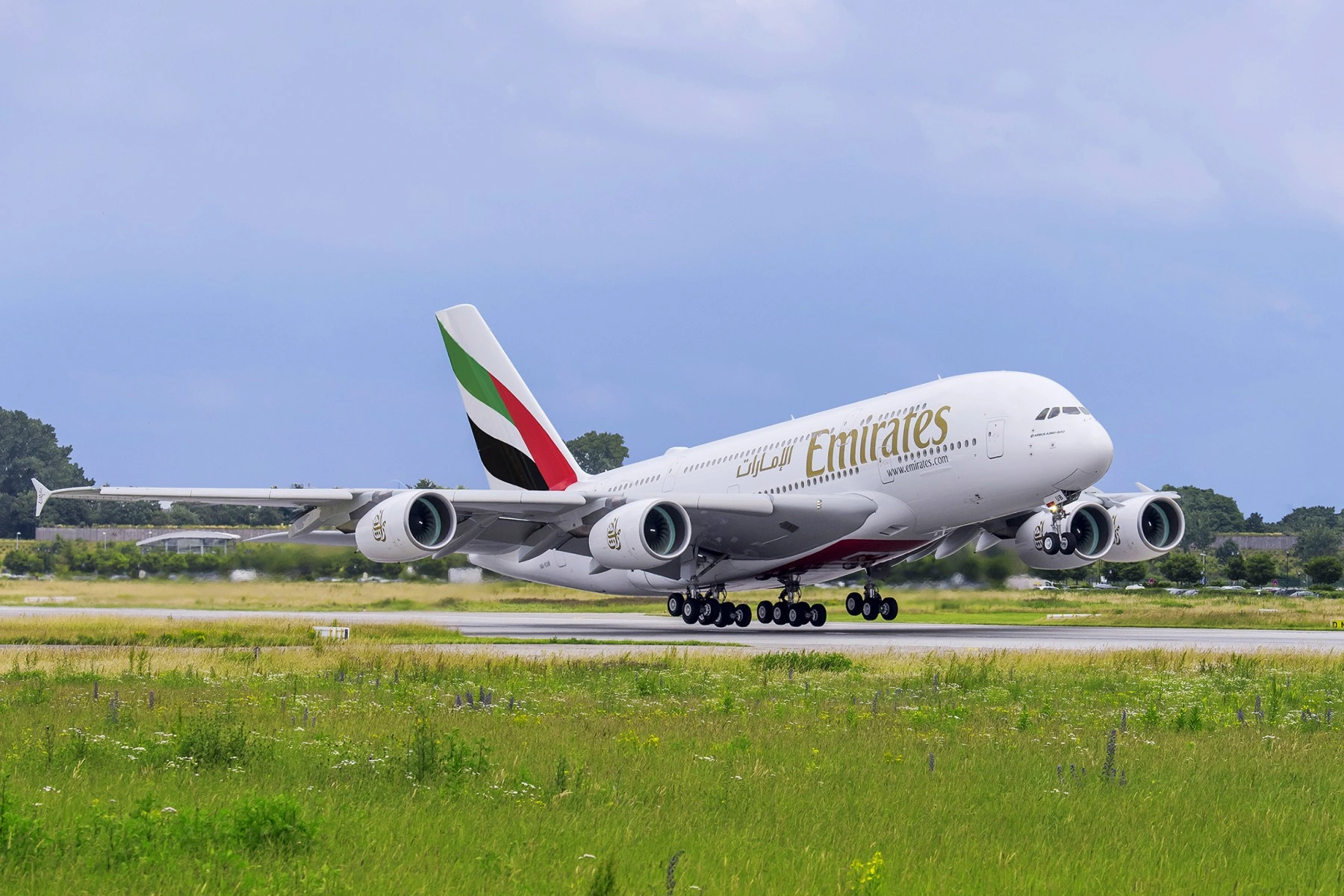
The Scale of Emirates’ June 2026 Capacity Cuts
In the previous scheduling cycle, Emirates had filed 7,116 two-way departures from Dubai International Airport (DXB) for June 2026. In the latest update, that figure stood at 6,007 outbound services. The arithmetic is stark: 37 fewer daily departures are now available, and while that number may seem modest in isolation, the airline operates an exclusively widebody fleet, comprising:
- Airbus A350-900s
- Airbus A380s
- Boeing 777-200LRs
- Boeing 777-300ERs
— which means each cancelled rotation can represent hundreds of revenue seats.
According to FlightRadar24’s Gulf Airline Recovery Index, Emirates had recovered more than 85% of its flights by 22 May 2026 compared to the last week of February, and the airline had earlier reported its overall network recovery crossing 96% in early May. The latest round of cuts, however, suggests that headline recovery figures do not capture the full picture: available capacity is still being actively managed downward, even as the airline projects outward stability.
Emirates now has 14% fewer services year-over-year compared to June 2025 — a meaningful contraction for a carrier that had entered 2026 with capacity growth of more than 5% year-on-year and was tracking above pre-pandemic benchmarks as recently as January. Emirates revised its June 2026 network plan by withdrawing the Airbus A380 from six routes across five countries, including Copenhagen, Osaka, Washington Dulles, Munich, Manchester, and London Gatwick, with 286 one-way A380 flights originally planned for June now to be operated by the Boeing 777 or the newly inducted Airbus A350.
47 Airports Bearing More Than the Average Cut
The 47 airports absorbing reductions greater than the network-wide 16% average span Africa, Asia-Pacific, Europe, the Middle East, North America, and South America. The following table, sourced from Cirium Diio schedule data and reported by Simple Flying, captures the breadth of the impact:
| Continent / Region | Affected Routes (% Change in June Flights vs. Prior Week) |
|---|---|
| Africa | Antananarivo* (−60%), Dar es Salaam (−17%), Johannesburg (−25%), Luanda (−41%), Mauritius (−33%), Nairobi (−33%), Seychelles** (−30%) |
| Asia-Pacific | Adelaide (−20%), Auckland (−27%), Bangkok (−18%), Beijing Capital (−50%), Brisbane (−50%), Ho Chi Minh City (−50%), Hong Kong (−20%), Karachi (−20%), Kuala Lumpur (−33%), Malé (−50%), Melbourne (−20%), Peshawar (−43%), Singapore (−25%), Sialkot (−29%), Sydney (−20%), Taipei (−20%) |
| Europe | Amsterdam (−48%), Athens (−18%), Barcelona (−33%), Birmingham (−50%), Bologna (−30%), Düsseldorf (−50%), Geneva (−20%), Hamburg (−20%), London Gatwick Airport (LGW) (−25%), London Heathrow Airport (LHR) (−17%), Lyon (−17%), Milan (−33%), Moscow Domodedovo (−33%), Newcastle (−30%), St. Petersburg (−53%), London Stansted Airport (STN) (−50%), Vienna (−50%) |
| Middle East | Amman (−50%), Bahrain (−36%), Kuwait (−76%), Muscat (−21%) |
| North America | Orlando (−32%) |
| South America | Buenos Aires** (−30%), Rio de Janeiro (−30%) |
* Served via the Seychelles. ** Served via Rio de Janeiro.
The Kuwait (KWI) figure — a reduction of 76% — is the single most dramatic in the dataset, though context is critical. Emirates currently has no operational flights to Kuwait because they remain suspended. While most of the previously scheduled services will not proceed, the airline does intend to maintain one daily service to Kuwait International Airport in June, which is more than it currently operates.
Wego’s Kuwait flight tracker confirms that Emirates resumed Kuwait flights on 1 May 2026 and is now operating up to five daily services, though the June plan pulls that back substantially.
London remains among the more notable cuts for European travelers. London Heathrow Airport (LHR) is Emirates’ most-served destination, and it will now see five daily departures rather than the six originally planned — with flights EK31 and EK32 removed from the schedule.
The fourth daily service to London Gatwick Airport (LGW) has been deferred to July at the earliest, leaving three daily rotations in June, and the second daily flight to London Stansted Airport (STN) has similarly been pushed back to July, leaving the route on a single daily frequency.
Two Routes Will See Zero Emirates Flights in June
Beyond frequency reductions, two routes have been removed from June’s schedule entirely. The Dubai–Algiers service and the DXB–Malé–Colombo tag-on route both remain suspended.
Flights to Houari Boumediene Airport in Algiers have been suspended since the outbreak of hostilities. Regular services to Algiers were last operated on 28 February 2026. Flightradar24 data indicates that two additional round-trip services operated in mid-March, but no scheduled flights have been available since. A June 2 resumption date had been filed — a five-weekly service on 354-seat, first-class-equipped Boeing 777-300ERs — but that plan has now been shelved. A restart is currently filed for 1 July 2026, though that date remains subject to change.
The Maldives situation involves a more operationally complex arrangement. This route runs DXB–Malé–Colombo–Malé–DXB, utilizing fifth-freedom rights on the Malé–Colombo sector. The latest schedule shows the first-class-equipped, three-class, 360-seat 777-300ER service returning on 1 July 2026, coexisting with three standalone daily DXB flights to both Velana International Airport in Malé (MLE) and Bandaranaike International Airport in Colombo (CMB). Whether the tag-on service ultimately resumes on that date remains to be seen.
Why Is Emirates Cutting So Many Flights?
The United Arab Emirates lifted all air traffic restrictions imposed since the start of the US and Israel’s war on Iran on 3 May 2026, with the General Civil Aviation Authority confirming that all air operations had returned to “normal status“.
Yet the formal lifting of restrictions has not translated into an instant restoration of schedules. By mid-March, Emirates had begun operating flights to over 110 destinations, but operations remained constrained and dependent on geopolitical conditions.
Emirates, in communications to passengers, confirmed that the extended suspension of services to Iran and Iraq reflected continued concerns over airspace safety and stability.
At least eight states announced full or partial airspace closures in the immediate aftermath of the conflict’s outbreak, including the UAE, Iraq, Jordan, Qatar, Bahrain and Kuwait. The resulting disruption restricted the number of routes available to carriers operating long-haul services between Europe and Asia.