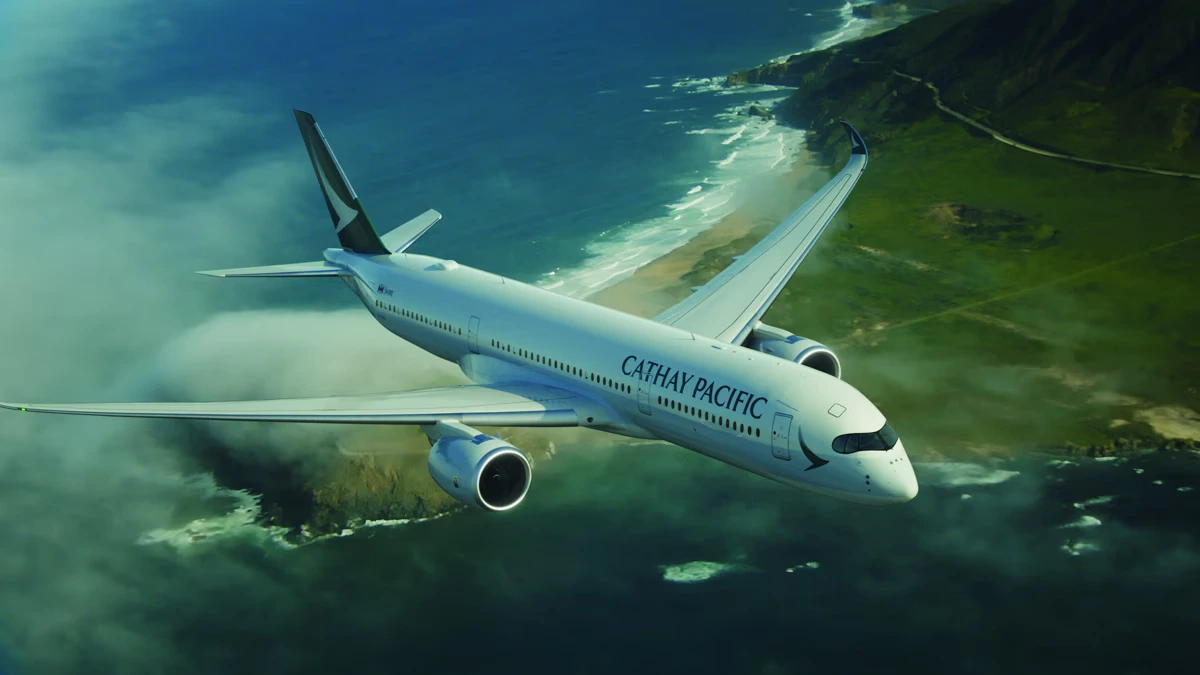
On May 21, 2024, a 73-year-old British passenger named Geoff Kitchen died aboard Singapore Airlines (SQ) flight SQ321 after the Boeing 777-300ER plunged through extreme clear-air turbulence over Myanmar, hurling unrestrained passengers into overhead bins and leaving over a hundred people hospitalized. Only today, Cathay Pacific’s Flight CX156, an A350 suffered turbulence over the skies injuring ten. The reason behind this incident was a phenomenon called turbulence – a word that derives from the Latin turbulentia, meaning agitation or disturbance.
In aviation, turbulence describes the chaotic, irregular movement of air currents that causes an aircraft to experience sudden, unpredictable changes in motion — rolls, pitches, and yaws that passengers feel as anything from a faint vibration underfoot to a violent, weightless lurch. Atmospheric scientists at the University of Reading have now documented that severe clear-air turbulence over the North Atlantic increased by 55 percent between 1979 and 2020.
The Physics Behind the Bump that is Turbulence
At its most fundamental level, turbulence is a state of fluid motion — in this case, air — characterized by chaotic fluctuations in velocity and pressure. The Nobel laureate physicist Richard Feynman famously described turbulence as the most important unsolved problem in classical physics. In practical aviation terms, turbulence occurs when an aircraft moves through a region of atmosphere where airflows at different velocities meet, creating eddies and vortices that impose sudden, asymmetric forces on the airframe.
Air behaves as a fluid, and like all fluids it moves in currents. When those currents are laminar i.e. smooth, layered, and orderly, an aircraft passes through them without perceptible disruption. When the currents become turbulent, the pressure differences across the wings and fuselage fluctuate rapidly, transmitting that instability directly to passengers and crew. The severity of the resulting motion depends on the scale of the eddies relative to the size of the aircraft: large, sweeping atmospheric disturbances tend to produce rolling or pitching motions, while smaller, faster eddies generate the rapid, staccato jolts that passengers find most alarming.
The Five Primary Types of Turbulence and How Each Forms
Understanding turbulence demands distinguishing between its distinct types, because each has a different origin, a different set of telltale signs, and a different mitigation strategy.One can characterize it variously in the forms of clear air turbulence, mechanical turbulence, thermal turbulence, mountain turbulence, and wake turbulence. This is a taxonomy broadly consistent with ICAO and FAA classifications.
Clear air turbulence (CAT)
CAT is arguably the most consequential and the least understood. It occurs above 15,000 feet in the complete absence of cloud cover, making it invisible to both the naked eye and conventional weather radar. CAT is generated primarily by wind shear concentrated in and around jet streams at cruising altitudes of 23,000 to 39,000 feet. As we previously explained, CAT is typically associated with regions exhibiting strong wind shear, horizontal deformation, and convergence, often with insufficient moisture to form clouds.
The fact that specific cloud patterns can sometimes indicate nearby CAT means that pilots and dispatchers must treat these formations as early warning markers. Temperature inversion, or vertical wind shear potential, can also produce it. CAT constitutes 75 percent of all turbulence encounters above cloud-free regions and represents the variant most closely associated with climate-driven increases.
Mechanical turbulence
Mechanical Turbulence arises when horizontal wind flows over physical surface obstructions such as buildings, forests, coastlines, and mountain ranges, producing chaotic eddies in the lowest layers of the atmosphere. The rougher the terrain and the stronger the surface winds, the more violent the mechanical disturbance.
At ground level, this manifests during takeoff and approach as gusty, unpredictable conditions; above terrain features, it can persist into the lower portion of the climb-out phase. IVAO’s documentation notes that mechanical turbulence can also produce squalls — sudden, sustained increases in wind speed lasting several minutes — which impose abrupt load changes on aircraft structure.
Thermal (convective) turbulence
Thermal Turbulence results from rising columns of warm air heated by solar radiation at the surface. On a clear summer afternoon, uneven surface heating creates localized updrafts and compensating downdrafts, producing the characteristically bumpy conditions that make mid-day flying at lower altitudes uncomfortable.
Cumulonimbus clouds are the visible, dramatic expression of convective turbulence taken to its extreme: thunderstorms can generate vertical currents powerful enough to impose extreme structural loads on commercial aircraft and cause uncommanded altitude excursions of thousands of feet.
Mountain turbulence
Mountain Turbulence, also called orographic turbulence, occurs when stable air flows over a mountain ridge and generates a series of atmospheric waves on the downwind (lee) side. Mountain waves can extend more than a thousand kilometres downwind and can reach jet stream altitudes, producing violent rotors at their crests.
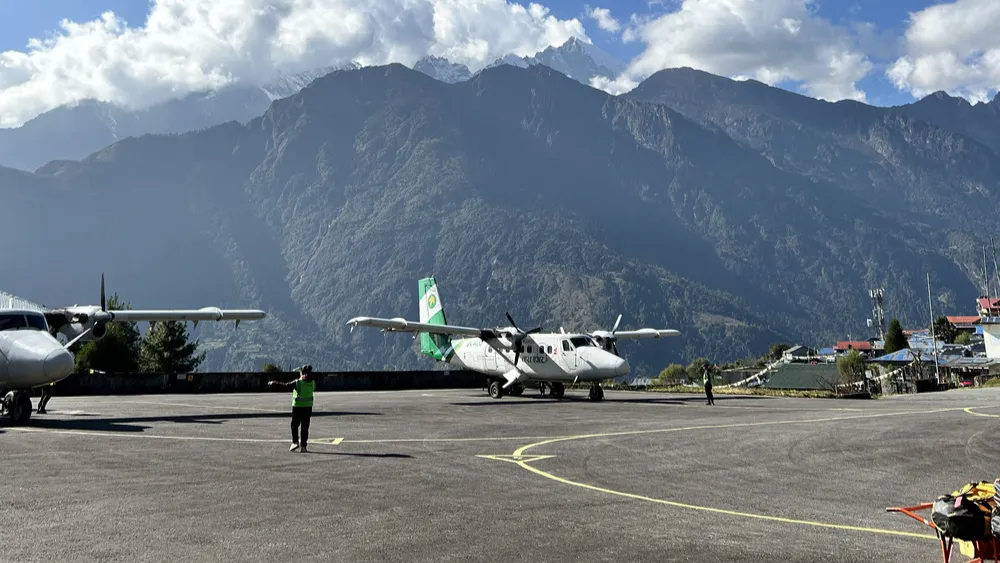
This type of turbulence was observed at Mingbo Airport, a rather esoteric aerodrome that was located in the Lukla region of Nepal, and was considered to be the most dangerous. The catastrophic 1966 crash of BOAC Flight 911 near Mount Fuji (addressed in detail below) remains the defining historical case study in the lethal potential of orographic turbulence.
Wake turbulence
Wake Turbulence is an entirely aircraft-generated phenomenon. As a wing produces lift, it sheds tight, swirling vortices from its tips that trail behind the aircraft in a gradually descending, counter-rotating pair. A following aircraft that flies through these vortices can experience sudden, violent roll inputs.
Wake turbulence is most intense at low speed and high angle of attack. This is why air traffic controllers enforce minimum separation distances between successive aircraft, particularly when a heavy widebody precedes a smaller jet on final approach.
Five Misconceptions and Myths Related Turbulence
Despite the breadth of publicly available information, a number of persistent myths about turbulence continue to generate unnecessary fear and, in some cases, dangerous complacency.
The first myth holds that turbulence can be fully predicted. It cannot. The second myth holds that turbulence can tear an aircraft apart. With the exception of extreme, well-documented circumstances involving mountain wave rotors or entry into tornadoes, this is false. As the engineering discussion above makes clear, design load factors, destructive wing testing, and composite construction provide an exceptional safety margin over any turbulence an aircraft is realistically likely to encounter.
The third myth holds that pilots are always warned about approaching turbulence. In the case of convective turbulence associated with visible cloud formations, onboard weather radar provides useful guidance. In the case of CAT, no such warning system exists.
The fourth myth holds that injuries are common among passengers following standard crew instructions. The data show the opposite. Of the serious turbulence injuries recorded by the FAA between 2009 and 2021, the majority involved individuals who were not wearing seatbelts. The seatbelt is the single most effective turbulence injury-prevention tool available and requires no technological investment whatsoever.
The fifth myth conflates the discomfort of turbulence with structural danger, as we should note that Turbulences are issues of comfort rather than danger. Cabin crew experience exactly the same physical motions as passengers during a turbulence encounter. Their composure is not performative indifference — it reflects professional knowledge that what the aircraft is experiencing is well within the envelope it was designed to survive.
Climate Change and The Rising Frequency of Clear Air Turbulence
The most consequential development in the field of aviation turbulence over the past decade is not an operational or engineering one but a geophysical one: mounting scientific evidence that clear air turbulence is already increasing as a direct consequence of anthropogenic climate change and will continue to do so at an accelerating rate.
The landmark study, published in June 2023 in the peer-reviewed journal Geophysical Research Letters by researchers Mark Prosser and Professor Paul Williams of the University of Reading, analysed four decades of atmospheric reanalysis data and reached unambiguous conclusions. At a typical point over the North Atlantic — one of the world’s busiest flight corridors — the total annual duration of severe turbulence increased by 55 percent, from 17.7 hours in 1979 to 27.4 hours in 2020.
Moderate turbulence over the same corridor increased by 37 percent, and light turbulence by 17 percent. Significant increases were documented over the USA, Europe, the Middle East, and the South Atlantic as well.
Carbon dioxide emissions warm the upper troposphere unevenly, strengthening the temperature gradient between the tropics and the poles and thereby intensifying jet stream wind shear — which has already increased by 15 percent at aircraft cruising altitudes since 1979.
A further increase of between 17 and 29 percent is projected by 2100 under current emissions trajectories. At the May 2025 European Geosciences Union conference in Vienna, Professor Williams warned delegates that along some of the world’s busiest routes, turbulence was projected to “double or treble or quadruple over the next few decades” — with jet stream regions in both hemispheres affected.
A follow-up study published in the Journal of Geophysical Research: Atmospheres in 2024 found that moderate-to-severe CAT had increased by between 60 and 155 percent over East Asia, the Middle East, North Africa, the North Atlantic, and the North Pacific between 1980 and 2021. Mohamed Foudad of the University of Reading, the study’s lead author, stated: “We now have high confidence that climate change is increasing clear air turbulence in some regions.”