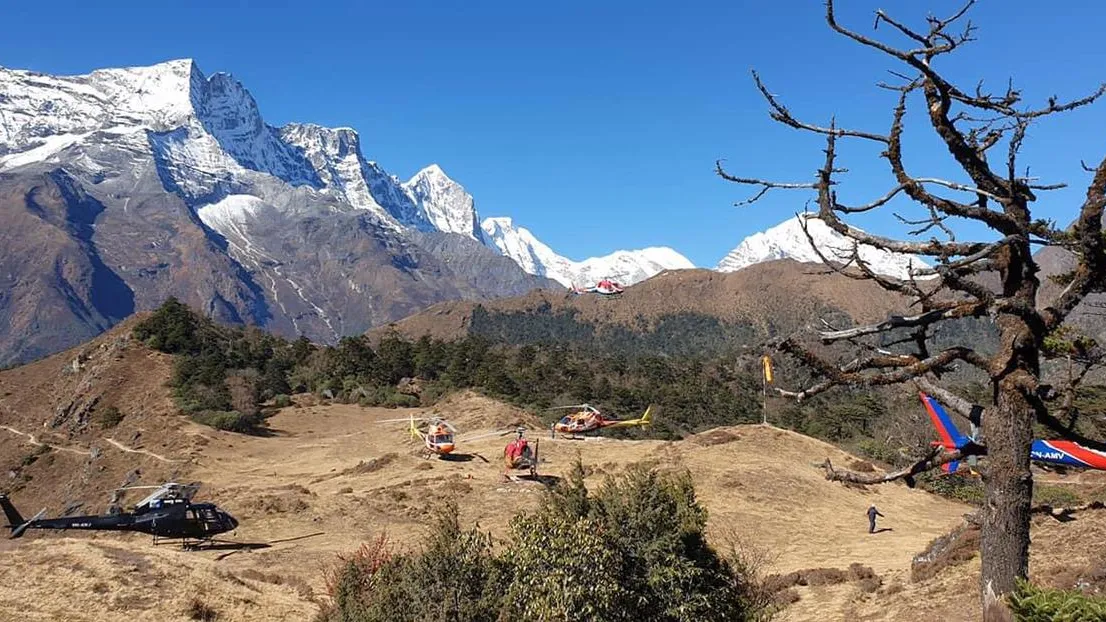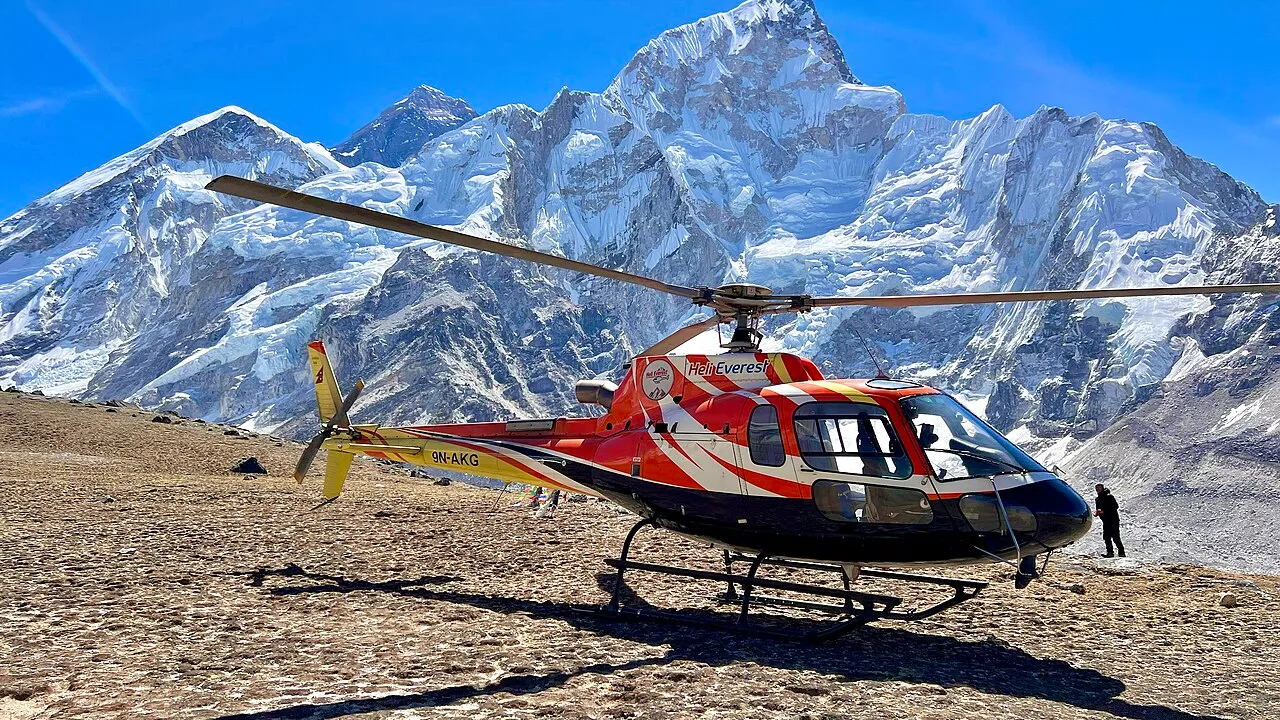
Amid these adversities, the recently exposed fake helicopter rescue scam has severely damaged Nepal’s tourism image. Although a report in 2018 revealed that Nepal-based agents of foreign insurance companies were involved in amassing insurance money through fake rescues, the concerned authorities failed to address it in a timely manner and allowed the racket to continue operating unhindered. With the Central Investigation Bureau (CIB) now having filed formal charges, the full scale of the fraud is finally becoming clear.

Photo: Dailyhelifly | Wikimedia Commons

The Scale and Structure of the Fraud

In late 2025, the CIB resumed the fake rescue investigation following an increase in complaints from foreign insurance companies regarding fraudulent rescue claims. The probe uncovered evidence of forged medical and rescue documents, inflated helicopter invoices, and unnecessary evacuations of trekkers. Fraudulent insurance claims totalling nearly USD 20 million were allegedly generated through the scam between 2022 and 2025.

The CIB’s findings show the fake rescue scam was not a sporadic, opportunistic act by random tour operators, but a coordinated, structured, and commission-based network. Between 2022 and 2025, investigators reviewed 4,782 foreign patients treated at hospitals suspected of involvement; at least 317 rescue operations were found to be completely fabricated or manipulated. According to Business Standard, Financial records show that one hospital in Kathmandu received more than USD 15.8 million linked to such cases, while another received over USD 1.2 million.

The Fraud Network — Who Was Involved

  • Trekking guides & company managers
  • Helicopter charter operators
  • Private hospitals & administrators
  • Doctors signing forged discharge records
  • Rescue company executives
  • Insurance claim processors
  • Government officials (alleged)
  • Some complicit tourists

The scheme was sophisticated in its mechanics. Guides allegedly convinced trekkers unwilling to walk back down from high-altitude points to feign illness, then ferried multiple tourists on a single helicopter while supplying separate invoices to each passenger’s insurance company — inflating claims from USD 4,000 to as high as USD 12,000 per supposed dedicated flight.

Medical officers acting in concert prepared discharge summaries using forged digital signatures of senior doctors. Investigators also found CCTV footage showing tourists drinking beer at a café while hospital records claimed they were receiving intensive care.
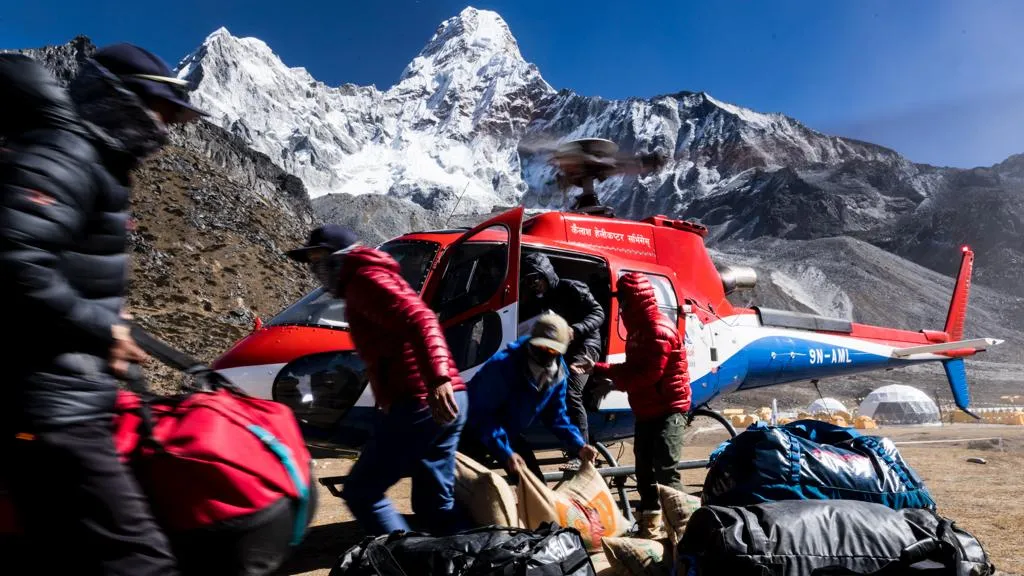
Photo: Chhutin Sherpa | aviospace.org

The CIB Investigation and Charges

In 2018, an investigative report published by Insurance watchdog Traveller Assist found a third of Nepal’s 1,600 annual helicopter rescues are fraudulent. This amounted to nearly USD 4 million, according to Nepali Times.
In September 2025, the time when 2,000 protestors threatened to burn down the nation’s main international airport, Citizen group ‘Deshbhakta Gen Z’ filed formal complaint, triggering CIB to reopen investigation.
In January 25, 2026, CIB arrested six senior executives from Nepal Charter Service, Everest Experience, and Mountain Rescue on charges of organised crime, fraud, and money laundering. A couple of months later, CIB submitted 1,243-page investigation report to government attorney’s office, recommending 33 individuals be charged.  However, on March 23, 2026, Government attorney’s office files charges at Kathmandu District Court against only 32 defendants. 
In April 2026, international media coverage intensifies as Der Spiegel, Nikkei Asia, Business Standard, and Outside Online all publish major reports on such cases. Nepal Police CIB issued statement denying food poisoning allegations. The CIB identified Rajendra Bahadur Singh — former managing director of Mountain Helicopters and former vice-president of the Airlines Operators Association — as the alleged mastermind.  However, the government attorney’s office filed the case against only 32 individuals, notably dropping Singh. CIB investigators expressed dissatisfaction: “We had submitted audio recordings showing how he instructed others to hide evidence.” 
Critics further allege that the original 1,243-page report was significantly shortened to 748 pages, with important evidence removed. The 32 defendants span the full breadth of the fraud network: helicopter company staff, doctors and hospital administrators from Era International, Swacon, and Shreedi International hospitals, and personnel from 16 trekking companies:
Name Organization / Company Role / Position Status / Details
Pasang Dawa Tamang Altitude Air Station Manager Charged
Prakash Babu Dahal Manang Air Junior Marketing Staff Charged
Chandra Prasad Pyakurel (Sudeep) Altitude Air Marketing Manager Charged
Sandip Bhandari Mountain Helicopters Staff Member Charged
Dr Minlama Pandey Swacon International Hospital Doctor Charged
Dr Shyam Sundar Kandel Doctor Charged
Shreeram KC Hospital-Linked Individual Charged
Dr Girban Raj Timilsina Shreedhi International Hospital Doctor Charged and Previously Arrested
Ganesh Silwal Era International Hospital Former Operator Charged
Jeevan Pandey Era International Hospital Current Operator Charged
Bhanu Dhakal Hospital-Linked Individual Charged
Furba Chhiring Sherpa Hospital-Linked Individual Charged
Mamita Bhatta Hospital-Linked Individual Charged
Chungla Bhutiya Sherpa Hospital-Linked Individual Charged
Muktiram Pandey Everest Experience and Assistance Chairman Previously Arrested
Subash KC Everest Experience and Assistance Shareholder Previously Arrested
Bivek Pandey Mountain Rescue Service Manager Previously Arrested
Jayaram Rimal Mountain Rescue Service / Swacon Hospital Chairman / Shareholder Previously Arrested
Rabindra Adhikari Nepal Chartered Service Chairman Previously Arrested
Sandip Tiwari Royal Holidays Adventure Staff Member Previously Arrested
Pasang Sherpa Panorama Himalayan Trekking and Expedition Shareholder Previously Arrested
Bivek Thapaliya Nepal Chartered Service Staff Member Previously Arrested
Sandip Dhungana Himalayan Masters Adventure and Travel Staff Member Charged
Shanta Kumar Baniya Magic Himal Treks and Expedition / Heli On Call Director Charged
Binod Sapkota Nepal Trek Adventure and Expedition Operations Head / Executive Director Charged
Tenzing Sherpa Himalaya Trekking and Expedition Trekking Guide Charged
Badri Lamsal Spiritual Excursion Staff Member Charged
Kabindra Lamsal Spiritual Excursion Staff Member Charged
Bishnu Prasad Lamsal Nepal Hiking Adventure Company Staff Member Charged
Santosh Adhikari (Khomraj Adhikari) Nepal Chartered Service / Flying Yak Kathmandu Former Shareholder / Operator Charged
Ram Kumar Phuyal WorldMed Assistance Nepal Staff Member Charged
Photo: Ajendra Rai | aviospace.org

Inside The Food Poisoning Allegation And The Questions That Followed

Perhaps the most damaging allegation — and the one most amplified by international media — is that trekking guides deliberately spiked tourists’ food with substances to induce illness and justify helicopter evacuations. Germany’s Der Spiegel, one of the most influential news magazines in Europe, published a prominent report on this allegation, raising serious alarm given that Germany is a major source market for Nepal’s trekking industry.


Nepal Police’s CIB has explicitly stated that its investigation found no evidence of food adulteration. The CIB warned that spreading such unverified claims is illegal, and cautioned media against amplifying unconfirmed allegations. An independent analysis of the 32-defendant charge sheet found hundreds of pages of evidence for insurance fraud — and zero evidence for intentional poisoning.
The distinction matters enormously. Insurance fraud, however serious, is a targeted financial crime. A narrative of systematic poisoning of foreign tourists transforms Nepal into a destination that is fundamentally unsafe — a characterisation that international headlines like “A Scam on the Roof of the World” and “Stop providing cover to tourists travelling to Nepal” have already begun to propagate globally. Of the 32 defendants, only one trekking guide faces charges for direct client interaction — and those charges do not include poisoning.
Photo: Ajendra Rai | aviospace.org

What Happened After The 2018 Warning Was Overlooked

This is not the first time Nepal’s helicopter rescue industry has faced scrutiny. The 2018 report revealed that a third of Nepal’s 1,600 annual helicopter rescues were fraudulent, costing up to USD 4 million. Insurance companies issued Nepal an ultimatum; an investigation committee was formed; 13 companies were named. Insurance premiums for tourists visiting Nepal increased drastically, and some foreign insurance companies stopped providing coverage for Nepal entirely.

Nepal did implement a rule requiring trekking companies and helicopter rescue companies to register with the Tourist Search and Rescue Committee, the Tourist Police, and the Department of Tourism. But the reforms were insufficient.

The fraud declined in scale but never ceased — and by 2025 had resumed with renewed sophistication, now implicating some of the largest trekking agencies and helicopter companies in Kathmandu. Six years of regulatory inaction between the 2018 warnings and the 2025 CIB investigation represents a systemic failure of governance.

Mil Mi-17s in Phaplu Airport
Photo: Chhutin Sherpa | aviospace.org

The Growing Impact on Insurance Rescue Operations and Ethical Companies

The consequences of the scam extend well beyond the immediate fraud. Several international insurance underwriters have already imposed stricter verification protocols or increased premiums for high-altitude coverage in the Everest region.

If insurance companies lose broader confidence in Nepal’s rescue system, legitimate emergency evacuations — the kind that save the lives of genuinely ill climbers — could become harder to obtain or prohibitively expensive for trekkers to insure against. In a region where helicopter evacuation is often the only means of saving a critically ill trekker, such changes could prove fatal.


Dawa Sherpa of Ticino Treks and Expedition was quoted by The Tourism Times as saying:

“The ongoing global discussion and complaints regarding so-called fake helicopter rescues are having a serious and negative impact on Nepal’s tourism sector. This issue has raised significant concerns about the country’s image and credibility, which is deeply worrying.”
Ethical trekking guides, legitimate rescue providers, and tourism workers stand to suffer from reduced business and increased suspicion even though they were not involved in any wrongdoing. New verification procedures — however necessary — will unintentionally delay genuine emergency rescues in high-altitude regions where minutes matter. Adventurers from key source markets including India, the US, the UK, China, and Bangladesh are already demonstrating hesitancy about booking Nepal trips.
A heliport in Hotel Everest View in the Khumbu region.
Photo: Ajendra Rai | aviospace.org

The Path Forward id Accountability Without Impunity

Tourism is one of Nepal’s most important economic pillars. Tourists have frequently complained of overpriced trekking packages, fake or partially fake trekking permits, and other fraudulent acts that have depreciated Nepal’s global reputation over the years.

Nepal Tourism Board CEO Deepak Joshi has acknowledged the structural problem: “Nepali business needs a new strategy. We are moving on a price war rather than a service war. And that is causing desperate measures.” The dropping of charges against the alleged mastermind Rajendra Bahadur Singh — despite audio recordings submitted by CIB investigators — sends a wrong signal to both domestic fraudsters and the global tourism community.