Japan Airlines (JL), an airline with one of the longest beds in the business class, announced on 27 May 2026 the launch of the ARGO Trans-Lunar Heritage Project — a commercial initiative to transport physical cultural artefacts and contemporary human heritage to the surface of the Moon aboard a lunar lander operated by Japanese space startup ispace. The project, jointly developed by JAL, its trading subsidiary JALUX, and ispace, targets ispace’s Mission 3 lunar landing, currently scheduled for 2028, and opens payload booking to private companies and local governments from the date of announcement.
If executed as planned, JAL will become the world’s first airline to transport items beyond Earth’s orbit, a milestone that analysts describe as the carrier’s initial step into the broader space economy. The announcement formalises a relationship with ispace that dates to November 2025, when JAL, JALUX, and JAL Engineering signed a memorandum of understanding (MOU) with the lunar exploration company to explore cooperation in lunar transportation and operations.
Wednesday’s payload service agreement (PSA) between JALUX and ispace represents the first concrete implementation of that memorandum. In an official press release, JAL stated:
“In the rapidly changing world, there is a constant risk that precious cultural artefacts and ways of life could be suddenly lost. The lunar environment offers a location to protect and preserve these valuable cultural assets until the day they are opened by future generations.”
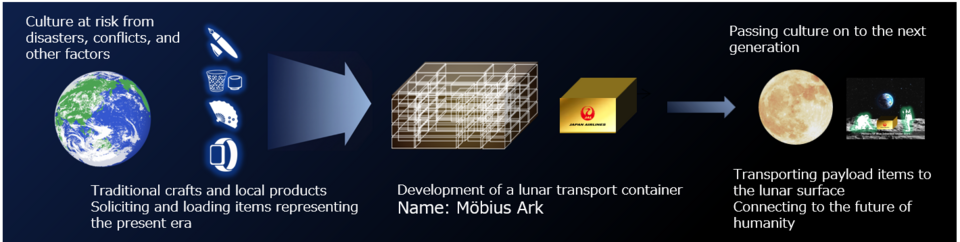
What Is the ARGO Trans-Lunar Heritage Project and How Will It Work?
The ARGO project draws its name from Argo Navis, the now-defunct constellation that represented the mythological ship sailed by Jason and the Argonauts in Greek legend. JAL frames the initiative around the concept of an “Ark Relaying for Generations Onward” — a deliberate preservation mission aimed at safeguarding human culture against the existential threats of climate change, armed conflict, and natural catastrophe.
Operationally, the project assigns distinct responsibilities to each partner:
- JALUX will design, develop, and manage the dedicated lunar transport container, named the Möbius Ark. It will also solicit and curate the items slated for inclusion from businesses and public bodies.
- JAL will coordinate with local governments and companies across Japan to collect artefacts that reflect contemporary culture, including regional specialties and products representative of local industries.
- ispace will transport the Möbius Ark aboard its ULTRA lunar lander to the Moon’s surface during Mission 3, planned for launch in 2028.
The Möbius Ark container measures approximately 20 centimetres in length and width and 10 centimetres in height, with its interior divided into compartments and constructed from materials engineered to withstand the extreme thermal, vacuum, and radiation conditions of the lunar environment. The container is not designed for retrieval; it will remain on the lunar surface indefinitely, to be accessed, in JAL’s framing, by future generations of lunar inhabitants.
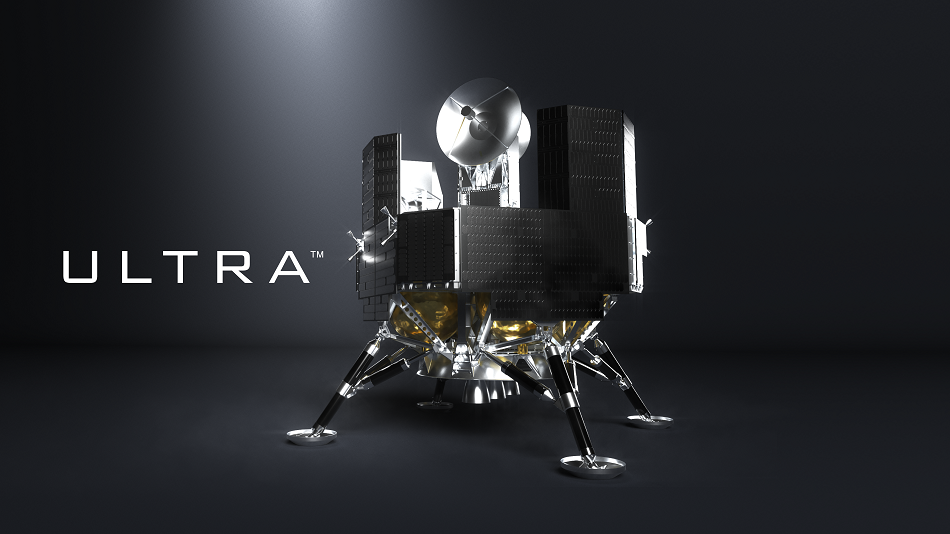
The ispace ULTRA Lander: the Vehicle That Will Carry the Möbius Ark
The lander designated to carry the Möbius Ark to the Moon is ispace’s ULTRA, the company’s newest and most advanced spacecraft model. ispace announced the ULTRA lander in March 2026, describing it as an integrated design that unifies two previously parallel development programmes — the APEX 1.0 lander developed by ispace’s U.S. subsidiary and the Series 3 lander under development by the Japanese parent entity. The ULTRA’s name derives from the Latin word for “beyond,” and its design incorporates propellant tanks and a communications system originally developed for the APEX 1.0 programme.
According to Reuters, the ULTRA lander is capable of carrying a payload of up to 200 kg to the lunar surface. Mission 3, to be led by ispace’s Japan entity and funded in part through a Small Business Innovation Research (SBIR) grant from Japan’s Ministry of Economy, Trade and Industry (METI), is scheduled for launch in 2028. The mission will deploy the ULTRA to the lunar surface, carrying both the ARGO payload and other commercial customers’ consignments contracted under the same agreement.
The ULTRA represents a significant redesign from the landers used in ispace’s two previous missions, both of which ended in hard landings on the lunar surface. As SpaceNews reported in March 2026, the redesign includes a change in engine vendor from Agile Space Industries, whose VoidRunner engine was originally planned for both the APEX 1.0 and Series 3 platforms, and consolidates development under a single global team.

Industry Opinion on the ARGO Project is Divided
Industry opinion on the ARGO project is divided between those who see it as a genuine and strategically coherent step toward space-sector diversification and those who question whether it represents meaningful commercial activity or principally a brand-building exercise.
Toshimitsu Sogabe, an aviation industry analyst at Tokyo-based Cirium Ascend Consultancy, offered a measured endorsement of the initiative when quoted by the South China Morning Post:
“I see this as a diversification away from the purely commercial aviation space for the airline, and we have seen other companies pursue similar strategies with advanced mobility and other projects. The commercial aviation industry is going through a bit of a tough time at the moment, and there’s a lot of uncertainty around, so it makes sense for airlines to be diversifying.”
Sogabe’s framing positions the project as the opening move in a longer-term strategy rather than a standalone initiative.
The South China Morning Post also noted that sceptics characterise the project as a public relations stunt, a critique that the payload’s small dimensions and the absence of any confirmed mechanism for the artefacts to be accessed or retrieved from the lunar surface makes difficult to entirely dismiss.
The Möbius Ark, at 20 cm × 20 cm × 10 cm, can carry only a limited volume of material, and the project’s cultural impact will depend substantially on whether ispace’s Mission 3 achieves what two previous missions could not.
Travel And Tour World noted that the ARGO project carries notable tourism potential for Japan, with the prospect of museum exhibitions and interactive cultural events in cities such as Tokyo and Osaka centred on the items destined for the Moon. This secondary dimension of the initiative — activating domestic cultural tourism interest — may prove to be as commercially significant for JAL’s brand as the mission itself.

Japan’s Broader Lunar Ambitions
Japan’s Ministry of Economy, Trade and Industry (METI) has actively funded ispace’s Mission 3 development through the SBIR programme, and Japan’s participation in NASA’s Artemis programme has provided a framework for civilian-commercial cooperation in lunar exploration.
“While it’s true that we are moving against NASA’s push to accelerate moon missions in 2028–29 … as the only private company outside the U.S. with moon landing technology, we are seeking a greater role in their programme.”
Changes to the American space programme under President Donald Trump have introduced uncertainty for Japanese space ventures that had anticipated deeper U.S.-Japan cooperation, particularly as a counterweight to China’s expanding lunar ambitions. The ARGO project, with its payload sales launch, injects both cultural purpose and commercial momentum into ispace’s Mission 3 at a moment when the geopolitical rationale for Japanese lunar participation has arguably never been stronger.