
When President Donald Trump – the person after whom the Salt Lake Airport could be renamed into Donald Trump Airport – unveiled an ambitious new defense initiative called Golden Dome, a proposed multi-layered missile defense system designed to protect the United States from ballistic, cruise, and hypersonic missile threats, little did people know that the estimated $175 billion price tag would be absolutely dwarfed compared to the $1.1 trillion estimated in a report presented by Sana Pashankar, Becca Wasser, Kyle Kim, Stephanie Davidson for Bloomberg Businessweek.
Based on Congressional Budget Office (CBO) guidance (which had produced a report in May claiming that the constellation of space based interceptors (SBIs) alone could cost as much as upwards of $500 billion) and think-tank modeling, total expenditures over 20 years could exceed $3 trillion, outstripping the original estimate by more than 500 percent.
Key Numerical Data Related to the “Golden Dome” Missile Defense Proposal
| Category | Figure | Context / Description |
|---|---|---|
| Estimated total project cost (Trump) | $175 billion | President Trump’s stated cost to build the Golden Dome missile defense system |
| Initial funding request | $25 billion | Proposed allocation to begin construction in the next federal budget |
| Target completion timeline | Before end of presidential term | Trump’s stated goal for completion |
| Estimated construction period (Trump) | ~3 years | Implied timeline based on Trump’s comments |
| Satellite constellation size (Golden Dome) | Thousands of satellites | Estimated number of missile-sensing and interceptor satellites required |
| Starlink satellites in orbit (comparison) | ~7,000 satellites | Current size of SpaceX’s Starlink constellation |
| CBO lower-bound cost estimate | $161 billion | Congressional Budget Office estimate over 20 years |
| CBO upper-bound cost estimate | $542 billion | High-end Congressional Budget Office estimate over 20 years |
| Cost estimate timeframe (CBO) | 20 years | Period used by CBO for lifecycle cost modeling |
| Senator Tim Sheehy cost outlook | Trillions of dollars | Estimate if Golden Dome reaches full operational maturity |
| Reagan SDI announcement year | 1983 | Launch of the Strategic Defense Initiative |
| Reagan feasibility horizon | Decades | Timeframe Reagan cited for potential completion |
| Existing U.S. ICBM interceptors | Small number | Current midcourse interceptors targeting North Korea |
| ICBM terminal speed | Hypersonic | Speed regime during reentry phase |
Source: wusf.org (as reported in May 2025)

Golden Dome Project Overview
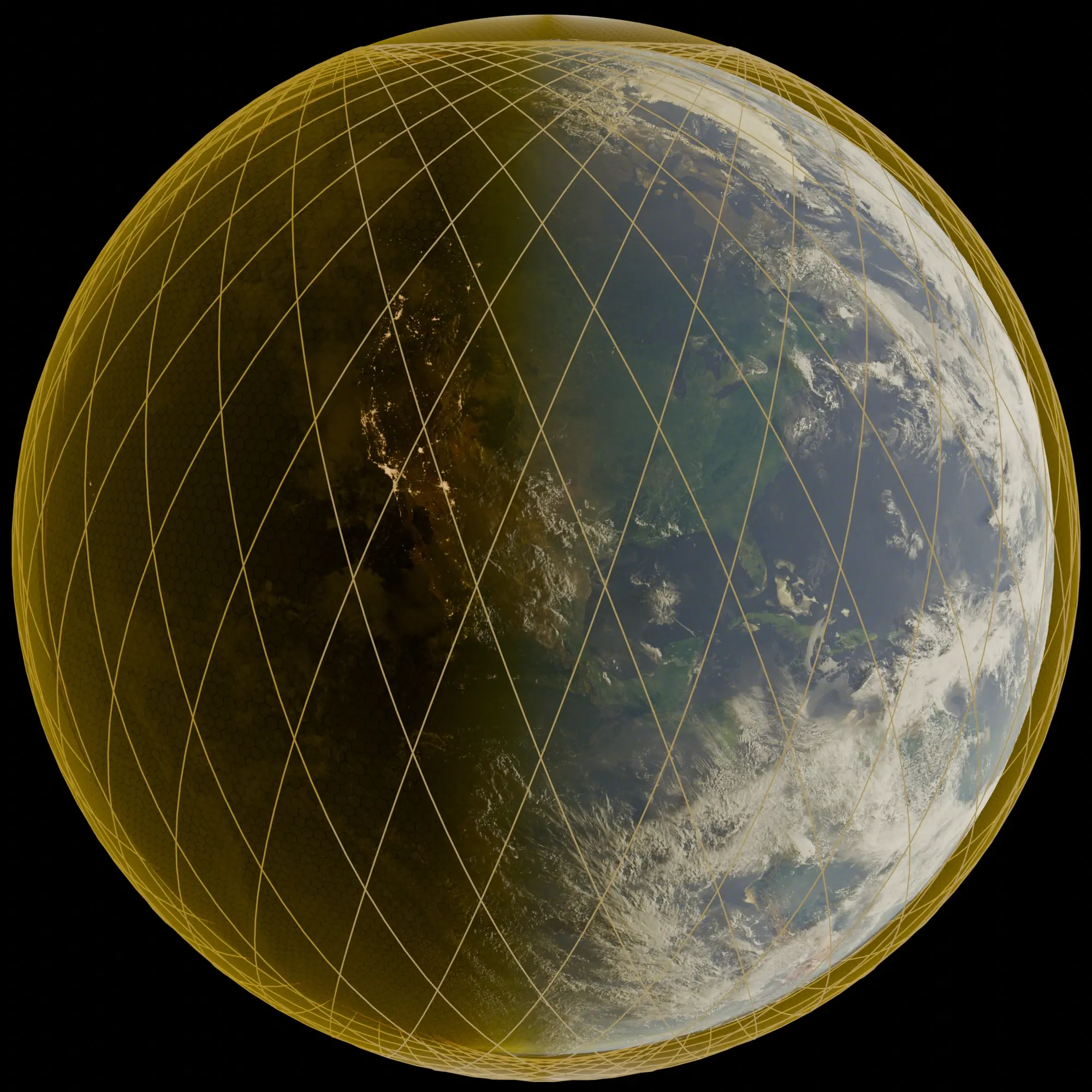
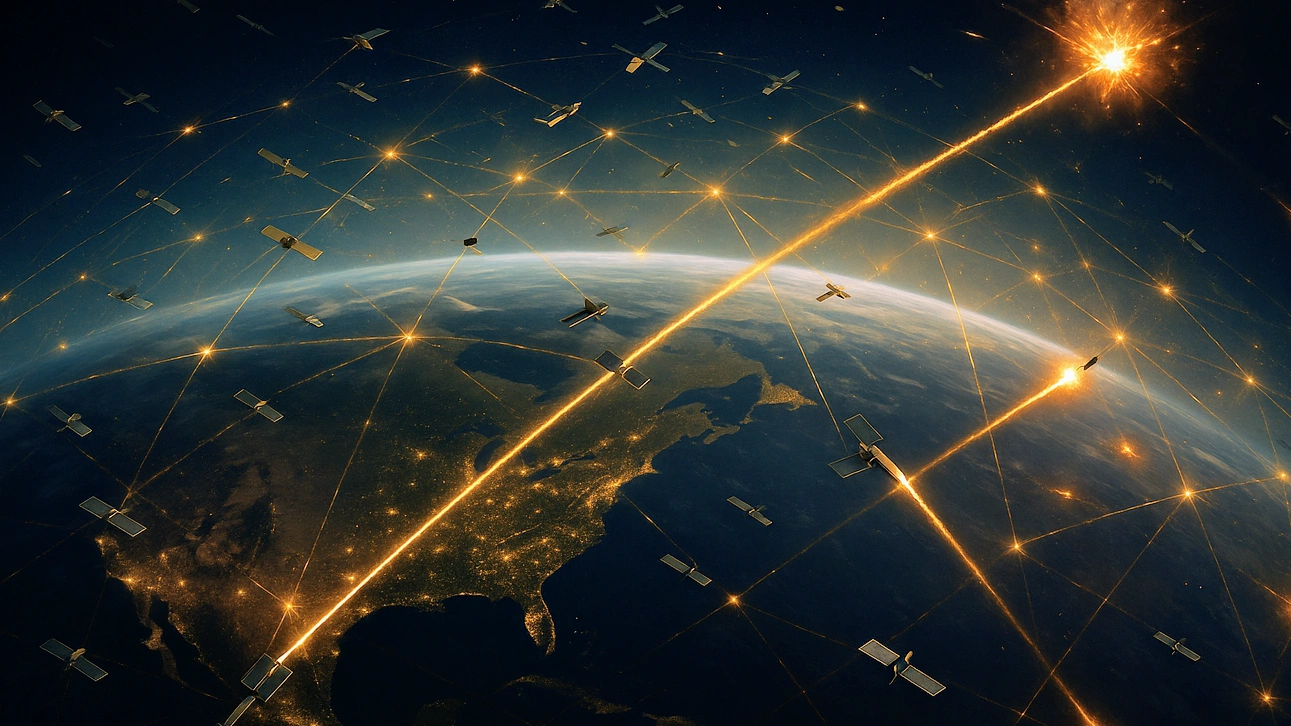
The Golden Dome missile defense concept aims to create a global shield capable of detecting and intercepting missiles at multiple phases of flight, including during boost, mid-course, and terminal stages. Its architecture combines space-based interceptors, advanced satellite sensors, and integrated ground-based systems, an approach resembling but far broader in scale than Israel’s Iron Dome.
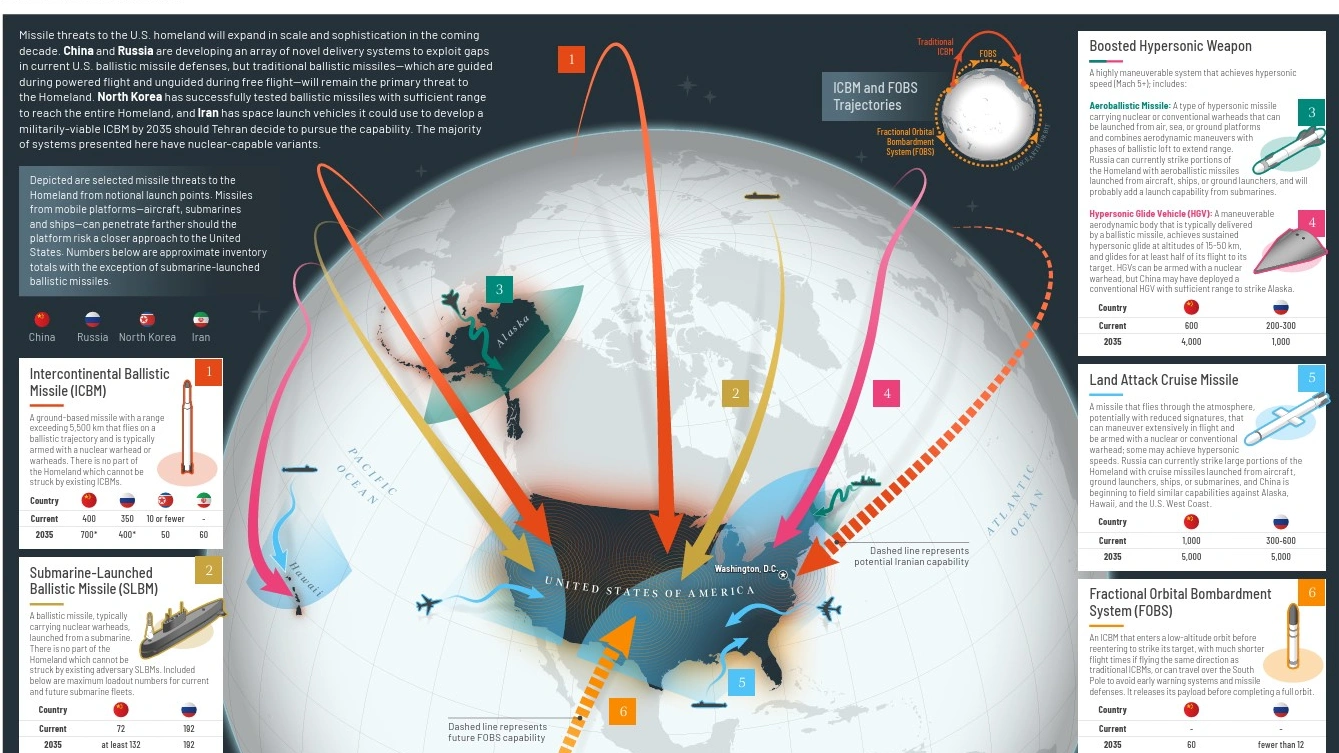
The following are the types of threats that the Golden Dome is designed to address:
| Threat Type | Description of Threat | Golden Dome Relevance | Notes |
|---|---|---|---|
| Intercontinental Ballistic Missiles (ICBMs) | Long-range nuclear missiles launched from deep inside adversary territory | Builds on existing U.S. ICBM-focused systems with added layers | – |
| Hypersonic weapons | Weapons traveling faster than the speed of sound with maneuverability | Requires earlier detection and new interception methods | The United States’ North American X-15 was the first hypersonic program in aviation history. Since then, other nations such as Russia and China have |
| Fractional Orbital Bombardment Systems (FOBS) | Weapons that enter partial orbit before attacking from unexpected directions | Demands space-based sensing and interception | FOBS are capable of delivering warheads from space. |
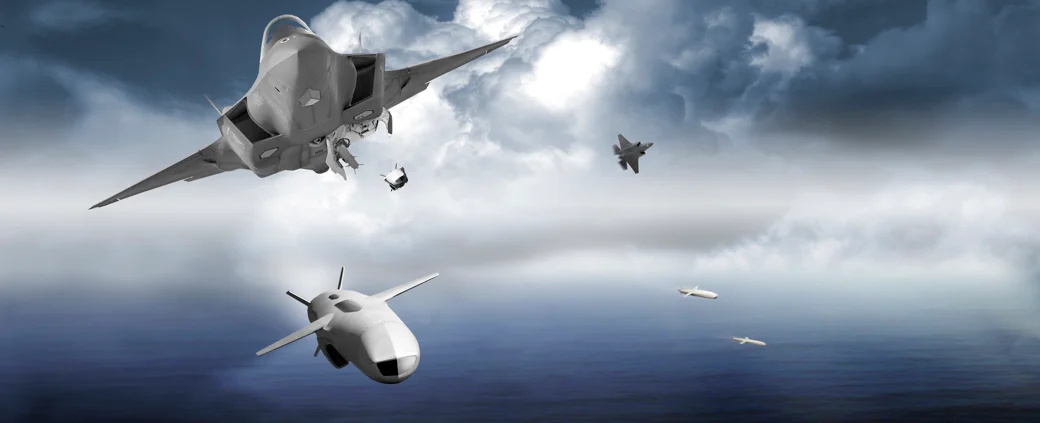
| Cruise missiles | Low-flying, maneuverable missiles targeting infrastructure | Necessitates multi-layer, non-ICBM defense | – |
| Electromagnetic Pulse (EMP) attacks | High-altitude nuclear detonations disabling electronics | Drives emphasis on early interception in space | According to the BBC, an EMP could be generated when a single, relatively small nuclear detonation took place a hundred miles over the US airspace : “Planes would fall out of the sky across the country. Everything from handheld electronics and medical devices to water systems would be rendered completely useless“. |
.jpg)
When the Golden Dome Project was launched, President Trump was quoted in The White House as having said:
“In the campaign I promised the American people I would build a cutting-edge missile defense shield…Today I am pleased to announce we have officially selected architecture for this state-of-the-art system. Once fully constructed, the Golden Dome will be capable of intercepting missiles even if they are launched from other sides of the world, and even if they are launched from space…This is very important for the success and even survival of our country.”
The Golden Dome initiative is formally grounded in a January 27, 2025, executive order directing the Department of Defense to produce a comprehensive architecture, with The Space Force expected to play a seminal role, but the service’s Chief of Space Operations, Gen. B. Chance Saltzman, was “worried about having the resources needed for everything it’s already been asked to do”, reported Space Policy Online. One of the concerns that the Space Force faced was “the loss of 14 percent of their civilian personnel due to the Trump Administration’s directive to cut the federal workforce”. The following numbers were pertinent too:
- Around 1,000 fewer civilian by the end of this year than planned
- Civilians comprise about one-third of the Space Force’s 14,000 personnel.
Gen. B. Chance Saltzman was quoted in the same source as having said:
“With about 3 percent of the DOD budget and less than 1 percent of the personnel, the Space Force is a great value proposition for the Department. For this tiny fraction of resources you enable a service that has become indispensable to modern power projection. However, despite the dramatic rise in threats and increasing importance of space over the last few budget cycles, the Space Force has experienced shrinking resources. This disconnect between value and investment creates risk for our nation, further exacerbating the situation.”
US Golden Dome: Initial Cost Estimate vs projected long-term costs
The Trump administration’s public estimate for Golden Dome is $175 billion — a figure the president has repeated as a cornerstone of his defense planning. This initial figure reflects a down payment of $25 billion already approved in legislative spending and budget requests.
However, a range of independent cost projections underscores how that number may be only a fraction of the full financial commitment:
| Category | Metric | Value |
|---|---|---|
| Executive Order | Time since signing | ~11 months |
| Adversary arsenals | Nuclear missiles (combined) | Hundreds |
| Adversary arsenals | Other weapons | Thousands |
| Existing US interceptors | Ground-based interceptors | 44 |
| Planned additional interceptors | GBIs | 20 |
| Planned start year (additional GBIs) | Year | 2028 |
| Selected companies (MDA) | Companies | ~1,000 |
| Funding pool (unallocated) | USD | $151B |
| Trump cost estimate | USD | $175B |
| Funds already allocated | USD | ~$25B |
| Trump completion target | Year | 2029 |
| Space-based interceptors cost (CBO) | USD | $161B–$542B |
| Space Force prototype contracts | Contract size | < $9M each |
| Bloomberg full defense estimate | USD | ~$1.1T |
| Bloomberg modest scenario | USD | ~$844.4B |
| Canada proposed contribution | USD | $61B |
| Canada share of total | Percent | ~5% |
Data: Bloomberg
Cost Drivers and Technical Challenges
A key reason for divergent cost projections lies in the space-based component of Golden Dome. Space interceptors and surveillance satellites represent a significant fraction of the budget due to manufacturing, launch, and maintenance requirements. Unlike ground-based defenses, orbiting assets must be regularly replenished due to atmospheric drag and orbital decay. [Take for example, Ingenuity, the helicopter that few on Mars. This tiny 680 gram helicopter cost $80 million. ]
Space-based interceptors would need to detect and engage hostile missiles shortly after launch, demanding both rapid response sensors and precise guidance systems.
Other major cost drivers include:
-
Sensor integration: Coordinating data from ground and space systems in near real-time.
-
Interceptor production: Manufacturing large quantities of weapons designed to operate in harsh orbital environments.
-
Sustainment costs: Replacing aging or spent satellites and interceptors over decades.
These complexities suggest that building and operating a reliable globe-spanning missile network far exceeds the simplified “$175 billion” narrative, prompting concern among defense analysts.
Bloomberg’s report also broke down the cost of various Selected Defense Systems:
| System | Quantity | Cost |
|---|---|---|
| IFPC Inc 2-I | 50–100 | $636.3M–$1.3B |
| IFPC-HEL | 25–50 | $1.4B–$2.8B |
| IFPC-HPM | 40–80 | $696.7M–$1.4B |
| AIM-9X missiles | 2,000–4,000 | $1.5B–$3B |
| MADIS | 160–320 | $2.9B–$5.8B |
| DE M-SHORAD | 130–260 | $4.7B–$9.4B |
| M-LIDS | 100–200 | $261.5M–$523M |
| Coyote interceptors | 8,000–16,000 | $1B–$2B |
| Aegis Ashore | 15–30 | $12B–$24B |
| SM-3 missiles | 1,440–2,880 | $41.3B–$82.7B |
| THAAD batteries | 20–40 | $7B–$14B |
| THAAD interceptors | 960–1,920 | $12.3B–$24.5B |
| AN/TPY-2 radar | 15–30 | $7.3B–$14.6B |
| Patriot batteries | 20–40 | $8B–$16B |
| Patriot interceptors | 1,920–3,840 | $8B–$16.1B |
According to Physics Coalition for Nuclear Threat Reduction, the proposed Golden Dome missile shield is assessed as technically infeasible based on current and near-term technology. The same source also quoted a recent American Physical Society (APS) study which found that the existing midcourse missile intercept system is:
-
-
Highly vulnerable to countermeasures
-
Difficult to scale quickly
-
Not cost-effective to expand
-
Unlikely to provide reliable defense beyond very limited, unsophisticated attacks over the next 15 years
-
claiming that
” a space-based system of interceptors that would have even the theoretical ability to defend the continental United States against a salvo of 10 relatively simple solid-propellant ICBMs and avoid being spoofed would have to have about 40,000 interceptors and could be defeated or destroyed relatively easily.”

Expert Concerns and Feasibility Questions
Critics of Golden Dome emphasize both technical limitations and strategic implications. A recent report by Jessica West and Kathryn Barrett, suggests the proposal is unrealistic and potentially destabilizing. Their analysis estimates that comprehensive coverage might cost as much as $4.4 trillion over 20 years, while also escalating global arms competition. Here’s what the authors identify as key areas:
| Challenge Area | What Golden Dome Aims to Do | Core Technical Constraint | What the Evidence Suggests |
|---|---|---|---|
| Boost-Phase Interception | Destroy missiles seconds after launch using space-based interceptors | Boost phase lasts only ~2–5 minutes, leaving almost no margin for detection, decision-making, and interception | Physics and timing make reliable boost-phase interception at scale extremely unlikely |
| Orbital Coverage Requirements | Maintain constant interceptor presence over all potential launch areas | Satellites move rapidly and cannot hover; ensuring coverage requires massive numbers | Even limited scenarios could require thousands of interceptors; peer-level threats would demand tens of thousands |
| Interceptor Scale | Scale space-based defenses to counter China and Russia | Missile inventories and launch geography far exceed those of smaller states | Defensive scale grows faster than feasibility, making full coverage impractical |
| Sensor Detection Limits | Detect every threat instantly, from drones to hypersonic weapons | Existing sensors weren’t designed for low-flying, stealthy, or unpredictable weapons | Even with new sensors, gaps in detection and tracking would persist |
| Data Fusion & Tracking | Integrate radar and satellite data into a single real-time picture | Current systems are fragmented and generate overwhelming data volumes | AI can help, but software cannot fully compensate for sensor and physics limits |
| Hypersonic Weapons | Track and intercept fast, maneuvering threats at low altitude | Hypersonic weapons move unpredictably and compress reaction time | These weapons remain among the hardest threats to track or defeat |
| Systems Integration | Seamlessly link land, sea, air, and space defenses | Requires near-instant coordination across multiple interceptor types | Current command-and-control technology is not mature enough for this task |
| Automation & Decision Speed | Automate shoot decisions in seconds | Risk of errors rises as systems become faster and more complex | Reliable, fully automated missile defense at this scale remains unproven |
| Political & Legal Constraints | Deploy weapons in orbit at unprecedented scale | Orbital weaponization raises international and domestic resistance | Even if technically feasible, large-scale deployment faces major opposition |
| Overall Feasibility | Deliver full-spectrum homeland missile defense | Multiple unresolved constraints stack on top of each other | A complete Golden Dome resembles a theoretical concept more than a deployable system |
In their study, the authors also quoted the testimony of Lieutenant General Robert Rasch who said that a missile defence system for Guam, would cost approximately $8 billion, using today’s available technology. Scaling this by the number of cities gives an estimate of $6.4 trillion while by land at least $119 billion.

Bottom Line
The Golden Dome missile defense initiative represents one of the most ambitious — and potentially costly — defense projects proposed in recent U.S. history. While initial estimates position it as a $175 billion endeavor, independent assessments suggest the true cost could exceed $3 trillion over 20 years when space-based systems and sustainment are included.
The disparity between political rhetoric and technical realism has sparked deep debate among experts, legislators, and defense planners about whether the promise of near-total defensive coverage is worth the staggering fiscal and strategic price.
To reiterate here are the various projections of the estimated costs of the Golden Dome, as suggested by various sources
-
President Donald Trump has stated that Golden Dome would cost approximately US$175 billion, with the system completed by the end of his second term.
-
US lawmakers have already earmarked nearly US$25 billion for early Golden Dome research and development in Trump’s One Big Beautiful Bill Act.
-
Todd Harrison of the American Enterprise Institute (AEI) estimates that a limited Golden Dome architecture could stay within US$175 billion for the first five years, but would rise to US$471 billion over 20 years. (Source: AEI, “Build Your Own Golden Dome” report)
-
Harrison further estimates that a space-heavy system designed to counter advanced threats from China and Russia would cost roughly US$2.4 trillion over 20 years, with 96% of funding directed to the US Space Force. (Source: AEI)
-
A more ambitious “robust all-threat defense” model could push total Golden Dome costs to US$3.2 trillion over two decades, according to Harrison’s analysis. (Source: AEI)
-
The Congressional Budget Office (CBO) estimates that space-based interceptors alone would cost between US$161 billion and US$542 billion to counter a limited North Korean ICBM threat. (Source: CBO, May report)
-
The CBO notes that defending against peer adversaries like China and Russia would require a significantly larger interceptor constellation, increasing costs well beyond existing estimates. (Source: CBO)
-
A Bloomberg analysis concludes that a Golden Dome capable of defending the US against an all-out multi-adversary aerial attack would cost approximately US$1.1 trillion. (Source: Bloomberg)
-
Bloomberg calculates that even a scaled-down version designed to counter a single major adversary would still cost around US$844 billion. (Source: Bloomberg)
-
Defense experts widely agree that Trump’s US$175 billion estimate understates the true cost by several multiples due to unaccounted research, testing, deployment, and long-term operations. (Source: AEI, Bloomberg, Arms Control Centre)