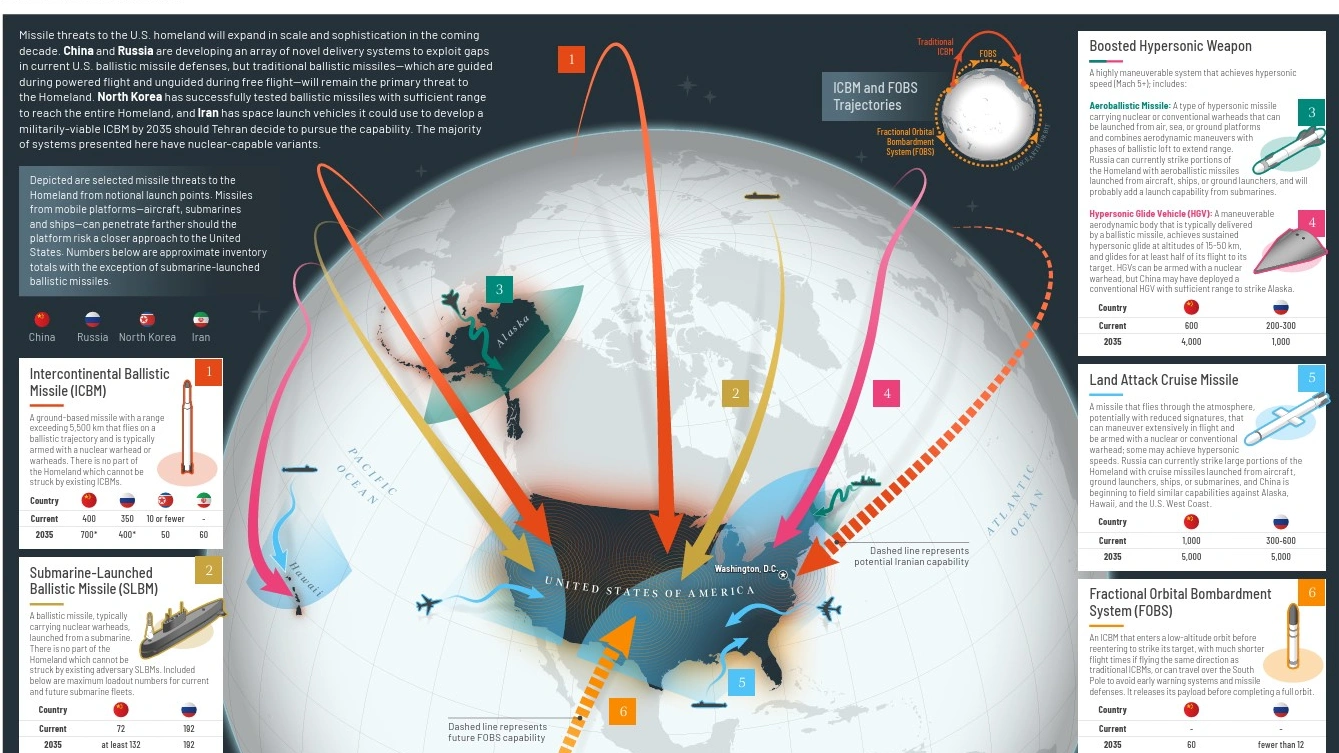
When President Donald Trump – the person after whom the Palm Beach Airport could be renamed into Donald Trump Airport – unveiled an ambitious new defense initiative called Golden Dome, a proposed multi-layered missile defense system designed to protect the United States from ballistic, cruise, and hypersonic missile threats, little did people know that the estimated $175 billion price tag would be absolutely dwarfed compared to the $1.1 trillion estimated in a report presented by Sana Pashankar, Becca Wasser, Kyle Kim, Stephanie Davidson for Bloomberg Businessweek.
The CBO’s own May 2026 estimate put the full 20-year cost at $1.191 trillion — more than six times the administration’s original $175 billion figure. Separate think-tank modeling, including AEI analyst Todd Harrison’s most expansive scenario, puts a maximalist version of the system as high as $3.6 trillion.
The Official Price Tag
Congress has already set aside close to $25 billion for Golden Dome through the tax and spending bill Trump signed in 2025. Defense officials have cited figures ranging from $175 billion to $185 billion as the full cost, though it’s unclear over what time period that number is meant to apply.
The CBO noted that discrepancy directly: its $1.2 trillion figure is “significantly higher” than the $185 billion the Pentagon has cited, and the office said that gap suggests either a much smaller planned system than the one described in Trump’s executive order, or an expectation that other budget accounts will absorb much of the real cost.
Independent Estimates Pull Far Higher
The CBO’s number moved twice. A first estimate in May 2025 put space-based interceptors alone at $161 billion to $542 billion. A follow-up study published in May 2026, using the full scope of Trump’s executive order, arrived at $1.191 trillion over 20 years, with acquisition costs alone topping $1 trillion.
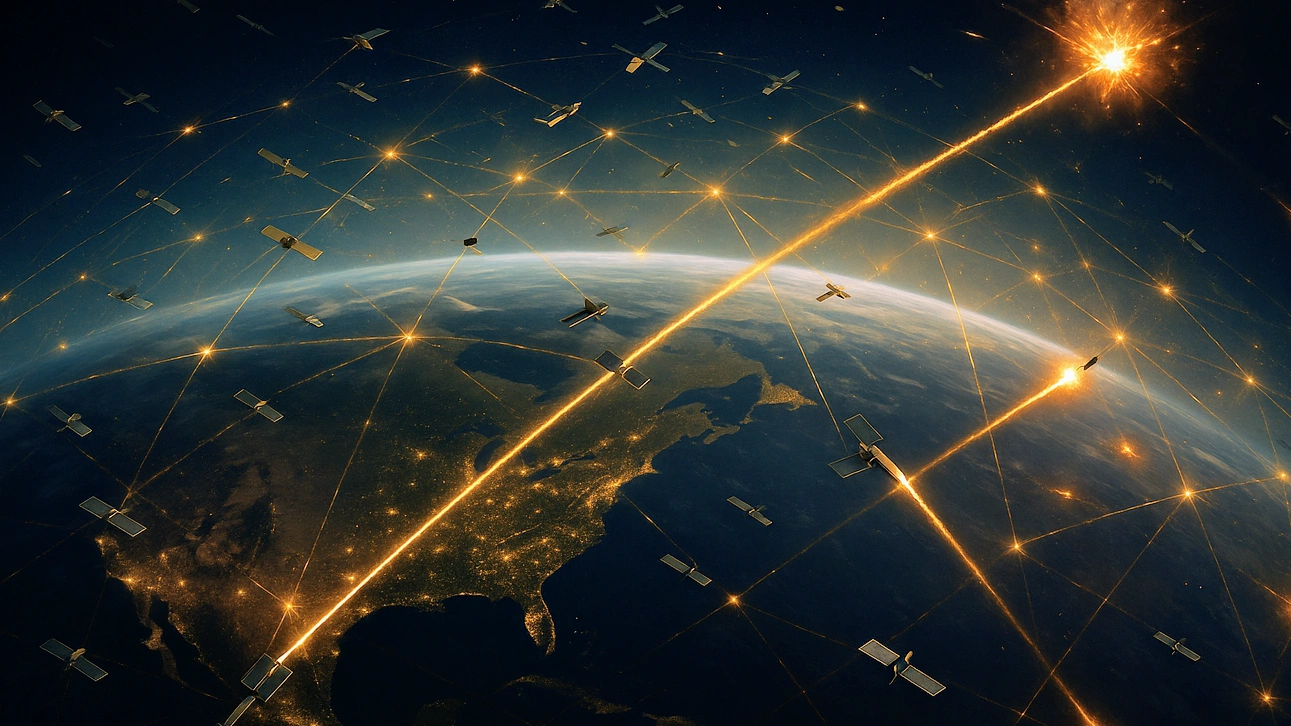
Space-based interceptors are the single biggest driver. The CBO’s model calls for 7,800 satellites in low Earth orbit, enough to intercept ten ICBMs launched in quick succession by a “regional adversary” such as North Korea. That constellation would cost $723 billion to build and about $1 billion a year to operate, which is 70 percent of total acquisition costs and 60 percent of the lifetime total.
Bloomberg’s reporting team, working separately, built a bottom-up cost model covering everything from Patriot batteries to THAAD interceptors to space-based systems, and landed close to the CBO’s number: $1.1 trillion for full coverage against a multi-adversary attack.
AEI defense analyst Todd Harrison took a third approach, modeling six different Golden Dome architectures rather than one fixed design. A stripped-down version limited to drone and cruise-missile defense would run about $252 billion. A version that stays within Trump’s $175 billion figure for five years would cost $471 billion over 20 years. A system built mainly around space-based interceptors to counter China and Russia would run $2.4 trillion, with 96 percent of that money going to the Space Force. His most expansive model, built to defend against every threat type, reached $3.6 trillion. As Harrison put it in his report, Golden Dome’s final cost “will not be determined by fiscal constraints or technical capabilities, but by political choices.”
Photo: USAF
Why The Cost Keeps Rising
Every cost model points to the same reason space dominates the budget: satellites in low orbit decay and need constant replacement, unlike a ground-based radar or interceptor site that can operate for decades with maintenance.
A constellation large enough to watch the whole planet and respond within the two-to-five-minute boost phase of a missile launch has to be big by design, not by mistake.
Other cost drivers compound that problem. Sensor data from ground radar, sea-based Aegis systems, and orbital satellites all have to be fused into one real-time picture, a level of systems integration the Pentagon has not built before at this scale. Interceptors built for the vacuum and radiation of orbit cost more to manufacture and test than their ground-based counterparts.
And because satellites fail or deorbit, the constellation needs a standing replacement pipeline for the life of the program, not just an initial purchase.
Photo: Capt. Andrew Layton USAF
Doubts About Whether It Can Work
Cost isn’t the only open question. A February 2025 study from the American Physical Society’s Panel on Public Affairs concluded that a space-based interceptor layer capable of stopping just ten simple ICBMs, while resisting countermeasures, would require around 40,000 interceptors, and that such a constellation “could be defeated or destroyed relatively easily.”
A separate analysis by researchers Jessica West and Kathryn Barrett put the price of comprehensive coverage at $4.4 trillion once inflation is factored in, and raised a strategic concern beyond cost: large-scale orbital weaponization could accelerate an arms race with Russia and China rather than deter one.
Their report also cited testimony from Lt. Gen. Robert Rasch that defending a single location like Guam with current technology would cost about $8 billion, a figure that scales into the trillions once applied to multiple U.S. cities.
Reagan’s Strategic Defense Initiative, announced in 1983, promised a similar shield and never fielded one, largely for the same physics-driven reasons critics now raise about Golden Dome: intercepting a missile in its first few minutes of flight, from orbit, at scale, remains an unsolved engineering problem.
The Bottom Line
Trump’s $175 billion figure and the government’s own $185 billion figure describe a partial system or an early phase of funding, not the full 20-year cost of the shield described in his executive order. Every independent group that has modeled the complete architecture — the CBO ($1.191 trillion), Bloomberg ($1.1 trillion), and AEI (from $2.4 trillion for a China/Russia-focused system to $3.6 trillion for full-threat coverage) — has landed somewhere between roughly $1.1 trillion and $3.6 trillion, with the space-based interceptor layer responsible for most of that spread.


.jpg)
