
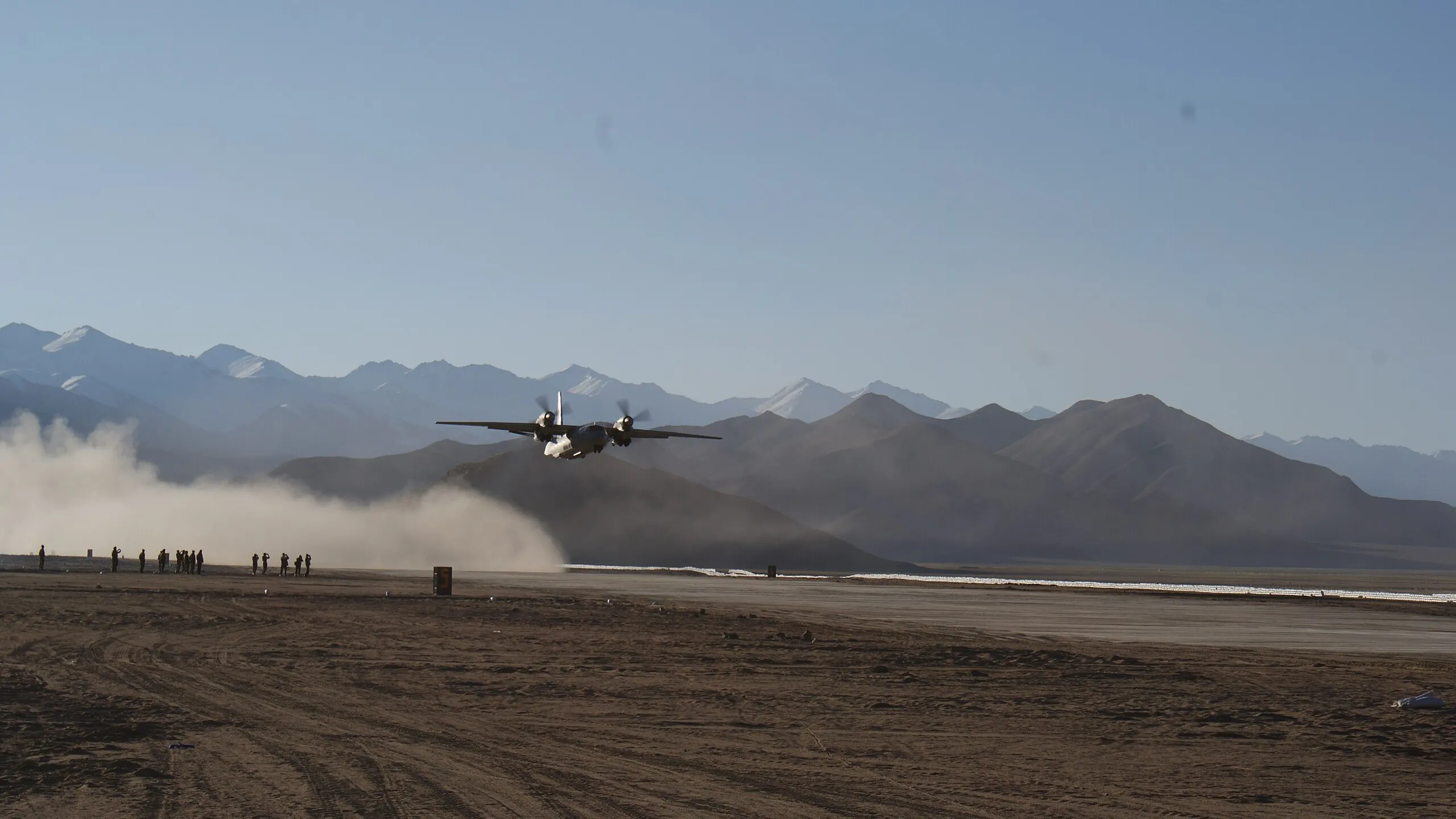
On 13th November, 2025, the Indian Air Force (IAF) officially operationalized the Mudh-Nyoma Air Force Station in eastern Ladakh, located at an altitude of approximately 13,700 feet, making it one of the world’s highest fighter-capable bases (and according to India Strategic, the world’s highest operational fighter base).
The inauguration occurred when Air Chief Marshal A. P. Singh landed a C-130J transport aircraft on its newly upgraded runway, marking a strategic milestone in India’s military posture along the Line of Actual Control (LAC) with China.

Photo: Government of India
Nyoma Airbase (Mudh-Nyoma ALG) — Key Facts
| Category | Details |
|---|---|
| Location | Changthang region, eastern Ladakh; on the banks of the Indus River |
| Altitude | ~13,700 feet |
| Distance from LAC | Around 25 km from the Line of Actual Control (LAC) with China |
| Project Cost | ₹218 crore (~ US$ 26–27 million) |
| Implementing Agency | Border Roads Organisation (BRO) |
| Foundation Stone Laid | September 2023 by Defence Minister Rajnath Singh |
| Operational Capabilities | Can now support fighter jets, helicopters, and transport aircraft |
| Climate Challenges |
|
| Nearby Strategic Areas | Close to Hanle, Chumar, Demchok, Kailash Range, and Skakjung plains |
| Original Construction | Built as a mud-paved landing ground in 1962 |
| Periods of Inactivity | Remained dormant for decades after initial construction |
| Reactivation | Reactivated in 2009 with successful landing of an AN-32 transport aircraft |
Where Is Nyoma Airbase Located and Why Is It Strategically Important?
Nyoma, located in Ladakh, is the fourth such Air Force base in this famed Himalayan region of India. The three others Airbases of this region are perched in Leh, Kargil and Thoise. One of the higher airfields (and one which is more easily recognizable in the Indian (Defense) Aviation is the Kargil Airstrip, which is located at an altitude of approximately 10,500 ft. Noticeably Ladakh also houses Advanced Landing Grounds at Daulet Beg-Oldie and Fukche.
According to NDTV, the ministry of defense of India has been working on “enhancing infrastructure at almost all airfields along the LAC, including the Advanced Landing Grounds (ALGs), as per operational requirements”:
” It is also in the process of boosting infrastructure at Daulat Beg Oldi Advanced Landing Ground in the Ladakh region. The Daulat Beg Oldi ALG is located close to the LAC at an altitude of 16,700 feet and is known as the highest airfield in the world.”
Nyoma Airbase was built under the supervision of the Border Roads Organisation (BRO), lies just 23–35 km from the LAC, enhancing India’s rapid deployment capability in a region of intense geopolitical sensitivity. According to New Indian Express, the Nyoma was also deployed during the post the 2020 India-China border standoff when the Indian Air Force (IAF) used then existing Nyoma landing ground and operated:
- Apache and Chinook helicopters
- C-130Js and AN-32s transport aircraft
When Rajnath Singh, the Defence minister of India laid the foundation stone for Nyoma airbase in September 2023; he had opined that this airstrip located at an altitude far higher than the most dangerous airport in the world (Lukla Airport) would be a “game-changer” for the armed forces.
Lukla: 5 Fast Facts About The World’s Most Dangerous Airport
The high-altitude base strengthens India’s combat readiness along its northern frontier. According to reports, the 2.7-kilometre concrete runway can now support fighter jets, transport aircraft, and helicopters, enabling a rapid response to security contingencies.
Prior to Nyoma’s mos recent upgrade, it merely functioned as an Advanced Landing Ground (ALG), restricting operations to specialised transport aircraft and rotary-wing assets. In 2023, Vayu Aerospace had reported that the construction of the airbase would take 20 months:
” Situated at a staggering altitude of 13,700 ft, Nyoma holds the distinction of being the world’s highest airfield. This unique feature mandates adaptations to fighter engines, enabling them to perform optimally at such elevations. Currently designated as an ALG, Nyoma’s existing runway comprises mud, restricting its utility to specialised transport aircraft and helicopters. However, with the imminent completion of the new runway, the operational capabilities will extend to accommodate heavier transport aircraft. This development is poised to significantly enhance India’s military strategic depth”
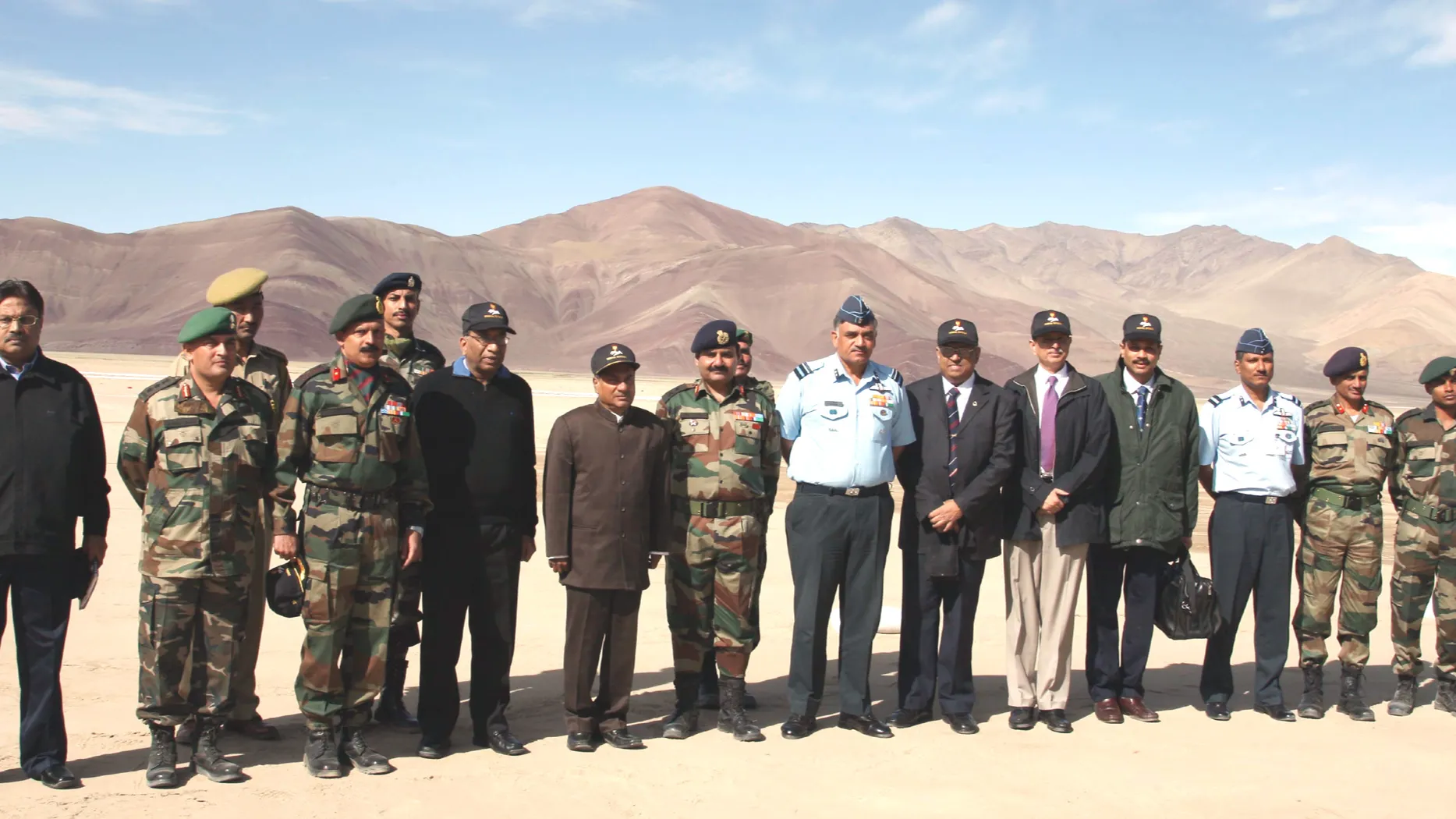
How India Upgraded Nyoma Airbase to Operate at 13,700 Feet: Runway, Facilities, and Engineering
Transforming Nyoma into a full-fledged airbase posed formidable engineering challenges such as:
- Contending with thin air
- Dealing with Freezing temperatures (down to –30 °C) that limited construction season, which required specialized adaptations for both infrastructure and aircraft operations.
- “Operational challenges have included environmental concerns due to Nyoma’s proximity to the Changthang Wildlife Sanctuary, home to protected species such as the Tibetan Wild Ass and black-necked cranes”, as reported by Indian Defense News.
According to the same source, the sub-freezing temperatures of Nyoma necessitated “specialised adaptations to aircraft engines and year-round logistical planning to ensure sustained operations“. Whether Nyoma will send crisp signals to India’s neighboring nation, which it trumped recently in the WDMMA rankings , by “its heliport expansions and plateau airstrip limitations“, we do not know. Nevertheless, the airbase is to serve:
- Fighter and Transport aircraft such as the Ilyushin Il-76 (this transport type was also seen in Venezuela in the ongoing US-Venezuela tensions) and the C-17 Globemaster-III
- Unmanned Combat Aerial Vehicles (UCAVs)
- Fighters such as the Rafale, Su-30MKI, and MiG-29UPG
The airbase’s precarious position in the Himalayas means that aviation technology it is equipped with, such as advanced air traffic control systems, high-altitude fuel storage systems, precision navigation aids, and hardened aircraft shelters became indispensable. Further, its resilient infrastructure allows all-weather operations, overcoming the accessibility limitations posed by extreme terrain and long winter isolation.
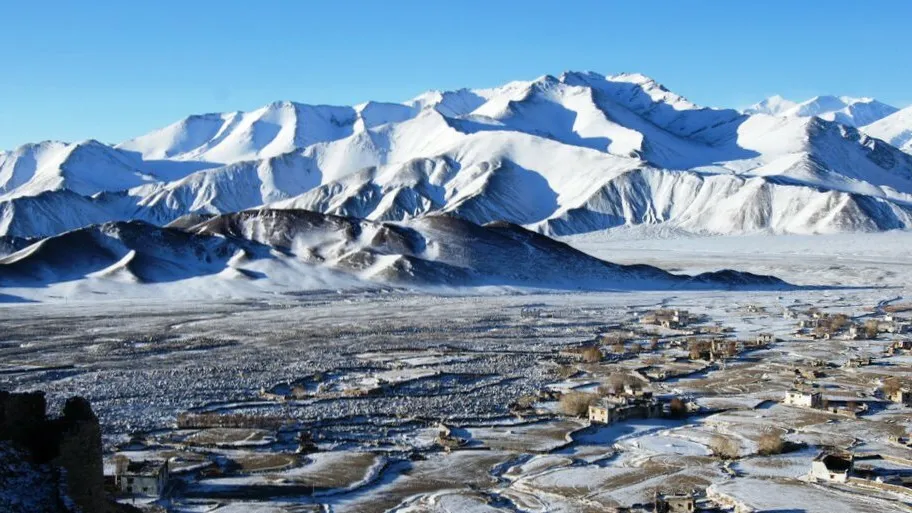


Previous High-Altitude Airfields: Comparison with Similar Cases
Nyoma’s altitude compares with Mingo Airstrip in Nepal- both of these were first constructed in the 1960s, with Mingbo being made without the use of mechanical equipment, and at a cost of merely $900, making it one of the cheapest airstrips ever. You can read about in details in our guide below:
Here is how Nyoma stacks up against other notable high-altitude airfields:
Comparing Nyoma with other high-altitude airfields
| Attribute | Daulat Beg Oldi – DBO (India) | Rutog / Ritu Airfield (China) | Qamdo / Bamda Airport BPX (China) | Leh Airport (India) |
|---|---|---|---|---|
| Location / Region | Northern Ladakh (Depsang–DBO) | Rutog County, Ngari Prefecture, Tibet | Bamda (Baxoi County), Qamdo (Changdu), Tibet | Leh, Ladakh |
| Elevation (ft / m) | ~16,700 ft (~5,100 m) | ~14,040 ft (~4,280 m) | 14,219 ft (4,334 m) | ~10,682 ft (3,256 m) |
| Status / Role | Advanced Landing Ground (transport/logistics) | PLA military installation / dual-use upgrades | Civilian high-altitude airport | Military + civil airport |
| Capabilities | AN-32, C-130J transport ops | Logistics and PLA support | 4,500 m runway; civil operations | Transport aircraft |
| Distance to LAC | Extremely close (~8–10 km) | Near frontier opposite Pangong-Tso | Far from Indian LAC sectors | Far from frontline |
| Key Notes | One of the world’s highest ALGs | Part of Tibetan military complex | One of the world’s highest civilian airports | Ladakh’s major air transport node |
| Extra Notes | revived in 2008 | limited fighter ops |
When the Nyoma airfield was inaugurated a few days ago, Anil Chopra, a strategic affairs expert and retired Air Marshal, was quoted in the Hindustan Times as having said:
“It will allow quicker launh of interdiction strikes, and troop and equipment insertion in the forward areas if needed.”
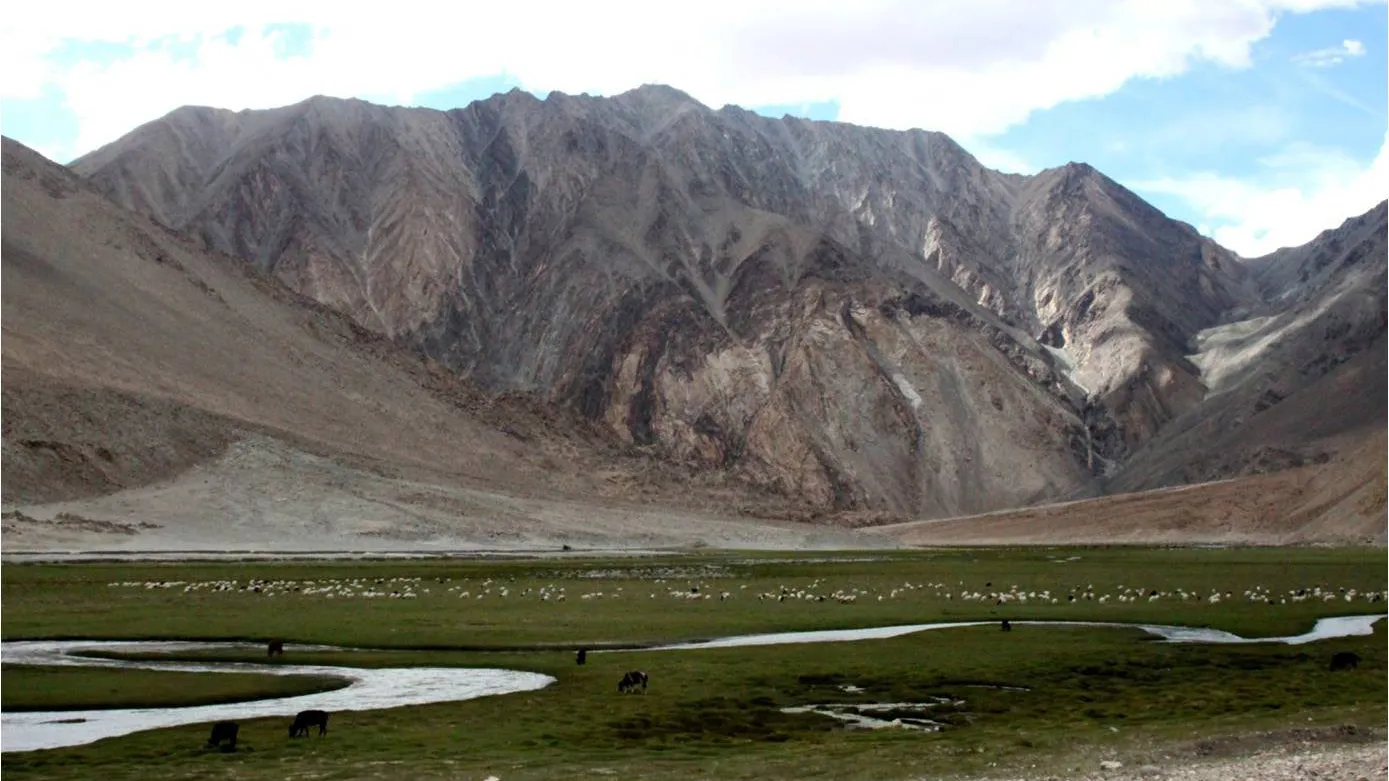
Photo: Ministry of Agriculture and Farmers’ Welfare
Background: History and Evolution of Nyoma airfield
According to Matribhumi.com, India had constructed the world’s highest airstrip at Daulat Beg Oldie (DBO) at 16,600 feet. This is an altitude that is much higher than the Mingbo Airstrip we previosuly touched upon, However, much like the Mingbo Airstrip, harsh weather and operational challenges at DBO rendered it unsuitable for regular use:
“Nyoma, on the other hand, was found more reliable, acting as a strong support base for Leh and Thoise, where bad weather often disrupted operations. After a detailed study of both Nyoma and Fukche, the government found that Fukche, located in the Koyul Lungpa valley of eastern Ladakh, just 2.5 km from the LAC, had space and infrastructure issues, while Nyoma offered the right conditions for all-weather operations.”
By July 2025, almost 95% of the work on Nyoma had been completed. The recent upgrade at this airfield is a part of a broader “Project Himank” portfolio overseen by the BRO, has transformed it into a fully operational fighter base, with hardened shelters, weapon depots, radar, and ATC infrastructure. With Nyoma now operational, the IAF can more effectively project air power in high-altitude theatres, reducing dependence on more distant bases like Leh or Thoise.

Photo: Vinay Goyal, Ludhiana | Wikimedia Commons

All in all
Even though Nyoma is now operational, future work will likely include fully integrating fighter squadrons, possibly including Su-30 MKI, MiG-29 UPG, or other high-altitude capable aircraft. Sustaining high-altitude operations will pose ongoing challenges: maintenance logistics, fuel supply, and adapting aircraft engines to thin air require constant management.
Also note that the Anotnov An-124, one of the largest aircraft ever made, crashed in Irkutsk, which had a temperature of -20 degrees. It was theorized that a mixture of cold fuel (at this temperature) mixed with regular fuel led to the accident. So we will have to see if the airbase doesn’t produce tragedies of the kind the An-124 was involved in.
There is also a dual-use potential: while currently military, Nyoma’s infrastructure could support civilian or humanitarian flights, improving connectivity in an otherwise remote region. How the airport will evolve is something that the defenses of India, China, and enthusiasts will have a keen eye on.