
Spring Airlines, a Chinese budget carrier, once offered an airfare of merely 13 cents (1 Yuan) for flights between Shanghai and the northern city of Jinan. In 2012, this low-cost airline made a profit of $22 million in 2021. Ryanair, perhaps the most famous budget airline, offered flight tickets for as low as €1 during an early promotional deal. It also offered a round-trip vacation (encompassing various multiple European cities) for under €10. It shouldn’t, then, come as a surprise that Ryanair is Europe’s largest airline (by the number of passengers flown). But their after-tax profit of 149 million euros for the final three months of 2024 might leave people wondering how carriers like these make profit, let alone in millions.
The success of budget airline is not a one-off scenario. India, which recently saw the crash of the Air India Flight 171, has a budget carrier known as IndiGo, which is the nation’s largest carrier. It has set the records for the highest number of aircraft orders, too. Safair, a low-cost airline in Southern Africa, made it to the ranks of the most punctual airlines in the world.
All carriers (reagrdless of whether they are budget airlines or legacy carriers) have to pay money to the airports they operate in and out of. New Delhi Airport – one of the busiest aiprorts in the world – for example, charges approximately $1,500 for each aircraft that lands. This corresponds to a landing charge of $ 90 per metric ton of an aircraft. In the teeth of such stupendous charges, how do budget airlines keep their costs so low? Let’s find out.

Image: Mark Harkin | Wikimedia
It all started with Southwest Airlines
When Joshua Beckman wrote about the material lure of cities in the United States in his poem “Leave New York”,
Do not spend $1.00 on two scallion pancakes.
Do not hail a ten dollar cab to blow off steam
and smoke his back seat up
and watch the meter jump by quarters.
Do not spend $7.50 on AXE HANDLES by Gary Snyder
Do not spend $35.00 on the collected anyone.
he perhaps was aware that it was the United States that had come with the idea of a budget airline. Skybus Airlines, an Ohio-based carrier, had once offered flights as low as $10. No one, perhaps not even Joshua, would argue that we ought not spend $10 on a flight. The story of a budget airline didn’t start with any of the names we’ve mentioned so far, though.
Southwest Airlines, the world’s largest low-cost carrier, pioneered a business model so influential that the United States Department of Transportation (USDOT) coined the term “Southwest Effect” (in 1993) for the effect they were to have in shaping the fares offered in the aviation industry. Before Southwest changed the course of what airfares airlines could offer, federal control helped airlines thrive by keeping ticket prices relatively high. This changed after the US Congress signed the Airline Deregulation Act in 1978. However, the deregulation act gave airlines the freedom to choose any routes they found profitable. Airlines themselves needed to set the airfares.
From Wright Brothers to Jet Age: Evolution of Aviation History
Alfred E. Khan, a Cornell economist who championed deregulation, getting rid of the shackles of federal control would allow new airlines to offer cheaper rates, reported Cornell University:
“Kahn became best known as the “architect of airline deregulation” when he spearheaded the U.S. Airline Deregulation Act of 1978 as chair of the now-defunct Civil Aeronautics Board (CAB). He showed that flexible pricing was beneficial for both customers — who have saved billions of dollars in fares since Kahn’s efforts — and the U.S. airline industry. He was largely instrumental in garnering the support necessary for the federal legislation that deregulated the airline industry and was the first thorough dismantling of a comprehensive system of government control since 1935.”
And passengers did save billions of dollars in airline fees. When Southwest Airlines introduced the low-cost carrier model, it had an effect of an increase in the total supply of tickets. This in turn led to carriers competing for more for passengers which eventually led to the lowering of airfares. While it has been said that whenever Southwest enters the market airfares drop (with Southwest claiming: “research found that every time Southwest entered a market, fares dropped by 50 percent and overall passenger traffic more than tripled“.) and hence the term “Sothwest Effect”, USA Today has claimed that that other low-cost carriers in the US such as “JetBlue.. and ultra-low-cost carriers such as Allegiant and Spirit have shown a greater impact on lowering the average price of a ticket where they fly.”
Budget airlines treat all their customers the same
Treating every client equally is a crucial tactic that budget airlines use to keep their expenses down. Budget carriers reduce administrative costs and streamline operations by standardising services and taking a no-frills attitude.
A budget airline’s IT and training expenses will rise if it provides perks and hidden benefits to its most devoted patrons or to travellers who use their credit cards. If a carrier gives free baggage to a member of its loyalty program, for example, the airline will need to develop sophisticated technologies for bag differentiation.

Image: DavidivardiL | Wikimedia
Having a common fleet helps budget airlines save money
According to planespotters.net, Southwest Airlines has 811 aircraft in its fleet, 787 of which are currently in operation. All of these are of the Boeing 737s type:
- 199 Boeing 737-800
- 271 Boeing 737 MAX8
- 334 Boeing 737-700
Another well-known low-cost airline, Ryanair, operates 311 Boeing 737s, Spirit has 198 Boeing 737-700s and 113 Boeing 737 MAX8s.
Here’s a table showing the fleet of some other budget carriers around the world:
| Name of the budget airline | Fleet Size | Aircraft Types |
| IndiGo | 359 | Airbus A320,A321,Boeing 777 |
| easyJet | 328 | Airbus A319,A320neo |
| JetBlue | 288 | Airbus A320, A321 |
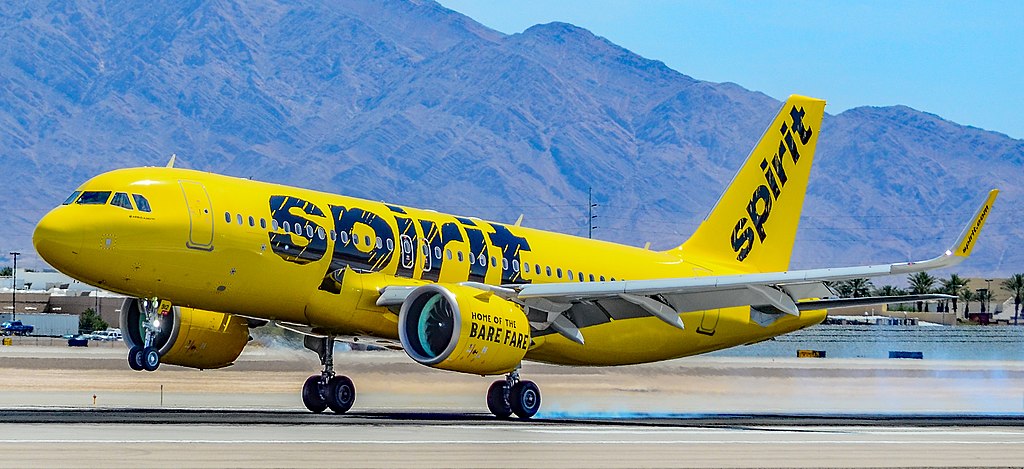
Image: Tomas Del Coro
Operating the same aircraft type helps budget airlines save money. Fixing different aircraft types would require mechanics that have specialized type-training for different aircraft types. This is one of the reasons why in a country like Nepal, almost all helicopter operators use the Airbus A350B3E. [Note: the Airbus A350B3 has also landed on the top of Everest]. Operating the same aircraft type also helps simplify maintenance as a single set of parts is needed for the entire fleet when all aircraft are the same.

Image: Sreejith K | Wikimedia
According to Forbes, airlines that fly the same kinds of aircraft will also save money on pilot training:
” In addition to having an Air Transport Pilot (ATP) license, pilots must be type-rated for the specific planes they will fly. Having different airplanes in the fleet often generates more training for each pilot to be type-rated in different equipment. Plus, each new pilot position opened generates a chain of training since pilots bid by seniority. Airlines with one fleet type train the pilots once, recurrent training is simpler because everyone flies the same plane, and no training cycles are generated because pilots are switch fleet types.”
easyJet and JetBlue are two carriers which operate the Airbus A320 family. Although the A320 family comprises A319, A320, and A321 – all of which have different lengths – these are almost the same plane except for “the length of the fuselage, with one section taken out for the A319 and one added on for the A321“. While the length of the fuselage means that there are other structural changes in these aircraft, there is a single pilot type-rating for the family. The training for these different aircraft of the A320 family, as well as the maintenance parts are highly common.
Budget airlines also operate a relatively young fleet of aircraft. They might be more likely to invest in modern aircraft that are more fule-efficient.
And the seating types are also fairly the same
Single-class cabins are common on low-cost carriers. Aerolopa.com, for instance, asserts that the 175 seats available on Southwest’s Boeing 737 MAX 8 have identical seating arrangements:
- “175 Collins slimline seats arranged in a 3-3 configuration
- Row pitch:32¨ standard ;38¨ at row 14
- Seats width :17.6
- Seats are “pre-reclining” and slide forward in the reclined position”
Ryanair’s Boeing 737-800s have a single economy class cabin accommodating 189 Zodiac Z110 seats. While some of the 737-800s operated by Ryanair are fitted with older Weber C100 seats, the following dimensions are consistent:
- Seat width: 17.7″
Seat pitch:
- Rows 2-15 ABC seats: 29.0″
- Rows 3-15 DEF seats: 29.5″
- Rows 16-17: 35″
- Rows 18-33: 29.5″
Such straightforward configurations devoid of economy, premium economy, first-class, and business class seats do away with complicated boarding control systems too.
Budget airlines don’t quite offer the same amenities like full-service carriers
Full-service airlines typically offer more amenities on board, and therefore, the higher fare associated with them. The absence of amenities has been dubbed as a “no-frills service business model“, which eliminates extra features (such as the fact that the seats on Ryanair’s Boeing 737-800 do not recline as non-reclining seats require less maintenance), luxuries (an absence of headrests and armrests), or services (dearth of seatback pockets). This allows the budget carriers to focus on offering a core product at the lowest possible price.
On budget airlines, food, and beverages are sold onboard (they’re not for free). Ryanair charges between $7.50 and $9.50 if you wish to have a cup of coffee and a sandwich during your flight. Prices might vary depending on where the flight is operating to/from. The seat pitch (the spacing between rows) of budget carriers can also be lower than full-service carriers. Lower pitch means more seats and greater revenue.
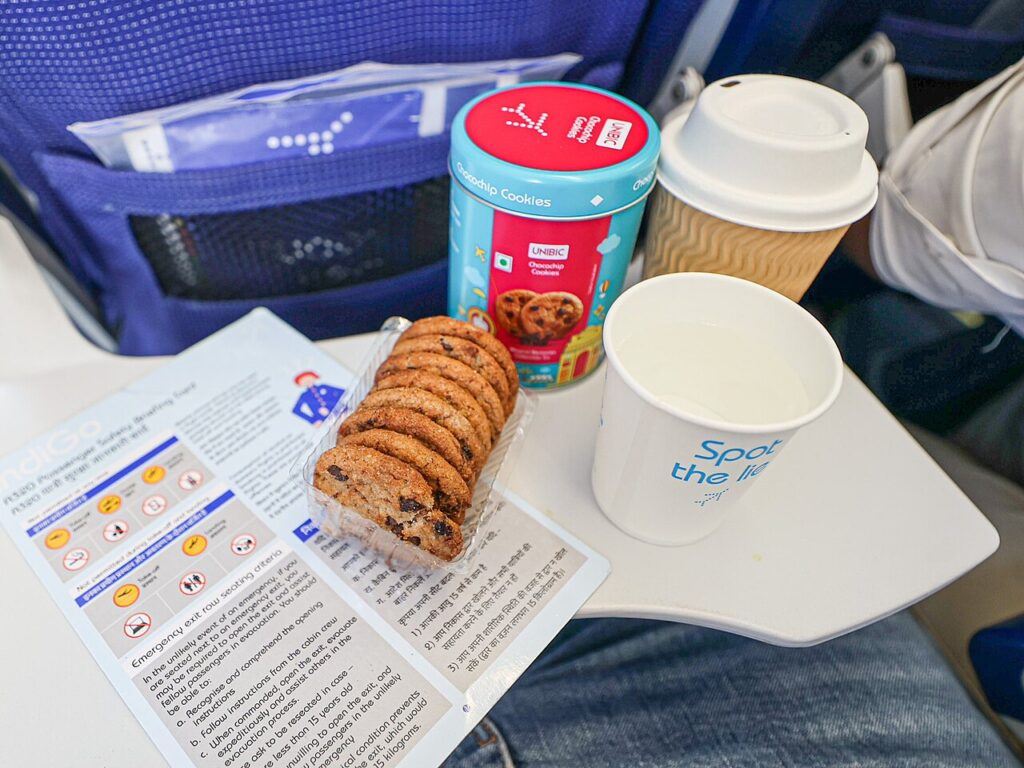
Image: Twitter- Simply Aviation
Budget airlines save money by using secondary airports
Airports that are located outside of major cities or in less populous areas have become known as secondary airports,and they are frequently used as a substitute for the bigger, principal airports in the area. These airports are commonly used by low-cost airlines to minimise expenses and increase operational effectiveness.

Image: Wikimedia
Airlines can save a lot of money by using secondary airports, which often have lower landing fees and handling costs than principal airports. As secondary airports are less overcrowded, they also allow for quick turnaround times and a lower probability for delays.. Secondary airports, such as Stansted (STN), are commonly utilised by low-cost airlines to save on operational costs, particularly landing fees.
| Heathrow (LHR) landing fees average roughly £20.71 per passenger, with a £17.60 service charge. | Stansted (STN) landing fees are far lower, at around £7 per trip for up to 15 minutes. |
Here are a few comparisons between a secondary airport and a major hub:
| Low-Traffic Airports (Secondary Airports) | High-Traffic Airports (Major Hubs) |
Examples:
|
Examples:
|
|
|
As a way to draw carriers and increase local tourism or business, many secondary airports provide financial incentives to airlines, such as fee reductions or marketing assistance.
Avoiding the hub and spoke model and other tricks of the trade
Full-service carriers often operate out of the ‘hub and spoke’ model where passengers are routed through a central hub. However, budget carriers opt for point-to-point flights, operating directly between smaller airports. Point-to-point flights help to do away with costly transfers and the potential delays that exist thereof, as they don’t have to coordinate multiple connecting flights. Such flights also help larger cities with lesser-known destinations, often creating greater demand for travel.
Here are a few other ways budget airlines keep their costs low:
- Low-cost airlines often operate from a single gate at the airport. Operating from a number of different gates would cost more.
- Spirit Airline’s introduced “carry-on bag fee” to do away with gate delays associated with gate-checking bags that didn’t fit onboard.
- They allow a greater Available Seat Miles (ASMs) for each aircraft they fly, lowering the unit the unit cost rate.
- A flight attendant working for a budget carrier might have a greater set of responsibilities: such as cabin cleaning or assisting ground crews during boarding.
- RyanAir allows for an online boarding pass. Therefore, it has (almost) no agents checking in, reducing airport personnel costs.