Hong Kong International Airport (HKG) opened the departure facilities of its new Terminal 2 (T2) on May 27, 2026, part of a HK$141 billion (~US$18 billion) Three-Runway System (3RS) expansion designed to increase annual capacity to 120 million passengers and 10 million tonnes of cargo. The Airport Authority Hong Kong (AAHK) timed the commissioning deliberately to coincide with the onset of the summer travel peak, with 15 airlines beginning phased check-in relocations to the new building through mid-June 2026.
The launch positions HKIA squarely against two of Asia’s most formidable aviation rivals. Singapore Changi International Airport (SIN) set an all-time passenger record of 70 million in 2025 and broke ground on a fifth terminal in May 2025, while Dubai is pressing ahead with a $35 billion expansion of Al Maktoum International Airport (DWC) that will eventually accommodate 260 million passengers annually. HKIA, which handled 61 million passengers in 2025, now seeks to close that gap — and T2 is its opening gambit.
What Passengers Will Find Inside Terminal 2
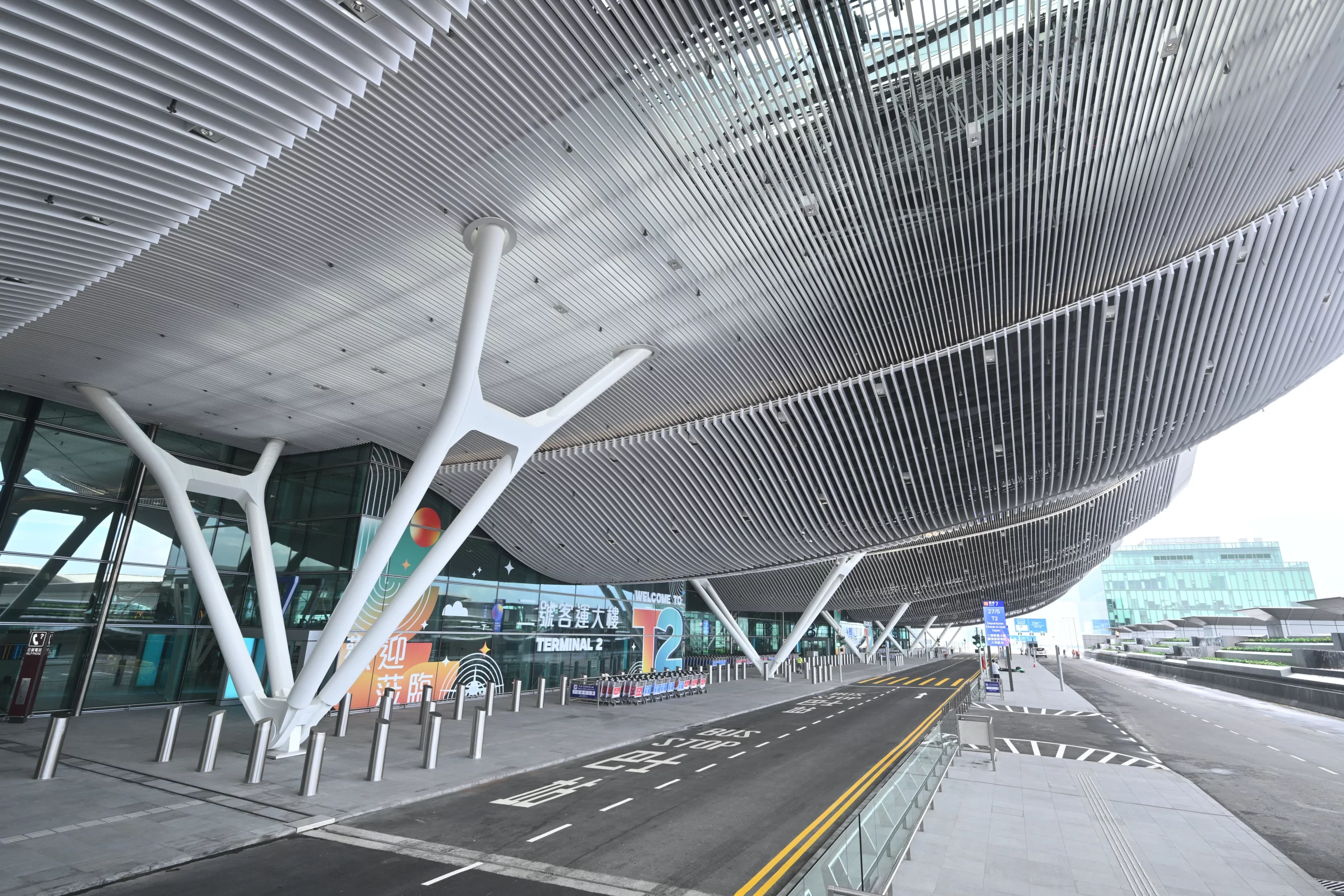
T2 is positioned as a leisure-focused terminal, designed with a distinctly youthful aesthetic. The departure hall, split into eight aisles designated P through W, offers a broad range of self-service options alongside hybrid-staffed counters.
Key facilities in the T2 departure hall include:
- 160 hybrid check-in counters across eight aisles (P–W), with ultra-low platform designs to ease baggage handling
- 68 express self-bag-drop counters and 58 smart check-in kiosks concentrated in self-service zones at Aisles R, S, T, and U
- 20 e-Security Gates at the entrance to the restricted area, all equipped with facial recognition technology
- 15 smart security screening channels inside the restricted area, where passengers may keep laptops and liquids under 100ml in carry-on luggage during screening
- 35 e-Channels and 60 counters for departing passengers at immigration clearance
- A food court in the departures hall featuring eight catering outlets, four of which operate around the clock, and 12 retail shops
Source: Human Resources Online / AAHK press release
The terminal introduces what the airport describes as its “Flight Token” biometric system, which allows passengers whose faces have been scanned prior to security screening to pass through without presenting a passport or boarding pass at subsequent checkpoints.
In tandem with T2’s opening, AAHK lowered the minimum age for facial recognition use at e-Security Gates from 11 to seven, applying across both T1 and T2. T2 connects to Terminal 1 (T1) via an air-conditioned footbridge and the airport’s Automated People Mover (APM), while the Airport Express station serves both buildings from the same platform.
What the Ceremony Revealed about HKG’s Ambition
Hong Kong International Airport (HKIA) officially opened Terminal 2 (T2) on May 22, 2026, with around 1,500 guests from the government, aviation, cargo and ground-handling industries attending the ceremony. Senior officials present included AAHK Chairman Fred Lam, Acting Financial Secretary Michael Wong, Secretary for Transport and Logistics Mable Chan, Secretary for Labour and Welfare Chris Sun, and AAHK CEO Vivian Cheung.
Lam described the opening as another major step in HKIA’s development, with T2 designed primarily to serve leisure travellers while focusing on passenger comfort and operational efficiency. The terminal incorporates extensive self-service technology, including automated check-in, baggage drop and streamlined immigration procedures.
He also highlighted the terminal’s open interior design and extensive use of LED displays, which are intended to create a more engaging environment for passengers.
Wong, meanwhile, praised the progress made by HKIA and said the government would continue working to build on the airport’s achievements, according to Travel Trade Journal.
The opening coincided with the HKIA Reception 2026, where 40 business partners presented their latest innovations. The venue was subsequently transformed for the HKIA Expo and Career Fair on May 23 and 24, with more than 4,400 airport-sector vacancies advertised.
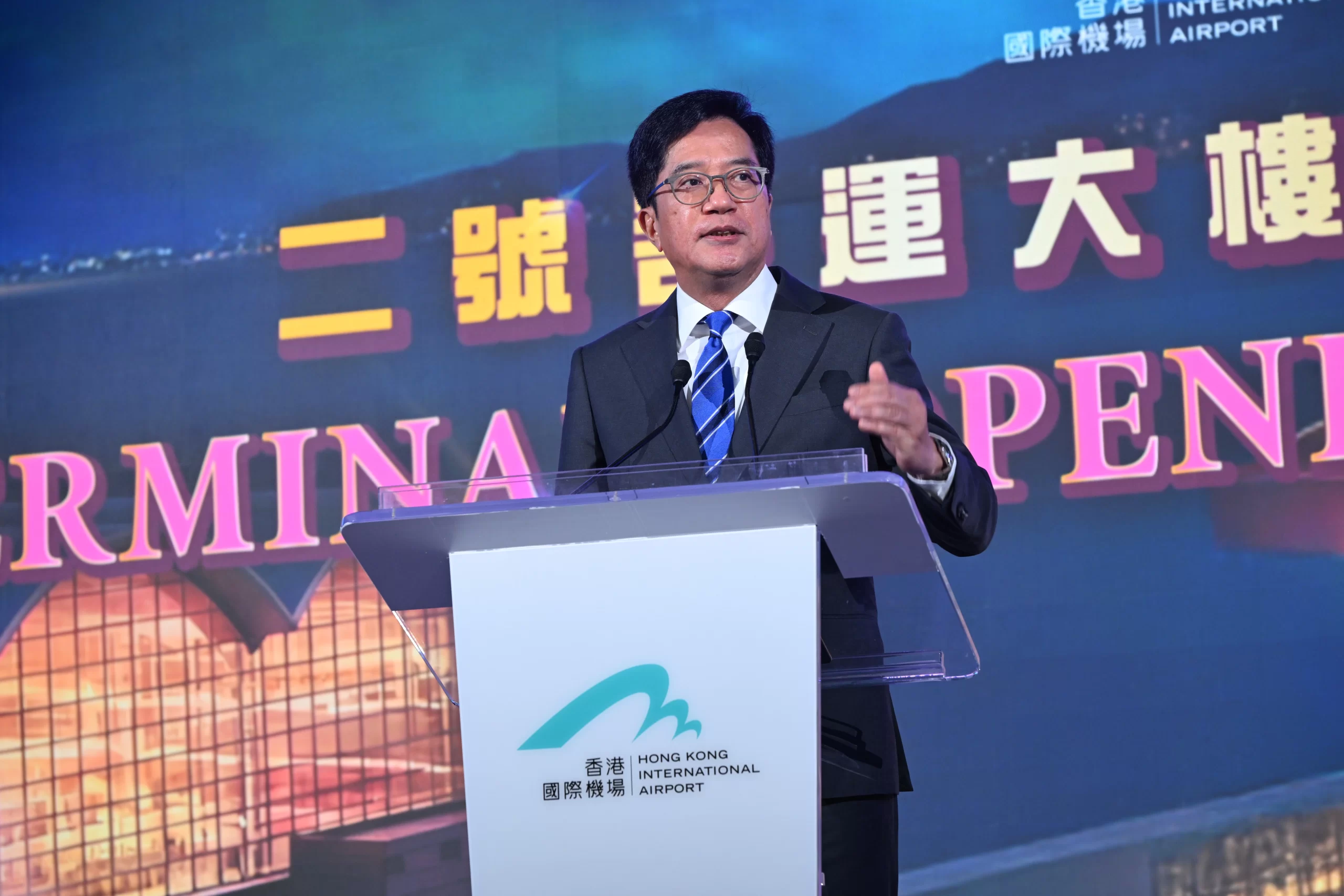
Photo: Hong Kong Airport
The 15 Airlines Relocating to T2
AAHK confirmed that 15 airlines, predominantly short-haul and regional operators, will relocate their check-in services from T1 to T2 in phases. Passengers checking in at T2 will continue to use T1 boarding gates via the APM connection until the T2 concourse opens in 2027.
The relocation schedule is as follows:
- May 27, 2026 — Hong Kong Airlines (HX) becomes the first carrier to relocate all check-in counters to T2, operating from Aisle Q
- June 3, 2026 — Greater Bay Airlines (HB) begins check-in operations at T2
- June 10, 2026 — HK Express (UO) completes its move to T2
- By mid-June 2026 — All remaining carriers, including selected Cathay Pacific (CX) flights, complete relocation
AAHK expects T2 to handle approximately eight million passenger journeys during its first year of operations, with early estimates from Time Out Hong Kong suggesting T2 could accommodate up to 15 million passengers by end-2026 as capacity scales. The split between T1 for long-haul and full-service operations and T2 for leisure and regional travel is a deliberate operational strategy to redistribute passenger flows and reduce congestion.
Hong Kong’s T2 Arrivals, The Concourse, And the Road To 2035
T2’s May 2026 commissioning covers only departure facilities. Arrival facilities are scheduled to begin operations in 2027, in line with traffic demand. The full airside concourse, a Y-shaped structure designed by architects Aedas with 27 boarding gates including seven multi-aircraft ramp stands, is also due in 2027. Once linked to T2 via an airside APM, the concourse will allow passengers to check in, clear security and immigration, and board — all without crossing to T1.
The expanded T2 is ultimately designed to process up to 50 million passengers per annum, according to AECOM’s project documentation. Alongside T1 and the new infield concourse, HKIA’s full buildout under the 3RS programme will support 120 million passengers a year by the mid-2030s, at which point the airport will rank among the world’s few mega-hubs.
.jpg)