
The infinite infinitude of infinity is what is at stake when we are discussing Black Holes.
Let’s conduct what the Germans call a “gedankenexperiment“, a thought experiment. Imagine you are on the Earth’s surface waiting to catch a glimpse of John Doe (JD) plunging into a Black Hole(BH), you’ll never quite see JD “enter” a Black Hole. And you can wait, as is the expression, till “the cows come home“, or “until hell freezes over“, or until “the end of time” or till “forever and a day” or until the “infinite infinitude of infinity” has been exhausted.

Two space dimensions suppressed. There are time and distance from center.
Image:Vilnius | Wikimedia Commons
A BH might not be a region, but an “event” that we have no access to
When we say that we can “never” see JD (or any other object/person) enter a black hole, it is not that JD doesn’t enter the black hole. From the point of view of JD, events do take place. JD does spiral into the Black Hole and reaches the singularity that the Black Hole houses. But for an observer outside the Black Hole, such as humans on the planet Earth, we’ll see JD decelerate as he approaches the Black Hole – the deceleration so high that as it approaches the edge of the black hole, JD appears frozen in time.
When JD is near the Black Hole, he might have experienced only a day, and yet, for humans on Earth, many months/years might have been spent. A parallel of this was seen in the movie Interstellar, where the pilot orbiting a Black Hole experiences only a few years of aging, while the people on Earth have experienced decades. This effect is called gravitational time dilation, a phenomenon that could be detected, albeit on a far smaller scale, on Earth as well. Atomic clocks in high-altitude orbit will get ahead of clocks on the ground by a few microseconds each day.

For JD, events take place even after he is inside the black hole. For any observer outside, JD experiences no events. Ever. From the frame of reference of anyone outside the Black Hole, anyone who enters the Black Hole, experiences no “events”. In the words of astrophysicist Gabe Perez-Giz, “there are apparently events that, according to us out here, cannot consistently be assigned a ‘when’ From our frame of reference outside the black hole, those events (as experienced by JD)* just don’t occur, even if we wait an infinite amount of time..
[*Note: the parantheses inside the quote is was inserted by the author of this article]

Image:Osanshouo| Wikimedia Commons
This means that we could, instead of regurgitating that a “black hole is a region so dense that not even light can escape“, think of a black hole as a set of events. According to observers JD (in our thought-experiment) who are at those events, those events take place at spatial locations inside black holes, which interestingly enough aren’t just a set of locations. According to observers who are physically there, Black Holes are all the events that have ever taken place or will ever take place there. It is just that those events inside Black Holes aren’t concurrent with the events in the outside world. Instead, the black hole is the collection of happenings that we say don’t happen at all.
This change in the way of looking at the world has been written elsewhere by astrophysicist Carlo Rovelli in his book, “The Order of Time”:
“We can think of the world as made up of things. Of substances. Of entities. Of something that is. Or we can think of it as made up of events. Of happenings. Of processes. Of something that occurs. Something that does not last, and that undergoes continual transformation, that is not permanent in time.”

Image: Wikimedia Commons
Let’s think of the Event Horizon as a shielder of events
Notice how we said that JD would be frozen in time, just at the moment he was poised to cross over into the black hole? If we were to take the corpus of the final batch of events entering the Black Hole, it would be called the “Event Horizon”. Once JD streaks this “horizon“, we’d have no access to the “events” he’d experience, hence the term “event horizon” represents a surface in spacetime, the last events to which you can even assign a “when.” Once again, to quote Gabe Perez-Giz, black holes are what result when we “delete entire occurrences from every external observer’s self-consistent record of the history of the universe“.
The Black Hole

Image: Wikimedia Commons
Why do we talk about Black Holes as objects anyhow?
Any object, when compressed enough, could be turned into a Black Hole. If we were to condense all of the Earth’s mass into the size of a ping-pong ball, or were able to squash the mass of the Sun in the size of a small city with a radius of approximately 3 kilometers, we’d have made a Black Hole. How much mass needs to be concentrated into how tiny a space for to render the whole collection into a Black Hole is dictated by the Schwarzschild metric.
So if we were to replace the Sun with a spherical black hole with a diameter of around six kilometers across, the orbit of the Earth, or any other planet for that matter, wouldn’t be affected. The surface temperatures of the planets might be drastically affected, but the geodesics would essentially be the same. This gedankenexperiment shows us that a black hole most definitely behaves as an object.
So we arrive at a veritable loggerhead: Is the Black Hole an event or a mass? Or is Black Hole simply mimicking the properties of a mass. In orde to answer this question, we need to do away with some misconceptions about Black Holes:

Image: Wikinedia Commons
Black Hole Misconception 1: Black Holes “Suck” Matter

Image: Wikimedia Commons
Black holes suck matter into themselves as much as a waterfall sucks you into a plunge. Get tantallizingly close to the edge of the stream that pours down as a waterfall, and of course, you’re likely to fall. But as long as you keep your distance, you’re safe. The same analogy would be true of Black Holes as well.
For any planetary orbit, there is a cutoff radius. Cross it at your own peril and be hurled into the planet in a free fall. As long as you don’t cross this limit, you’ll forever be bound to the planet in circular geodesics, much like the moon circles around the Earth: the Earth doesn’t suck the moon in. Earth doesn’t suck asteroids or meteorites, it just that they’ve crossed the cutoff radius. After this, there’s no choice but to be dragged into the Earth’s atmosphere. A similar case is to be made for Black Holes.
Misconception 2: black holes are black because not even light can escape their gravitational pull

Image: Wikimedia Commons
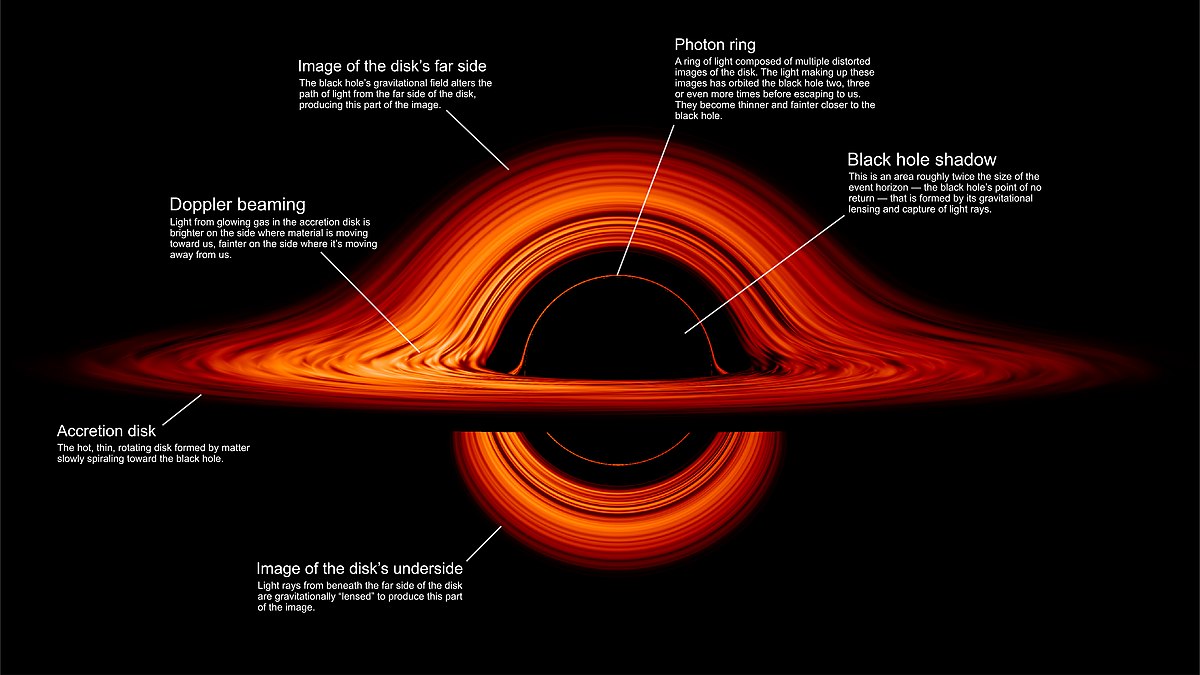
You might have noticed that if we draw a wave on the fabric of a balloon, the wave will stretch if we inflate the balloon. Much like the (wave on the) balloon, the universe is also undergoing expansion, and any light from a distance galaxy or a star towards the Earth would stretch too. This physical phenomenon is known as a redshift, and when redshifts are too strong, waves be stretched to invisibility. Such is the case in a black hole. At the moment JD has frozen in time (as he appears to enter the black hole), light emitted from this person would be redshifted to undetectably low frequencies. Hence, the black hole is black. Stehen Hawking’s imperishable essay on Black Holes touches upon this fact:
You would get dimmer and dimmer, and redder and redder, until you were effectively lost from sight. As far as the outside world is concerned, you would be lost for ever. Because black holes have no hair, in Wheeler’s phrase, one can’t tell from the outside what is inside a black hole, apart from its mass and rotation.
There’s another way of looking at why black holes are black. They’re not black because light cannot escape the gravitational pull of a black hole. In General Relativity, gravity is not even a force, and in a black hole, photon is not being “pulled”: the photon is just moving radially inward. The curvature of the black hole renders “radially outward” an impossibility. There is no other direction for light to move anywhere but in, in a Black Hole.
Misconception 3: Black Holes are super dense
Density of a Black Hole is often defined as the BH’s mass divided by its volume. This means that only microscopic Black Holes can be super dense. Massive black holes, on the other hand, such as the one at the center of the Milky Way (Name: Sagittarius A-star; Mass: 4 million Solar Mass) is only about as dense as water.
Infinite Black Hole Universes: The Black Hole Bigger Than The Universe
Such black holes wouldn’t either sphaggetify or pancake detonate you as soon as you enter them. Theorists suggest that one could enter Super Massive Black Holes (SMBH) completely unharmed. A solar mass black hole (which incidentally bears the same acronym as supermassive black holes) would turn you into a noodle from a distance.

There’s also a different way in which people visualize the “density” of a Black Hole. As all matter in the black holes ultimately collapse into the infinitely dense point called the singularity, one could say Black Holes are super dense for this very reason. But we have to noe that “singularity may be either a physical structure or a purely mathematical one, but right now astronomers don’t know which is true“. So, calling a Black Hole infinitely dense in light of the dubious nature of a singularity might be missing the point.
A black hole is formed when a really heavy star collapses into a region smaller than what is dictated by the Schwarzschild metric. The mass of the precursor star will, therefore, be the same as that of the mass of the black hole. During the genesis of the Black Hole, the event horizon is formed in the interior of the star, followed by an expansion. For observers like us, who are outside the Black Hole, matter never crosses the horizon: it is all a frozen motion non-picture.
Scientists have also figured out that there must be eternal black holes – a type of BH that didn’t have a star as its precursor. something that didn’t form from anything. Such Eternal Black Holes are associated with a spacetime with an event horizon, but essentially massless. In this case, could we really think of Black Holes as housing infinite masses, so as to render their densities infinite, too?
Events happen inside a black hole but we’re just not privy to it
Most physicists imagine a singularity as a puncture in spacetime, and not as a place or an object. A puncture that will help us revise the laws of physics as we know now? We’ll have to wait.
Hawking reasoned that any region of space with too much information would collapse into a black hole, with the size of the BH being an indicator of the amount of information: “It is like piling more and more books into a library. Eventually, the shelves will give way, and the library will collapse into a black hole“. We’ll have no idea about how the letters and sentences in the books would read inside the black holes, whether the information housed in the books would be palatable enough for anyone like us, outisde the Black Hole. And this would not change. Ever. Even in the infinite infinitude of infinity.