Nepal Airlines Corporation (NAC), Nepal’s state-owned national flag carrier that has been mired in many cases of corruption in the past, has crossed a debt milestone that financial analysts describe as the point of no recoverable return without structural state intervention: its outstanding loans reached Rs 55.78 billion by the end of the last fiscal year — an increase of Rs 19 billion over the past decade — as revealed in the 63rd Annual Report of the Office of the Auditor General (OAG), published in May 2026. My Republica’s reporting on the OAG findings confirms the corporation now owes Rs 31.33 billion to the Employees Provident Fund (EPF) and more than Rs 21.12 billion to the Citizen Investment Trust (CIT) — both institutions managing the long-term retirement savings of millions of Nepali workers across the government, public enterprise, and private sectors.
The OAG has formally instructed NAC to prepare an annual repayment calendar to clear these dues, a directive that carries no enforcement mechanism beyond political will that has historically proven insufficient to compel action. The debt figures alone do not fully capture the severity of the crisis — the structural ratios beneath them do. Online Patrika’s November 2025 analysis of the government-commissioned Sinha committee report confirmed that NAC’s current ratio — the measure of its ability to meet short-term obligations with current assets — stands at just 0.60, meaning its current assets cover only 60 percent of its short-term liabilities.
More critically, the debt-to-equity ratio has reached negative 12.33, a figure that means NAC’s paid-up capital has turned fully negative and its liabilities now dwarf its assets by a factor that makes conventional financial recovery impossible without either a substantial equity infusion from the government or a restructuring of the debt instruments themselves. Nepal News English’s January 2026 deep analysis of the corporation delivered the most damning arithmetic: even if NAC generated an annual profit of Rs 5 billion, it would take more than ten years to repay its current debt load at that pace.
Retirement Savings of Millions of Nepalese Now at Risk
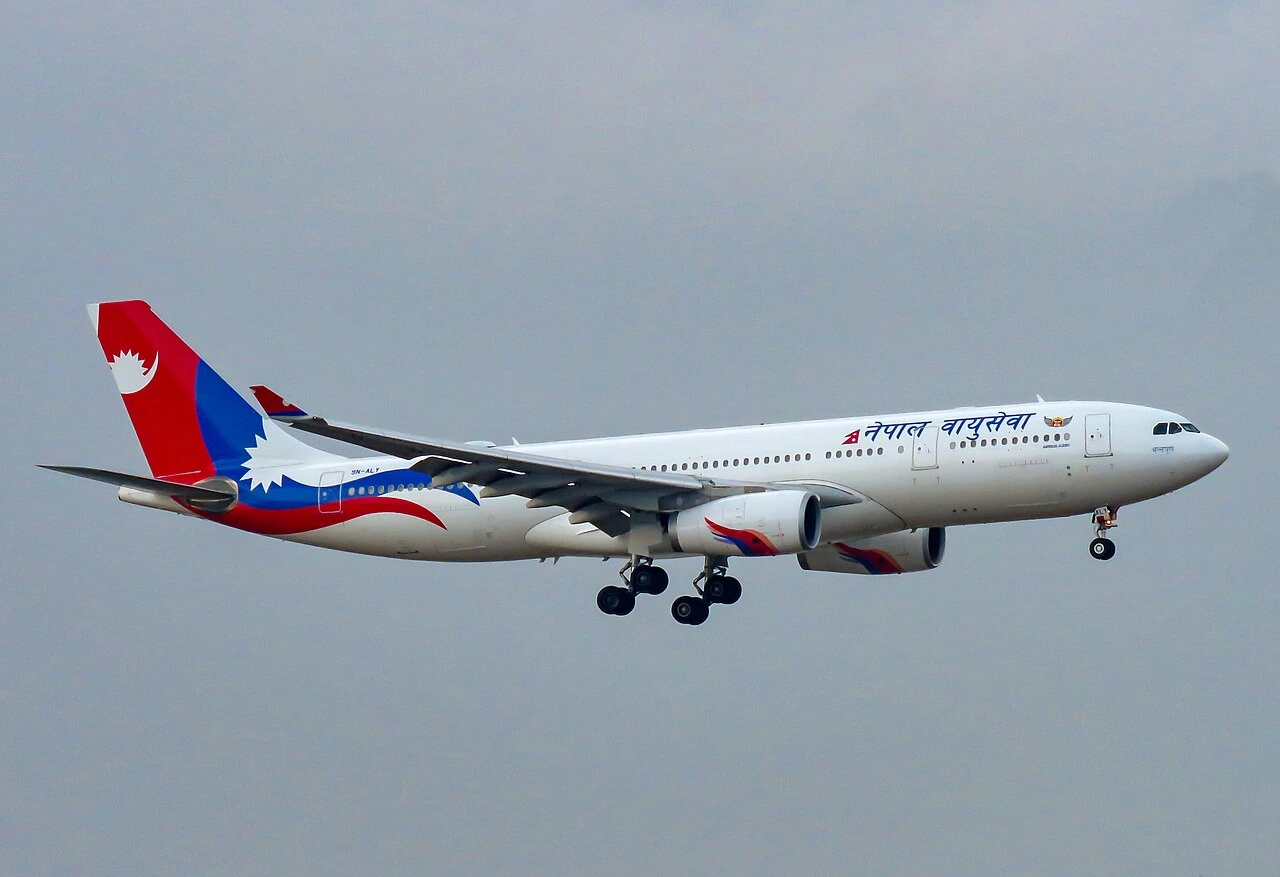
The mechanism by which NAC’s debt became a crisis of public savings rather than merely a corporate balance sheet problem traces to a procurement decision made in 2013. Rising Nepal Daily’s reporting on the 63rd OAG report confirms that NAC took a loan of Rs 22 billion from the EPF and Rs 12 billion from the CIT to purchase Airbus A320 narrow-body and Airbus A330 wide-body aircraft — agreements executed under government guarantees, which transferred the ultimate repayment obligation to the Nepali state if NAC defaulted.
The narrow-body EPF loan of Rs 10 billion, signed in 2013, has been serviced for more than a decade; Clickmandu’s July 2025 investigation calculated that NAC has already repaid Rs 10.93 billion toward the narrow-body aircraft alone. Despite this, the carrier still owes over Rs 10.21 billion due to accumulated interest.
The wide-body loan is the catastrophic core of the debt structure. Clickmandu confirmed that NAC borrowed Rs 12 billion each from the EPF and CIT at 9 percent annual interest in May 2017 to acquire two Airbus A330s, and that this debt has since ballooned to Rs 42 billion — more than three times the original principal — through compound interest accrued during periods of non-payment.
NAC has repaid only Rs 9.93 billion of the wide-body aircraft loans in total, with Rs 4.91 billion to EPF and Rs 5.01 billion to CIT. The Kathmandu Post’s November 2025 investigation warned directly that without immediate corrective measures, “the situation may worsen to a point where Nepal’s two largest public saving institutions — custodians of vital retirement funds — could be adversely affected.” The report used language ordinarily reserved for systemic risk — noting that an erosion of public confidence in EPF and CIT would follow if the government failed to intervene.

Photo: Rucksackschule-dresden | Wikimedia Commons
OAG’s Instruction and the Repayment Calendar Nobody Expects
The OAG’s instruction to NAC to prepare an annual repayment calendar is not the first time Nepal’s supreme audit institution has directed the corporation to organise its debt obligations. The OAG has flagged NAC’s financial condition across multiple consecutive annual reports, each time producing a formal instruction and no structural change.
Nepal Airlines’ own press release on its July 2024 loan payment to EPF and CIT — a single combined payment of Rs 1.35 billion — was presented as evidence of the corporation’s financial recovery, yet New Business Age’s contemporaneous reporting confirmed the payment had been delinquent for one and a half years and that the NAC had only managed it after a period of improved flight occupancy rates, not from any structural revenue improvement. Immediately after that payment, NAC failed to pay its next scheduled installment to EPF by the July 2024 deadline, reverting to the pattern within a single quarter.
The mathematical reality that the Sinha committee calculated — that even Rs 5 billion in annual profit would take a decade to repay the current debt — frames the OAG instruction as an accounting exercise rather than a recovery plan. NAC’s annual interest burden on its aircraft loans alone now exceeds Rs 3.5 billion per year, meaning the corporation must first generate sufficient revenue to service interest before a single rupee of principal can be reduced.
Nepal News English’s explainer on the widebody corruption scandal described the debt as having “turned into a nightmare” for the millions of Nepali workers whose savings in EPF and CIT now finance an airline that cannot profitably compete in its own airspace — a fiscal transfer from the pension savings of ordinary citizens to the operating costs of a corporation systematically looted by a political class that has never faced accountability.

_@_HKG,_March_2019.jpg)
