Qatar Airways (QR) has ended Airbus A380 services on five routes since the type entered its fleet in September 2014 — Atlanta, Guangzhou, Melbourne, Frankfurt, and, most recently on a permanent basis, Perth again after a brief return — with a further three destinations (Paris Charles de Gaulle, Singapore Changi, and Sydney) currently operating without the superjumbo through at least September 2026, Simple Flying reported.
The carrier’s double-decker network has been shaped by forces ranging from the COVID-19 pandemic to the structural economics of specific markets, the emergence of a Virgin Australia codeshare capacity strategy, and the airline’s increasingly deliberate preference for the Airbus A350 (an aircraft type that is deployed on the longest routes in the world) on routes where flexibility matters more than raw seat volume. As of May 2026, Qatar Airways retains eight operational A380 frames, each configured with 517 seats, with two earlier examples permanently withdrawn and unlikely to fly commercially again.
The full picture of those retirements is especially instructive in 2026 because the airline’s A380 fleet is currently grounded in its entirety. Due to the war in Iran, all of the carrier’s double-deckers are presently grounded; the original plan was for them to return to service on June 1, but that date has been pushed back to June 16. When the fleet does return, it will initially serve only two destinations — London Heathrow (LHR) and Bangkok Suvarnabhumi (BKK) — making the five permanently retired routes a more consequential part of Qatar’s route map than they might otherwise appear. Qatar Airways’ A380 services will fall by 43% year-over-year in 2026, from 1,620 outbound superjumbo departures in 2025 to just 920.
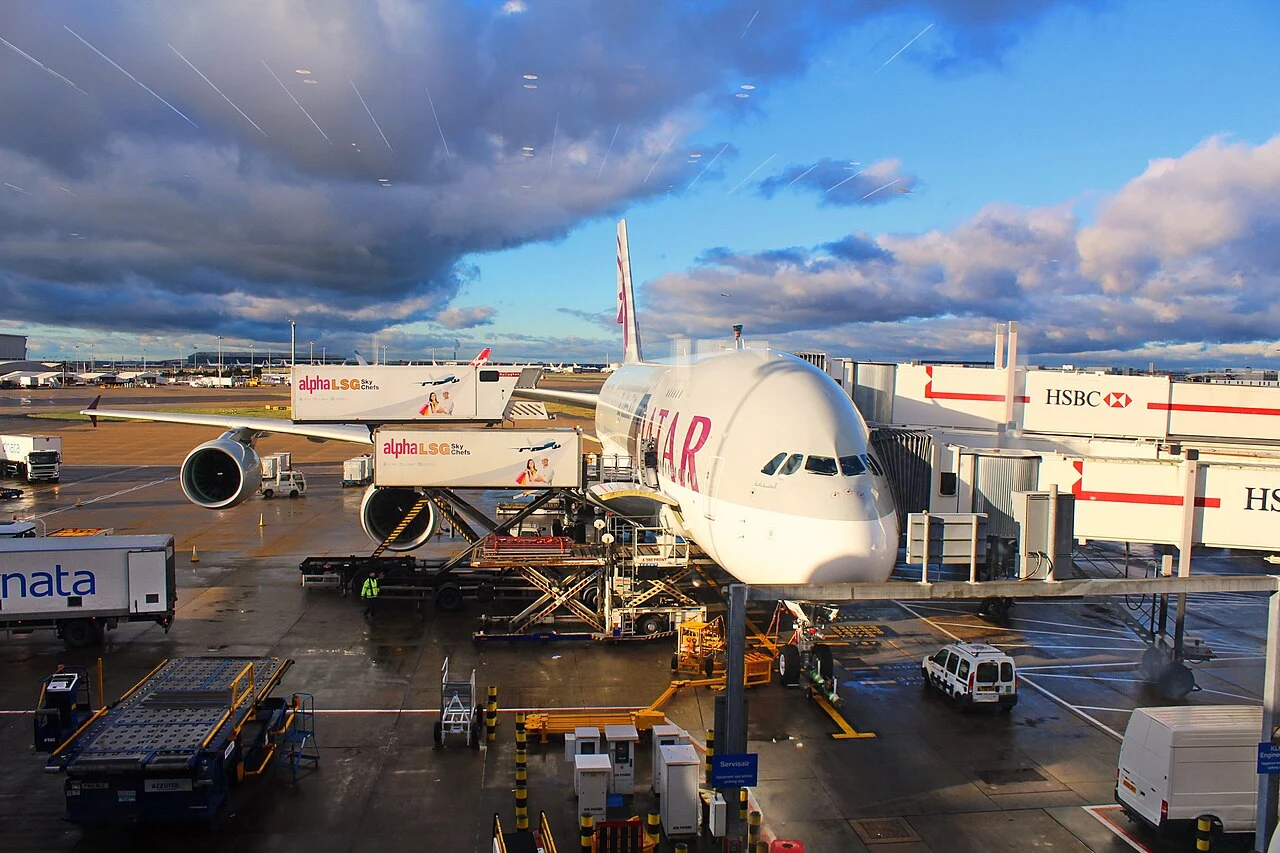
Perth International Airport: Qatar Airways’ Most-Flown A380 Route
According to Simple Flying, with 1,543 departures from Doha, Perth International Airport (PER) was the single most-served destination in Qatar Airways’ A380 history. The superjumbo operated the Doha–Perth sector daily from May 2018 until the forced COVID-19 suspension in March 2020, and then again from December 2022 until late June 2025 — covering a route distance of 5,031 nautical miles (9,317 km) each way. The aircraft of choice on nearly every rotation was the full 517-seat configuration, including eight first-class suites and 48 Qsuite business class seats.
The reason for the A380’s removal was the introduction of Virgin Australia’s Perth–Doha flights in June 2025, operated using Qatar Airways’ own 354-seat Boeing 777-300ERs on a wet-lease arrangement. This was not a routine codeshare: Virgin Australia operates entirely to feed partner Qatar Airways, deploying Boeing 777-300ERs and crew leased from the Gulf carrier, using the Australian half of the traffic rights between the two nations.
The practical effect was a doubling of daily seat capacity between Western Australia and Doha — Qatar Airways’ own QR901 flight plus Virgin Australia’s VA21 — without the brand exposure of a single-airline A380 rotation. Qatar Airways’ withdrawal from the A380 on Perth coincided with an enhanced partnership with Virgin Australia, which expanded codeshare access to over 150 destinations across Europe, the Middle East, Africa, and beyond, with connections through Hamad International Airport.
The substitution also carried a tangible product downgrade for the market’s premium travellers. The move ended the A380’s eight first-class suites on the route, though the Boeing 777-300ER retained the Qsuite business class product — widely regarded as one of the most competitive in global aviation.
Qatar Airways will deploy the 777-300ER and, on occasion, the 293-seat A350-900 on the route for the remainder of 2026. Due to the Iran War, Virgin Australia’s DOH flights are due to resume in September 2026, later than the resumption schedule for some of Qatar’s other Australia–Doha routes.
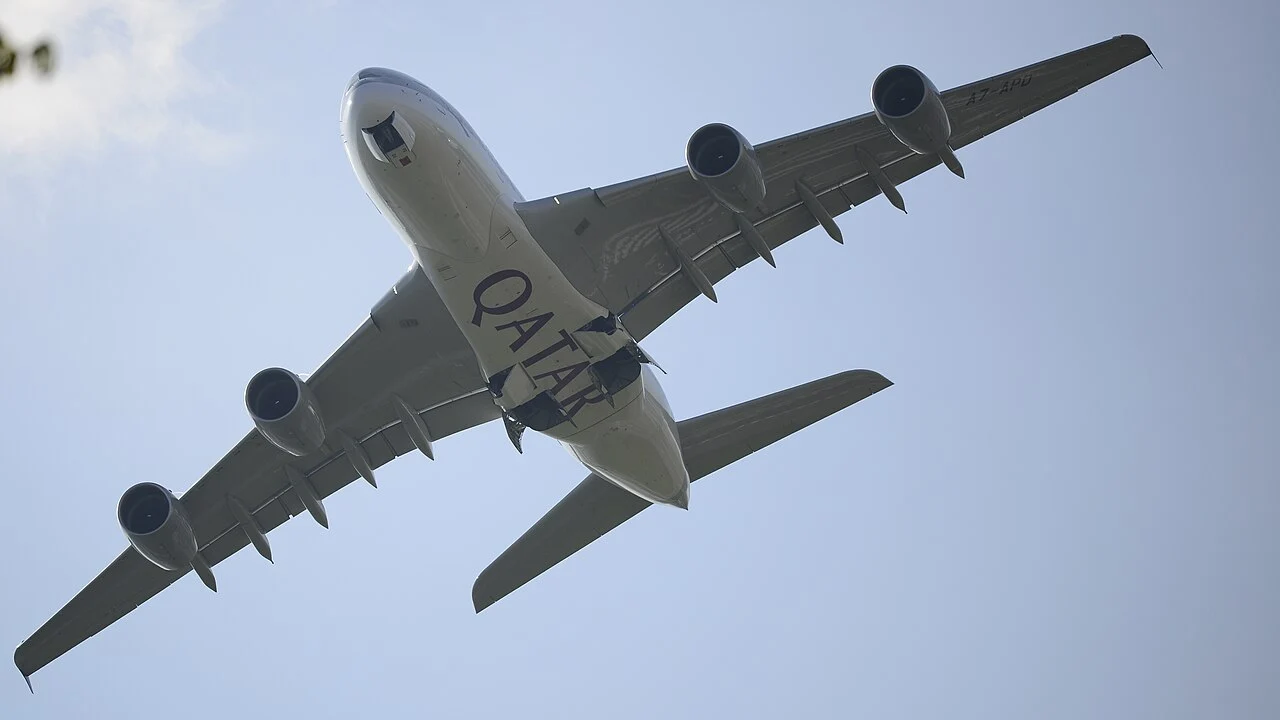
Qatar Had 1,153 Operations to Guangzhou Baiyun International Airport
Simple Flying’s data also points that Qatar Airways operated 1,153 A380 departures from Doha to Guangzhou Baiyun International Airport (CAN), deploying the type daily between July 2016 and January 2020. Guangzhou is one of China’s most significant aviation markets — the metro population exceeds 20 million, and the Pearl River Delta economic zone, which it anchors, is home to approximately 40 million residents — making it a commercially logical candidate for a high-capacity widebody on paper. The A380’s withdrawal coincided with the onset of COVID-19, and the aircraft has not returned to CAN since.
The replacement aircraft for the Doha–Guangzhou route is the economy-heavy, 412-seat Boeing 777-300ER. Qatar Airways now deploys the 777-300ER on the route, which offers more freight capacity than the A380 — a meaningful operational consideration on a sector connecting the Gulf to one of the world’s most active manufacturing and export hubs.
Cargo yield on China routes tends to outperform passenger yield during periods of global trade flux, and the 777-300ER’s belly-hold configuration is better suited to high-density cargo loading than the A380’s lower deck. In 2026, only Emirates continues to use the A380 on Guangzhou, while China Southern and Korean Air have both discontinued the type on that route in prior years.
Melbourne Airport’s A380 Operations Were Designed for European Transit
Melbourne Airport (MEL) was part of Qatar Airways’ superjumbo network between July 2017 and March 2020, accumulating 1,004 A380 departures from Doha. The daily service operated during that period, but the schedule reflects a network architecture that used Melbourne primarily as a connecting node rather than as a standalone origin-destination market.
In March 2020, when the Airbus A380 (which hold the distinction of being among the five largest aircraft ever)was last used on the Melbourne route, booking data shows that the top ten outbound markets were London, Athens, Beirut, Rome, Dublin, Paris, Istanbul, Manchester, Barcelona, and Berlin. Not a single Australian city ranked in the top ten source markets for Melbourne–Doha A380 passengers — every one of the top demand centres was European.
This data point exposes the operating logic behind the type’s removal from MEL. The A380 was being deployed not because Melbourne generated 517 seats of demand, but because the Qatar Airways hub model aggregated European-bound traffic from Australia onto a single high-capacity departure.
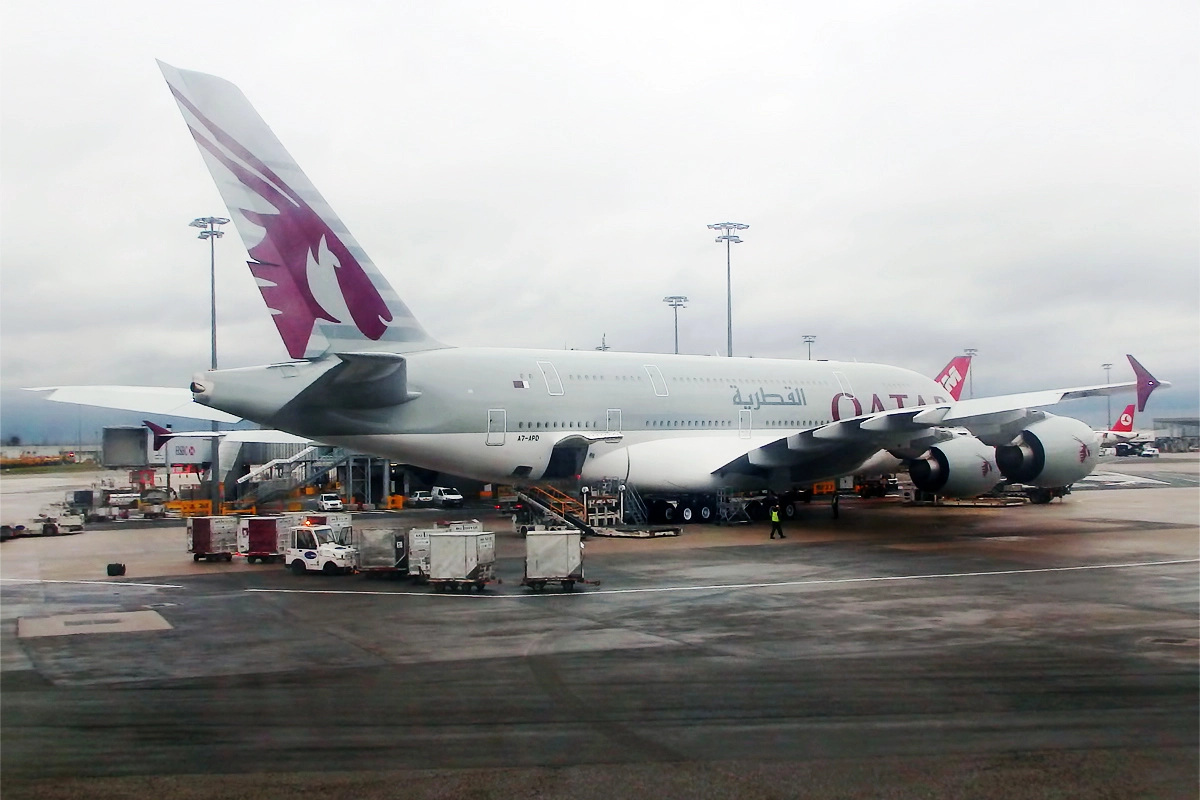
When COVID-19 eliminated that demand, the route reverted to the 777-300ER and has remained that way. The 777-300ER is now flown on the Doha–Melbourne sector by both Qatar Airways and partner Virgin Australia. Emirates, by contrast, has maintained dual-daily widebody services to Melbourne — including an A380 — throughout the post-COVID recovery.

Frankfurt Airport Had One Year of A380 Flights
Qatar Airways operated 364 A380 departures from Doha to Frankfurt Airport (FRA), Germany’s busiest airport, with the type flying daily between March 2019 and March 2020. That window of just over one year represents the shortest continuous A380 deployment across any of the airline’s five retired routes.
The pandemic grounded the aircraft before the route could establish a second full season of performance data, but the fact that the A380 has not returned to Frankfurt in over six years since is, in Simple Flying’s assessment, a telling indicator of the carrier’s satisfaction — or lack thereof — with that market’s performance relative to other opportunities.
Since the delivery of Qatar Airways’ first superjumbo in September 2014, the airline has used the A380 to just three European airports: Frankfurt, London Heathrow, and Paris CDG. In 2026, CDG and Heathrow account for 35% of the carrier’s A380 departures from Doha; only Frankfurt no longer sees the double-decker.
The Doha–Frankfurt sector now operates using the Boeing 787-8, A350-900, and 777-300ER, depending on the frequency and season. Five other A380 operators have also ended services to Frankfurt, illustrating that the type’s presence at FRA was always a commercial experiment by a small number of carriers rather than a sustainable niche.
How the Iran War Suspended Every A380 Qatar Airways Owns
The five permanently retired routes tell only part of the A380 story in 2026. The Iran War has produced the most operationally dramatic chapter: Qatar Airways has parked all eight active Airbus A380s in Doha for April and May 2026, cutting more than 12,000 scheduled flights and suspending service to over 64 destinations.
These six aircraft join the two permanently grounded earlier frames in sitting idle at Hamad International Airport.
| Aircraft Registration | Arrival Date | Arrival Origin |
|---|---|---|
| A7-APC | April 1 | Teruel |
| A7-APD | March 28 | London Heathrow |
| A7-APE | March 25 | Bangkok |
| A7-APF | March 24 | London Heathrow |
| A7-APG | March 28 | Rayong |
| A7-APH | March 24 | Bangkok |
The temporary grounding of Qatar Airways’ A380 fleet in April and May 2026 was a direct response to regional airspace restrictions and the rising cost of jet fuel.
When the fleet resumes service on June 16, only two routes will initially receive the A380: London Heathrow, with twice-daily service, and Bangkok Suvarnabhumi, also with twice-daily service. Paris Charles de Gaulle, Singapore Changi, and Sydney Kingsford Smith Airport have had their A380 service pushed back to September 16, 2026.
In the interim, Paris will be served by the 354-seat Boeing 777-300ER; Singapore will receive a mix of the 283-seat Airbus A350-900 and the 327-seat A350-1000; and Sydney will be operated exclusively by the A350-1000.

The Broader Case Against the A380
Qatar Airways’ relationship with the A380 has never been straightforwardly enthusiastic. Former Qatar Airways CEO Akbar Al Baker once described the A380 as the carrier’s biggest mistake. Between April 2020 and November 2021, Qatar’s entire A380 fleet sat idle. The airline only brought the aircraft back into service because the post-pandemic demand surge and ongoing issues with its Airbus A350 fleet forced the carrier to deploy every available seat.
Of the ten A380s originally delivered to Qatar, only eight were ever reactivated post-pandemic. The two oldest examples have been permanently withdrawn and, as of May 2026, are not expected to return to commercial service.
The core commercial problem with the A380 is structural. Former Qantas CEO Alan Joyce stated that it was cheaper to operate two Boeing 787s than a single A380, and the economics become especially problematic when a carrier operates only a handful of units.
Qatar Airways’ eight-frame A380 fleet sits alongside a diverse long-haul widebody portfolio — A350-900s, A350-1000s, 777-300ERs, 777-200LRs, and the inbound 787 Dreamliners ordered in 2025 — and the maintenance cost pool for the A380 is spread across a comparatively small denominator.
This structural reality is part of why the carrier has consistently chosen the A350-1000 over the A380 for new routes, and why both the Frankfurt and Guangzhou deployments appear, in retrospect, to have been tests the airline concluded without a positive verdict. Avio Space In our previous reportinng, we confirmed that when the A380 does return from June 16, Qatar’s eight aircraft average 10.4 years of age.

Qatar’s A380 Network Today
When the geopolitical situation stabilizes enough for the full network to resume, the carrier will operate its Airbus A380 to the following airports:
- London Heathrow
- Bangkok Suvarnabhumi
- Paris Charles de Gaulle
- Singapore Changi
- Sydney Kingsford Smith Airport
All five share specific characteristics: exceptionally high two-way premium demand, strong connecting traffic via Doha’s hub, severe slot constraints at the destination airport that reward seat-maximization per movement, and leisure demand patterns that justify a premium-heavy 517-seat configuration.
About the operations of Qatar’s A380 to Atlanta, Simple Flying wrote:
“Then there is the Hartsfield-Jackson Atlanta International Airport (ATL), which is the world’s busiest airport for passenger traffic but not for flights. Qatar Airways only had one A380-operated flight from DOH to ATL, which was nearly exactly a decade ago. On June 1, 2016, the type was deployed to Georgia to celebrate the then-new route. Since then, the 777-200LR, 777-300ER, A350-900, and A350-1000 have been used.”
Perth, Guangzhou, Melbourne, and Frankfurt share the opposite profile to varying degrees: more freight sensitivity than premium passenger demand (Guangzhou), a slot environment that does not penalise smaller aircraft (Frankfurt, Melbourne), or a codeshare capacity strategy that made the A380’s removal commercially rational even as overall route capacity grew (Perth).
Despite the Perth cut, Qatar Airways planned 35 weekly A380 take-offs from Doha in November 2025 — up from 28 in November 2024 — because Paris CDG was added and London Heathrow moved to double daily, meaning the network’s aggregate A380 capacity actually grew year-on-year even as one of its most historically frequent routes was dropped.
References
- https://simpleflying.com/qatar-airways-has-ended-airbus-a380-flights-on-5-routes-updated-list/
- https://simpleflying.com/qatar-airways-has-ended-airbus-a380-flights-on-5-routes-full-list/
- https://simpleflying.com/massive-airbus-a380-cuts-qatar-airways-slashes-2026-flights-by-43pc/
- https://simpleflying.com/perth-dropped-qatar-airways-reduces-airbus-a380-network-to-just-4-routes/
- https://simpleflying.com/qatar-airways-grounds-all-airbus-a380s-for-2-months-heres-whats-next/
- https://simpleflying.com/qatar-airways-airbus-a380-june-resumption/
- https://simpleflying.com/why-airlines-dont-want-airbus-a380s-anymore/
- https://aviospace.org/qatar-airways-to-deploy-a380-flights-on-these-busiest-routes/
- https://blog.wego.com/qatar-airways-flight-status-2026/
- https://www.aviationanalysis.net/emirates-qatar-airways-cut-a380-services-from-7-routes-amid-iran-war/
- https://www.paddleyourownkanoo.com/2026/04/07/qatar-airways-grounds-its-entire-airbus-a380-superjumbo-fleet-where-are-they-now/
- https://www.travelandtourworld.com/news/article/qatar-airways-a380-fleet-frozen-luxury-dreams-to-london-paris-crushed-by-iran-crisis/
- https://www.travelandtourworld.com/news/article/qatar-and-the-united-kingdom-join-forces-as-qatar-airways-resumes-a380-flights-to-london-and-bangkok-amid-reduced-operations/
- https://www.travelandtourworld.com/news/article/australia-sees-major-aviation-shift-as-qatar-airways-removes-a380-from-perth-route-and-replaces-it-with-qsuite-equipped-boeing-777-to-match-new-capacity-demands/
- https://www.travelandtourworld.com/news/article/qatar-airways-to-focus-airbus-a380-operations-on-two-key-global-hubs-following-strategic-fleet-grounding/
- https://www.aeronewsjournal.com/2025/06/qatar-airways-replaces-a380-with-qsuite.html
- https://www.aeronewsjournal.com/2026/04/emirates-and-qatar-airways-slash-a380.html
- https://www.traveltourister.com/news/qatar-airways-a380-grounded-april-may-2026-june-comeback-london-sydney-bangkok/
- https://www.visaverge.com/australiaimmigration/qatar-airways-replaces-a380-with-qsuite-on-perth-route/
- https://gulfnews.com/business/aviation/qatar-airways-takes-delivery-of-its-first-airbus-a380-1.1386526
Meta Description
Qatar Airways has retired its 517-seat Airbus A380 from five routes — Perth (after 1,543 departures, driven out by a Virgin Australia codeshare capacity play), Guangzhou (1,153 departures, replaced by a 777-300ER with more cargo capacity), Melbourne (1,004 departures, ), and Frankfurt () — while the Iran War in 2026 has simultaneously grounded all eight remaining A380s for two full months, slashing superjumbo services by 43% year-on-year. Crucially, former CEO Akbar Al Baker once called the A380 Qatar’s biggest mistake: this is the inside story of how the world’s second-busiest international airline has been quietly reclaiming itself from a superjumbo it never quite wanted.
