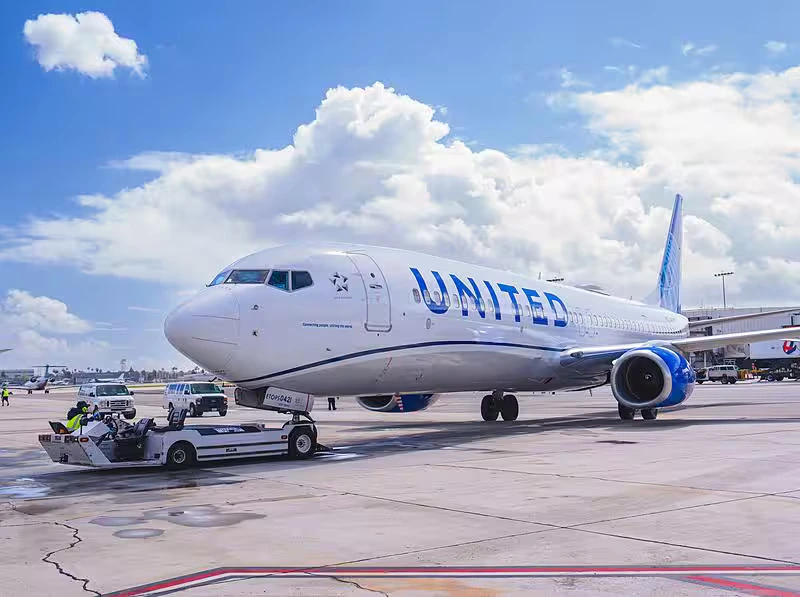
A United Airlines (UA) Boeing 737 MAX 8 operating flight UA779 landed safely at Denver International Airport (DEN) after its crew reported a severe electrical disturbance during approach, an incident that also triggered a collision-avoidance warning and briefly overwhelmed the flight deck’s radios.
What Happened on Approach of UA779
According to the FAA’s incident log, UA779 landed safely at DEN around 12:45 p.m. local time on Sunday, August 2, after departing Austin-Bergstrom International Airport. The agency confirmed it will investigate. Once on the ground, the crew stopped on the taxiway to report the problem to air traffic control.
The pilots described interference over the radios strong enough to make it hard to communicate even with each other in the cockpit, let alone hear instructions from air traffic control. During that same stretch of the approach, the aircraft’s Traffic Alert and Collision Avoidance System (TCAS) issued a Resolution Advisory — the system’s highest-level warning, which directs pilots to climb or descend and overrides standard ATC guidance while it’s active. Audio of the exchange with Denver tower was posted online by a user tracking ATC communications.
The aircraft involved, registered N67350, is only about two years old, according to Planespotters.net data cited by Simple Flying — a young airframe that makes an onboard equipment fault possible but not the obvious explanation.
This 2.1-year-old aircraft was built under manufacturer serial number (MSN) 67627 and line number 8910. The jetcarried the test registrations N4022T and N4025T before entering commercial service. It was delivered to United Airlines in July 2024 and is configured to seat 166 passengers, including 16 in First Class and 150 in Economy. It carries fleet number 7350.
No cause has yet been confirmed for either the radio interference or the TCAS alert, and it’s not yet clear whether the two were related or coincidental.
Why the FAA Is Investigating
The FAA investigates any incident involving a loss of communication with air traffic control, and the addition of an active TCAS Resolution Advisory raises the stakes here: TCAS is designed to keep aircraft separated independently of ground systems, specifically as a backstop for situations like this one, where radio contact with controllers was degraded. An approach involving both problems at once warrants a closer technical look at whether they shared a common cause.
An Echo of Denver’s 2025 Comms Failure
This isn’t the first time Denver-bound flights have lost their radios. On May 12, 2025, transmitters covering part of the airspace managed by Denver Air Route Traffic Control Center went down simultaneously, and roughly 20 aircraft reported dropped communications for up to 90 seconds or more during their approaches — a duration Denver7 Investigates reported as running as long as six minutes for some pilots, a figure the FAA disputed. Controllers shifted traffic to a backup frequency, and the agency said separation was maintained throughout.
FAA officials later attributed that outage to overlapping failures in transmitters and circuits at the facility and said both have since been repaired. Colorado’s congressional delegation — Senators John Hickenlooper and Michael Bennet, and Representatives Joe Neguse and Diana DeGette — pressed the Department of Transportation afterward for faster action on aging communications infrastructure and controller staffing, with Hickenlooper calling the system “decrepit and long past its expected life.”
A Modernization Effort Already in Motion
Congress has since approved $12.5 billion for a national overhaul of air traffic control systems, covering telecommunications, radar surveillance, and data management. FAA Administrator Bryan Bedford told a House aviation subcommittee the agency compressed what was originally a 15-year rollout into three years, targeting completion by the end of 2028, with Peraton managing the program. Early work includes replacing copper wiring with fiber and standing up a new digital command center.
The plan also covers new tower simulation systems at 113 facilities, upgraded display systems at 435 towers, new surface radar at 44 airports, and updated flight-data management technology at 89 airports. Denver itself is getting a separate $43 million investment for runway and taxiway tracking systems meant to reduce incursion risk, plus additional radar due for installation by November 2026 and a shift from paper to electronic flight strips. Denver handles nearly 1,000 aircraft movements a day, which is part of why communication reliability there gets outsized attention.
Whether Sunday’s electrical interference turns out to be connected to the same aging-infrastructure problems as the 2025 outage, or an isolated equipment issue on N67350, is now for FAA investigators to determine.

_-_cn_42176_-_4802_(30608964114).jpg)
.jpg)
