
Top 5 Fighter Jets with the Longest Time in Active Service

Fighter aircraft have a special place in aviation history. During the world war, pilots and aviation personnel often decorated their aircraft with the most astonishing nose art. During the same war, which is described by Russia as “The Patriotic War”, military aircraft helped propel aviation forward with the introduction of much speedier planes. Almost all of the fastest aircraft that have been produced till date have been fighter planes. But which fighter jets have served the longest time in active service? Let’s find out.

5 most wonderful aircraft destroyed in the Russia-Ukraine war


5. McDonnell Douglas F-4 Phantom II

The McDonnell Douglas F-4 Phantom II entered operational service with the U.S. Navy in 1960. The aircraft was deployed first by the U.S. Air Force in 1963. The aircraft was initially designed as a fleet defense interceptor but evolved into a multirole fighter.

Its heyday came during the Vietnam War, when over 800 Phantoms were deployed by U.S. forces. They flew more than 500,000 sorties between 1964 and 1973, as they were deployed in air-to-air combat, ground attack, suppression of enemy air defenses (SEAD), and “Wild Weasel” missions.

Photo: SSGT. SCOTT STEWART – Defense Visual Information Center (DVIC) | Wikimedia Commons
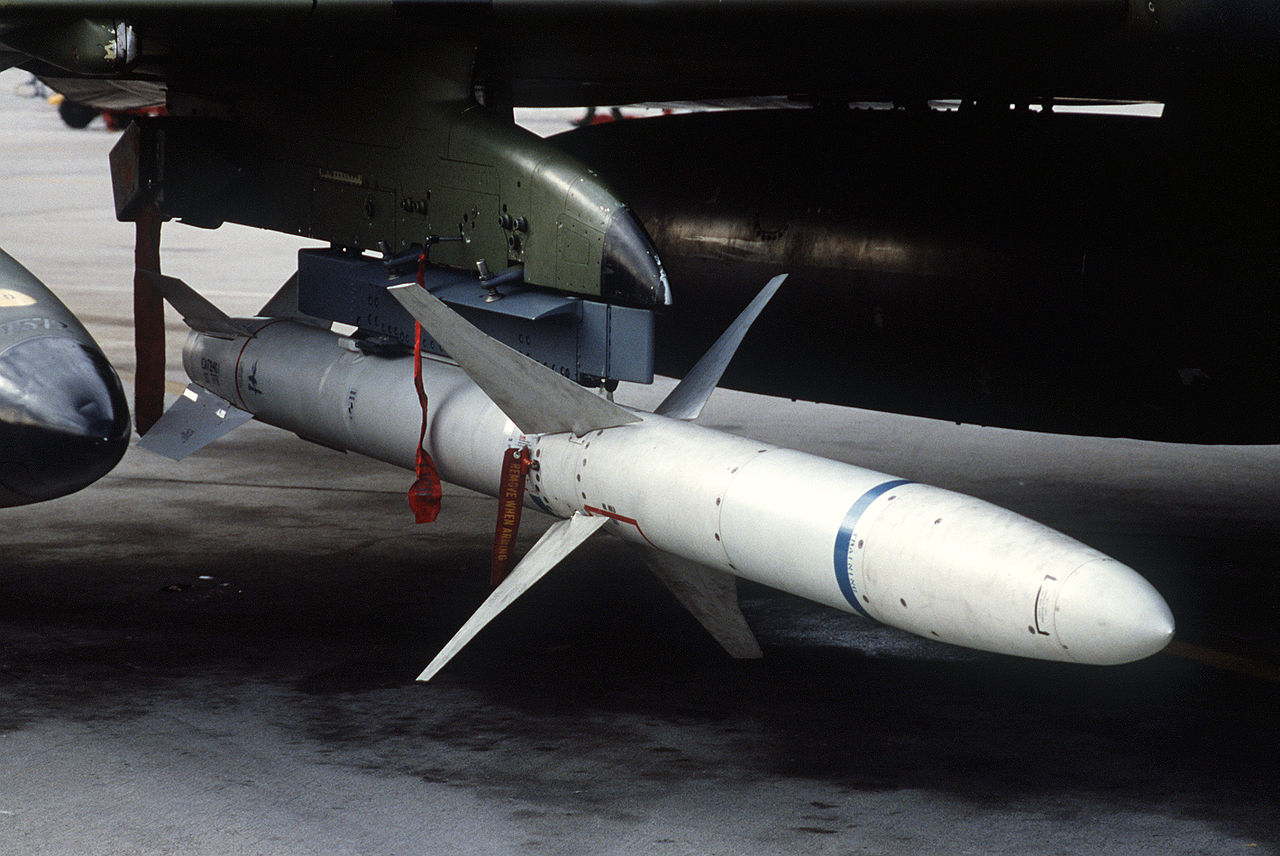
view of an AGM-88 HARM high-speed anti-radiation missile mounted beneath the wing of a 37th Tactical Fighter Wing F-4G Phantom II “Wild Weasel” aircraft located in George Air Force Base, California

Major Wars and Conflicts

  • Vietnam War (1964–1973): In this war, the McDonnell Douglas F-4 Phantom II served as a backbone of U.S. air combat. During the Vietnam war, the aircraft recorded 445 combat losses recorded by USAF alone.

  • Yom Kippur War (1973): The McDonnell Douglas F-4 Phantom II was Israel’s primary fighter during this war where it was deployed against Syrian and Egyptian MiGs.

  • Iran–Iraq War (1980–1988): Iranian Phantoms flew deep-strike missions against Iraqi infrastructure.

  • Gulf War (1991): F-4G “Wild Weasel” variants conducted SEAD missions with AGM-88 HARM missiles.

Specifications of F-4 Phantom II

Parameter Specification
Crew 2 (pilot + radar intercept officer)
Length 63 ft (19.2 m)
Wingspan 38 ft 5 in (11.7 m)
Height 16 ft 6 in (5.03 m)
Empty Weight ~30,328 lb (13,757 kg)
Max Takeoff Weight ~61,795 lb (28,030 kg)
Powerplant 2 × General Electric J79-GE-17A turbojets (17,900 lbf with afterburner each)
Maximum Speed Mach 2.23 (~1,470 mph, 2,370 km/h) at altitude
Service Ceiling ~60,000 ft (18,300 m)
Combat Radius 370 nmi (~680 km)
Ferry Range ~1,750 nmi (~3,240 km)
Armament 1× M61 Vulcan 20mm cannon (F-4E+), up to 18,000 lb of ordnance, AIM-7 Sparrow, AIM-9 Sidewinder, guided bombs
Source: Smithsonian National Air and Space Museum, USAF Historical Research Agency
Photo: TSgt. Brad Fallin, USAF | Wikimedia Commonsg

Early F-4B and F-4C models carried the AN/APQ-72 radar, which was capable of basic pulse-Doppler tracking. However, a later model i.e., F-4D had he AN/APQ-109 radar, which unlike the previous models wasn’t limited to ground-attack modes but had improved reliability for Sparrow missile guidance and added better ground-mapping.

The F-4E variant later introduced the AN/APQ-120 radar, which gave the aircraft a look-down/shoot-down capability against low-flying adversaries. Avionics shifted from analog to hybrid digital, incorporating head-up displays, inertial navigation, and advanced ECM pods such as the AN/ALQ-119 and AN/ALQ-131.

Major Variants of F-4 Phantom II

Variant Key Features vs Base Model
F-4B (USN) Initial carrier-based model, AN/APQ-72 radar, no cannon
F-4C (USAF) Dual controls, USAF boom refueling, adapted avionics
F-4D AN/APQ-109 radar, improved ground attack capability
F-4E AN/APQ-120 radar, M61 Vulcan cannon, HUD integration
F-4G “Wild Weasel” SEAD variant with radar-homing sensors and AGM-88 compatibility
RF-4 Reconnaissance model with nose cameras instead of radar
Source Boeing archives, USAF Historical Research Agency

Over 5,200 units of this aircraft type were produced. McDonnell Douglas F-4 Phantom II was adopted by more than 11 countries, including the U.S., Israel, Japan, Germany, and Turkey. Many remain in limited service today, particularly in Greece, Turkey, and Iran.

4. Lockheed Martin F-15 Eagle

The Lockheed Martin F-15 Eagle entered service with the U.S. Air Force in 1976. It was designed as an air-superiority fighter capable of outperforming Soviet MiGs. With a high thrust-to-weight ratio and advanced avionics, it quickly became the backbone of U.S. air dominance, and its capabilities were deployed in the following wars:

Major Wars and Conflicts

  • Gulf War (1991): F-15s achieved over 35 confirmed air-to-air kills during the Gulf War. According to the US Air Force, the C, D and E models were deployed “in support of Operation Desert Storm“, and that the “F-15E’s were operated mainly at night, hunting SCUD missile launchers and artillery sites using the LANTIRN system

  • It was also deployed in precision strike missions against strategic targets during Iraq War (2003), Operation Inherent Resolve (2014–present) and Syrian Airspace Operations.

Photo: USAF via Wikimedia Commons.
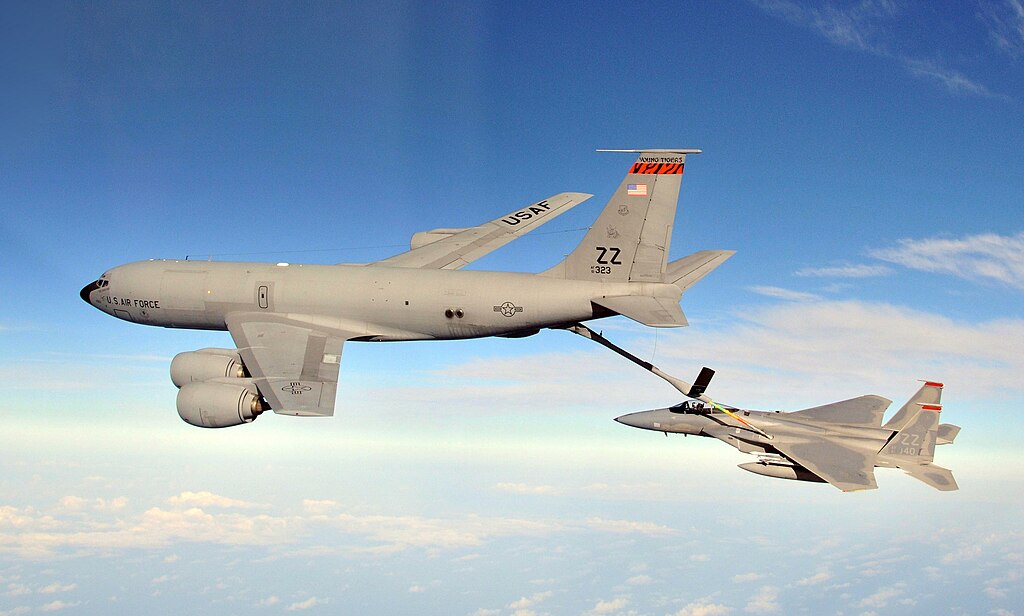
F-15C Eagles from the 67th Fighter Squadron at Kadena Air Base, Japan, refuelled by a KC-135 Stratotanker from the 909th Air Refueling Squadron during joint bilateral training with other U.S. forces and the Japan Air Self Defense Force Feb 25, 2010.

A former F-15C Eagle driver, retired Major Shari Williams explained in Hush-kit about the capabililties of the F-15:

The F-16 has decent AOA capability, but the FBW(fly by wire) system is limited in speed of movement of the controls as it approaches its AOA limit. The F-15 has no such limits. In my experience I usually had more air-air experience (total and recency) than the vast majority of F-16 pilots and usually had little trouble neutralising and then killing them in close.

Specifications of F-15 Eagle (F-15C Variant)

Parameter Specification
Crew 1 (F-15C) / 2 (F-15D)
Length 63 ft 9 in (19.43 m)
Wingspan 42 ft 10 in (13.05 m)
Height 18 ft 6 in (5.64 m)
Empty Weight 28,000 lb (12,700 kg)
Max Takeoff Weight 68,000 lb (30,844 kg)
Powerplant 2 × Pratt & Whitney F100-PW-100/220 turbofans (23,830 lbf dry / 29,160 lbf afterburner each)
Maximum Speed Mach 2.5 (~1,650 mph, 2,655 km/h)
Service Ceiling 65,000+ ft (19,812 m)
Combat Radius ~1,061 nmi (1,960 km)
Ferry Range 3,450 nmi (6,390 km)
Armament M61 Vulcan 20 mm cannon, AIM-7 Sparrow, AIM-120 AMRAAM, AIM-9 Sidewinder, bombs, and external fuel tanks

Early models of the F-15 featured the AN/APG-63 radar for long-range detection and missile guidance. Later upgrades introduced the AN/APG-63(V)3 AESA radar, along with:

  • modern HUDs,
  • Advanced inertial navigation systems
  • integrated digital flight controls
  • Electronic warfare and countermeasure pods, such as the ALQ-135
An F-15C Eagle from the 44th Fighter Squadron flies during a routine training exercise April 15, 2019, out of Kadena Air Base, Japan. The F-15 Eagle is an all-weather, maneuverable, tactical fighter designed to permit the Air Force to gain and maintain air supremacy over the battlefield. (U.S. Air Force Photo by Airman 1st Class Matthew Seefeldt | Wikimedia Commons)

Despite the fact that the F-15 had enhanced survivability, allowing the F-15 to remain effective against contemporary SAM systems and highly maneuverable adversaries, it has suffered notable crashes. Boltflight reported that approximately 159 F-15 aircraft have crashed till date. Here’s a breakdown by of the number of crashes of the F-15 by nation:

Country Number of F-15 Crashes
United States 131
Japan 10
Israel 8
Saudi Arabia 8
South Korea 2

Major Variants of F-15 Eagle

Variant Key Features vs Base Model
F-15A/B Original air-superiority models; analog radar; single/two-seat versions
F-15C/D Improved AN/APG-63 radar, increased fuel capacity, upgraded engines, single/two-seat
F-15E Strike Eagle Dual-role fighter-bomber; AN/APG-70 radar, advanced avionics, precision strike capability
F-15EX Latest USAF variant; AN/APG-82 AESA radar, digital avionics, increased payload and survivability

3. Mig-21

Despite the fact that the MiG-21 was given the rather unwanted moniker of being a “flying coffin“, an epithet it shares with the Consolidated Aircraft B-24 Heavy Bomber plane.

Top 5: Facts About The Consolidated B-24 Liberator Heavy Bomber – Avio Space

The Mig-21 entered service with the Soviet Air Force in 1959. Over 11,000 units were produced, and it served in more than 60 countries. Despite its age, limited upgrades kept it operational for decades in various air forces.
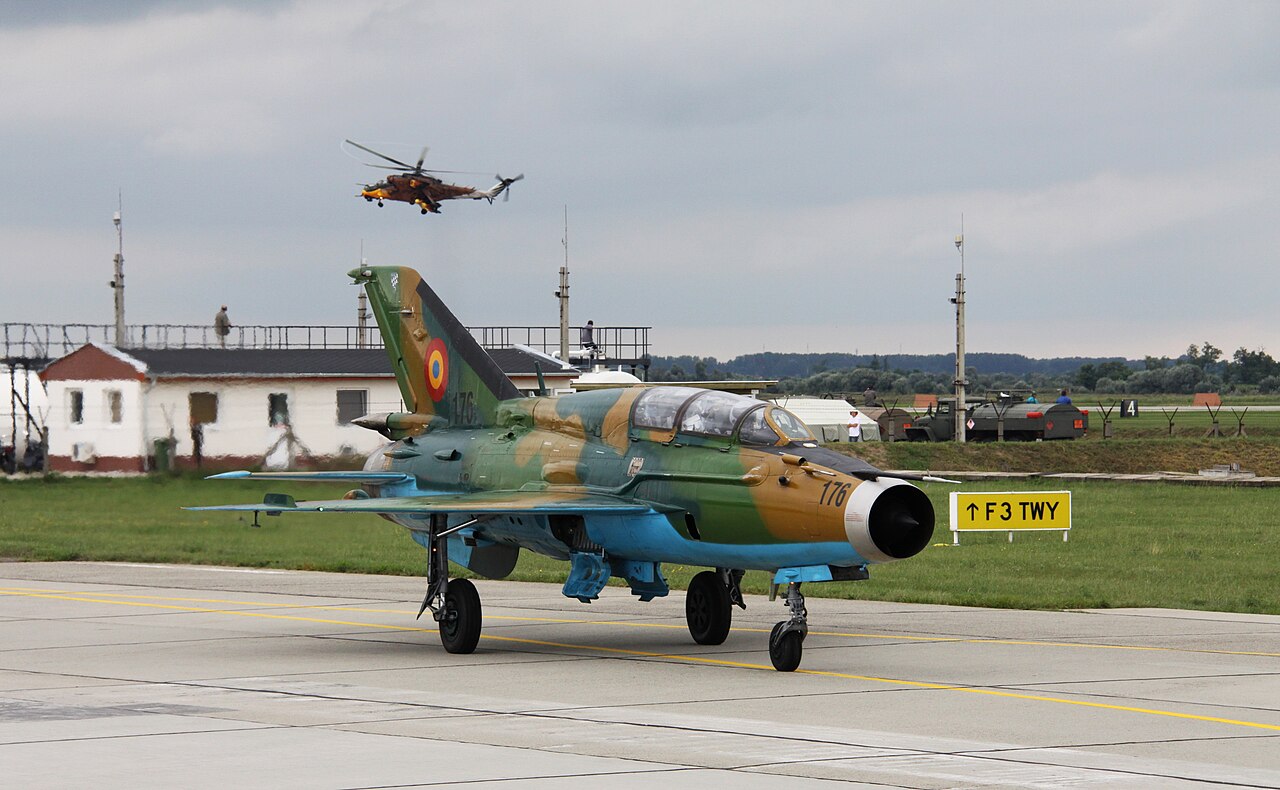
Photo: Łukasz Golowanow | Wikimedia Commons

Major Wars and Conflicts

  • Vietnam War (1965–1975): North Vietnamese MiG-21s engaged U.S. aircraft and was at loggerheads with the McDonnell Douglas F-4 Phantom II. [Key.Aero also reported that for “every single F-4 Phantom produced, Mikoyan-Gurevich could produce at least three MiG-21s”.]

  • The Mig-21 was also used during the Arab-Israeli Conflicts (1967, 1973, 1982).

  • Indo-Pakistani War (1965 & 1971): Indian Air Force deployed MiG-21s in air superiority and ground-attack roles during the Indo-Pakistan War in 1965 and 1971. [India initially got hold of 13 MiG-21s in 1963. At the time of the introduction, the Indian Air Force was “looking for a high-altitude interceptor designed to counter aircraft like the American U-2 spy plane”, reported NDTV.] Incidentally, 200 pilots of the Indian Air Force lost their lives in approximately 400 crashes involving the MiG-21, giving it the epithet “a flying coffin“.

  • Iran and Iraq operated MiG-21s in combat during their conflicts during their war.

Specifications of MiG-21 (MiG-21bis Variant)

Parameter Specification
Crew 1
Length 49 ft 2 in (14.99 m)
Wingspan 23 ft 4 in (7.15 m)
Height 11 ft 2 in (3.4 m)
Empty Weight 9,200 lb (4,173 kg)
Max Takeoff Weight 19,621 lb (8,900 kg)
Powerplant 1 × Tumansky R-25-300 turbojet (37.3 kN dry, 69.6 kN afterburner)
Maximum Speed Mach 2.05 (~1,386 mph, 2,230 km/h)
Service Ceiling 58,000 ft (17,700 m)
Combat Radius ~400 nmi (740 km)
Ferry Range 700 nmi (1,300 km)
Armament 1× 23 mm cannon, up to 4,400 lb of ordnance, K-13 (AA-2 Atoll) missiles, bombs, rockets

Early versions of the Mig-21 had analog targeting and navigation systems, which were later enhanced with radar ranging improvements, RWR (Radar Warning Receiver) systems, and updated communications suites in MiG-21bis and MiG-21-93 variants.

Major Variants of MiG-21

Variant Key Features vs Base Model
MiG-21F Original production, basic radar, limited range
MiG-21PF All-weather interceptor, upgraded radar and engine
MiG-21bis Improved engine, avionics, weapons; NATO reporting name “Fishbed-L”
MiG-21-93 Modernized Indian upgrade, digital cockpit, RWR, HOTAS controls
MiG-21M Export variant with enhanced fuel capacity and weapon systems

The MiG-21’s was the most produced supersonic fighter plane, ever. Mig-21 hails from the nation which produced the second-most produced aircraft of all time- the USSR:

In Pictures: 10 Most Produced Planes in The World – Avio Space

There are plenty of reasons why Mig-21 saw such staggering production numbers – the first of which included  the fact that the USSR allowed licensed production  of the aircraft. India produced more than 600 MiG-21s under license at Hindustan Aeronautics Limited. In China, for example. more than 2,400 MiG–21 have been made as the Chengdu J-7.

2. Dassault Mirage III

The Dassault Mirage III, a supersonic interceptor with delta-wing configuration, entered service with the French Air Force in 1961. Over 1,400 aircraft of this type were made and it served in more than 15 air forces worldwide.

How do double delta blended wing body aircraft work? – Avio Space

The aircraft was deployed in the Six-Day War (1967) as the Israeli Mirage IIIs conducted deep strike missions against Arab airfields. It was also deployed in the Yom Kippur War (1973), the Indo-Pakistani War (1965 & 1971), and the South African Border War (1966–1989). More recently, the aviation standoff between India and Pakistan (during the Operation Sindoor) also hinted at skirmishes involving the Mirage III.
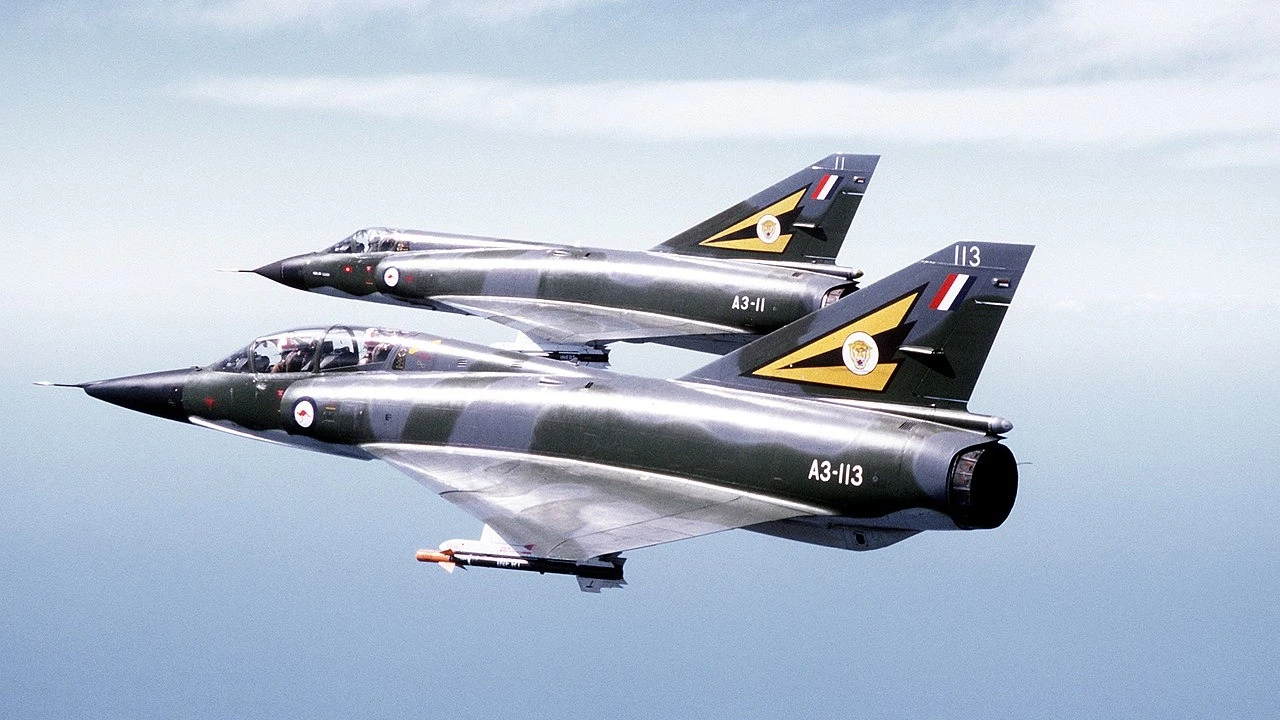
Operation Sindoor results in a flurry of flight cancellations – Avio Space

Specifications of Dassault Mirage III (Mirage IIIE Variant)

Parameter Specification
Crew 1
Length 50 ft 8 in (15.45 m)
Wingspan 26 ft 11 in (8.2 m)
Height 14 ft 3 in (4.35 m)
Empty Weight 12,125 lb (5,500 kg)
Max Takeoff Weight 24,250 lb (11,000 kg)
Powerplant 1 × SNECMA Atar 09C turbojet (13,669 lbf dry, 16,207 lbf afterburner)
Maximum Speed Mach 2.2 (~1,450 mph, 2,330 km/h)
Service Ceiling 55,000 ft (16,800 m)
Combat Radius ~360 nmi (667 km)
Ferry Range 1,240 nmi (2,300 km)
Armament 2× 30 mm DEFA cannons, Matra R550 Magic or AIM-9 Sidewinder missiles, bombs, rockets
Photo: TSGT CURT EDDINGS | Wikimedia Commons

Early models of the Mirage III used analog fire-control systems with simple ranging radar, while the Mirage IIIE introduced the Cyrano II radar, capable of air-to-air and air-to-ground modes. Later upgrades incorporated modern navigation systems, digital HUDs, and improved electronic countermeasure suites.

Major Variants of Dassault Mirage III

Variant Key Features vs Base Model
Mirage IIIC Original interceptor model, basic radar, limited ground attack
Mirage IIIE Multirole upgrade, Cyrano II radar, advanced avionics, ground-attack capability
Mirage IIIR Reconnaissance variant, cameras replacing cannon or radar
Mirage IIIBE Two-seat trainer with dual controls and simplified avionics
Mirage IIIDS Export fighter variant with localized avionics and weapon systems

The Mirage III remains in service with countries including Brazil, Chile, and Lebanon.

1. Boeing B-52 Stratofortress

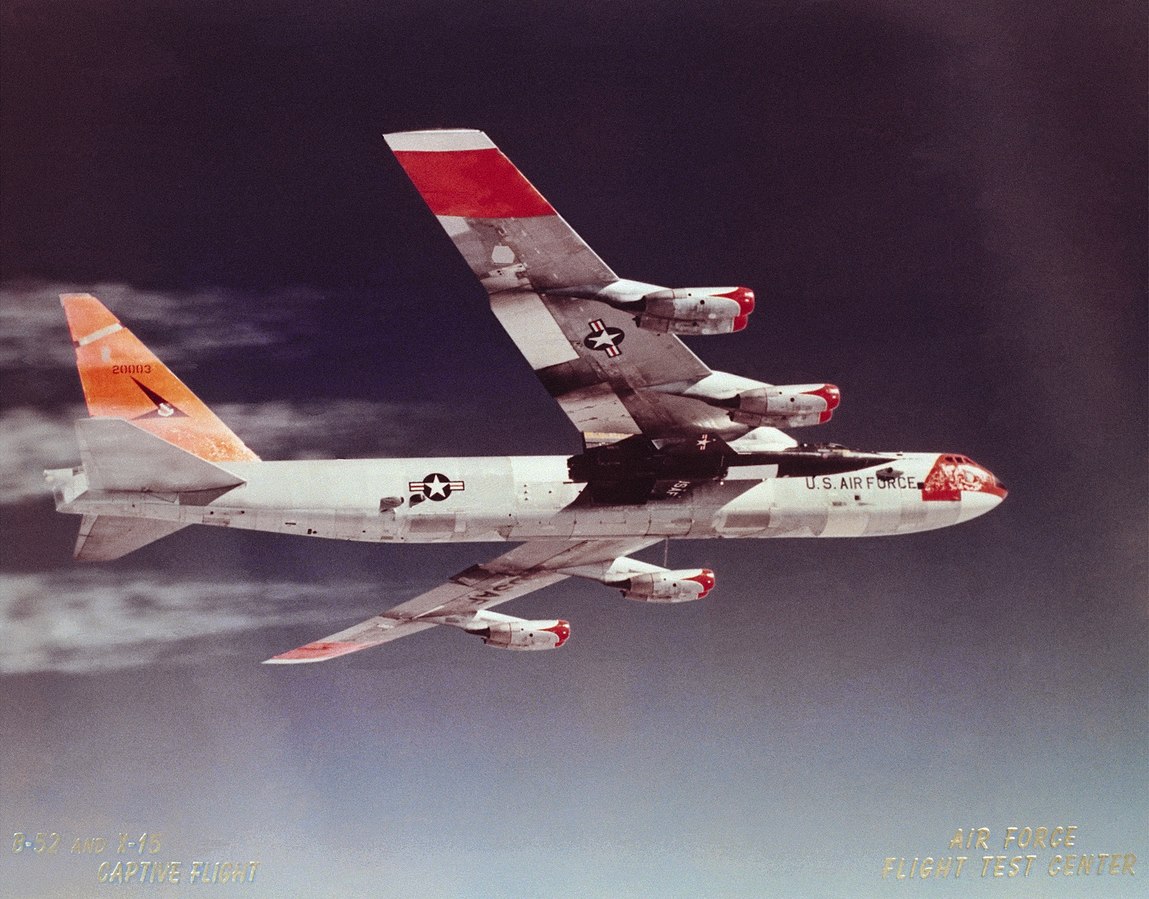
The Boeing B-52 Stratofortress entered service with the U.S. Air Force in 1955 as a long-range strategic bomber designed to deliver nuclear payloads during the Cold War. Its eight-engine design and large payload capacity allowed for both strategic and conventional bombing missions. Continuous upgrades have kept the B-52 relevant for over 65 years, making it one of the longest-serving military aircraft in history.
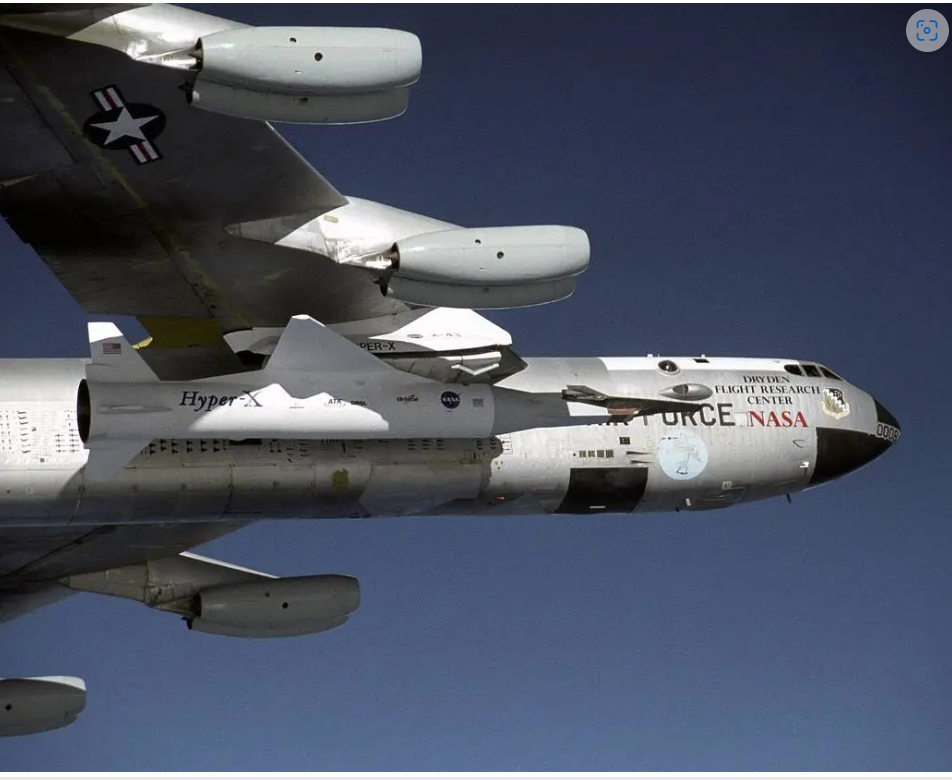
The third X-43A hypersonic research aircraft, attached to a modified Pegasus booster rocket, was taken to launch altitude by NASA’s B-52B launch aircraft from the NASA Dryden Flight Research Center
Photo: NASA/Carla Thomas

Specifications of Boeing B-52 Stratofortress (B-52H Variant)

Parameter Specification
Crew 5 (pilot, co-pilot, radar navigator, navigator, electronic warfare officer)
Length 159 ft 4 in (48.5 m)
Wingspan 185 ft 0 in (56.4 m)
Height 40 ft 8 in (12.4 m)
Empty Weight 185,000 lb (83,900 kg)
Max Takeoff Weight 488,000 lb (221,350 kg)
Powerplant 8 × Pratt & Whitney TF33-P-3/103 turbofans (17,000 lbf thrust each)
Maximum Speed 650 mph (1,046 km/h)
Service Ceiling 50,000 ft (15,240 m)
Combat Radius ~8,800 mi (14,160 km)
Ferry Range 8,800 mi (14,160 km)
Armament 70,000 lb (31,500 kg) of bombs, cruise missiles, conventional and nuclear payloads

The analog navigational systems of the B-52 have undergonne some transformations such as:

  • APQ-166 radar replaced by modern terrain-following radar
  • inertial navigation systems enhanced with embedded GPS, and HUD integration for precision targeting.

Incidentally, the B-52 was used to launch the hypersonic program that was the North American X-15. You can read about it in detail in our guide below:

In Pictures: Aircraft Used In The North American X-15 Hypersonic Program – Avio Space

NB-52B cruise overhead NASA research pilot Bill Dana.
Photo: NASA

Major Variants of B-52 Stratofortress

Variant Key Features vs Base Model
B-52A/B/C Initial production models; limited avionics, lower payload
B-52D Upgraded engines, conventional bombing capabilities, Arc Light modifications
B-52G Improved fuel efficiency, electronic countermeasure enhancements, longer range
B-52H Latest variant; TF33 engines, digital avionics, updated radar, capable of modern conventional and nuclear missions

The B-52 Stratofortress’s longevity is unmatched, with 744 aircraft produced and 77 B-52Hs still operational with the U.S. Air Force. Its ability to adapt to new mission requirements, from nuclear deterrence to precision conventional strikes, ensures it will remain a strategic asset well into the 2050s.

Leave a Comment

Your email address will not be published. Required fields are marked *

Scroll to Top