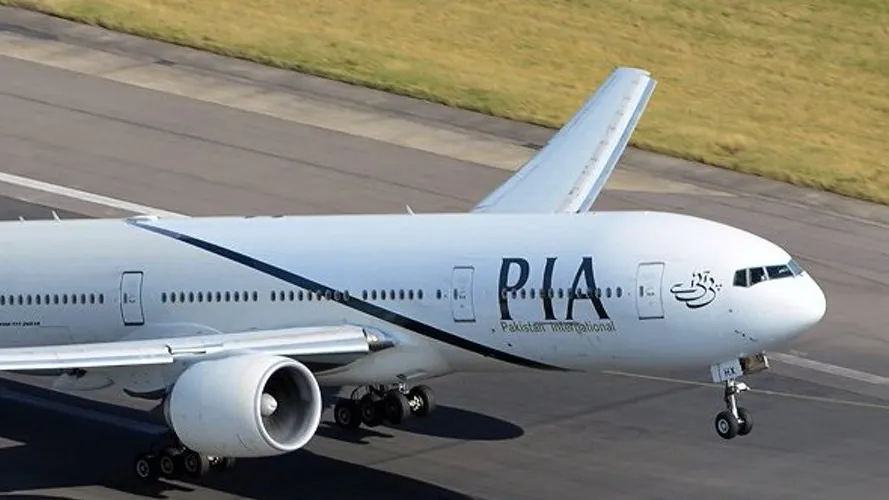
Filed by Advocate Nabeel Javed Kahloon, the plea argues that the federal government’s December 23, 2025, approval of a Rs135 billion deal for a 75 per cent stake in the carrier was illegal and lacked required constitutional and statutory endorsements.
The petition, lodged at the LHC’s Rawalpindi bench on January 4, 2026, contends that the sale violates the Pakistan International Airlines Corporation (Conversion) Act, 2016 and bypasses mandatory approvals from the Council of Common Interests (CCI) under Article 154 of the Constitution.

Carrier Profile: Pakistan International Airlines (PIA)
| Attribute | Details |
|---|---|
| Full Legal Name | Pakistan International Airlines Corporation Ltd. |
| IATA Code | PK |
| ICAO Code | PIA |
| Founded | 29-Oct-1946 (as Orient Airways) |
| Commenced | 11-Mar-1955 as PIA |
| Headquarters | Karachi, Pakistan |
| Main Hub | Jinnah International Airport (KHI), Karachi |
| Secondary Hubs | Allama Iqbal International Airport (LHE), Lahore; Islamabad International Airport (ISB) |
| Fleet Size | 32 aircraft |
| Destinations | ~50 globally |
| Ownership (Post-2025) | Arif Habib Consortium 75 %, Government of Pakistan 25 % |

Legal Challenge to PIA Privatization
The petition was filed by Nabeel Javed Kahloon and contends that the government’s sale notification was:
-
Issued without CCI approval as mandated for trans-provincial institutions under Article 154.
-
Undertaken without adequate Parliamentary scrutiny on a matter of national public interest.
The petition argues that the process was marred by “lack of transparency, arbitrary decision-making, and misuse of authority” and that “restructuring or transfer of assets should remain within government-controlled entities as per the sections 3 and 4 of the 2016 Act“.

What Existing Law Says: CCI, PIAC Act, and IATA principles
There are various constitutional and statutory framework under the Constitution of Pakistan that Pakistan International Airlines’ privatization doesn’t follow, and these are:
| Legal Basis | Provision Referenced | Argument Presented |
|---|---|---|
| Asset Restructuring Restrictions | Sections 3 and 4, Pakistan International Airlines Corporation (Conversion) Act, 2016 | Any restructuring or transfer of PIA assets must remain within government-controlled entities |
| Judicial Review Authority | Article 199, Constitution of Pakistan | The sale of a national strategic asset such as PIA is subject to high court judicial scrutiny |
| Status of PIA | Federal Legislative List, Part II | PIA is classified as a trans-provincial institution |
| Mandatory Approval Requirement | Article 154, Constitution of Pakistan | Privatization cannot proceed without prior approval of the Council of Common Interests (CCI) |
| Alleged Legal Oversight | Expression of Interest (EOI) issuance | Federal government failed to account for PIA’s constitutional status when initiating the privatization process |

However, one has to note that this is not the first time a petition has been filed in a Pakistani court alleging that the privatization of PIA is illegal. In November 2025, the Islamabad High Court (IHC) in Pakistan dismissed a case that was filed by the People’s Unity of PIA Employees, a registered Collective Bargaining Agent (CBA), that flied nine cases against the privatization of PIA.
Barrister Minaal Tariq. the Counsel of Privatization Commission of Pakistan, was speaking to HUM News, and was quoted to have said:
“Five out of nine constitutional challenges to the Privatization of PIA have been dismissed by this latest judgement. These decisions are all the more significant as Pakistan embarks on an ambitious and wide-ranging privatization program, where legal certainty is essential for investor confidence and for the State’s ability to restructure its state-owned enterprises.”

Comparison with Previous Legal Actions on PIA Privatization
| Category | 2025 IHC Petitions | 2025 LHC (Rawalpindi Bench) | 2026 LHC Constitutional Challenge |
|---|---|---|---|
| Year | 2025 | 2025 (July) | 2026 (January) |
| Court | Islamabad High Court | Lahore High Court (Rawalpindi Bench) | Lahore High Court |
| Nature of Petition | Challenges to privatisation framework | Challenge to initiation of privatisation | Challenge to approved sale |
| Core Legal Focus | Transparency, bidding process, asset valuation | Procedural validity of EOI | Constitutional authority and statutory compliance |
| Laws / Articles Invoked | — | — | Articles 154 & 199; PIAC Act, 2016 |
| Outcome | Dismissed | Dismissed | Pending |
| Judicial Posture | Deference to executive economic policy | Procedural threshold not met | Constitutional questions under review |
| Significance | Limited judicial intervention in privatisation | Cleared path for sale process | First direct constitutional test of PIA privatisation |

With regard to the petition against the privatization of PIA that was dismissed by Lahore High Court (LHC) Rawalpindi Bench:
-
Section 23 (Privatization Commission Ordinance, 2000): The petition argues that the federal government advertised the sale of PIA without first satisfying the statutory prerequisites mandated under this provision, rendering the privatization process unlawful.
-
Article 199 (Constitution of Pakistan): The petitioner maintains that the high court possesses constitutional authority to review and remedy alleged legal violations committed by statutory bodies involved in the privatization exercise.
-
Section 28 (Privatization Commission Ordinance, 2000): The petition challenges the 2023 amendment introduced by the caretaker government, asserting that the establishment of an appellate tribunal improperly limits the high court’s jurisdiction and undermines constitutional judicial oversight.
Then, Barrister Minaal Tariq, who represented the Privatisation Commission, defended the government’s position, was quoted in profit.pakistantoday.com that:
“…..the current privatisation process adhered to Article 173 of the Constitution and the Pakistan International Airlines Corporation (Conversion) Act, 2016. With the government owning 96% of PIA’s shares, she stressed that a competitive sale was crucial to address the airline’s financial issues and meet Pakistan’s commitments to the International Monetary Fund (IMF).”

Nepal’s Biggest Plane Crash: Pakistan International Airlines Flight 268
Background: how PIA privatisation unfolded
the sale process
In May 2025 the government published an Expression of Interest (EOI) inviting bids for Pakistan International Airlines’ majority stake. The Cabinet Committee on Privatisation (CCoP) later endorsed a Rs135 billion bid by a consortium led by the Arif Habib Group for a 75 per cent stake in the flag carrier. Investors pledged additional capital (Rs80 billion – Rs125 billion) for fleet modernisation and restructuring.
According to The Associated Press, “the sale fulfills a long-standing demand by the International Monetary Fund, which has repeatedly urged Pakistan to privatize the airline as part of broader economic reforms tied to bailout programs“.
The Associated Press also quoted the following figures:
| Monetary / Quantitative Figure | Currency / Unit | Context / Description |
|---|---|---|
| $7 billion | USD | Staff-level IMF loan agreement reached by Pakistan |
| $1.1 billion | USD | Final tranche released under previous IMF bailout |
| $3 billion | USD | Total size of the earlier IMF bailout package |
| 37 months | Duration | Length of the new IMF loan programme |
| 25% | Percentage | Proposed maximum increase in government employee salaries |
| 13 trillion rupees | PKR | Targeted tax collection set by the government |
| $44 billion | USD | Dollar equivalent of the targeted tax collection |
| 40% | Percentage | Increase in tax collection compared to the current fiscal year |
| 5 million | People | Estimated number of registered taxpayers in Pakistan |
| $68 billion | USD | Size of the new national budget |
| $50 billion | USD | Size of the previous fiscal year’s budget |
| $6–8 billion | USD | Estimated IMF loan Pakistan aims to qualify for |
| 2023 | Year | Reference year of near foreign debt default |

What Happens Next in PIA’s Privatization Process: Court Timelines and Possible Outcomes
The Lahore High Court is expected to hear detailed arguments on:
-
Jurisdictional competence of LHC post-2013 privatisation law amendments
-
Constitutional legitimacy of sale without CCI approval
-
Conformance with PIAC (Conversion) Act requirements
Should the court rule in favour of the petitioner, the sale could be declared null and void, and future steps stalled until full compliance with constitutional and statutory processes is demonstrated.
Conversely, an adverse ruling could bolster government privatisation policy and limit judicial interference in economic reform trajectories.

Court Jurisdiction and Relief Sought
| Aspect | Details |
|---|---|
| Jurisdiction Argument | Amendments limiting high court jurisdiction do not apply |
| Nature of Case | Constitutional violations and public interest matter |
| Relief Requested | Declaration that the sale agreement is null and void |
| Interim Relief | Suspension of all further privatization steps |
| Additional Request | Halt actions linked to the earlier expression of interest |