In a few days’ time, we will stumble upon the 17th anniversary of the extraordinary events of the miraculous landing of US Airways Flight 1549. The Airbus A320 operating from New York’s LaGuardia Airport (LGA) to Charlotte Douglas International Airport (CLT) hit a flock of geese that can weigh as much as 12 pounds, and both its engines lost power. And yet, despite the pilot asking the flight attendants to request everyone on board to take “brace position,” the aircraft — with 150 passengers and five crew on board, and one without thrust flying over one of the most crowded airspaces in the United States — landed without the loss of life of a single passenger.
While US Airways Flight 1549 was an extraordinary occurrence in its own right, there have been various aviation incidents that have not been so lucky — among them the still-unexplained disappearance of MH370, and the crash of the Boeing 737 MAX8 with faulty MCAS systems.
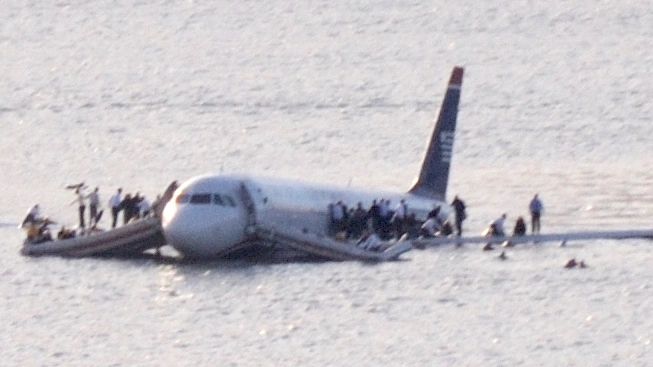
In the background of such terrible tragedies, the survival of US Airways Flight 1549 is a shining light in the world of aviation. In this article, we are going to have a look at how, in freezing winter conditions, Captain Chesley “Sully” Sullenberger and First Officer Jeffrey Skiles performed a controlled ditching of a commercial jet into the Hudson River without a single fatality — an episode that would come to be known worldwide as the “Miracle on the Hudson.”
What Really happened on US Airways Flight 1549
US Airways 1549 couldn’t have been operated by better pilots. Captain Sullenberger, then 57 years old, was a highly experienced pilot and aviation safety expert with nearly 20,000 flight hours. First Officer Jeffrey Skiles, though new to the A320 as pilot flying, had clocked less than 50 hours on the aircraft type despite carrying over 15,000 flight hours total — the vast reserve of his experience came from the Fokker 100 and Boeing 737. Notably, the flight was also the final leg of a four-day rotation for the crew, and it was the aircraft’s second flight of the day.
The aircraft departed LaGuardia at approximately 3:25 p.m. EST and climbed normally for the first two minutes. Almost two minutes into the flight, Captain Sullenberger shouted the word “Birds!”, signaling that the aircraft was on a collision course with a flock of migratory Canada geese. At about 2,800 feet, the flock struck the aircraft, resulting in catastrophic damage to both General Electric CFM56 engines. According to Captain Sullenberger:
“They have five- or six-foot wingspans. They struck the airplane along the leading edges of the wings, the nose, and into the center, the core of both jet engines. Jet engines are turbines. They are finely balanced machinery spinning at tens of thousands of revolutions per minute. Having a ten-pound object or two go through each of them, in the center of the engine core, is incredibly damaging and disruptive.”
One has to note that the Airbus A320 and its CFM56 engines were certified using birds weighing only two to two and a half pounds — a fraction of the size of the geese actually encountered that day.
There was almost no way for the pilots to assess the extent of the damage as it happened. Jeff Skiles’ words immediately after the strike were “Uh-oh,” while Captain Sullenberger said, “We have one… no, both engines are rolling back.” This was followed, just two seconds later, by “I’m starting the APU and I have controls.” Ten seconds after this, he declared a Mayday — though his call was partially blocked by another transmission. Flames were visible, engine parameters collapsed, and the aircraft transitioned into a powerless glide.
One of the more important details pertinent to the crash was revealed by Mentour Pilot:
“At the time, US Airways operated A320s configured both for extended over-water operations and for domestic routes only. Aircraft equipped for over-water use carried life vests for all passengers and had emergency slides that could double as life rafts at both forward and aft exits. By sheer luck, this aircraft was one of those equipped for extended over-water operations, despite not being scheduled to fly over water that day.”
Despite several restart attempts, neither engine recovered. The aircraft descended rapidly, accelerating past 200 knots as it passed through 1,650 feet. With altitude and time disappearing, the crew had only seconds to evaluate their remaining options — some of which can be seen in the cockpit voice recordings below:
US Airways 1549: This is Cactus 1549, hit birds, and both returning back towards LaGuardia.
ATC: Okay, uh, you need to return… turn left heading up 220.
Captain: 220.
…
ATC: …you want to try to land, one 3?
Captain: We may end up in the Hudson.
ATC: Cactus 1549, it’s going to be less traffic to Runway—
Captain: Unable.
ATC: 31, okay. What do you need to land? Cactus 1549, Runway 4 is available if you want to make left traffic to Runway 4.
Captain: What’s over to our right? Anything in New Jersey — maybe Teterboro?
ATC: Okay, yeah — off your right side it’s Teterboro Airport. Do you want to try to go to Teterboro?
Captain: Yes.
Turning a twin-engine failure into a miracle in the Hudson
The aircraft was quickly losing momentum, while outside, winter temperatures hovered well below freezing. According to Captain Sullenberger:
“Then the thrust loss was sudden, complete, symmetrical, bilaterally, both engines at once. It felt as if the bottom had fallen out of our world, and my body responded immediately in a very normal human way to this sudden life-threatening stress. I was aware as it happened. I could feel my pulse shoot up, my blood pressure spike, and my perceptual field narrow into tunnel vision because of my stress. I remember vividly my first three conscious thoughts.”
His first three conscious thoughts were along the following lines:
- Sheer disbelief that the aircraft had lost both engines so early into the flight.
- He couldn’t believe that a task as grave as that could befall him.
- A feeling of never having been so challenged in the four decades of his aviation career.
Air traffic controllers cleared Captain Sullenberger to land on Runway 1, but the captain quickly determined the aircraft would not reach it. With no viable runway within gliding distance, Sullenberger committed to a water landing on the Hudson River. From the moment of engine failure to impact, only 208 seconds elapsed. The entire flight lasted just over five minutes.
Here’s a timeline of how the events unfolded:
| Time (EST) | Event |
|---|---|
| 14:51 | Weather observation recorded visibility at 10 miles with broken clouds at 3,700 feet |
| 15:24:56 | Aircraft cleared for takeoff and departed from LaGuardia Runway 4 |
| 15:25:51 | Flight crew reported passing 700 feet during initial climb |
| 15:26:37 | Captain Sullenberger remarked, “What a view of the Hudson today” |
| 15:27:11 | Aircraft struck birds, leading to dual engine failure |
| Approx. 15:51 | Updated weather showed few clouds at 4,200 feet and winds from 310 degrees |
Brace for Impact
Jeffrey Skiles worked to the best of his abilities to use the checklists to restart at least one of the engines, so the aircraft could fly again and return to a runway. Two minutes after the aircraft’s engines had given way, Captain Sullenberger picked up the PA microphone and announced, “This is the captain. Brace for impact.”
The flight attendants might have been taken aback, as until this time there had been no direct communication with the cabin crew about the gravity of the situation. An announcement like “Brace for impact,” according to Cabin Safety Investigation Guidelines, helps “pre-position your body against whatever it is most likely to hit during the crash, and thus avoid the secondary impact which could otherwise take place.” The captain also heard flight attendants relaying commands to the passengers: “Brace, brace, brace. Heads down, stay down.”
Captain Sullenberger had multiple warnings competing for his attention in these critical seconds, including TCAS alerts due to rotorcraft traffic over central New York and Ground Proximity Warning System alerts. He later revealed during the investigation that he felt as if he was flying at green-dot speed.
Roughly two and a half minutes after the dual-engine failure, First Officer Skiles reached a critical assessment: restarting the engines was unlikely. About 20 seconds later, Sullenberger requested flap extension. Skiles reported an airspeed of 170 knots at an altitude of 250 feet. According to Sullenberger, “without engine thrust, we were using gravity to provide forward motion, descending like a hotel elevator at two floors per second.”
Photo: Izno, cropped by Falcorian | Wikimedia Commons
Skiles suggested advancing the thrust levers as a final check, then confirmed the aircraft was configured with flaps two and asked whether further extension was required. Sullenberger decided to maintain flaps two — a choice later scrutinized during the investigation.
| Configuration Option | Operational Impact |
|---|---|
| Flaps 2 | Lower drag, improved nose-up attitude |
| Flaps 3 | Increased drag, steeper descent risk |
Sullenberger explained that flaps three would have increased drag at a critical phase, while flaps two offered a more favorable pitch attitude for water contact. Investigators ultimately supported this judgment.
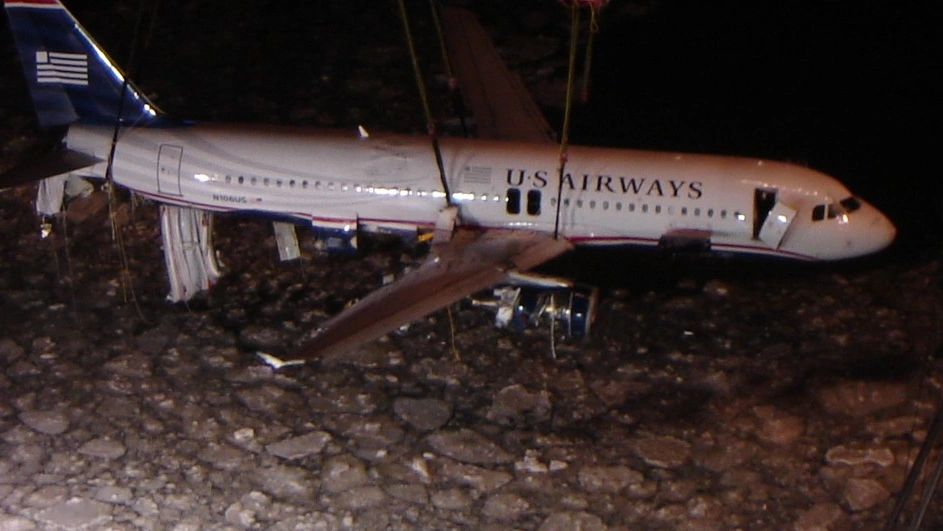
Photo: Spyropk | Wikimedia Commons
The Auxiliary Power Unit Kicks In
Sullenberger’s decision to start the APU was also important, because it restored an independent source of electrical power while the engines were no longer providing normal generator output. The APU helped preserve the aircraft’s electrical configuration and supported the flight-control systems during the approach to the river.
One of the protections unavailable outside normal law is alpha floor, an automatic thrust function designed to help prevent the aircraft from reaching an excessively high angle of attack. Without the APU keeping the aircraft in normal law, controlling the A320 at very low speeds during the approach would have been considerably more demanding for the pilots.
As Sully approached landing on the water, he asked his first officer if he had any ideas. Jeff responded that he did not, signifying that the two had realized they had not overlooked any options, and that in whatever little time they had, they had taken every possible action into consideration. According to Captain Sullenberger:
“Had Jeff not also had 20,000 hours of flying time like I did, had he not been a captain before, and had he not been so experienced, he would not have known either to do that or how to do that. He made important suggestions at several points in the flight. He was silently supporting me as I made each decision, ready to intervene or check my performance if he thought I was making an error.”
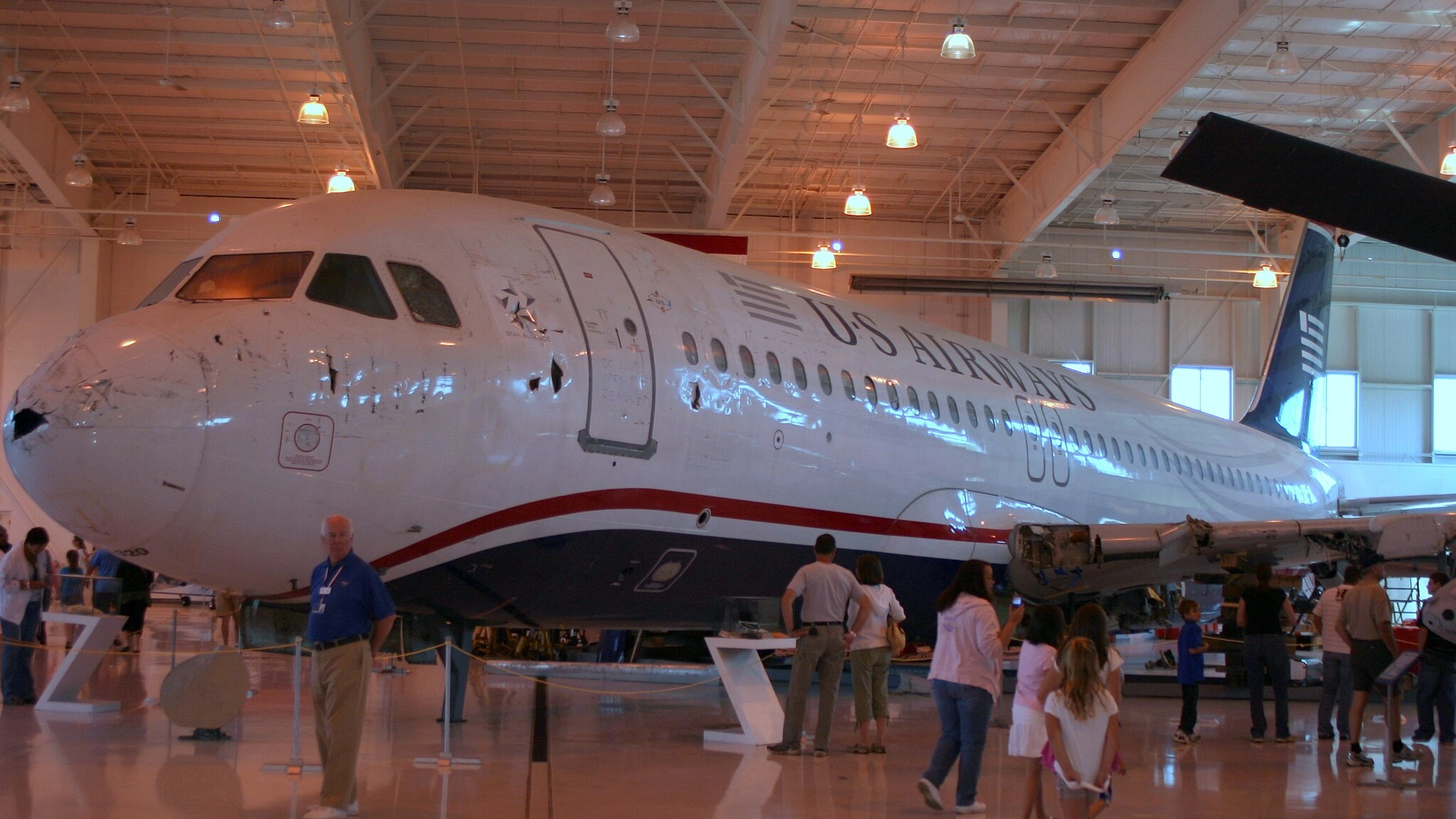
Photo: radio Fan | Wikimedia Commons
The Final Descent and Ditching
Here’s how an analysis of the events describes the seconds before the A320 made its water landing:
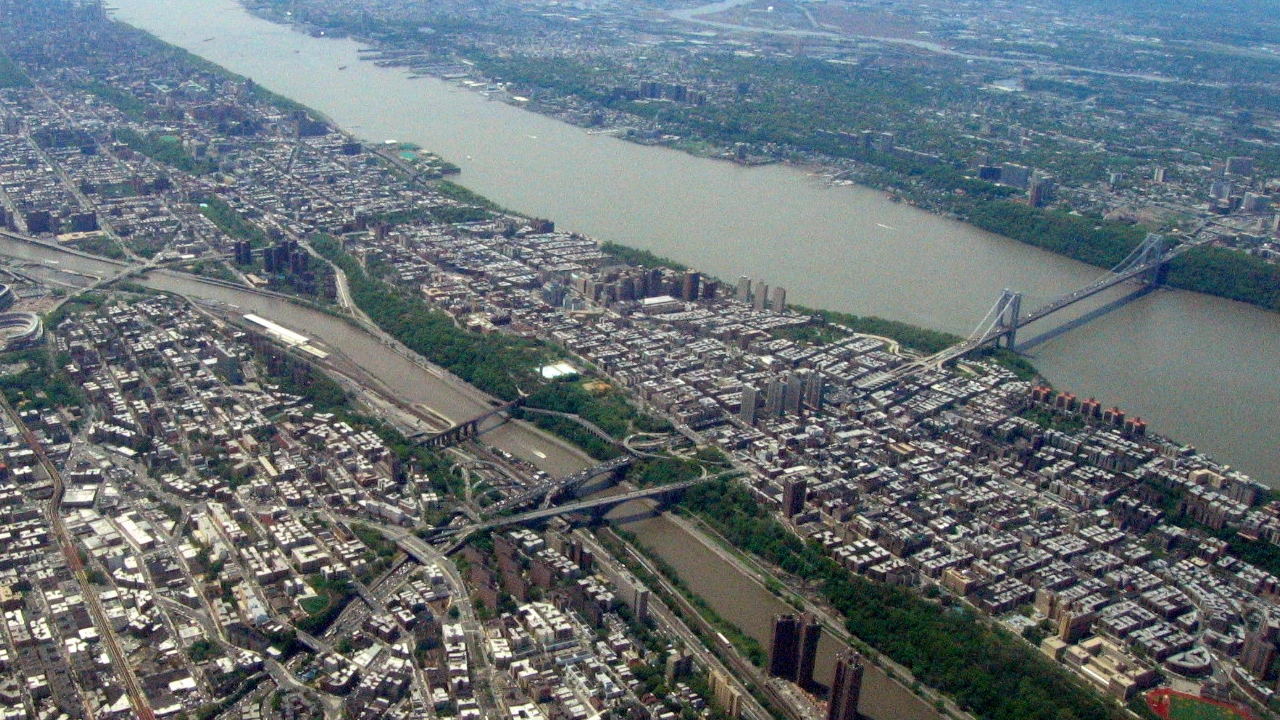
“The controller later recalled being unable to process the decision, believing it to be a death sentence. Sullenberger lined up the A320 with the Hudson River, clearing the George Washington Bridge. As the aircraft descended through 1,000 feet, he addressed the passengers with a brief announcement, instructing them to brace for impact. As the engines failed to restart, the aircraft descended below the skyline. At 250 feet, partial flaps were deployed to reduce speed. The aircraft briefly flew nearly parallel to the water before descending again.”
During the final approach, Sullenberger maintained the aircraft’s speed and attitude as he initiated the flare maneuver. The Airbus A320 touched down firmly on the river’s surface with a single impact and no bounce, at a relatively low vertical speed that helped it remain largely intact despite substantial structural damage. Even so, the aircraft contacted the Hudson at loads exceeding its certified ditching limits, and structural damage was concentrated toward the aft section. The rear of the fuselage contacted the water first, allowing water to enter the cabin and causing the aft section to begin sinking. Because the fuel tanks were not full, the aircraft remained buoyant long enough for evacuation to begin — though the progressive flooding required immediate action from the cabin crew.
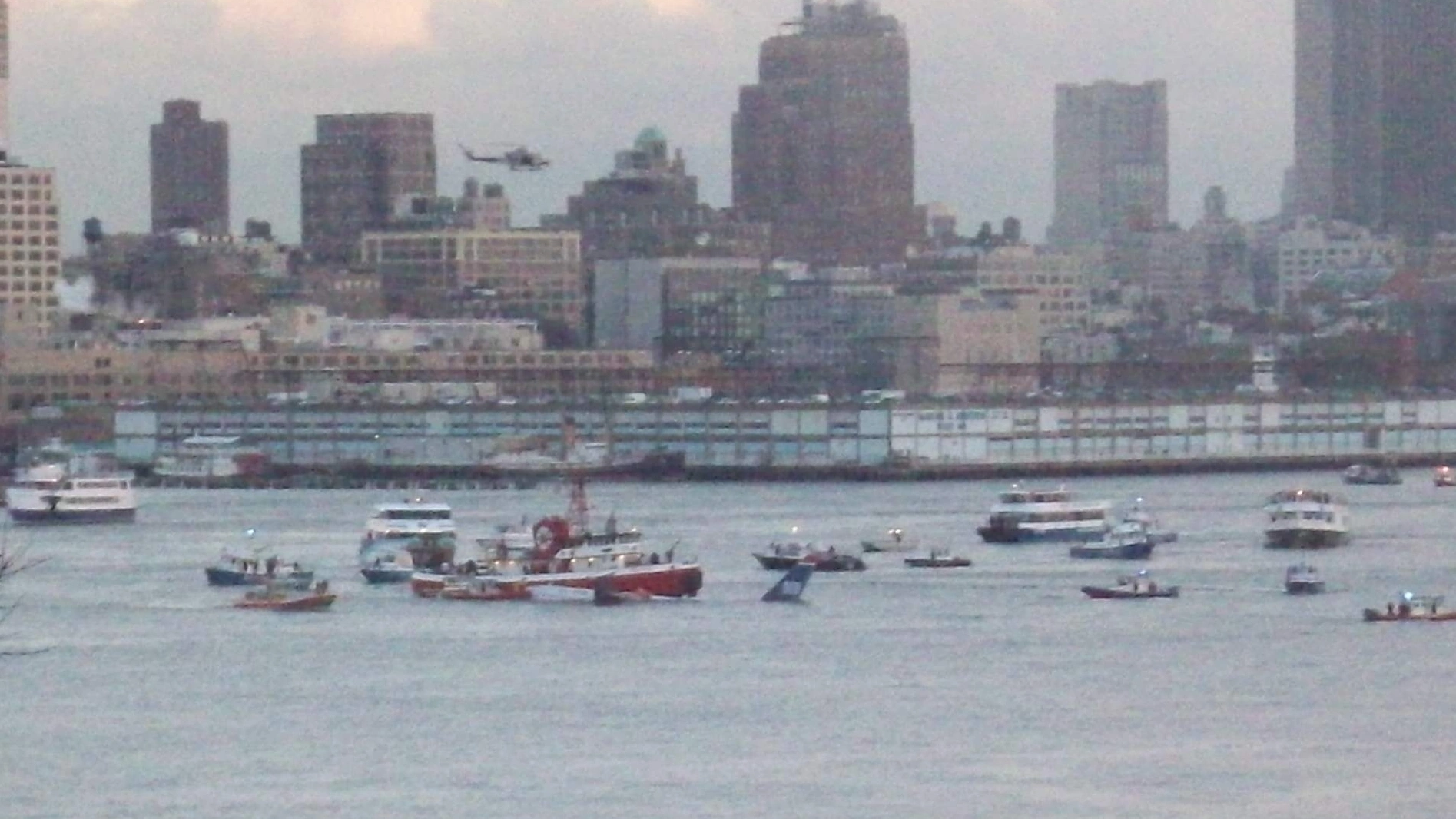
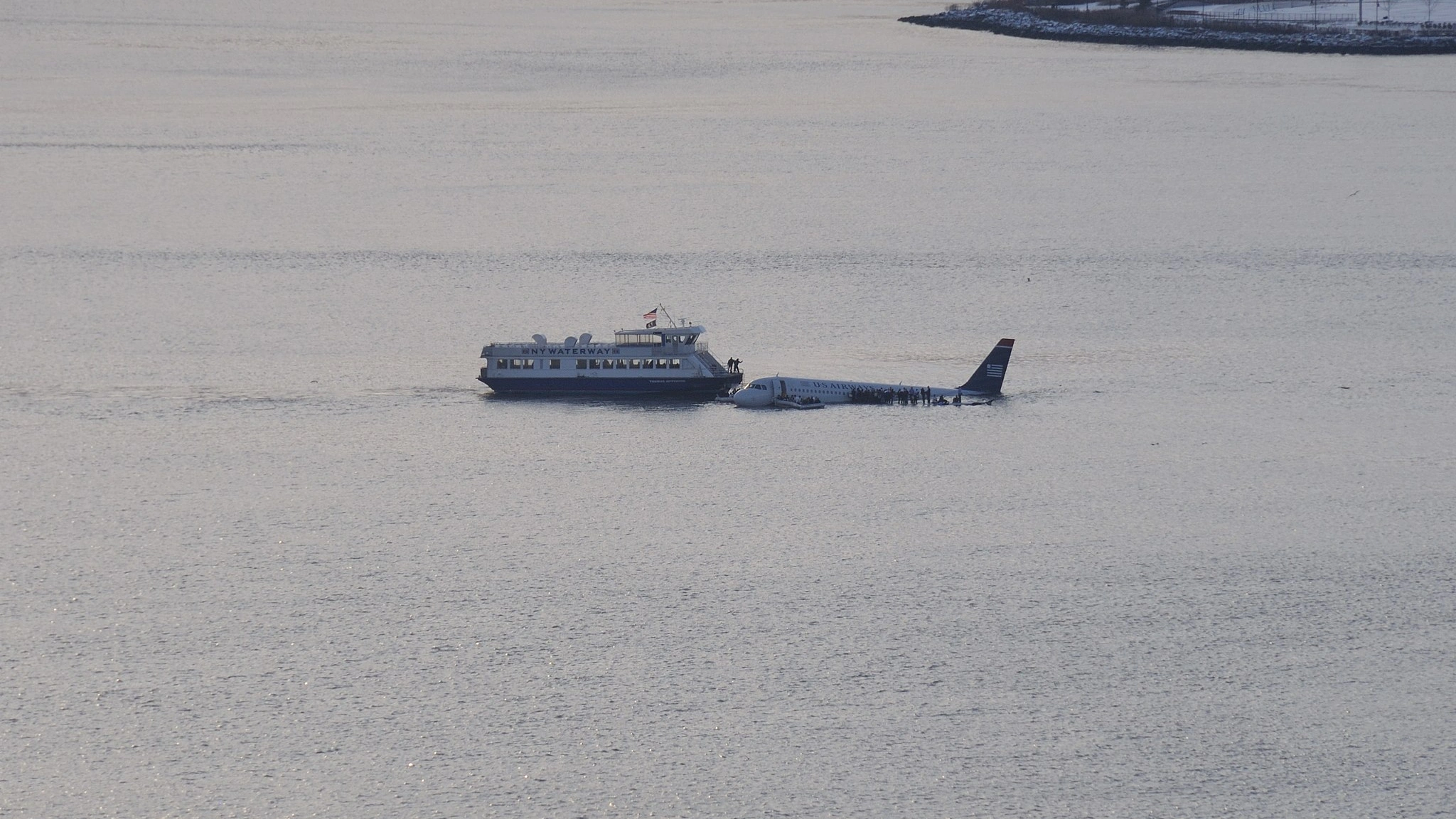
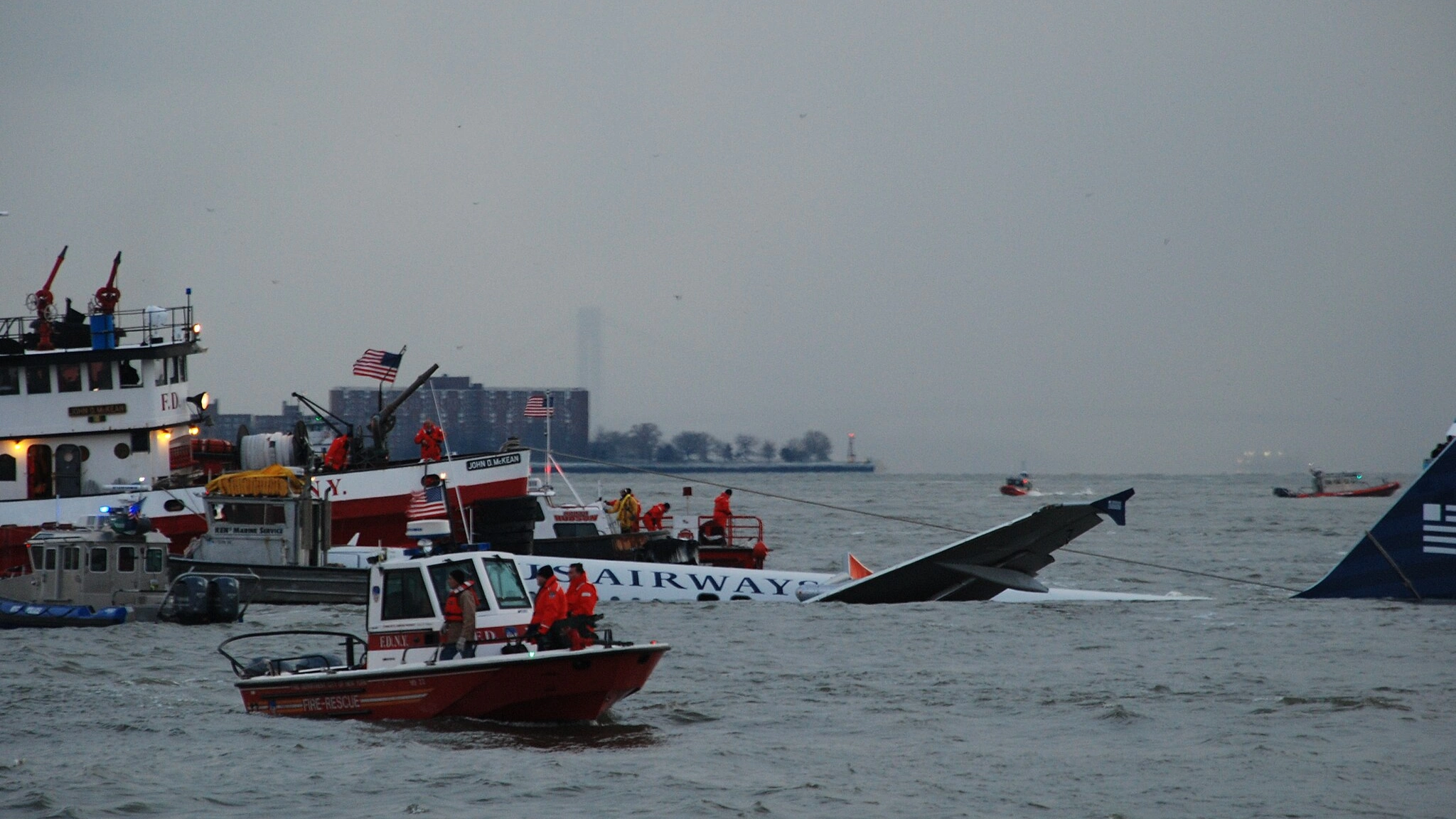
Air traffic control rapidly coordinated with the Port Authority, initiating waterborne rescue operations within minutes of the ditching, and multiple vessels reached the aircraft shortly after impact. The proximity of ferries and boats was critical in preventing hypothermia-related fatalities.
Evacuation and Crew Response
Flight attendants opened the overwing exits and the forward right door, deploying inflatable slides that doubled as life rafts. Evacuation over the wings progressed more slowly than a standard water evacuation, with cabin crew redirecting passengers away from the flooding aft cabin and focusing evacuation efforts on the overwing exits and forward slides — those seated toward the rear were guided forward where possible.
Many passengers remained standing on the wings rather than entering the river, while those who moved forward from the rear cabin used the slide rafts. The available space on the wings and rafts was sufficient to accommodate everyone, and all 150 passengers and five crew members were evacuated without overcrowding. Local ferries and emergency responders arrived within minutes, pulling survivors from the river and transporting them to shore.
The flight crew remained uninjured throughout the event. After the aircraft stabilized, Captain Sullenberger and First Officer Skiles conducted a final cabin inspection to confirm that all passengers and cabin crew had evacuated. Only after verifying the aircraft was empty did the pilots exit through the forward doors, with the last person leaving the aircraft at approximately 3:55 p.m.
Aftermath and Investigation
Although there were no fatalities, many passengers suffered hypothermia, and several sustained injuries during evacuation. Investigators later reported 95 minor injuries and five serious ones. A flight attendant required surgery for a leg injury, and one passenger suffered eye damage due to fuel exposure.
In the immediate aftermath, questions were raised about whether the aircraft could have reached a runway. The National Transportation Safety Board conducted a detailed investigation, including simulator testing, and ultimately concluded that the ingestion of large birds into both engines caused the total loss of thrust, and that ditching in the Hudson was the only viable option. The investigation affirmed that Captain Sullenberger’s decision-making, combined with effective crew coordination, calm air traffic control support, favorable weather, and rapid emergency response, collectively led to the successful outcome.
What Happened to the ‘Miracle on the Hudson’ Plane?
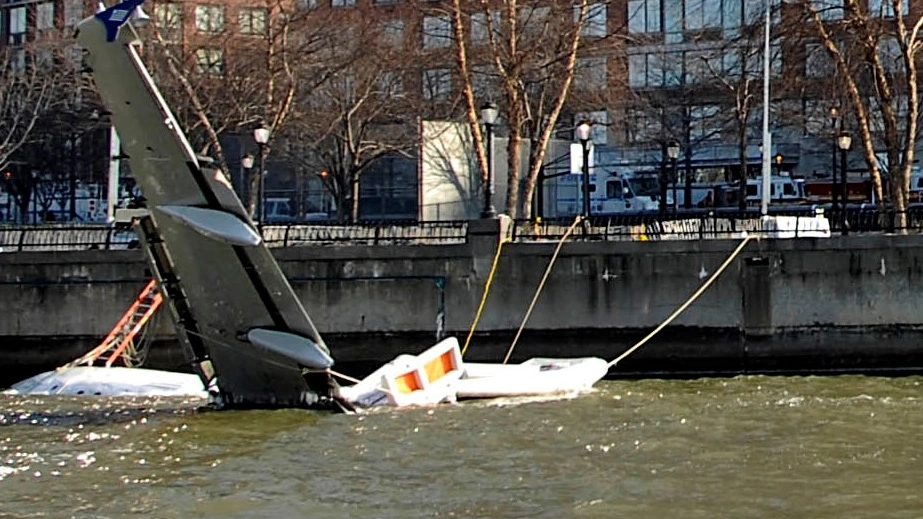
While the crew and passengers returned to their lives, the aircraft itself became a subject of public interest. The damaged A320 was lifted from the Hudson River on January 17 and transported to New Jersey for examination. It had suffered extensive damage to the tail and lower fuselage, and its left engine had detached during the ditching; parts of the engine cowling were later recovered from the riverbed.
Delivered to US Airways in August 1999, the aircraft had been a reliable part of the fleet until Flight 1549 became its final journey. After the investigation concluded, the aircraft was put up for auction in early 2010 but attracted no buyers.
In June 2011, insurer American International Group donated the aircraft to the Carolinas Aviation Museum. Initially displayed without wings or engines, it later became the museum’s centerpiece. Today, it stands as a preserved artifact of one of aviation’s most improbable survivals, symbolizing how preparation, training, and decisive leadership can turn catastrophe into history.

_after_crashing_into_the_Hudson_River_(crop_2).jpg)


