In 2018, a Swedish social movement called flygskam, meaning “flight shame,” set out to make people feel guilty about boarding a plane. Seven years later, Sweden has scrapped the aviation tax it introduced at the movement’s peak, and global air travel closed out 2024 at a record high, according to a report by Flight Global.
The reversal took effect on July 1, 2025, ending a levy that had taxed airline tickets by distance flown since 2018. At Stockholm Arlanda Airport (ARN), Sweden’s busiest, domestic and international traffic never fully returned to where it stood before the movement began. But the story of what actually happened is more complicated than a simple win or loss for the activists who started it.
How Flygskam Actually Changed Sweden’s Own Numbers
Flygskam’s clearest, most measurable impact happened at home. Sweden’s ten Swedavia-run airports lost 4% of their passengers between 2018 and 2019, dropping to 40.16 million travelers, a shortfall of almost two million people compared with the year before.
Arlanda alone lost 1.2 million passengers in that single year. Domestic Swedish traffic fell 12.5% over the same period, and Swedavia itself pointed to flygskam as one of several factors behind the decline.
The dip did not last. Swedish airports later climbed back to 172.1 million total passengers, but that recovery came with a catch: Sweden’s own transport regulator, Transportstyrelsen, found that domestic travel alone had only clawed back to around 4 million passengers by 2024, still roughly half of pre-pandemic levels. The regulator’s own analysis pointed to a mix of causes:
- A weakening Swedish currency
- Rising air fares, partly driven by the aviation tax itself
- Growing competition from rail on routes like Stockholm-Malmo and Stockholm-Gothenburg
- A broader economic slowdown
Crucially, the regulator concluded that public enthusiasm for the cause itself had faded. “There are indications that environmental issues are not as highly valued by the public today as when the aviation tax was introduced,” the agency stated in its analysis.
Why Sweden Reversed Course in July 2025
By 2023, Sweden was in recession, and its economy shrank again between April and July 2024. A new right-of-center coalition, elected in 2022 and reliant on the Sweden Democrats party, decided the aviation tax had become an economic liability rather than an environmental win.
Sweden Democrats MP Linda Lindberg made the government’s reasoning plain at a press conference. “This will lead to lower prices for travellers and rising demand, boosting the competitiveness of airlines,” she said, a comment later reported by Reuters. The move cut ticket prices by 80 kronor on European flights and 325 kronor on routes beyond Europe.
Airlines responded immediately. Ryanair (FR) added two aircraft back to its Swedish fleet along with ten new routes, easyJet (U2) welcomed the move as a way to “keep flying affordable,” and Norwegian (DY) announced new domestic Swedish routes. The International Air Transport Association (IATA) went further, calling the tax “counterproductive economically and ineffective environmentally.”
What Global Air Travel Data Shows About Flygskam’s Wider Reach
Outside Sweden’s borders, flygskam’s influence on actual passenger behavior is far harder to find in the numbers. IATA’s full 2024 figures show global passenger traffic rose 10.4% compared with 2023, landing 3.8% above pre-pandemic 2019 levels entirely.
IATA director general Willie Walsh summed up what the data showed. “2024 made it absolutely clear that people want to travel,” he said. “With 10.4% demand growth, travel reached record numbers domestically and internationally.”
Asia-Pacific carriers led the surge with international traffic up 26% year over year, while European airlines posted 9.7% growth and Middle Eastern carriers rose 9.4%. Airlines also filled a record 83.5% of available seats on average, the highest load factor ever recorded for a full year. None of these regions showed any sign of a flygskam-style pullback.
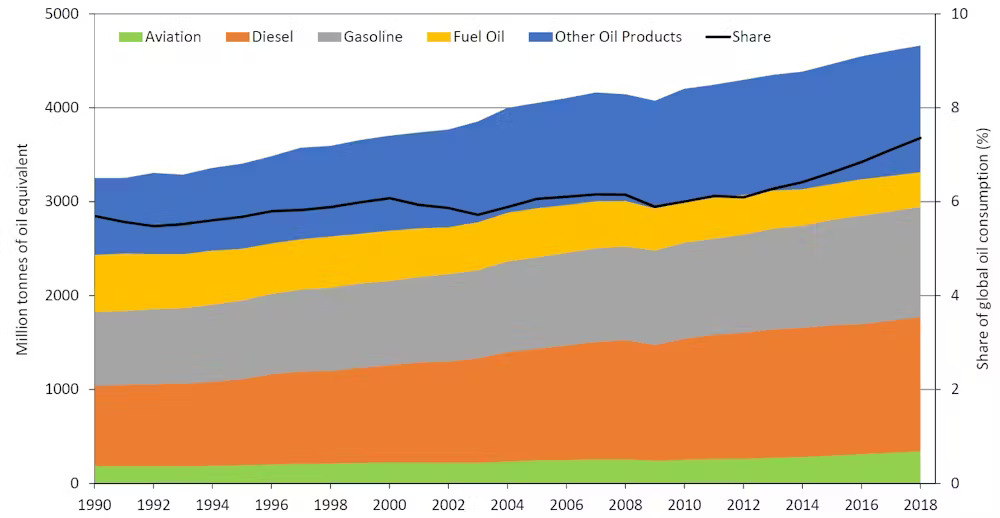
Global oil consumption by fuel type. Consumption measured in million tonnes of oil equivalent (mtoe) on the left axis, and the share of aviation in global oil consumption on the right axis. Jan Ditzen
Comparing Sweden’s Domestic Slump to the Airlines That Filled the Gap
The pattern reveals a split outcome rather than a clean verdict. Sweden’s own domestic market genuinely shrank and, as of 2024, had fallen behind the domestic aviation market of Scotland, a far smaller country by population.
Yet the very carriers most exposed to Sweden’s domestic dip, Ryanair, easyJet, and Norwegian, treated the tax repeal as an opportunity rather than a retreat from a lost cause. Their rapid route additions suggest these airlines never saw flygskam as an existential threat to demand, only as a local tax problem that raised their own ticket prices in one specific market.
That distinction matters. Flygskam appears to have functioned less as a force that reduced humanity’s underlying desire to fly, and more as a temporary, geographically contained dent that a change in tax policy could reverse in a matter of months.
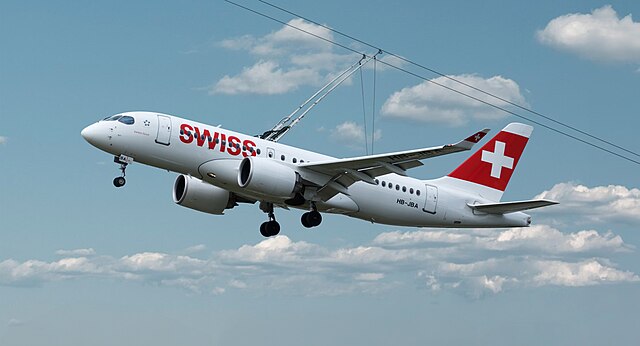
Electric Airbus A220 (Bombardier C-Series)
What The Movement Achieved Beyond Ticket Sales
Even as passenger numbers rebounded worldwide, flygskam left a lasting mark on the policy conversation. Sustainable aviation fuel investment, corporate short-haul flight bans, and airline carbon-offset programs all gained traction during the years the movement was most visible.
The core tension it exposed has not gone away. Cutting flights lowers emissions in the short term, but it also threatens regional connectivity, tourism revenue, and the kind of economic growth that made Sweden’s own government abandon its tax after just seven years.
Flygskam did not stop the world from flying. It briefly slowed one small, wealthy country’s domestic market, sparked a global conversation about aviation’s environmental footprint, and then watched as record demand and a change in government proved stronger than the shame it tried to instill.