
On January 15th, 2009, when a U.S Airline plane, Airbus A320-214 scheduled to take off from New York City to Seattle hit a flock of birds, the pilot had to bellyland the aircraft in the Hudson river, resulting in what has been dubbed “The Miracle on the Hudson”. Nine days prior to this incident, a Sikorsky S-76C++ helicopter operated by PHI, Inc. (PHI), and registered N748P crashed 12 miles southeast of Lake Palourde Base Heliport. 8 fatalities in this accident meant that this was the deadliest bird strike incident involving a helicopter.
Given that two of the more (in)famous accidents related to bird strikes took place in the nations with the highest number of airports of any nation, it would be quite common to wonder how common and dangerous are bird strikes in the US.
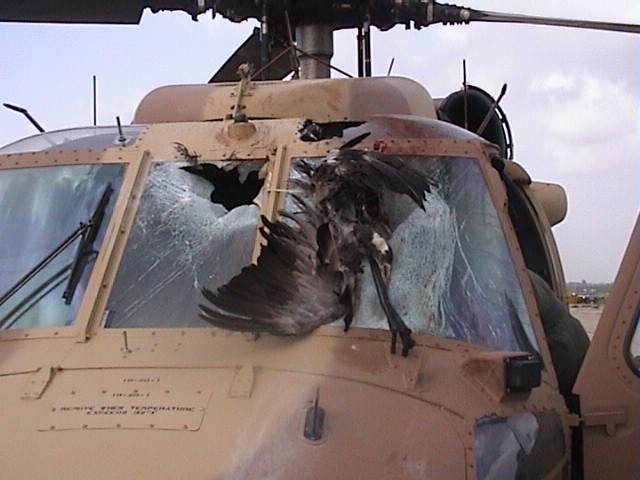
Photo: U.S. military | Wikimedia Commons

There has been a surge in the number of bird strikes
The BBC reported that in 2012, the number of bird strikes to civil aircraft in the US was 10,343 – a six-fold rise from 1992. While aviation has gotten lot bigger compared to the nineties, the number of Canada geese in North America now has also doubled in the same timeframe. The rise in the number of birds isn’t the only reason behind a surge in the number of bird strikes, though. To take an example of a different continent, an Air Ivory Coast flight collided with a Rüppell’s vulture at an altitude of 30,000 ft. [To put this in perspective, this altitude is greater than the height of Mt Everest, where a helicopter had once landed]. Perhaps aircraft are treading on spaces where they didn’t before, and often find themselves on collision course with birds. Bird strikes coupled with environmental threats, and political ineptitude resulted in Mattala Rajapaksa International Airport (MRIA) earning the curious moniker of being “the emptiest airport in the world”.
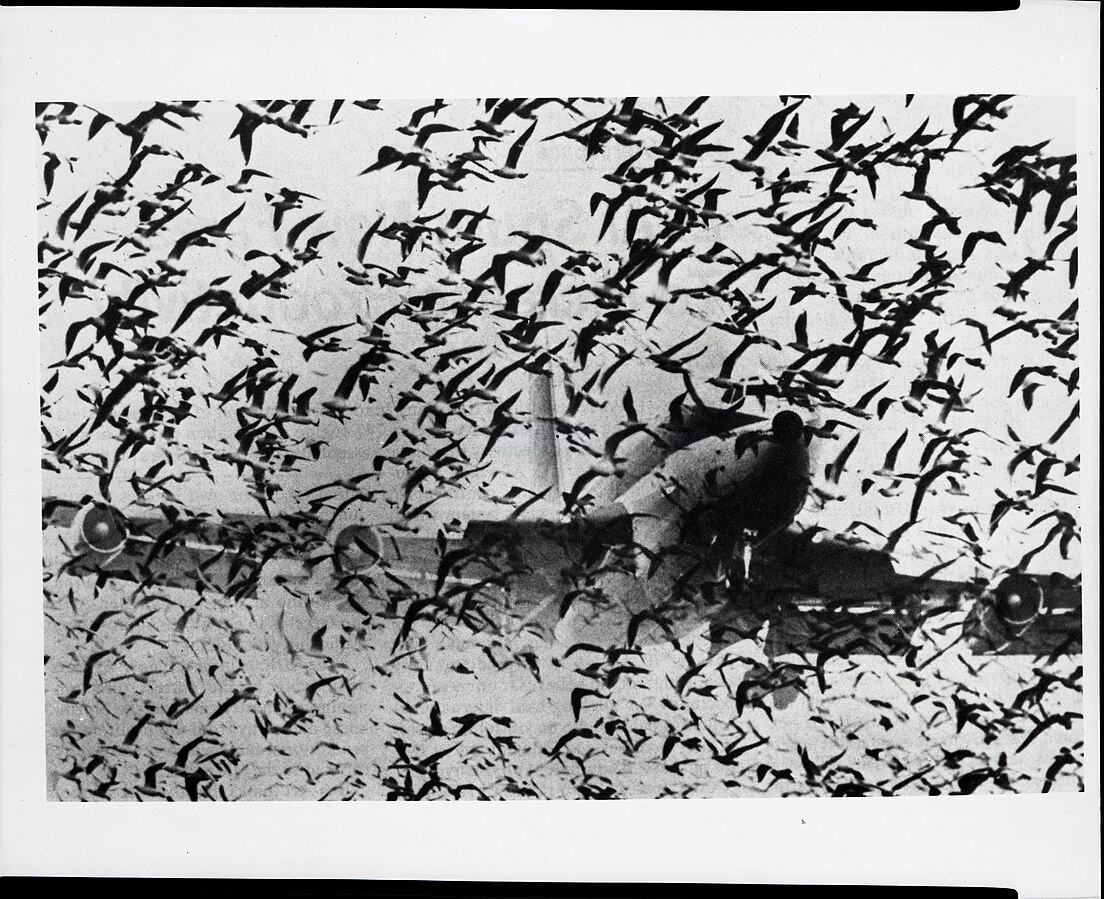
Photo: National Archives and Records Administration | Wikimedia Commons

We can almost imagine the terrible fate of birds after they’ve struck an aircraft. Think about the poignant story “The Scarlet Ibis” by James Hurst when they discover a bird that is tepid on blood:
“ On the topmost branch perched a bird the size of a chicken, with scarlet feathers and long legs. At that moment, the bird began to flutter. It tumbled down through the bleeding tree and landed at our feet with a thud. Its graceful neck jerked twice and then straightened out, and the bird was still. It lay on the earth like a broken vase of red flowers, and even death could not mar its beauty.”
Aircraft tend to plunder beautiful birds during actual instances of bird strikes, and also while testing whether an aircraft’s engines would be able to withstand the brunt of a bird strike. For instance, during the engine testing phase, chicken and other birds are hurled at the engines at a speed greater than that of sound, leading to one research center conducting such tests to claim that it was “home to the world’s fastest chicken”.
Here are some snippets of the scale of the impact of bird strikes on US aviation. The data was compiled by US Fish and Wildlife Service:
- Damages worth $900 million per annum to U.S. civil and military aircraft by bird and other wildlife strikes.
- 142,675 wildlife strikes between 1990 and 2013.
- A loss of 250 lives since 1988.
- Gulls (26%), raptors(18%), and waterfowl(21%) represent three-fourths of all reported bird strikes in the US.
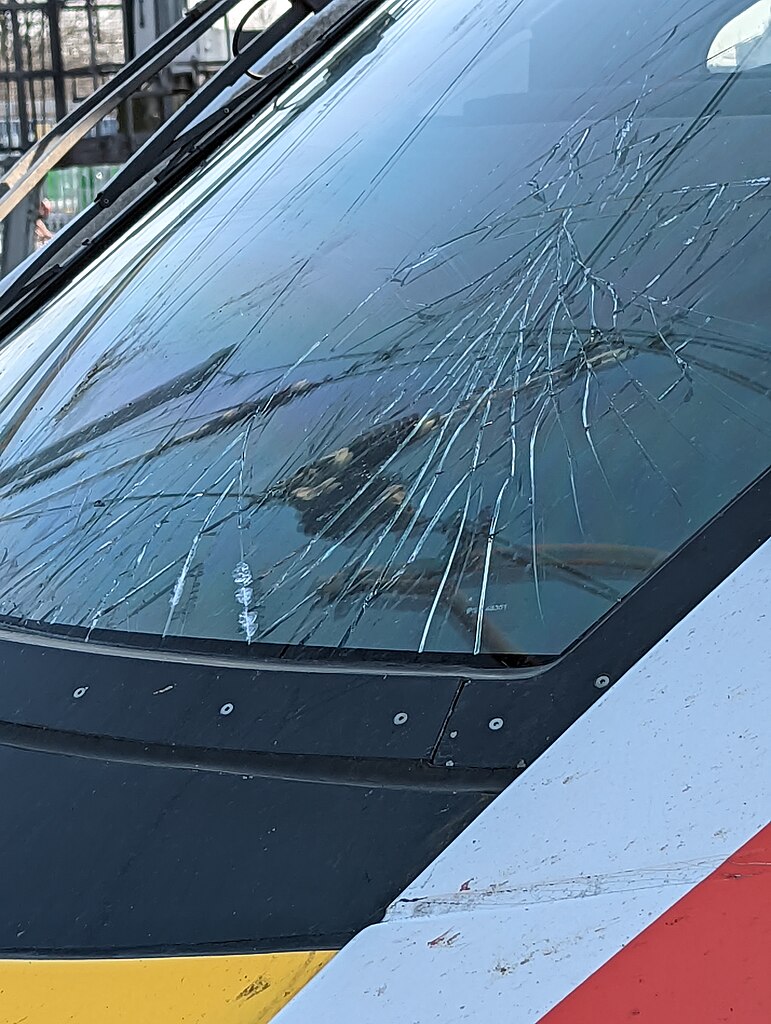
Photo: Bob Harvey | Wikimedia Commons

2023, which was reported by IATA to be the safest year for aviation, saw more than 2,300 reported cases of wildlife strikes – 97% of which were bird strikes. A report published in The Washington Post expounds on the details behind the numbers
- Between 1998 and 2021, 300 people were killed nearly 300 planes were destroyed due to wildlife strikes.
- 92 percent of bird strikes happen at 3,500 feet or lower.
- In 2019 and 2022, the FAA received reports of 17,300 and 17,200 bird strikes (respectively) in the United States or on U.S. carriers in foreign airports.
- In 2022, 695 bird strike damages were reported — 36 of which were substantial.
Reports had also projected that damages to the aviation industry in the United States in 2021 would be $328 million – a conservative estimate if we were to compare these with the numbers quoted above (by the FWS).


If we were to put a humane response to the death of the many birds, one wouldn’t be far off in imagining that the poem “Dear Bird” by Howard Altmann was actually written by the conscience of the US aviation:
The very alive souls of thirty-five hundred dead birds
are harbored in my body. It’s not uncomfortable…
must I nurse you till the end,
patch you with experience, pitch storylines
to your wound, killed by man killed by animal,
the reflection of a tree, well, you seem to be
thriving, as metaphor as travelling companion,
and whom to blame whom to assign fault
Diving into the numbers within the numbers of bird strikes in the US
Nepal, the nation that is home to the world’s most dangerous airport i.e., Lukla, suffered a terrible crash (Sita Air Flight 601) following a strike with a bird, killing all passengers onboard. Even the crash of jeju Air Flight 2216 is attributed to a bird strike. While there are procedures for pilots or ordinary planespotting citizens to record the instances of bird strikes, it goes without saying that not all bird strikes are reported. Military losses following bird strikes are tough to estimate, but research suggests that there have been “283 military aircraft lost and 141 deaths recorded in a limited number of western nations from which data are available between 1959 and 1999”.

Photo: Greg L | Wikimedia Commons
_after_crashing_into_the_Hudson_River_(crop_2).jpg)
Sometimes, the thud of the aircraft hitting a bird might be too imperceptibe to report. A research paper published in 2020 even claimed that airlines were reluctant to report damage costs (following a bird strike) “due to competitive reasons”. [We’ve forever drill into our minds the great maxim by Prof. Aaron Levenstein, “Statistics are like bikinis. What they reveal is suggestive, but what they conceal is vital.”]. The same paper gives us the following numbers behind the numbers we’ve previously reported:
- Costs for engine repairs following a bird strike: US $ 250,000 – $1 million (reported in 2002)
- Annual costs to mitigate the bird strike damages : $1 billion (in 2003)
- Costs of a non-damaging strike: nearly US $22,417 per strike (based on data obtained from United Airlines (UAL) between 1999 and 2002
- Average costs for a damaging strike amount to US$225,329
- Total average costs: US $ 192,194 per damaging strike between 1990 and 2015*
[* Note: The paper says “Indirect costs result from lost revenues, passenger rebooking, aircraft rescheduling and flight cancellations. On average, the repair costs amounted to US $ 164,595, the average indirect costs to US $ 27,599”]
A research paper published during the turn of the millennium estimated that damages and delays related to bird strike incidents was US$1.2 billion per year, but cautioned that the figure was “conservative and should be interpreted with caution as the data which underlie it are limited, and the assumptions made to arrive at the final figure are considerable”.
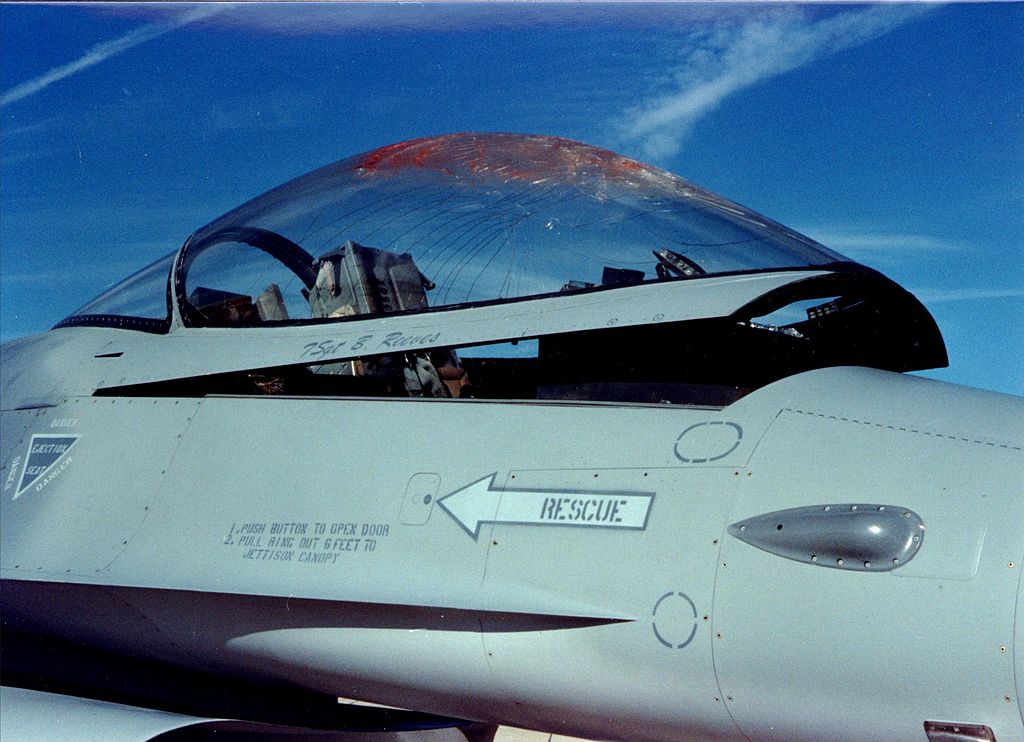
Photo: Wikimdia Commons

There are simulation studies to get a grip on the correlation between the shape of a bird and the impact of a bird strike. For instance, a paper titled “The influence of bird-shape in bird-strike analysis” modeled a bird with a mass of 8 lb, and having a physical resemblance to the Canadian goose, and revealed that:
“a target may become pre-stressed from the initial impact of the head and neck, prior to the impact of the bird’s torso. This may have an important consequence for damage initiation and failure of the target. The mass and length of the neck may also be significant during bird-strike for aero-engines since the duration of impact effectively increases. It is also possible that damage, initiated on fan-blades during the initial stage of impact (head and neck) would increase due to a secondary impact from the torso..”
Why do bird strikes happen?
Following the crash of Yeti Airlines flight 691, an incident involving a bird crashing into a regional aircraft headed to Pokhara city in Nepal surfaced in social media, sending an already frenzied aviation commentary in the nation to cower with fear. The Pokhara Airport (which has been mired with corruption) is close to an ecologically sensitive area – the Annapurna Conservation Area Project (ACAP), leading many to conjecture that bird strikes would be inevitable. After the crash of Sita Air Flight 601, the investigation committee recommended surrounding municipalities to not strew garbage in open spaces around the airport, lest they attract birds and increase the likelihood of strikes.
The almost improbable-sounding case of an aircraft striking a vulture at an altitude of 35,000 meters is an extraordinary one. After all, most birdstrikes are recorded during the takeoff phase or the landing phase – two phases where aircraft operate at altitudes where birds are gliding. Once an aircraft reaches cruise altitude (typicaly above 30,000 ft), chances of bird strikes become too low.
In US, the first recorded birdstrike incident involved Orville Wright, who noted a bird strike on September 7, 1905, near Dayton. The bird was quite likely a red-winged blackbird. Until the 1930s, planes used to fly at an altitude of around 5,000 ft high, which in addition to lurchier rides, were also susceptible to more bird strikes. But there just weren’t as many aircraft back then.
From Wright Brothers to Jet Age: Evolution of Aviation History
Airport with the highest number of bird strikes in the US?
Let’s take a look at the airports that are affected the most by bird strikes, as reported by foxweather.com:
- Denver International Airport (DEN) records 750 animal encounters every year. Akin to Pokhara Airport’s proximity with an ecologically sensitive cnservation area, DEN is close to the Rocky Mountain Arsenal National Wildlife Refuge.
- Chicago O’Hare International Airport (ORD), Dallas/Fort Worth International Airport (DFW), and Hartsfield-Jackson Atlanta International Airport (ATL) – all of which are some of the busiest airports in the US – had 322,300, and 323 animal encounters, respectively.
- Charlotte Douglas (CLT), Orlando Airport (MCO), and Los Angeles Airport (LAX) experienced 207, 217, and 117 wildlife encounters, respectively, while Miami (MIA), Harry Reid (LAS), and Phoenix Sky Harbor (PHX) saw less than a hundred encounters.
How to curb the instances of bird strikes
One of the more obvious ways to reduce the instances of bird strikes is to modify the flight schedules of airlines (depending upon the times of the day when bird activity is low). However, only aerodromes with relatively few aircraft movements are likely to resort to this method. One can chase away birds from airports using robot of prey birds such as Flacon, or airport authorities can chase away birds by using dogs or playing loud sounds.
Bird Strike Prevention: Technologies and Prevention Strategies
Some of the other methods to reduce bird strikes (that are not discussed in our guide above) in the US are the following:
- Under the Bald and Golden Eagle Protection Act, the U.S. Fish & Wildlife Service issues a migratory bird permit allowing aerodromes to relocate eagles.
- A migratory bird permit is also issued for the removal of birds such as Canada Geese, which is notoriously difficult to remove by hazing.
- For further guidance, one can refer to the Habitat Management to Deter Wildlife at Airports.
All in all
It was Joseph Stalin, the dictator, to whom we attribute the quote “ A single death is a tragedy; a million deaths is a statistic”. For now, atleast, we know that the number of birds who have succumbed to death following strikes with aircraft isn’t a million, nor is the death of people who’ve lost their lives in bird strikes. Perhaps the consciousness of the tragedy associated with the lives of birds wasn’t there in the past, but as we’ve seen other creatures deployed in airports to comfort passengers, we know how much of an emotional bond we share with them. And we’re growing discontent as:
The birds’ disputations grow louder
frantic against glass
stunned splintered and hushed,
in shadowy, honeyed innocence
– Erica Hunt “Mourning Birds”
And there are innovative measures we’re coming up with. As long as we’re innovating to deter bird strikes, the number of birds agonizing after striking an aircraft might get smaller. There’s hope in that. Maybe redemption. too.