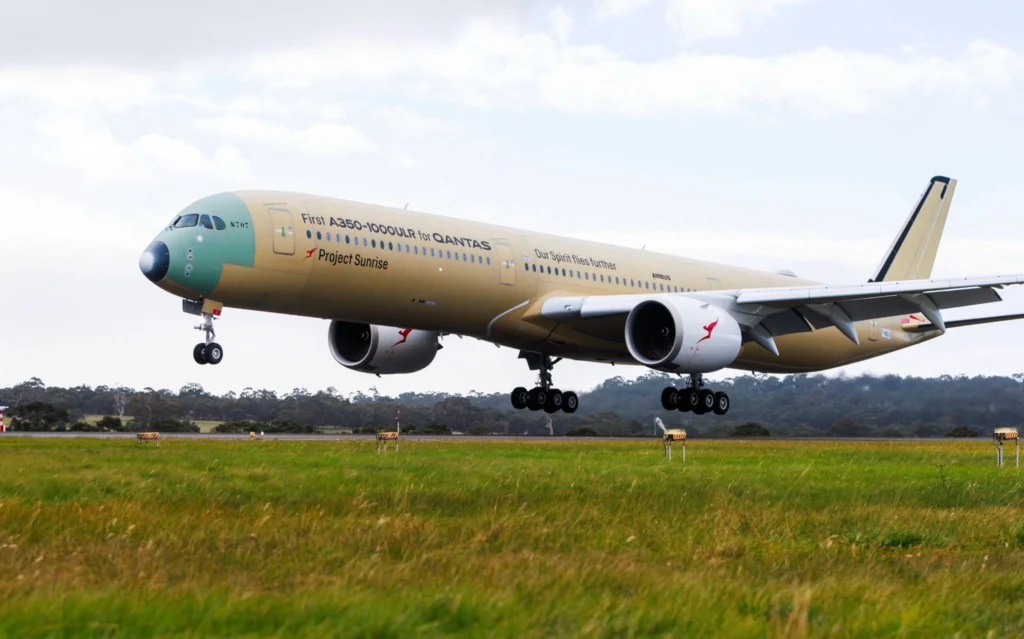
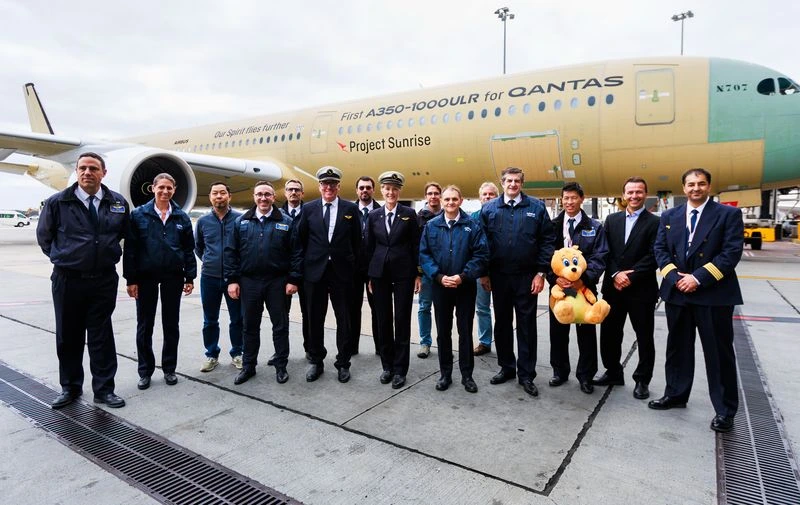
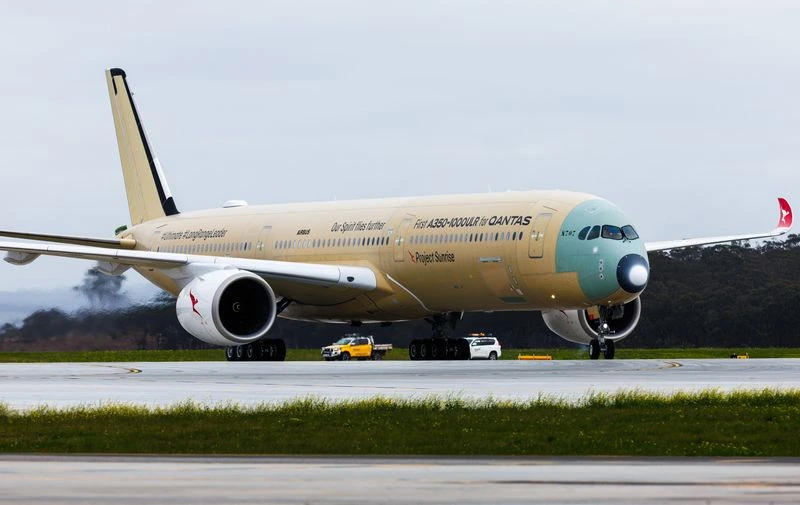
Airbus flew its first Airbus A350-1000ULR nonstop from Toulouse, France, to Melbourne, Australia, on July 23 and 24, 2026. The aircraft, registered F-WULR and known by its serial number MSN 707, departed Toulouse-Blagnac Airport (TLS) at 07:34 local time and landed at Melbourne Airport (MEL) roughly 19 hours and 11 minutes later, at about 10:45 local time.
The flight covered close to 17,000km and ranks among the longest test flights Airbus has ever attempted. It forms part of a 75-80 hour certification campaign for the ULR variant, which Qantas Airways (QF) needs before it can launch nonstop Sydney-London flights in October 2027. Four Airbus test pilots and five flight-test engineers were on board, and no passengers flew.
Toulouse-Melbourne Flight Covers a Quarter of Certification Hours
The Toulouse-Melbourne sector alone accounts for roughly a quarter of the 75-80 flight hours Airbus needs to certify the A350-1000ULR. European regulators require Airbus to prove the aircraft can fly longer than its longest scheduled route, with a safety margin built in for delays, so the test needed to run close to 23 hours in a worst-case scenario.
The aircraft’s route took it over Italy and the Mediterranean Sea, then Egypt and Saudi Arabia, before it crossed the Indian Ocean near Sri Lanka and continued on to Australia. It reached a maximum altitude of 41,000ft along the way. On arrival, the Melbourne tower controller greeted the crew over the radio, congratulating them on the milestone before clearing them to taxi in.
According to data quoted in The Guardian:
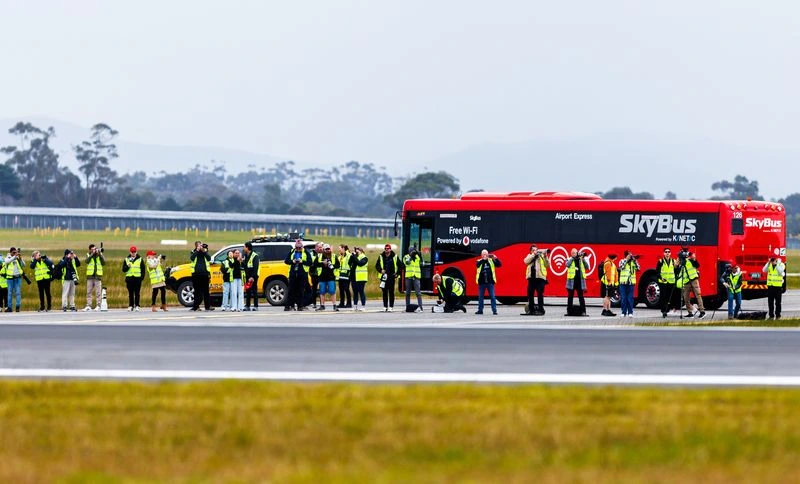
The test flight has attracted attention from transport enthusiasts, with more than 67,000 people following its almost 17,000km path on flightradar24.com on Friday morning – the most-watched flight globally on Friday. The plane touched down at 10.46am on Friday in Melbourne. The air traffic website indicates the flight departed Toulouse at 7.33am on Thursday, local time. It landed in Melbourne just over 19 hours later, at 10.46am, local time.
Two Qantas pilots will join the Airbus crew for the return leg to Toulouse, scheduled to depart Melbourne on July 27. Airbus described the journey in a social media post as going “from summer to winter in a single hop,” since the aircraft left the height of the European summer and landed in the middle of the Australian winter.

What Makes the A350-1000ULR Different from a Standard A350
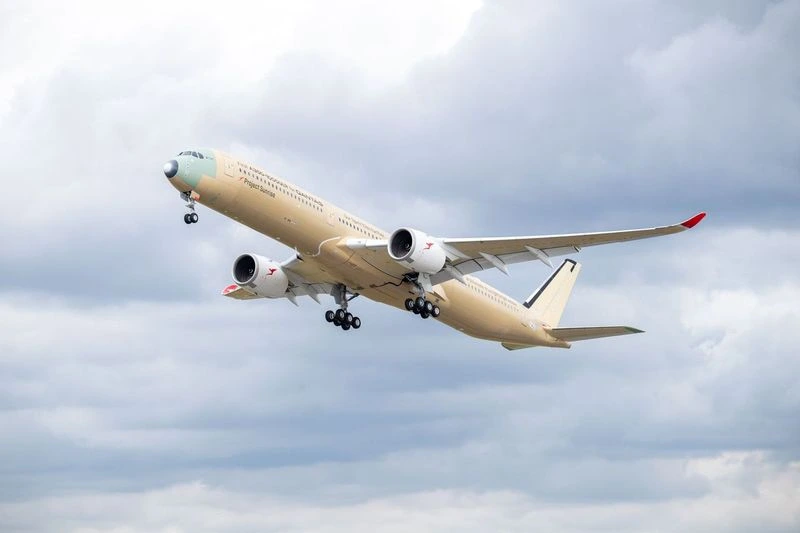
The A350-1000ULR is a specially modified version of the standard Airbus A350-1000, built to meet Qantas’s range requirements for Project Sunrise. The main change is a new rear centre fuel tank holding 20,000 litres of additional fuel, which brings total capacity to 130,700 kilograms, about 6,000 kilograms more than the standard aircraft.
Key differences from the baseline A350-1000 include:
- An additional rear centre fuel tank, extending range by around 1,000 nautical miles
- A higher maximum take-off weight, increased in stages from 319 tonnes to 324 tonnes during development
- Taller wingtips that reduce drag and improve fuel efficiency
- A New Generation Air Chiller system that cools each galley individually rather than relying on one centralised unit
- A cabin cooling system built for long-duration flights, using lighter, more efficient refrigeration equipment
These changes push the aircraft’s range to roughly 18,000km, or about 9,700 nautical miles, enough to sustain flights of up to 22 hours without a fuel stop.
Five Tonnes of Sensors Replace the Passenger Cabin
Because MSN 707 is a production aircraft rather than a dedicated test airframe, Airbus faced an unusual engineering challenge. Engineers needed a way to gather flight data without damaging the finished cabin that will eventually carry paying Qantas passengers.
Airbus began planning the instrumentation in 2023, ultimately installing around five tonnes of monitoring equipment. About 80% of it, including more than a thousand purpose-built sensors, went in during production. The system tracks fuel flow, cabin pressure, temperature, ventilation, and structural behaviour throughout the flight.
Heat-generating dummies also played a role in the test. These devices mimic the thermal load of real passengers, letting engineers check how heat builds up inside a fully loaded cabin over nearly a full day in the air. Airbus test flight engineer Laurent Rossignol has said flight-testing a production aircraft adds “a layer of extra pressure,” since every switch and manoeuvre has to account for both passenger comfort and operational reliability, not just raw data collection.
How This Fits into Qantas’s October 2027 Launch Plan
Qantas confirmed on June 17, 2026, that it will launch the world’s first nonstop commercial service between Sydney Kingsford Smith Airport (SYD) and London Heathrow Airport (LHR) in October 2027. The route will cover about 17,015km and take up to 22 hours, making it the longest scheduled passenger flight in the world once it enters service.
Qantas Group CEO Vanessa Hudson framed the announcement against the airline’s history. “Since we first flew the Kangaroo Route in 1947, where we stopped seven times on the way to London, every generation of aircraft has taken a stop out of the journey,” she said. “Today, we’re taking out the last one.”
The Sydney-London aircraft will carry just 238 seats across four cabins: six first class suites, 52 business class suites, 40 premium economy seats, and 140 economy seats. Qantas has ordered 12 A350-1000ULRs in total. The first, named Vega, is due for delivery in April 2027, and tickets for the Sydney-London route go on sale in February 2027. A Sydney-New York route is planned to follow later the same year.
Once it launches, Project Sunrise will overtake the two Singapore Airlines routes that currently hold the title of world’s longest scheduled flight. Singapore Airlines’ New York JFK to Singapore service, flown on a stripped-down Airbus A350-900ULR, covers 15,332km in about 19 hours 15 minutes and has held the record since 2021. Its Newark to Singapore sister route trails by just 3km.
Both current record-holders skip an economy cabin entirely to maximise range. Qantas has taken a different approach, keeping a full four-class layout, including 140 economy seats, on a route roughly 1,700km longer than Singapore Airlines’ current record-holder. Sydney-London will beat that existing record by more than three hours of flight time once it launches.

A Rivalry Playing Out Across the Tasman
Air New Zealand (NZ) says it has emerged from years of engine trouble across its Airbus and Boeing fleets, a period its chief customer officer Jeremy O’Brien described as “waking up from the world’s longest hangover.” The carrier is now retrofitting its Boeing 777-300ER fleet with new business class seats and introducing Skynest, its first economy bunk beds, on new Boeing deliveries later this year.
O’Brien has downplayed direct competition with Qantas’s Sunrise plans, arguing the two airlines are chasing different customer segments. Qantas’s own international division posted a 20% improvement in underlying earnings before interest and tax to A$903 million in FY2025, helped in part by strong demand on its existing one-stop long-haul routes through Perth and Auckland.
Timeline Has Already Slipped Once
Project Sunrise has not moved in a straight line. Qantas first announced the plan in 2017 and originally targeted 2025 for launch, before the COVID-19 pandemic disrupted manufacturing and travel demand between 2020 and 2022. The current October 2027 date is itself about six months later than the timeline Qantas pointed to the previous November.
Airbus executive Benoit de Saint-Exupery has pointed to premium cabin seat production as the main bottleneck behind recent delays, telling a panel discussion in Toulouse that “the seat situation is definitely the bottleneck for us.” With the Toulouse-Melbourne test now complete, Airbus and Qantas move closer to finishing the certification campaign needed to keep the October 2027 date on track.