


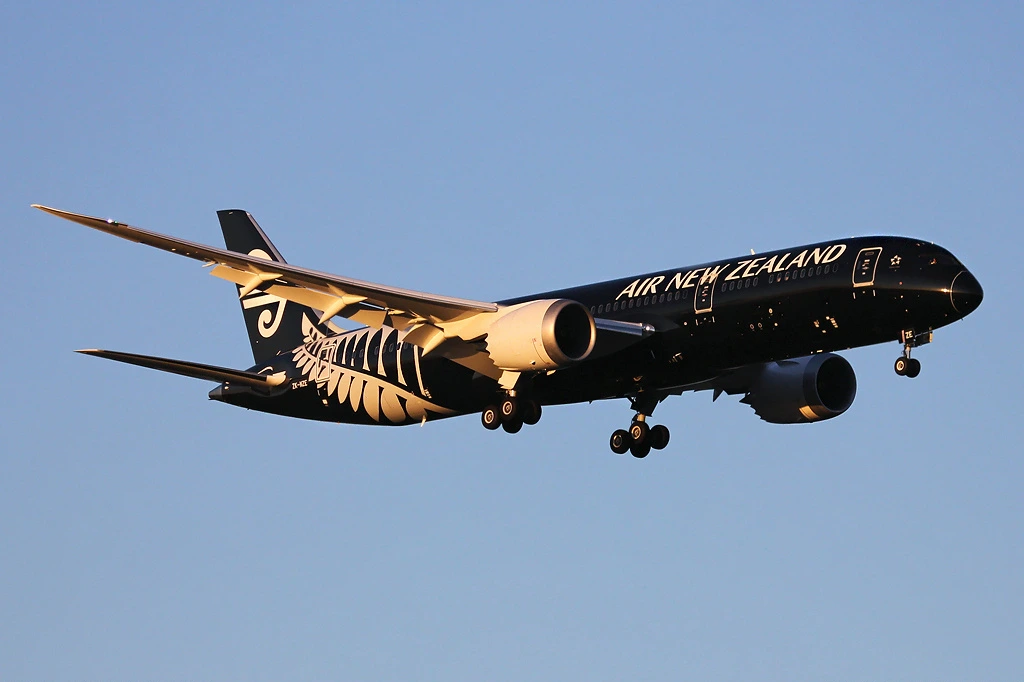
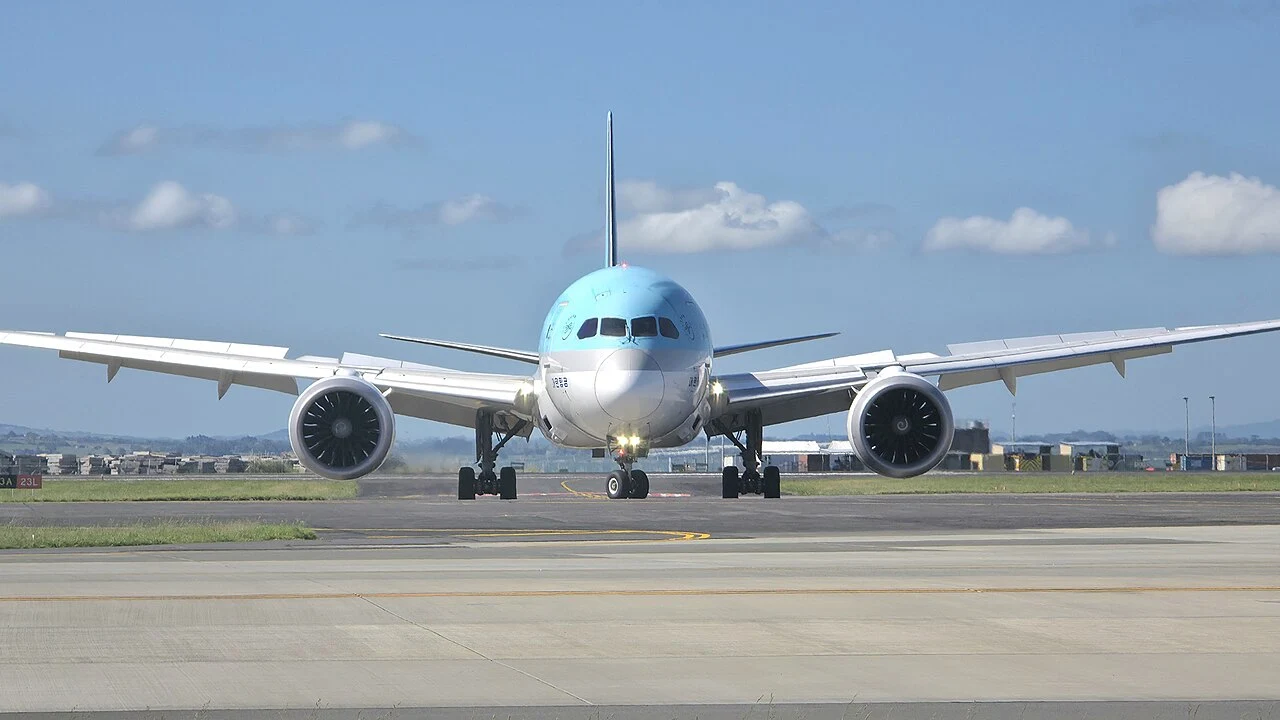
Titanium plates and sheets are critical structural materials in modern commercial and military aviation. The aerospace industry uses titanium because it combines low density with high tensile strength, exceptional corrosion resistance, and the ability to withstand extreme heat. Titanium accounts for approximately 15 percent of the Boeing 787 Dreamliner‘s empty weight. The Airbus A350 XWB incorporates roughly 14 percent titanium by total airframe weight.
Titanium first entered aerospace use in the 1950s, when the emerging jet age demanded materials that aluminium could not provide at high operating temperatures. Since then, every generation of commercial aircraft has increased its titanium content, and the Boeing 787 and Airbus A350 represent the peak of that trend. Twin-aisle aircraft use a significantly higher percentage of titanium than single-aisle types, and next-generation designs are expected to continue that trajectory.
Wikimedia Commons
In aviation, the fundamental driver for titanium adoption is weight reduction. A lighter aircraft consumes less fuel, achieves higher payload capacity, reduces operational costs, and lowers environmental impact.
Titanium’s density is about 60 percent that of steel, yet its tensile strength matches or surpasses many steel alloys. Titanium plates are stronger than steel but approximately 45 percent lighter. That combination makes it the preferred choice wherever structural integrity and weight savings must coexist.

Key Physical Properties of Titanium Plates and Sheets
The properties that make titanium plates indispensable to aviation engineers are well-documented and measurable. They are:
- High strength-to-weight ratio: Titanium is stronger than steel but significantly lighter.
- Corrosion resistance: Titanium naturally forms a stable, self-healing oxide film that protects it against oxidation and corrosion from moisture, fuels, and chemicals.
- Thermal stability: Titanium alloys can operate for extended periods at temperatures between 450°C and 500°C
- Thermal expansion compatibility with composites: Titanium shares similar thermal expansion rates with carbon fibre-reinforced polymer (CFRP).
- Non-magnetic: This makes titanium plates suitable for use near sensitive avionics and navigation equipment.
Titanium also maintains its structural integrity at supersonic speeds, where aerodynamic heating would warp or degrade other materials. This is why titanium featured in the construction of Concorde.
Titanium Grades Used in Aviation
Not all titanium is identical. The aerospace industry uses specific grades depending on the application and performance requirement.
Grade 2 (Commercially Pure): Grade 2 is an unalloyed, medium-strength product used in airframes, aircraft engines, and marine parts, valued for its excellent weldability and corrosion resistance. It is the most widely used commercially pure grade in the aerospace sector.
Grade 4 (Commercially Pure, Highest Strength): Grade 4 is the highest-strength pure titanium and is used almost exclusively in airframe and aircraft engine parts, as well as hydraulic tubing.
Grade 5 — Ti-6Al-4V (Aircraft Grade): The alloy combines 90 percent titanium with 6 percent aluminium and 4 percent vanadium. It is used to produce aircraft engine components, aircraft structural components, and fasteners, offering an advantageous combination of light weight, corrosion resistance, and high strength at low to moderate temperatures.
Near-Beta Alloys (Landing Gear): For the most heavily loaded structures, near-beta titanium alloys are specified. These alloys achieve tensile yield strengths of 170–180 ksi and ultimate tensile strengths of 180–195 ksi, providing the fracture toughness and fatigue resistance that landing gear demands during thousands of cycles of touchdown loads.

Where Titanium Plates and Sheets Are Used in Aircraft
Titanium appears throughout the aircraft, from the airframe skin to the deepest recesses of the jet engine. Its applications fall into several distinct categories.
Airframe Structures
Titanium plates are used in fuselage frames, wing structures, and fasteners, improving aircraft durability and fuel efficiency. Wing box fittings — the large structural elements that join the wings to the fuselage — are a particularly demanding application. Boeing’s own chief project engineer on the 787 programme explained that titanium was chosen for the large fittings joining the 787’s wings to its fuselage because “it’s very light and it does very well in a highly loaded situation”.
Bulkheads, floor beams, and pressure frame rings in wide-body aircraft are also commonly produced from titanium sheet and plate. Titanium alloys are used in aircraft beams and bulkheads where weight reduction and structural strength must coexist. In our previous reports, we have documented how the Boeing 787’s composite-heavy construction achieves a 25 percent reduction in fuel use versus the aircraft it replaces, and titanium structural components play a direct role in enabling that efficiency.
Jet Engine Components
Titanium is indispensable in jet engines because of its heat resistance and fatigue strength. It is used in forged titanium fans, compressor discs and blades, engine cowlings, and exhaust systems. Fan blades and compressor discs rotate at extreme speeds under intense thermal loads. Titanium alloys operate efficiently at temperatures between 450°C and 500°C for extended periods, enabling sustained use in compressor stages where temperature and pressure increase with each successive stage.
Landing Gear
Landing gear must absorb enormous impact loads repeatedly and reliably across decades of service. Near-beta titanium alloys engineered for landing gear deliver elongation values of 10–15 percent and reduction-of-area measurements of 25–35 percent, ensuring adequate ductility for damage tolerance. This combination of high strength and fracture toughness prevents catastrophic failure under the dynamic shock of touchdown.
Fasteners
Tens of thousands of fasteners hold a modern airliner together. Ti-6Al-4V fasteners achieve a double shear strength of 103 ksi (710 MPa), enabling the replacement of heavier iron-based fasteners in weight-critical assemblies. The mass savings from fastener substitution alone, across an aircraft with hundreds of thousands of fastening points, contribute meaningfully to overall empty weight.
Heat Exchangers and Hydraulic Systems
Titanium’s high thermal conductivity allows it to efficiently transfer heat away from critical parts in aviation cooling systems. Hydraulic system tubing made from Grade 4 titanium combines pressure resistance with corrosion immunity.

Titanium’s Compatibility with Composite Materials
A less-discussed but strategically important property of titanium is its compatibility with carbon fibre composites. Modern wide-body aircraft like the 787 and A350 use CFRP for their fuselage barrels, wing skins, and major structural panels. Aluminium and CFRP are galvanically incompatible — aluminium corrodes rapidly when in direct contact with carbon fibre. Titanium does not share this vulnerability.
By sharing the same thermal expansion rates as many popular composite materials, titanium is highly favoured as a composite interface material. This compatibility reduces thermal stress at join points between composite panels and metal structure during the extreme temperature swings of high-altitude flight. It is a key reason why the rise of composite design is a strong indicator of additional increases in titanium production.






.jpg)
,_N961AM_-_LHR.jpg)
Leave a Reply