American Airlines (AA) will temporarily suspend four nonstop routes from Los Angeles International Airport (LAX) — to:
- Cleveland Hopkins International Airport (CLE)
- John Glenn Columbus International Airport (CMH)
- Pittsburgh International Airport (PIT)
- Washington Dulles International Airport (IAD)
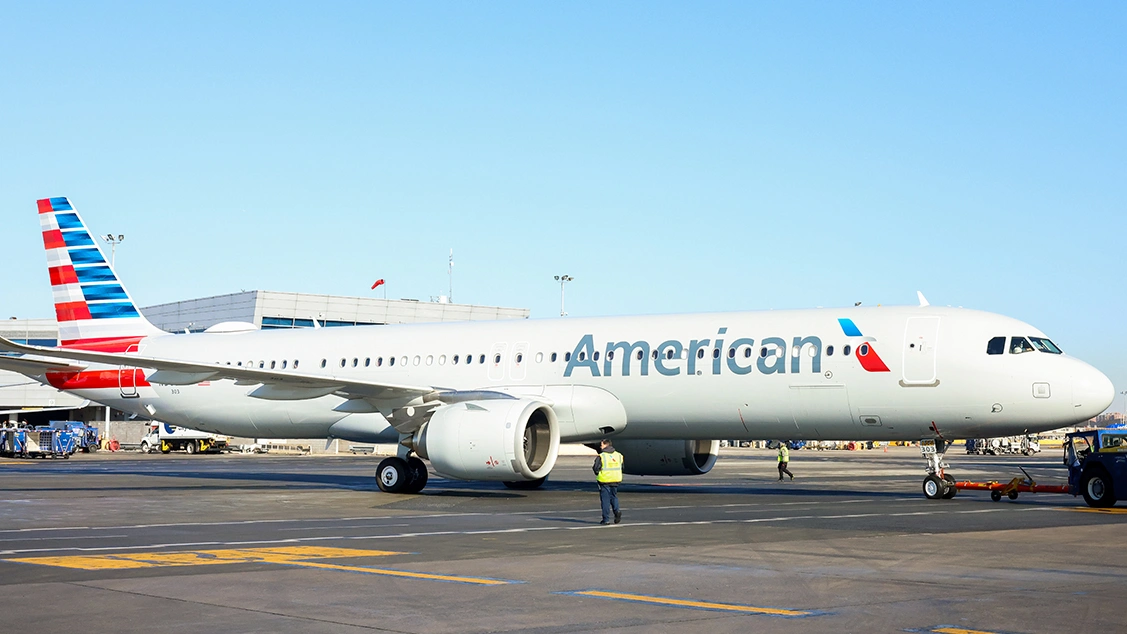
………..between August 5 and October 5, 2026, citing elevated jet fuel costs as the overriding factor. The suspensions, first flagged by aviation schedule-tracking account Ishrion Aviation on June 1 and confirmed by the carrier to AirlineGeeks on June 2, form part of a broader six-route pause that also removes American’s nonstop services from Charlotte Douglas International Airport (CLT) to Ontario International Airport (ONT) and Sacramento International Airport (SMF) in California.
In a formal statement confirmed to Airline Geeks, American Airlines said:
“American has seasonally adjusted service on select routes in August and September as the airline refines its capacity growth for 2026. American is not suspending any routes indefinitely as part of this adjustment and will continue to proudly offer an industry-leading network with more flights than any other U.S. airline.”
According to Aeronautics Magazine, the six affected markets collectively handled more than 1.4 million local, point-to-point round-trip passengers in 2025 — approximately 3,800 travellers per day — along with a further 300,000 connecting passengers transiting through one or both endpoints, and affected customers will be offered alternate travel arrangements or a full refund.
The Fuel Shock Involving Conflict in Iran Has Doubled Fuel Prices
No analysis of this network decision is complete without understanding its geopolitical origin. The US–Israel military operation against Iran, launched in late February 2026 under the designation Operation Epic Fury, effectively closed the Strait of Hormuz — the narrow maritime corridor through which approximately 20% of the world’s seaborne oil ordinarily transits.
In March 2026, crude oil prices surged 64% following the closure, disrupting up to a quarter of global energy supply in what Oxford Economics described as “the most significant oil shock since 2022.” , as quoted in Oxford Economics. According to the Argus U.S. Jet Fuel Index, jet fuel prices climbed from approximately $2.17 per gallon in early February to $4.56 per gallon by late March — a near doubling in the span of weeks.
NPR’s energy correspondent reported that jet fuel has experienced the sharpest proportional price increase of any refined petroleum product during this crisis, owing to the dual supply shock: the Strait’s closure simultaneously blocks finished jet fuel exports from Persian Gulf refineries and restricts the raw crude that Asian refineries depend upon to produce kerosene.
American Airlines’ Financial Position
The route suspensions are a direct operational consequence of a financial picture that deteriorated sharply despite record commercial performance. According to numbers quoted in Aviation Source News, American Airlines Group reported first-quarter 2026 revenue of $13.91 billion — a 10.8% year-over-year increase and, excluding the pandemic recovery period, the highest quarterly revenue growth in the company’s 100-year history. Despite that, the carrier posted a GAAP net loss of $382 million, or $0.58 per diluted share, after fuel expenses rose $400 million relative to the January forward curve in a single quarter alone.
Chief Financial Officer Devon May stated on the April 23 earnings call that “the increase in jet fuel prices kept this from being a profitable quarter.” American now projects its total 2026 fuel bill will exceed its 2025 level by more than $4 billion, forcing a dramatic revision of full-year adjusted earnings per share guidance — from the original January forecast of $1.70 to $2.70, all the way down to a range of negative $0.40 to positive $1.10.
CEO Robert Isom telegraphed precisely this kind of capacity response during the same call:
“We’re going to recover, but key to that is just supply and demand balance. We’re going to be quick to make sure that we adjust our flying if we need to.”
On May 27, 2026, Isom reaffirmed the airline’s intention to maintain 2025-level full-year profitability, contingent on holding to the fuel forward curve:
“We continue to see tremendous demand for travel. We are confident we can achieve 2025-level profitability in 2026 despite the $4 billion fuel headwind.”

Why American Airlines is Cutting These Four LAX Routes?
Not all of American’s approximately 145 peak daily LAX departures face equal commercial pressure. The four suspended routes share a set of structural characteristics — competitive exposure, thin margins at current fuel prices, and limited American market dominance — that made them the most logical candidates for a temporary pause.
LAX–Washington Dulles International Airport (IAD): This is the most commercially significant suspension of the four. The LAX–IAD corridor attracted over 648,000 local passengers in 2025, making it a substantial market by any measure. American launched daily nonstop service on the route only in April 2026, after a multi-year absence following its pandemic-era suspension — and in less than four months, it faces a second pause, Live and Let’s Fly reported.
The competitive context is unforgiving: Washington Dulles is a primary hub for United Airlines (UA), which carried 572,739 of the route’s 648,753 local passengers in 2025 alone — an 88% market share — averaging six daily departures in each direction, including widebody service on the Boeing 777-200 and 787-9.
LAX–Cleveland Hopkins International Airport (CLE): Like Dulles, the LAX–CLE service launched in April 2026 as part of American’s broader LAX expansion announcement in January of this year, which the airline’s Senior Vice President of Network and Schedule Planning, Brian Znotins, framed as part of “unmatched connectivity across the United States.”. The Cleveland launch was also explicitly a competitive challenge to United Airlines, which operates its own nonstop LAX–CLE service.
LAX–Pittsburgh International Airport (PIT): The LAX–PIT route carries a longer operational lineage than the two April launches, having resumed in April 2025 after an absence dating to 2017. United also serves the corridor, and the transcontinental distance — approximately 2,600 miles — makes the route particularly fuel cost-sensitive on a narrowbody when per-gallon prices nearly double.
LAX–John Glenn Columbus International Airport (CMH): The LAX–CMH route resumed in March 2025 after last operating in 2020. United announced plans to compete on the corridor, further eroding the rational basis for American to absorb elevated fuel costs on a route where it was not the established dominant carrier. As Live and Let’s Fly noted in its analysis of the suspensions: “when fuel prices rise, airlines cut marginal flying first, and American’s LAX network remains ripe for pruning.”
All four suspended LAX routes were operated on Boeing 737-800 or 737 MAX 8 narrowbody aircraft.
American’s LAX Ambitions and The Competitive Landscape That Complicated Them
The suspension of four LAX routes in the middle of what was supposed to be an expansion year reveals a structural tension in American’s West Coast strategy. In January 2026, the airline issued a formal press release heralding the LAX additions as part of a renewed push to deepen its Los Angeles presence, noting that “American and its partners fly to more than 85 destinations from LAX” and that the 2026 FIFA World Cup would drive elevated demand through Southern California.
Los Angeles is, by any measure, one of the most contested domestic aviation markets in the United States. Delta Air Lines (DL), United Airlines, Alaska Airlines (AS), Southwest Airlines (WN), and a constellation of smaller carriers all compete vigorously for the LAX passenger base.
American is the fourth-largest carrier at LAX by departures, a position that limits its pricing power on routes where United or Delta hold hub-derived advantages at the destination end. The four suspended corridors all terminate at airports where United maintains operational primacy, giving United inherent feed, frequency, and lounge advantages that American’s Boeing 737 service cannot easily overcome even in normal fuel environments.
American’s 2026 execution plan centres on deploying its new Flagship Suites on Airbus A321XLR and Boeing 787 aircraft from key hubs. The domestic narrowbody routes that are now being suspended are, by contrast, precisely the type of flying — thin, competitive, standard-cabin — that offers the least margin cushion in a fuel-elevated environment.

How American’s Suspensions Compare To Rivals’ Responses
American’s six-route pause sits within a panoramic pattern of industry-wide capacity retrenchment, though each carrier has calibrated its response differently.
United Airlines CEO Scott Kirby announced in March 2026 that United would cut approximately 5% of planned near-term flights, warning that sustained fuel prices at current levels could add $11 billion in annual expenses to the airline’s cost base.
Delta Air Lines (DL) trimmed approximately 3.5% of total capacity and removed routes from its Seattle hub — including leisure services to Cancún, Los Cabos, and Puerto Vallarta — with CEO Ed Bastian telling investors:
“We are meaningfully reducing capacity in the current quarter with a downward bias until we see the fuel situation improve.”
Spirit Airlines (NK), by contrast, was unable to navigate the fuel shock at all: it permanently ceased all operations on May 2, 2026 — the first major U.S. airline shutdown in 25 years. Spirit’s restructuring model had assumed fuel costs of approximately $2.24 per gallon; the actual figure of $4.51 by late April rendered the carrier financially unviable without financing it could not secure.
JetBlue Airways (B6) revised its Q2 2026 per-gallon fuel forecast upward to a peak of $4.36 in a June 1 Securities and Exchange Commission filing, while Allegiant Air announced a 6.5% capacity reduction.
According to Travel and Tour World, The US Travel Association recorded airline ticket prices in March 2026 running 14.9% above the prior year, a figure that reflects how broadly fuel cost pressure is flowing through to consumers across every carrier. American, alone among the major network carriers, has maintained its full-year capacity growth ambitions while selectively pruning marginal routes — a more precise surgical response than United’s broad 5% cut or Delta’s hub-specific restructuring.

All in All
For passengers holding bookings on any of the six affected routes between August 5 and October 5, 2026, American has committed to offering rebooking on alternative itineraries or issuing a full refund. Travellers are advised to verify their reservations directly through American Airlines’ website or mobile application rather than relying on third-party booking platforms, which may not reflect schedule changes in real time, The Travel noted.
Aviation analyst Henry Harteveldt of Atmosphere Research Group had noted to Al Jazeera that “Even when the hostilities do conclude, it may take many months, and possibly even a year, before jet fuel prices return to more normal levels.”
So, if we are to assume that American would return when airfares return to normalcy, we don’t quite know when the suspended routes might be reinstated.