The name is Tupolev Tu-144. In Russian, you’d call it Туполев Ту-144. The NATO reporting name for the Tu-144 is “Charger”. You might have other labels thrown at it: Concordski or the communist Concorde. For NASA, it was “a supersonic flying laboratory”. Given that the Tupolev Tu-144 was the first supersonic airliner to take to the skies, might it not be better calling the “Concorde” a “European Tupolev Tu-144”? The Russians have a word called “miryachit”, which describes a disease in which the sufferer mimics everything that is said or done by another. While the west might collectively accuse Russia of being a figurative victim of such kind, especially in the making of Tupolev Tu-144, Russia was the first nation to send a person to space and the first nation with a spacewalker.


Russia has managed to build aviation marvels: the Antonov An-225, which was destroyed in the Ukraine-Russia War; the Caspian Sea Monster, a watercraft cum aircraft; the Kalilin K-7, a metal monster, among others. These three aircraft, in addition to being some of the largest planes to have designed, carry what a student of aeronautics once described as possessing “a Russian ruggedness”, a kind that might not have a parallel elsewhere. [Russia’s distinction also includes building the highest number of fighter aircraft during the World War.] Tupolev Tu-144 was more suited to tougher operating conditions and had a different engine configuration. The pronounced differences were adumbrated by the only pilot who flew Concorde as well as its Soviet Counterpart: “A Concorde was like a Kentucky thoroughbred – a delicate horse but very speedy. And the Tu-144 is like a Clydesdale, a massive horse with unbelievable power but not nearly as efficient.”
Tupolev Tu-104: The Groundbreaking Innovation in Soviet aerospace engineering
But nowhere would we be calling Clydesdale a Scottish Kentuckian thoroughbred, or vice-versa. Calling the Tu-144 a Communist Concorde or Concordski means that the aircraft already has two sneering monikers to it (albeit that two of them could be, for obvious reasons, lumped under the same bracket). T.S. Elliot said that a cat needed three names: one that the family uses daily (such as Peter or John), the second would be fancier ones (such as Plato or Electra) for making them sound sweeter, and a final one that’s more “particular, peculiar, and more dignified”. To be called NASA’s “supersonic flying laboratory” might just have restored a bit of dignity into this aircraft that was designed not by the famed aeronautical engineer Andrei Tupolev but by his son.

.jpg)
Is the Tupolev Tu-144 a Concorde rip-off, or not? That is the question
“Is it a bird, is it a plane?” is one of those rhetorical questions that many people have asked themselves at the sight of an aircraft taking to the skies. After all, Emily Dickinson has reminded us that “Delight is as the flight—Or in the Ratio of it”. Sometimes the differences between the two might be blurred out as well. Here’s how an article (in the BBC) about the Tupolev Tu-144 starts in a poetic tangent:
“ It resembles a giant white dart, as futuristic an object as anything humanity has made in the 1960s. The aircraft is super streamlined to be able to fly at the speed of a rifle bullet – once thought too fast for a passenger-carrying aircraft. The distinctive, needle-nosed front of the aircraft looks like the business end of something rocket-powered from a Flash Gordon serial; when the aircraft approaches the runway, the whole nose is designed to slide down, giving the pilots a better view of the ground. The effect makes the aircraft look like a giant bird about to land.”
The joyousness of the flight of the Tu-144 has been drawn almost in near-perfect conjunction with the words of John Gillespie Magee’s poem, which was cited by Regan during the Challenger disaster in 1986:
danced the skies on laughter-silvered wings;
Sunward I’ve climbed, and joined the tumbling mirth
Of sun-split clouds, —— and done a hundred things
…trod
The high untrespassed sanctity of space,
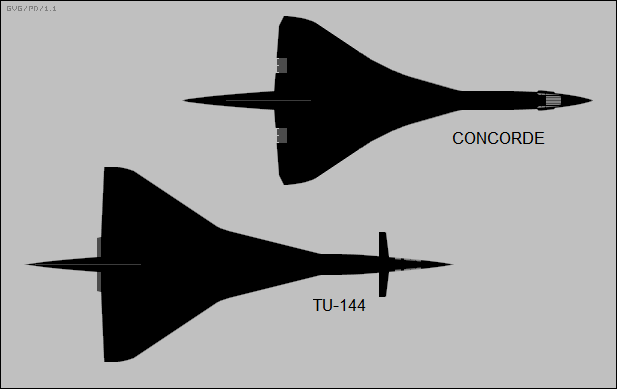

Despite such high poetics of the Tupolev Tu-144, there’s always been a stain to it that it has not been able to shrug off. Whether the Tupolev Tu-144 was a matter of espionage by the Soviets is something that has no conclusive answers. Disagreement runs amongst the expert class, too. Ilya Grinberg, a Soviet aviation expert and engineering professor at Buffalo State University, was quoted in CNN to have said that it was not. David Kaminski-Morrow of aviation publisher Flight Global was quoted in the BBC to have answered the question in an affirmative.
Ilya maintained that external similarities might have been down to the functional criteria and required parameters – after all both of them had to break past the sound barrier. She did maintain that “ the outlines of Concorde could have influenced some conceptual decisions”. One of the biggest reasons why charges of copying the Concorde is difficult to brush away is the absence of a horizontal stabiliser [tail planes]. This was, in Kaminski’s words, “a radical departure from previous Soviet designs”.
The charges of the Tu-144 being a copy of the Concorde began in June 1965, after a model of the Tu-144 was shown at the Paris Air Salon, say Andrei Kandalov and Paul Duffy, in their history about Andrei Tupolev and his eponymous aircraft he helped commandeer:
“…the aircraft certainly look alike. Tupolev’s designers advise that the general shape of the aircraft was determined mostly by the laws of aerodynamics, combined with the needs (or market) for the aircraft and by materials available. They also point to the similarities of the DC-9 and the BAC1-11; the DC-8 and the Boeing 707; and the DC-10 and Lockheed TriStar. Computer-aided design was in the early stages of development in those days; today, the air-raft might well be even more alike.”
The early designs for a supersonic transport aircraft began in the Soviet Union in the early 1960s, with ideas largely based on long-range bomber projects of the nation. Here’s a table that gives you a few details:
| Aspect | Details |
| Timeframe | Early 1960s |
| Initial Design Inspiration | Long-range bomber projects (105A, 106A) and the ‘135’ strategic missile strike aircraft |
| Primary Developer | Tupolev OKB |
| Key Contributor | S. M. Yeger |
| Initial Tu-144 Concept | Powered by Kuznetsov NK-144 afterburning turbofans; resembled Tu-135R |
| Other Design Bureaus | V. M. Myasishchev’s OKB-23 |
| Myasishchev SST Projects | M-53, M-55A, M-55B, M-55V |
| Myasishchev Design Basis | Derived from missile-carriers: M-50/M-52 and M-56/M-57 |


The Soviets had figured out that in order to build the SST, there were a few problems they had to overcome. These include:
- Stabilizing the aircraft at subsonic, transonic, and supersonic speeds
- balancing the aircraft under such speeds, whilst also maintaining low aerodynamic losses
- Adjusting air intakes for a wide range of altitudes and speeds
- Heat-resistant materials
- Structural integrity during cyclical kinetic heating
The Council of Ministers passed Directive No.798- 271 (for the development of an SST) on 16th July 1963. Ten days later, MAP Order No.276 was issued. The Tupolev OKB was tasked with designing and building an SST with the following specifications:
- Cruising speed: 2,300-2,700 km/h
- Range: 4,000-4,500 km, carrying 80-100 passengers
- Normal take-off weight: 120-130 tonnes
[ Note: With additional fuel tanks, the range was to be extended to 6,000-6,500 km while carrying 30-50 passengers.]


Nontheless. a report published in AeroXplorer, however, talks about how spies stole documents from the west and passed them to engineers in the Soviet Union:
“Among the documents secretly sent to the Soviet Union were the designs for the Concorde’s Rolls Royce Olympus 593 engines. The two-part film “Concorde: The Race for Supersonic” goes into great detail describing how a Soviet spy, nicknamed “Agent Ace”, “…handed 90,000 pages of classified records to the Soviet Union in the 1970s…”
Tupolev TU-144: the first aircraft to break the sound barrier
Mike Bannister, former Concorde chief pilot, in his own book named after the aircraft he flew in, was told by some senior members (when he was a trainee Concorde co-pilot) that “going through the sound barrier was a bit of an anticlimax because there was nothing to feel”. Tu-144 beat the Concorde to the skies twice: it completed its first maiden flight two months before Concorde, on Dec. 31, 1968. In June the following yearit touched supersonic speed.
The Soviet Government wanted the Tu-144 to be up before the Concorde. In 1965, it had announced that the Tu-144 would be rolling by the end of 1968. And it did. A few hours before the end of 1968, Eduard Yelian “pulled back the control column and SSSR68001 lifted off Zhukovski’s 5km/3.1-mile-long main runway with a MiG-21 escort, on the world’s first SST flight”. He waited a little over two weeks to make way for good weather conditions to complete the flight. Four Tu-144s were made during the test phase:
- One went to Sib Nil in Novosibirsk for heat tests
- Two went to TsAGI for static tests
- One was fatigue tested at Zhukovski


One of the most distinctive features on the Tu-144 was a pair of “canards” or “winglets”. These were placed right behind the cockpit and improved handling this SST at low speed, whilst also providing extra lift. Here are a few important milestones of the Tu-144:
| Milestone | Date | Altitude |
| First time crossing the sound barrier | 5 June 1969 | l,000m/36,091 feet |
| Crossing Mach 2 | 26 May 1970 | 16,300m/53,480 feet (at a speed of 2,150kph/l,336mph) |
| First public display | 21 May 1970 | At ground, in Sheremetyevo airport |
However, there were a problem that beckoned. Tu-144 consumed more fuel than calculated. This affected the range of the aircraft as the expected range of 6,500km/4,039 miles was cut down to 3,500km/2,175 miles.
But the Tu-144 was haunted by a few problems
There were a few competitive advantages that the Tu-144 had (over the Concorde). One of them was the fact that for the Concorde to get supersonic, it had to be over water. This would typically be when the aircraft was somewhere between the South Wales coast and the northern coastlines of Devon and Cornwall. This is because supersonic aircraft are often associated with sonic boom, which was capable of rattling windows of houses, teacups, and animals too. In short, SSTs like Concorde, as was later discovered, was not as amicable with the environment. But this concern of an SST like the Tu-144 affecting people over the ground wasn’t as big a problem in the Soviet Union, as most of the routes between the east and west of this nation would fly over sparsely inhabited areas.
Unbearable Noise
Despite the comparative advantage mentioned above, people onboard the Tu-144 had to communicate in a written form rather than verbally. This is because the aircraft’s noise would deaden whatever a passenger would wish to convey to a fellow passenger. Like most military aircraft of its time, the Concorde could only sustain supersonic speeds using afterburners.
Other Shortcomings
The Tu-144 turned out to be a rather cramped aircraft. It was five abreast (compared to Concorde’s four). It also suffered hundreds of failures, many of them in-flight. These included:
- Depressurization
- Engine failure
- Alarms that couldn’t be switched off.


The Tu-144 was around 20 tonnes heavier than its rival. Its additional wheels (twelve underneath the wings and two at the front) also added to its lugubriousness.
Flying only on a single route
December 26, 1975 marked the first service using Tu-144, as it was initially deployed to carry mail between Moscow and Almaty. These flights would serve as stepping stones for passenger operations on the same route that first took place on November 1, 1977. The aircraft had received its certification from the USSR Gosavia register only a few days prior to the first passenger flight i.e., on October 29, 1977.
[Note: The first assenger flight using the Tu-144 had a fare of $110, which, according to the New York Times, included a 21-ruble surcharge over the normal fare].


Aviation publication Simple Flying noted that there were 220 equipment failures in 102 commercial flights completed by the Tu-144. Here’s an anecdote from the same publication about the danger in the flight that was averted:
“ On January 25, 1978, just over a year after first entering service, a flight carrying high-level officials and journalists suffered instrument failures. Still, because of the VIPs onboard, pilot Aleksandr Larin carried on so as not to cause embarrassment. While flying a supersonic en route to Almaty, there was a worry that the landing gear would fail to deploy after a load warning siren sounded.”
Perhaps it was down to incidence like these that others have noted that each Tu-144 flight from Moscow could only depart after “the aircraft had been personally inspected by the plane’s designer, Alexei Tupolev himself”.
The New York Times also claimed that there were plans to deploy the Tu-144 on other routes, such as to Tashkent, and across the breadth of the country to Khabarovsk. However, these never materialized.
Economic problems beckoned
Concorde was enormously expensive as it cost $46 million apiece. The Tu-144 cost $23 million (including spare parts). Maybe the allure of a supersonic travel would have led to other carriers operating the Tu-144 (and the Concorde) but the OPEC oil embargo meant that airlines were looking for aircraft that would be able to avoid gas-guzzlers like the Tu-144. It was this embargo that helped bring new wing technologies such as winglets and sharklets into the aviation community.


Tu-144’s biggest nightmare: The Paris Air Show of 1973
The Paris Air Show of 1973 was supposed to be seminal for the Tu-144. After all, the Russians had a chance to demonstrate the aircraft was not rip-off of Concorde. The initial brio of Soviet can be captured in Test Pilot Mikhail Koslov’s words “Just wait until you see us fly..Then you’ll see something.” Koslov had taken his supersonic aircraft after French Pilot Jean Franchi had showcased Concorde’s abilities. Koslov’s maneuvres had even prompted U.S. Test Pilot Bob Hoover to say”“My God….I don’t see how he can do it!”
However, after flattening the Tu-144’s ckimb, Koslov started to lose the aircraft’s control, and at 2000 ft, the exorbitant stress on the aircraft led the left wing to be ripped off, reported Time Magazine:
“… the left wing ripped off first, followed by the tail and right wing. There was a flash of fire, and the plane fell apart. All six crewmen were killed, as well as seven residents of the village of Goussainville, where 20 homes were destroyed by the debris.The exact cause of the crash may never be known unless the Russians can recover more data from the TU-144’s damaged flight recorder. Most experts blame Koslov for trying to force the TU-144 through maneuvers better suited to a fighter than an airliner.”
Tu-144 mishaps that followed and the abandonment
There is a story collection by the name of “A Tupolev Too Far” which describes the journey of a person who hops on to a Tupolev aircraft operated by the state carrier of Russia. After getting onboard on the aircraft run by the Tsar’s of the nation, the protagonist is transported into Breznev’s Russia. After the Tupolev aircraft is hit by an electric storm, the narrow’s friend is transported into avariant subjective realities. Tu-144 was not amenable to such mishaps, though.


On the realistic side of the spectrum, On May 23, 1978, a Tu-144 undergoing a test flight (before delivery to the state carrier Aeroflot) caught met a fatal accident that led to the death of two flight enginners. Aviation Safety Network (ASN) reported that when the aircraft was at an altitude of 3000 m, a fire started at the Auxiliary Power Unit (APU), located in the right delta-shaped wing. The aircraft had to make an emergency landing during which two flight engineers were killed. Over the next few years, without much fanfare, the plane was quietly retired and production of new aircraft was stopped. Six minutes after the fire, the crew was able to belly land the aircraft. ASN’s report claims
“On impact the nose cone collapsed under the fuselage, penetrating the compartment in which two flight engineers were seated. It appeared that 27 minutes prior to the ignition, a fuel line ruptured, causing eight tons of fuel to leak, entering several compartments of the right wing. The fuel readings were judged incorrect by the flight engineers and where thus not reported to the commander.”
In 1984, the Tu-144 program was mothballed, after Aeroflot decided to ground the aircraft. The main factor behind this was the blatant inefficiency of the aircraft. A commentator even said that “the TU-144 may well rank as the biggest single failure in the whole history of aviation”.


Data from ATDB.aero reveals that seven Tu-144s have been preserved in the following places:
- One at the Museum of Civil Aviation at Ulyanovsk, Southwest Russia
- One each at the Aviation School in Kazan-North, Research Institute in Samara, and the Air Force Museum in Moscow.
- One at the Auto und Technik Museum at Sinsheim, Germany
- Two at Zhukovsky (registered as CCCP‑77114 and CCCP-77115)
The “D” model that made it to NASA’s research program
The last TU-144 ever built (constructed in 1981) made it to NASA’s research program. This aircraft was a “D” model, bore a tail number 77114, had clocked a total flight time of only 82 hours and 40 minutes but had never been used for commercial operations. Some of the upgrades and modifications that the aircraft underwent before making it to the “LL” Flying Laboratory included:
- Installation of emergency crew escape system
- Installation of NK-321 augmented-turbofan engines
- Replacing the analog system with A new Damien digital data collection system (intended to collect airworthiness data and other research data).
- To measure the aerodynamic boundary layer, Microphones, thermocouples, pressure sensors, and skin friction gauges were installed.

Tu-144D vs. Tu-144LL – Specification Comparison
| Specification | Tu-144D (Pre-Upgrade) | Tu-144LL (Upgraded) |
| Engine Type | 4 × Koliesov RD-36-51 turbojets | 4 × Kuznetsov NK-321 turbofans |
| Thrust per Engine | Not specified | >55,000 lbs (with afterburner) |
| Cruising Speed | Mach 2.15 (~1,450 mph) | Mach 2.3+ (~1,550 mph) |
| Cruising Altitude | 59,000 feet | Not specified |
| Absolute Ceiling | 62,000 feet | Not specified |
| Range | <2,500 miles | ~3,500 nautical miles (4,040 statute mi / 6,500 km) |
| Passenger Capacity | Up to 140 (typically 100 in service) | Not specified (test platform) |
| Wingspan | N/A | 94 ft 6 in |
| Length | N/A | 215 ft 6 in |
| Height | N/A | 42 ft 2 in |
| Nose Droop | N/A | Up to 12 degrees |
| Fuel Load | N/A | 224,000 lbs |
| Max Takeoff Weight | N/A | ~410,000 lbs |
| Special Features | N/A | Retractable canards for low-speed pitch contro |
The following were the technological goals set by NASA for the Tu-144LL:
“ Among the technological goals set for the aircraft is that it must be environmentally acceptable in the areas of noise generation and pollution control, i.e., the engine exhaust must not contribute to the depletion of the ozone layer in the stratosphere. At the same time, it must be economically viable, that is, be able to carry larger payloads for longer distances and at cheaper costs than first-generation SSTs. Among the targets are a 300 passenger capacity (three times that of first-generation SSTs), a range of 5,000 nautical miles (twice that of first-generation SSTs), and an efficiency which would allow fares to be set at no more than 20 percent above subsonic jetliner fares on the same routes.”


NASA’s observations into the flaws of the Tu-144 revealed heavy lateral control forces throughout tim flight envelope, difficulty in pitch control for pilots, poor visibility when nose of the aircraft was raised, excessive throttle friction, among other problems. NASA also noted some positive things about the aircraft during the research test, such as good crosswind landing capability, and the fact that “general lateral/directional and longitudinal characteristics remained fairly constant throughout the flighten envelope”.
All in all
If we were to use Tu-144 for commercial operations again, concerns such as “the need to warm up the wheel brakes during taxi for takeoff, the requirement to warm up the engines prior to flight (this may be unique to the Tu-144LL)” etc., should be looked into. While one, on the surface, shrugs the aircraft as a counterfeit of Concorde, we should remember that NASA pilot Bob Rivers had gone to receive Tu-144 two weeks after an accident had jeopardized his flight time for as much as eight months. The doctor who looked into Rivers’ case acquiesced to putting a metal on Rivers’ leg to ready him: the doctor had initially assessed no flying time for Rivers for six to eight weeks. Tupolev’s design director, Alexander Pukhov, who received Rivers is quoted to have said “As long as you’re not on crutches in front of the press, and as long as you’re not on crutches when you walk to the airplane, you can fly”. No one would go as far as Rivers if the Tu-144 was a mere Communist Concorde.


It was William Shire that advocated giving difficult names to daughters. He urged us to come up with names
that command the full use of the tongue.
My name makes you want to tell me the truth.
A poet did take Shire’s inspiration and came up with “a name that catches you in the throat if you say it wrong” and she says that she wants a name:
only the brave can say
a name that only fits right in the mouth of those who love me right,
because only the brave
can love me right
Maybe it is only the likes of Bob Rivers, and NASA, who can come up (for Tu-144) with something as appealing as a “supersonic research laboratory” to negate titles such as Concordski. Like the name of poet, the NASA’s sobriquet for the TU-144 fits right in the mouth of those who love it right. And ofter all, like the poet herself, and for the Tu-144, we might just be “collecting the shattered pieces of a continent much larger than my comprehension”.