Singapore Airlines (SQ), which operates the longest flights in the world, has initiated a trial of dedicated priority security screening lanes at Singapore Changi International Airport (SIN). This is the first time the carrier has introduced such a segregated pre-boarding privilege at its own home base. The lanes, spotted by a passenger in the early hours of May 7, 2026, are currently operational at the A cluster security checkpoint in Terminal 3, covering gates A1 through A8, and are reserved exclusively for travellers flying in Suites and First Class cabins, as well as members of the airline’s most rarified loyalty tier, the Solitaire PPS Club, Mile Lion reported.
Until now, Singapore Airlines has upheld a strikingly egalitarian security experience at Changi — one in which a passenger ensconced in a private Suites cabin and one wedged into an Economy middle seat joined an identical queue. That uniformity, as the trial demonstrates, may soon become a relic.
Singapore Airlines Trials Priority Security Lanes At Terminal 3’s A-Cluster Gates
According to reporting by The MileLion, the priority lane was spotted at the A cluster security checkpoint in Changi’s Terminal 3, which serves gates A1 to A8. The lane was witnessed by a reader identified as JDP, who passed through the checkpoint just after midnight on May 7, 2026. A SATS agent on-site confirmed the arrangement was a trial and indicated it may be extended to the B cluster gates, which serve gates B1 through B4.
Whether the priority screening will be further extended to the third cluster of Terminal 3 gates — A16 to A20 — or to the individual pier gates, remains unclear at this stage. Singapore Airlines has not issued a formal press release on the matter. Notably, supplementary Solitaire PPS Club cardholders — as distinct from principal members — appear to be excluded from the lane, with a security guard reportedly maintaining a passenger list and turning away those whose names do not appear on it.
Why Changi’s Gate-By-Gate Security Architecture Makes Priority Lanes Complex
To appreciate why this trial is structurally significant, one must understand how security screening at Changi differs fundamentally from most major international airports. Security checks at Singapore’s Changi Airport are conducted outside the boarding gates rather than at a central checkpoint, which means there are typically no long lines, as only passengers on a specific flight queue at any given time. Terminal 4 is an exception, featuring a centralised security screening area that utilises CT scanners, allowing passengers to keep liquids and laptops in their bags.
This decentralised model, while lauded for passenger flow, renders priority lanes largely redundant at pier gates — the incremental advantage of a dedicated lane, when only one flight’s passengers are present, is negligible.
However, wait times at the cluster gates can be more pronounced during peak departure windows, and for this reason, the cluster gates represent the most logical location for a priority screening deployment. The trial’s confinement to the A cluster is precisely where queue differentiation has the greatest practical effect.

Solitaire PPS: Why It Was Chosen for This Trial?
The beneficiaries of this trial sit at the apex of Singapore Airlines’ loyalty hierarchy. Flying in Singapore Airlines Suites, First Class, or Business Class earns KrisFlyer members PPS Value, which tracks towards PPS Club membership — with the Solitaire PPS Club representing the airline’s pinnacle membership tier. Qualifying for Solitaire PPS Club requires earning 50,000 PPS Value within a membership year, following initial qualification for PPS Club at 25,000 PPS Value.
The PPS Club — an acronym for Priority Passenger Service — is an elite tier of the KrisFlyer loyalty programme targeted at premium-class travelers who spend substantially on:
- Business Class
- First Class
- Suites tickets
Here’s a look at how you can qualify for the PPS Club:
Solitaire PPS Club members already benefit from private check-in services, access to the First Class area of the SilverKris Lounge, and fast-track immigration at Changi Airport, as is explained in the table below:
| Privilege Category | PPS Club Benefits | Solitaire PPS Club Additional Benefits |
|---|---|---|
| KrisFlyer Miles | KrisFlyer miles never expire while PPS Club status is active | Same benefit applies |
| Mileage Bonus | 25% tier bonus on KrisFlyer miles earned on Singapore Airlines flights | Same benefit applies |
| Lounge Access | Access to Business Class section of SilverKris Lounge with one guest | Access to First Class section of SilverKris Lounges with one guest |
| Global Lounge Network | Access to over 1,000 lounges worldwide with Star Alliance and partner airlines | Same benefit applies |
| Checked Baggage | Double baggage allowance and discounts on extra baggage | Same benefit applies |
| Reservation Priority | Priority reservations, waitlist, and standby for flights | Higher priority on waitlists and airport standby |
| Guaranteed Economy Seat | Guaranteed Economy Class seat availability on Singapore Airlines flights under eligible conditions | Same benefit applies |
| Award Redemption Priority | Priority for Saver award seats and waitlists | Enhanced waitlist priority |
| Advance Seat Selection | Complimentary seat selection in all cabins, including Extra Legroom and Forward Zone seats | Same benefit applies |
| Priority Check-In | Priority check-in counters even when flying Economy or Premium Economy | First Class check-in available worldwide regardless of cabin |
| Immigration and Security | Priority immigration and security clearance at selected airports | Same benefit applies |
| Boarding Priority | Priority boarding across cabins | Same benefit applies |
| Priority Baggage Handling | Faster baggage delivery after arrival | Same benefit applies |
| Scoot Benefits | Priority check-in, boarding, seat selection, and BookFlex fee waiver | Same benefit applies |
| In-Flight Wi-Fi | Unlimited complimentary Wi-Fi on Singapore Airlines aircraft | Same benefit applies |
| Priority Magazine | Complimentary Priority magazine subscription and digital access | Same benefit applies |
| Star Alliance Status | Star Alliance Gold status | Same benefit applies |
| KrisShop Benefits | Automatic KrisShop Ambassador tier with 4 KrisFlyer miles per SGD 1 spent | Same benefit applies |
| Shangri-La Benefits | Accelerated Shangri-La Circle Gold and Jade qualification | Same benefit applies |
| Marriott Bonvoy Benefits | Marriott Bonvoy Gold Elite status match and fast-track to Platinum Elite | Same benefit applies |
| Dedicated Support | PPS Connect callback service, WhatsApp Call, and Online Call support | Same benefit applies |
| Service Fee Waivers | Reduced or waived KrisFlyer service fees | Same benefit applies |
| Emergency Assistance | Worldwide emergency assistance through International SOS | Same benefit applies |
| Travel Insurance | Overseas emergency medical and travel accident insurance | Same benefit applies |
| Supplementary Membership | Not available | Solitaire PPS Club Supplementary Card for nominated member |
| Changi Airport Services | Standard priority services | Dedicated First Class Reception and porter assistance at Changi Airport |
| First Class Lounge Access | Not included | First Class SilverKris Lounge access when flying Singapore Airlines or Scoot |
| Family Travel Benefits | Priority services for immediate family on same booking | Expanded First Class check-in privileges for spouse and children |
| APEC Travel Benefits | Not included | Eligibility for APEC Business Travel Card fast-track privileges |
The addition of priority security would slot in logically between the immigration fast-track and the lounge, completing a seamless premium corridor from kerb to gate.
Singapore Airlines already offers priority security screening lanes at selected overseas airports to passengers flying in Suites, First Class, or Business Class, and extends fast-track security services at select airports to PPS Club, KrisFlyer Elite Gold, and Star Alliance Gold members travelling in lower cabins.
Other Airlines Already Offer Priority Security Lanes at Changi
Singapore Airlines is far from the first carrier to deploy priority security lanes at Changi Airport, and its delay in doing so is instructive. Airlines including ANA, Lufthansa, STARLUX, Turkish Airlines, and United already offer priority security lanes for premium cabin passengers and elite frequent flyers at Changi.
One should note that these carriers operate only a handful of flights per day from Changi, making it considerably more manageable to assign dedicated staff, erect appropriate signage, and segregate queues at specific gates.
STARLUX — the Taiwanese carrier — offers priority security at Changi, but passengers using that lane transit through what the aviation commentary community has described as the comparatively austere SATS Premier Lounge. Singapore Airlines, by contrast, directs its premium ground experience considerably upstream: Suites, First Class, and Solitaire PPS Club members already enjoy a private check-in reception and dedicated immigration channel in Terminal 3, placing them inside the SilverKris Lounge.
The trial, read in this context, represents a rounding-out of that upstream experience rather than a wholesale restructuring of it.
Singapore Airlines’ Broader Expansion Activity
The priority security trial does not exist in isolation — it emerges at a moment when Singapore Airlines is prosecuting one of the most ambitious network expansions in its recent history, signalling an institution operating from a position of considerable confidence.
On May 8, 2026 — the same day the security trial became publicly known — Singapore Airlines announced it would launch five-times-weekly services to Madrid via Barcelona on 26 October 2026, making Madrid the airline’s 15th European destination and its second in Spain, subject to regulatory approvals. The airline last operated to Madrid as a tag-on service from Paris, terminating that thrice-weekly route in October 2004 — meaning the Spanish capital’s return marks the end of a 22-year absence from the Singapore Airlines network.
Dai Haoyu, Senior Vice President of Marketing Planning at Singapore Airlines, noted in a statement:
“We are seeing strong demand for travel to Europe, and increasing frequencies to key destinations such as Manchester, Milan, Munich, and London Gatwick in response. Madrid is also an increasingly popular tourist destination, as well as a financial and business hub. These new services will give our customers more choice and greater value when planning their travel.”
Concurrent with the Madrid announcement, the carrier confirmed it would increase Singapore-Manchester services to daily from July 13, 2026; raise London Gatwick and Milan to daily operations from October 25, 2026; and introduce a new three-times-weekly Munich service from October 26, 2026, bringing total Munich weekly services to ten.

Changi’s Terminal 5 And the Case for Centralised Priority Screening
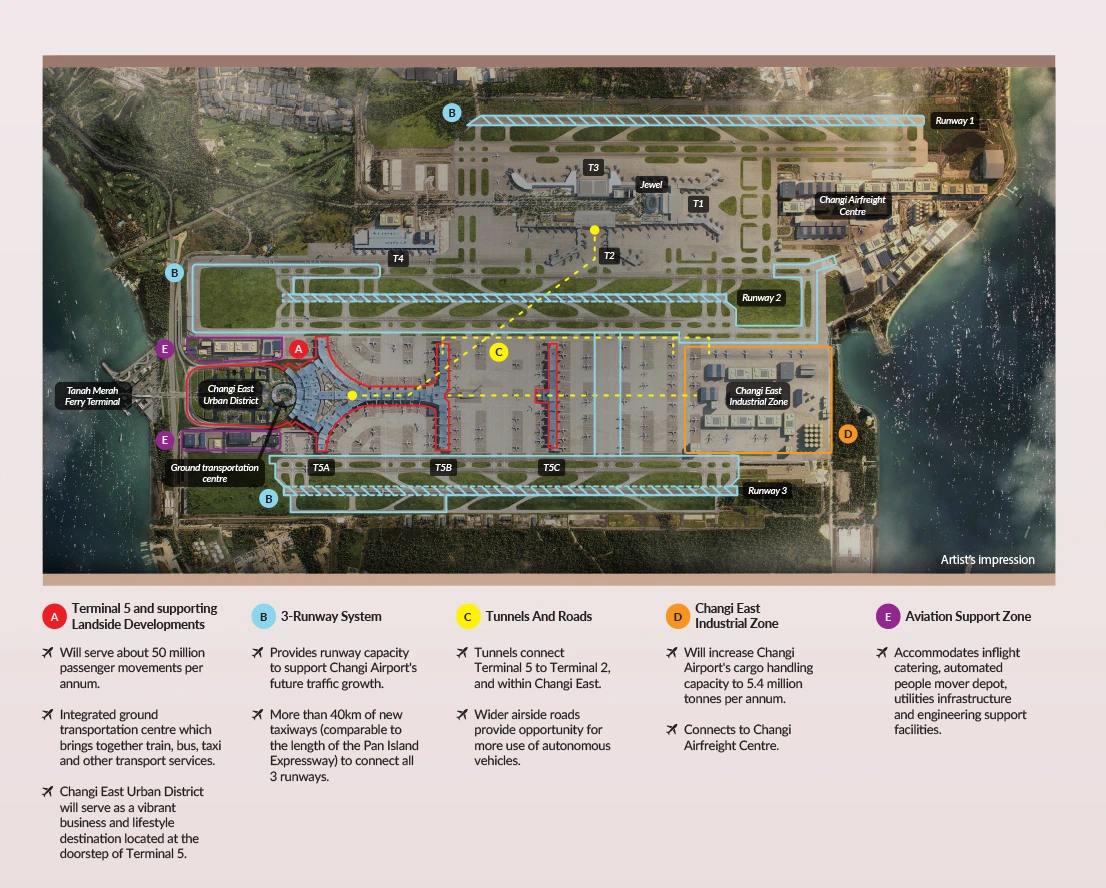
Changi Airport’s Terminal 5 is expected to open in the mid-2030s, and Singapore Airlines and its budget arm Scoot will consolidate their operations under one roof at Terminal 5 when the facility opens, with the new terminal designed to handle approximately 50 million passengers a year. This will effectively more than double the aerodrome’s existing capacity to 140 million passengers annually:
Key Highlights of Changi Terminal 5
- Terminal 5 (T5) will be built within the 1,080-hectare Changi East development area.
- The mega terminal is planned in two phases to match future passenger traffic growth.
- T5 Phase 1 will handle around 50 million passengers annually.
- The terminal is expected to begin operations in the mid-2030s.
- T5 will connect with existing Changi terminals to function as one integrated airport hub.
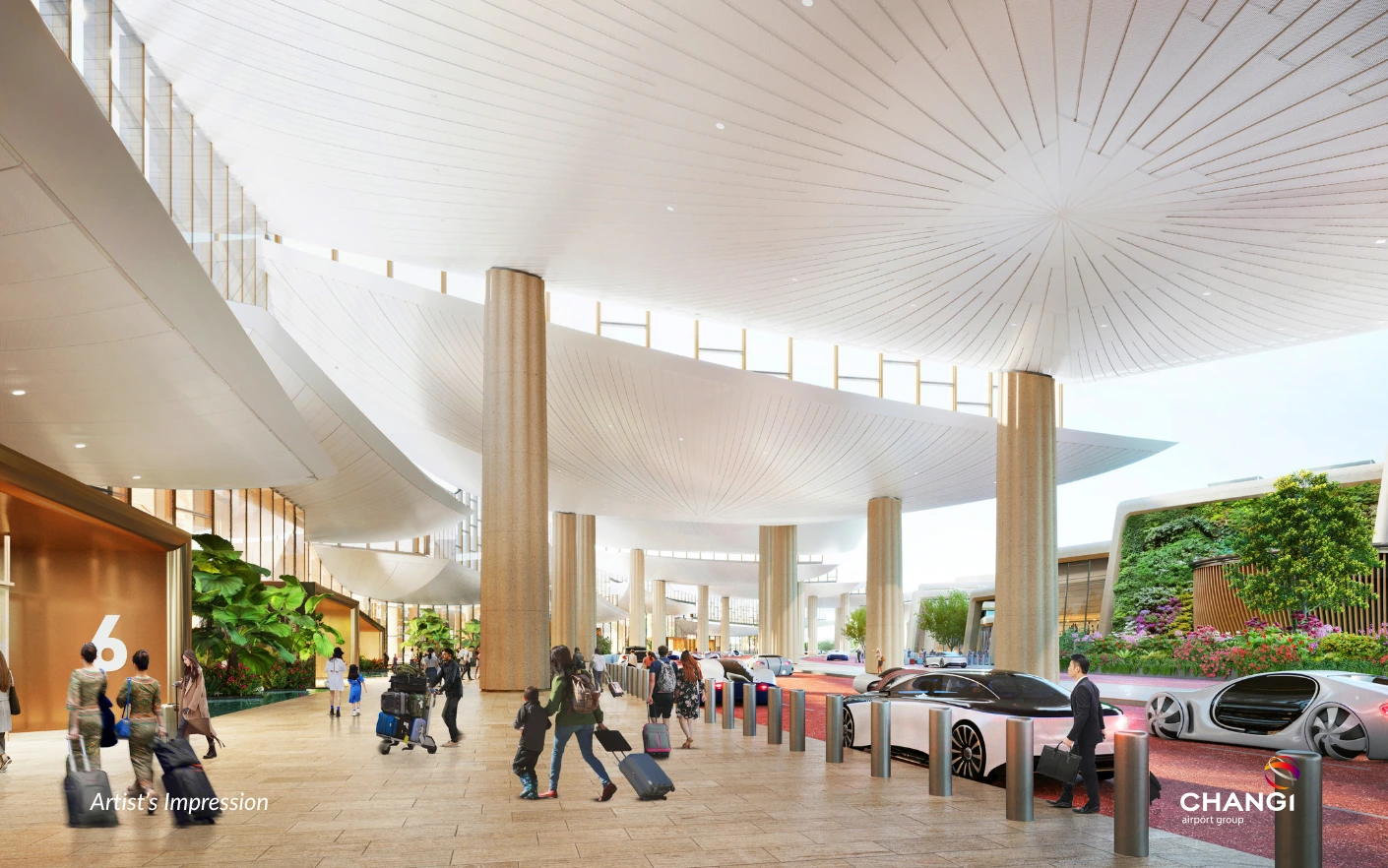
- A ground transportation center will combine train, bus, taxi, and other transport services in one location.
- Ferry connectivity could allow smoother air-sea transfer options for regional travelers.
- The terminal was redesigned after COVID-19 lessons to support flexible sub-terminal operations during health emergencies.
- Contactless passenger touchpoints and upgraded ventilation systems will help reduce disease transmission risks.
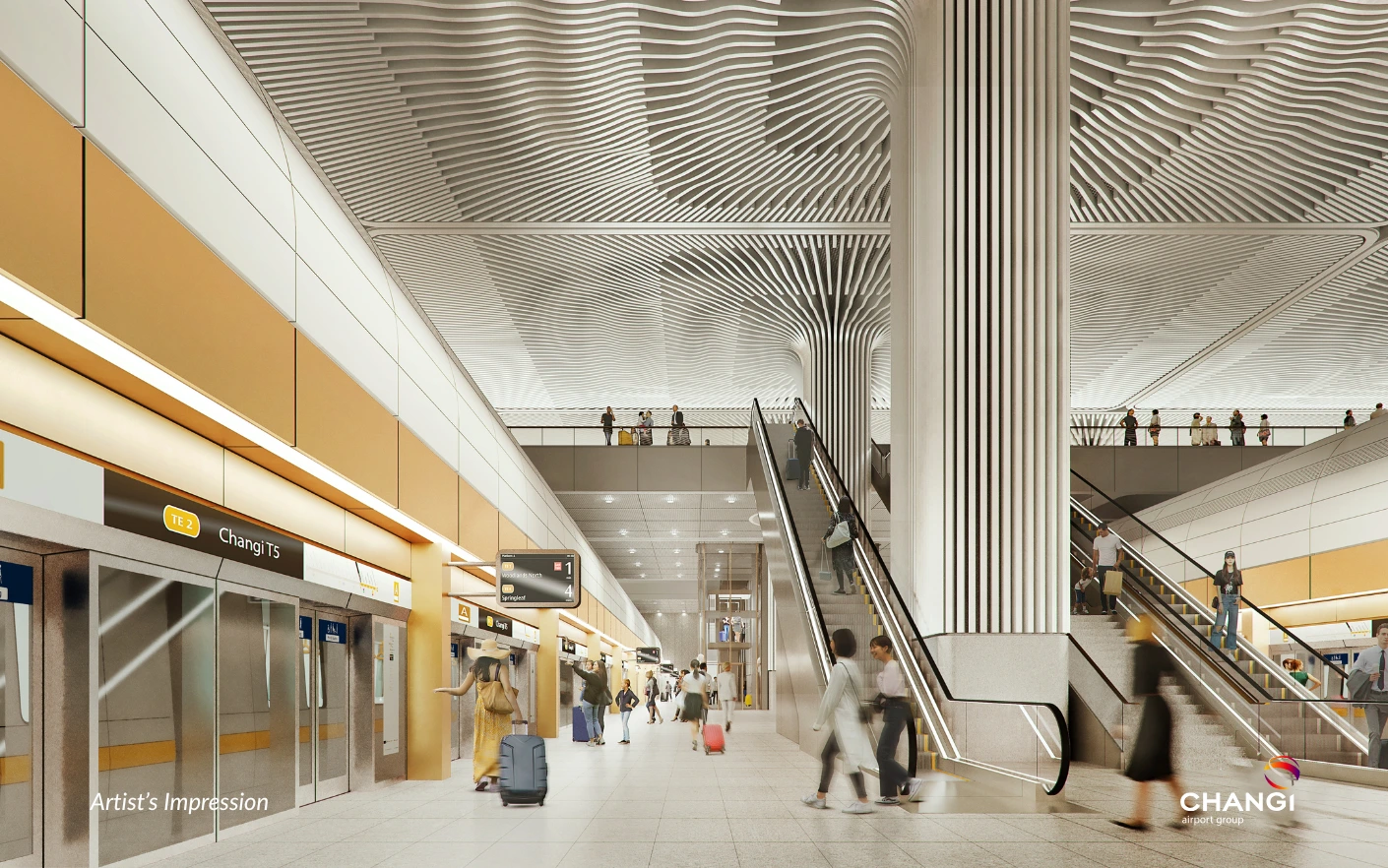
- T5’s architecture uses overlapping curved “roof leaves” to create smaller, human-scale spaces inside the mega terminal.
- Automated People Mover (APM) systems and travellators will reduce walking distances for passengers.
- The APM network will directly connect T5 with Terminal 2 for easier transfers.
- Changi plans to use AI, robotics, video analytics, and automation extensively in T5 operations.
Changi Airport Terminal 3 will itself undergo a major upgrade, with a tender to be called in the second half of 2026, as announced by Singapore’s Acting Transport Minister Jeffrey Siow. The upgrade will incorporate digital technologies and robotics for self-service check-in and security screening, with some solutions functioning as test beds for broader rollout at Terminal 5.
Crucially, Terminal 5 will see all passengers use contactless entry points, consistent with Changi’s strategy to transition entirely to biometric, document-free processing — and the terminal’s layered roof leaves are designed to allow the facility to be subdivided into modular sections in the event of future public health emergencies.
| Terminal 5 | Details |
|---|---|
| Location | Changi East development, Singapore |
| Development Size | 1,080 hectares |
| Opening Timeline | Mid-2030s |
| Initial Passenger Capacity | Approximately 50 million passengers annually |
| Construction Model | Built in two phases |
| Airport Integration | Linked with existing Changi terminals as one air hub |
| Transport Connectivity | Integrated train, bus, taxi, and transport hub |
| Sea Connectivity | Potential ferry integration for regional transfers |
| Health Safety Features | Contactless systems and enhanced ventilation |
| Terminal Design | Curved overlapping roof structures called “roof leaves” |
| Passenger Mobility | Automated People Mover system and travellators |
| Inter-Terminal Connection | Direct APM connection to Terminal 2 |
| Operational Technology | AI, robotics, automation, and video analytics |
| Delay Management System | Aircraft 360 platform for turnaround monitoring |
| Sustainability Certification | Green Mark Platinum Super Low Energy Building |
| Renewable Energy | Large rooftop solar panel installation |
| Solar Energy Capacity | Enough energy potential to power 20,000 four-room HDB flats annually |
| Environmental Systems | District cooling and fixed ground power support |
| Sustainable Fuel Readiness | Compatible with Sustainable Aviation Fuel operations |
When Terminal 5 introduces centralized security screening — as it almost certainly will, given its architectural design — the case for dedicated priority lanes becomes not just logical but structurally inevitable. The current cluster-gate trial may, in that light, be viewed as Changi and Singapore Airlines rehearsing a model they intend to standardise at scale.

The ChangiQ Precedent: An Earlier Experiment in Queue Management
This is not the first time Singapore Airlines and Changi Airport have explored differentiated security access. In 2022, Changi Airport trialled a service called ChangiQ — a virtual queuing system that allowed Singapore Airlines passengers to pre-book time slots for security screening via the iChangi app, enabling them to bypass the queue upon arrival during their selected window.
The concept was a COVID-era innovation designed to reduce congestion at security checkpoints, and Changi Airport described it at the time as follows:
“To ensure safe distancing in the terminals, passengers travelling on selected airlines can now book a check-in and pre-board screening queue slot with ChangiQ, available on the iChangi app. Simply add your flight details in iChangi to make a queue booking, to avoid the hassle of having to wait in line for your turn at the gate holdroom.”
The system ultimately failed to gain meaningful traction. Security queues at Changi, under normal operating conditions, are insufficiently protracted to create the sort of consumer pain that drives adoption of a booking-based workaround. The current priority lane trial takes a simpler, more operationally conventional approach — physical lane segregation based on cabin class and loyalty tier — which is both more immediately legible to passengers and far easier to enforce.

All in All
Several questions remain open as the trial progresses. The most immediate is whether Singapore Airlines will extend the priority lanes beyond the A cluster to the B cluster gates (B1–B4) and potentially the A16–A20 cluster, as suggested by the SATS agent on-site.
An expansion to Business Class and standard PPS Club members — let alone KrisFlyer Elite Gold and Star Alliance Gold holders — seems unlikely in the near term, given that on high-density routes such as Jakarta, premium-tier passengers could constitute a substantial proportion of a given departure.
The exclusion of supplementary Solitaire PPS Club cardholders also raises a pointed question about programme coherence. As The MileLion noted, supplementary Solitaire members retain access to Singapore Airlines’ First Class check-in facilities — making the security lane carve-out an incongruous inconsistency that the airline may need to address before any permanent rollout.
Whether the trial ultimately graduates into a permanent fixture, or follows ChangiQ into quiet discontinuation, will likely depend on passenger feedback and the operational complexity encountered at the cluster gates during peak periods.