Hanjin Group Bans In-Flight Power Bank Use: What Passengers Need to Know About Korean Air, Asiana, and Subsidiaries

A few years after the turn of the New year 2026, the Directorate General of Civil Aviation (DGCA) banned the use of power banks in flights across India. From January 26, 2026, South Korea’s Hanjin Group — comprising Korean Air, Asiana Airlines, Jin Air, Air Busan and Air Seoul — will follow suit as it looks to institute a full prohibition on the in-flight use of portable batteries and power banks, reported Straight Times.  This directive affects both domestic and international operations, and it forbids passengers from charging devices with portable batteries during flight, while requiring compliance with carry-on placement protocols.
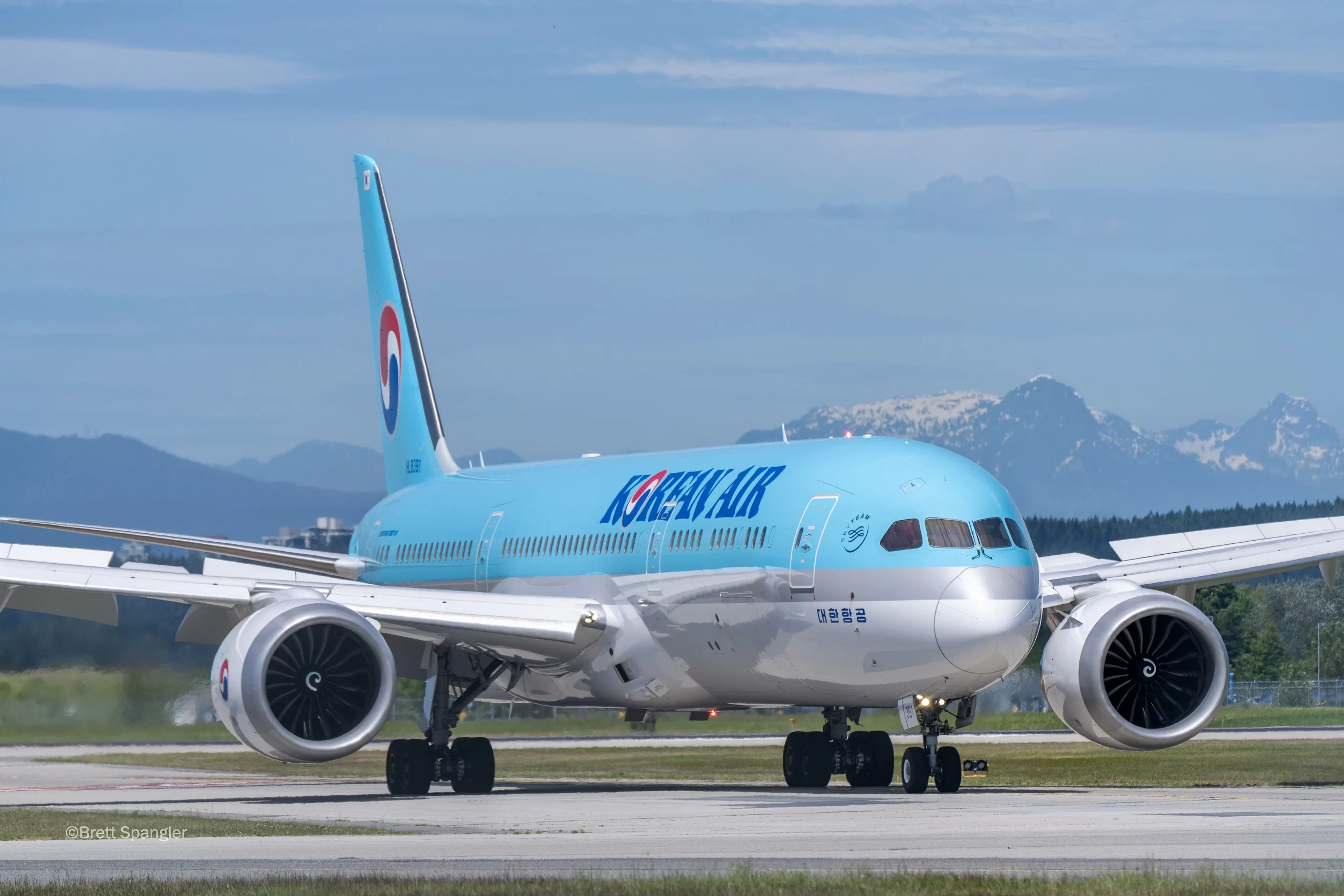
Photo: Brett Spangler | Wikimedia Commons

The ban arises from documented onboard lithium-ion incidents — including a notable blaze aboard an Air Busan aircraft (specifically Air Busan Flight 391) — and aligns with a broader global trend of carriers enhancing safety protocols for portable power sources, such as is the case of Southwest Airlines (WN) – the budget carrier that has already banned the use of power banks in carry-on bags. Passengers boarding flights at any one of the carriers of Hanjin Group may bring portable batteries onboard within existing capacity limits, but use, charging and storage in overhead bins are expressly prohibited under the new policy.
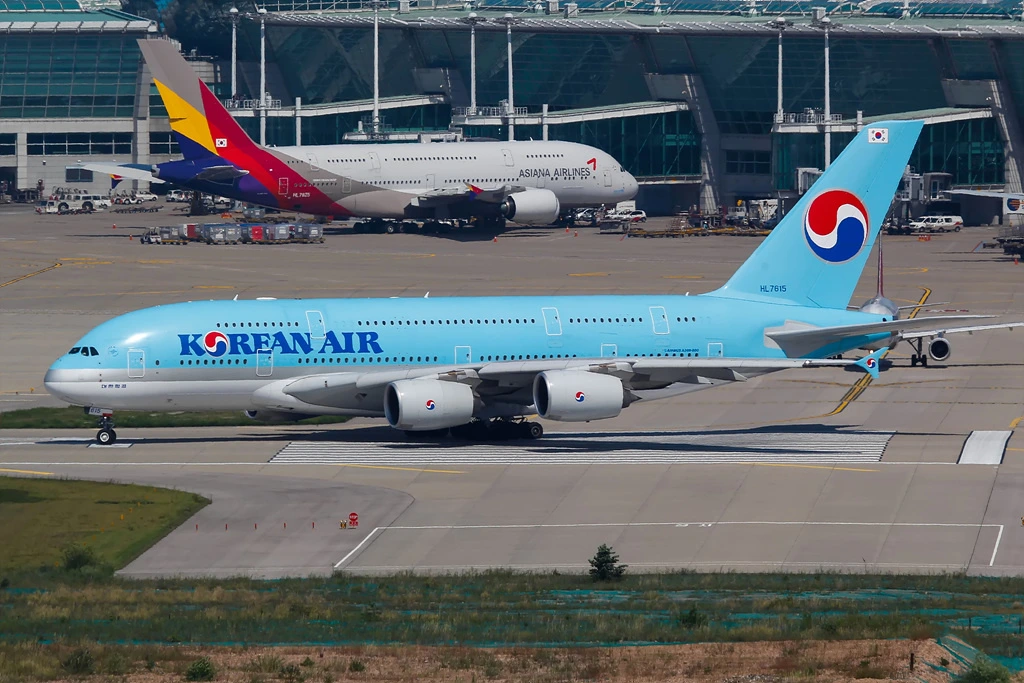
Photo: lasta29| Wikimedia Commons

Profiles of the Five South Korean Carriers Enforcing the Portable Battery Ban

Metric Korean Air Asiana Airlines Jin Air Air Busan Air Seoul
Codes KE / KAL / KOREAN AIR OZ / AAR / ASIANA LJ / JNA / JIN AIR BX / ABL / AIR BUSAN RS / ASV / AIR SEOUL
Founded 1962 / 1969 1988 / 1988 2008 / 2008 2007 / 2008 2015 / 2016
HQ Seoul Seoul Seoul Busan Seoul
Primary hubs ICN, GMP ICN, GMP ICN, GMP PUS ICN
Fleet ~169 ~69 ~31 ~20 ~6
Destinations ~108 ~78 ~45 ~35 ~21
Model Full-service Full-service Low-cost Low-cost Low-cost
FFP / Alliance SKYPASS / SkyTeam Asiana Club / Star Alliance SKYPASS (affiliated) Asiana Club Asiana Club
Parent Hanjin Group Korean Air / KDB Korean Air Asiana Airlines Asiana Airlines
Group role Flagship long-haul carrier Legacy secondary FSC Leisure-focused LCC Regional feeder LCC Intl short-haul LCC

Photo: Hyeonwoo Noh | Wikimedia Commons

Hanjin Group’s New Portable Battery Policy Explained

Under the ban effective January 26, 2026:

  • Passengers may carry portable batteries and power banks onboard only within existing carry-on restrictions (e.g., up to 100 watt-hours without approval).

  • Charging or using portable batteries during flight is prohibited on all flights of the five airlines.

  • Portable batteries must be kept within arm’s reach: on the passenger, in the seat pocket or under the seat in front.

  • Storage in overhead bins is strictly banned to allow immediate detection of overheating or anomalies.

  • Safety precautions such as insulating tape on terminals or plastic pouches are recommended before boarding.

This suite of measures reflects a preventative safety philosophy, prioritizing early detection and crew response to potential cell-thermal events — conditions that can rapidly evolve into fire incidents.

A Korean Air was quoted in The Strait Times to have said:

“This complete ban on the in-flight use of portable batteries is an unavoidable measure for safe aircraft operations, and cooperation from passengers is vital.. All of the Hanjin Group airlines will do their best to ensure safe, comfortable trips for customers.”

Photo: Masakatsu Ukon | Wikimedia Commons

Regulatory context: International and Domestic Battery Safety Laws

The International Air Transport Association (IATA), a power bank are “are classified as UN 3480, Lithium-ion batteries” and “considered spare batteries and must be individually protected from short-circuit and carried in carry-on baggage only“. According to the Federal Aviation Administration (FAA) advisory, the following are the rules on the portable power bank carriage on passenger flights.

Requirement category Rule / restriction Operational implication for passengers
Baggage placement Power banks must be carried in carry-on baggage only Portable batteries are not permitted in checked luggage under any circumstances
Capacity ≤ 100 Wh Allowed without prior airline approval Passengers may carry these power banks freely, subject to standard screening
Capacity 101–160 Wh Airline approval required; usually limited to two units Travelers must declare and obtain approval before travel
Capacity > 160 Wh Prohibited on passenger aircraft These power banks cannot be carried onboard or checked
Terminal protection Battery terminals must be protected Insulation or protective casing required to prevent short circuits
Security screening Subject to inspection by airport security Passengers should expect additional screening or questioning
Compliance advisory Airline and FAA guidance applies Rules may vary slightly by carrier; passengers should verify before departure
Photo: Gabriella918 | Wikimedia Commons

Even the Transport Safety Administration says that:

Portable chargers or power banks containing a lithium-ion battery must be packed in carry-on bags. Spare lithium batteries, which include both power banks and phone chargers, are prohibited in checked luggage.”

South Korea’s Ministry of Land, Infrastructure, and Transport implemented a policy last year to mitigate the effects of power banks on flights, reported news.koreaniar.com:

“insulating tape to prevent short circuits (short circuits) is provided to passengers who need it at check-in counters, boarding gates, and in-flight, and at least two power bank isolation storage bags are mandatory on board. A temperature-sensitive sticker that turns red when the temperature exceeds 40 degrees Celsius is attached to the outside of the cabin shelf so that the heat inside the shelf can be detected more quickly”.

Photo: Aeroprints.com | Wikimedia Commons

Recent Comparable Incidents That Drove Hanjin Group to Change Powerbank Rules

Air Busan Flight 391 is one of the catalysts for the Hanjin Group’s decision to ban in-flight use of portable lithium-ion batteries, though this case can be thought as a microcosm in the wider spectrum of events surrounding lithium-ion batteries in flights.

How Air Busan Flight 391 influenced the Hanjin Group’s lithium battery ban

In January 2025, an Air Busan Airbus A321 preparing for departure from Gimhae International Airport (PUS), Busan experienced a cabin fire that investigators linked to a lithium-ion power bank inside a carry-on bag.

Chronology of Air Busan Flight 391

Parameter Detail
Flight number Air Busan Flight 391
Operator Air Busan (BX), subsidiary of Asiana Airlines / Hanjin Group
Aircraft type Airbus A321-200
Aircraft registration HL82** (registration partially reported; exact suffix not consistently disclosed in early reporting)
Aircraft age ~17 years at time of incident (based on reported delivery year)
Departure airport Gimhae International Airport (PUS), Busan
Intended destination Hong Kong International Airport (HKG)
Flight phase at incident Pre-departure, aircraft on the ground
Scheduled flight duration ~3 hours (scheduled; flight did not depart)
Passengers / crew onboard 169 passengers / 7 crew
Suspected ignition source Portable lithium-ion power bank in carry-on baggage
Fatalities None
Photo: Aeroprints.com | Wikimedia Commons

The Aviation and Railway Accident Investigation Board (ARAIB) reported that the fire occurred in an overhead bin during pre-departure, prompting an emergency evacuation of all 169 passengers and 7 crew members. The incident dramatically highlighted the risks posed by unmonitored batteries in enclosed aircraft spaces, with National Forensic Service (NFS) stating the following:

“The battery remnants were extensively burned, making it challenging to determine the exact cause of the insulation breakdown based solely on the post-fire condition….No electrical abnormalities or fire-related damage were identified in the aircraft’s wiring, lighting fixtures, or circuit board remnants. This makes it highly unlikely that the fire originated from any part of the aircraft’s internal infrastructure.”

Photo: Md Shaifuzzaman Ayon | Wikimedia Commons

According to a report on the matter published in AJU Press, investigators assessed that the fire originated in the overhead bin above seat 30 on the left side of the cabin. Video recorded by a passenger captured flames emerging from that location, and charred remains of a portable backup battery were subsequently recovered near seat 31.

On 3 February, a joint team comprising the Aviation and Railway Accident Investigation Board (ARAIB), the National Forensic Service (NFS), police forensic specialists, and fire authorities carried out an on-site examination. Evidence gathered from rows 28 to 32—including cabin wiring, lighting components, and battery debris—was forwarded to the NFS for computed tomography (CT) imaging and microscopic analysis, with ARAIB reporting:

“Based on our findings so far, we are focusing on the likelihood that the fire was caused by the power bank and will continue our investigation accordingly..If we identify any necessary safety measures during the investigation, we will issue safety recommendations to the airline and other relevant parties.”

Photo: Alan Wilson | Wikimedia Commons

Comparison of Aviation Incidents Related to Power Bank / portable battery fire risks

Incident / Event Carrier / Location Nature of Event Outcome / Regulatory or Airline Response
In-flight diversion due to battery fire Air China Flight CA139 (Hangzhou → Incheon) Passenger lithium battery ignited during flight, producing smoke and flames Aircraft diverted to Shanghai
Taxi-phase fire involving power bank IndiGo (Delhi → Dimapur) Power bank reportedly overheated and caught fire during ground taxi
Emergency diversion after take-off Hong Kong Airlines HX115 (Hangzhou → Hong Kong) Power bank caught fire in overhead compartment shortly after departure Flight diverted
Mid-air smoke incident from portable charger JetBlue (Florida → Nassau) Portable charger overheated, causing smoke and small fire in cabin
  • Fire contained by crew
  • safe landing
Overhead locker fire Virgin Australia (Sydney → Hobart) Lithium-ion power bank entered thermal runaway in overhead bin Cabin crew extinguished fire

Airline strengthened passenger advisories on battery use and stowage

Leave a Comment

Your email address will not be published. Required fields are marked *

Scroll to Top