
When smoke from Canada’s wildfires in 2023 affected the visibility of US airspace, operations at laGuardia Airport came to a halt. Myrtle Beach International Airport suffered a similar fate when a suspected Chinese spy balloon made its way across the airport in the same year. In both of these cases, the Federal Aviation Authority issued a Ground Stop – the most famous example of which is what happened to aircraft operations following the tragedy of 9/11 (which saw the use of airfones). Although the few examples above might already have given you cues about what a ground stop in aviation means, let’s dive deeper into the details of this traffic control initiative.
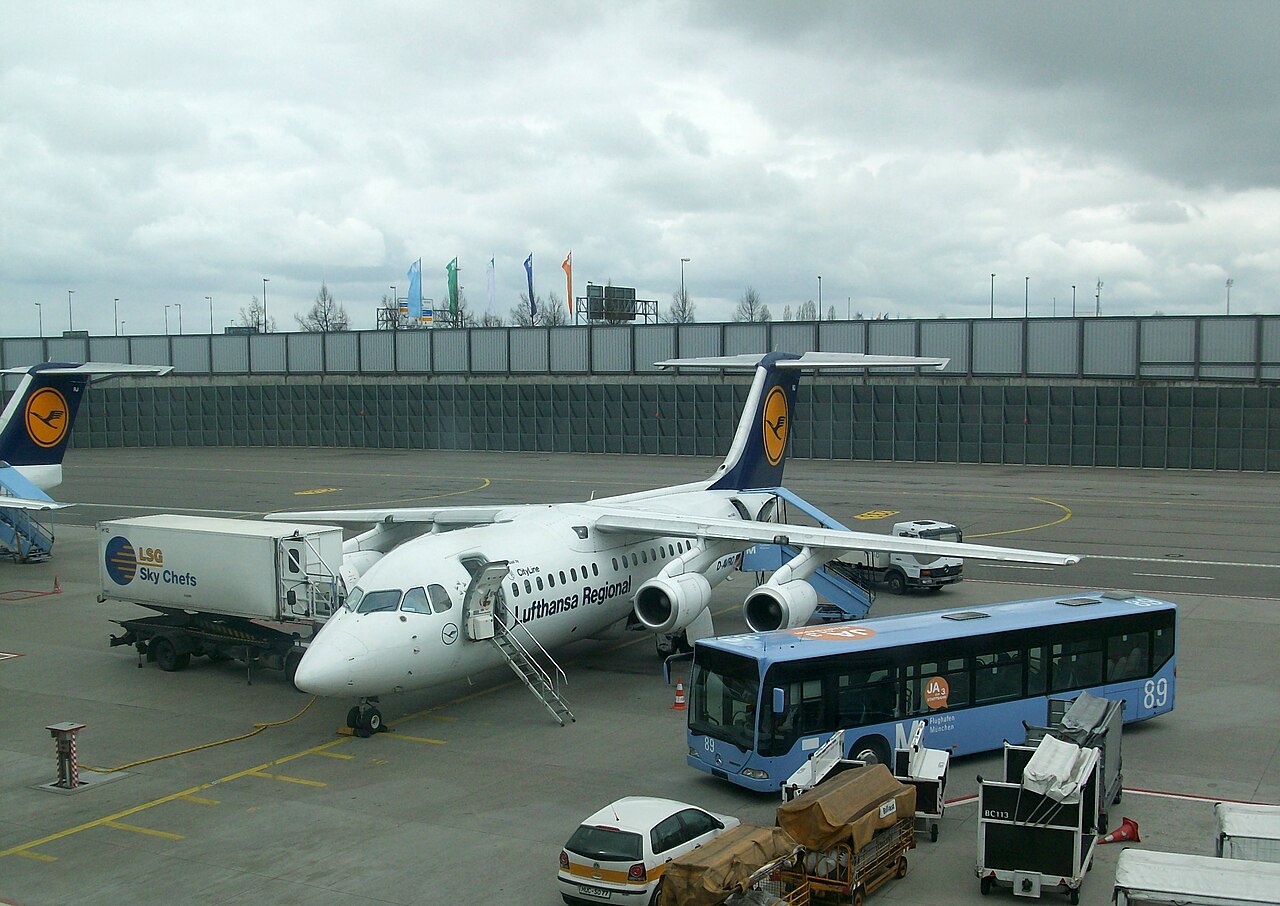
Photo: Kevin.B | Wikimedia Commons
Ground Stops: The Basics
According to the National Business Aviation Association, Ground Stop (GS) is the most restrictive traffic management initiative (TMI). It requires aircraft meeting specific criteria to remain on the ground at the airport of origin. A ground stop is issued by the FAA Air Traffic Control System Command Center (ATCSCC) in conditions such as:
- Weather too inclement to prevent landing
- Catastrophic events
- Extreme weather that reduces usable routes
- Major equipment outages
Top 5: Ways in which US airports are adapting to cater to travelers with accessibility requirements
In addition, the NBAA points out that the GS is most frequently used for:
- Precluding extended periods of airborne holding
- Precluding sectors from reaching saturation levels
- Precluding airports from reaching gridlock*

Photo: Kambui | Wikimedia Commons
[*Note: Gridlocks might either mean Clogged airspace, clogged airport or demand outstripping supply]
The FAA points out that the a GS can be implemented “in severely reduced capacity situations (below most user arrival minimums, airport/runway closed for snow removal, or aircraft accidents/incidents)” or “in the event a facility is unable or partially unable to perform ATC services due to unforeseen circumstances”.
Immediately following 9/11, a nationwide GS was implemented in the US. It was the first (and only) of its kind in the nation and necessitated the closure of the entirety of US airspace. In addition, the GS after 9/11 also required all airborne flights to land.

Photo: Wikimedia Commons
National vs Local: the two types of ground stops
One might already guess that the ground stop implemented after 9/11 was a National Ground Stop. While less restrictive traffic management initiatives must be evaluated before implementing a national GS, the staggering scale of the attacks on September 11, 2001 left no room for less restrictive TMIs to be assessed.
According to the FAA, when it becomes clear that “an immediate constraint is needed to manage a condition”, the ATSFCC must:
- Time permitting, conference affected facilities and system users, as appropriate, to implement a national GS.
- When appropriate, utilize Flight Schedule Monitor (FSM) to implement a national GS, except when deemed impractical.
Local Ground Stop
Before a local ground stop is implemented, the traffic management unit must assess if there are are alternative measures it can take. A terminal facility can implement a local ground stop “when the facilities impacted are wholly contained within the facility’s area of responsibility and conditions are not expected to last more than 30 minutes”.

Photo: Wikimedia Commons
If the local GS is to be implemented, the terminal facility must notify the TMU, which must in turn notify the ATCSCC. If the GS is to be extended, the TMU should take an approval from the ATCSCC. In case a GS has to be applied before there’s time to correspond with the ATCSCC, the TMU must notify the ATCSCC about the implementation as soon as it is practical.
Learning about the tiers of a ground stop
The effects of a Ground Stop could be divided into three tiers. The most common of these tiers is the first, which is for aircraft that are in the immediate vicinity of the airport, and necessitate holding aircraft for a short time without a stop. Neil Byers, an air traffic manager at the Philadelphia International Airport (PHL) ATC Tower/TRACON, explained the nature of the first tier in the following way:
“For instance, if there is a thunderstorm that’s rolling through the airspace, ATC will try to time it to where those aircraft won’t be affected by the thunderstorm…We’ll put in a short-term ground stop, which is about 30 minutes-to-an hour to stop the traffic and give a little break. That’s a mechanism that we use to control the throughput of the airport.”
A first-tier GS at PHL might affect nearby airports such as:
- New York market airports (in the north)
- Pittsburgh (in the west)
- Raleigh, NC (in the south).

.jpg)
While a second-tier GS at PHL involves aircraft (fixed-wing or otherwise) departing out of the following areas:
- Atlanta
- Boston
- Chicago
- Cleveland
- Indianapolis
- Miami
…a third-tier GS halts all aircraft movement inbound for Philadelphia. PHL reported that “the only reason why something like that can happen are major events that impact airport operations greatly, such as recovery from a blizzard or hurricane”.
But how long does a Ground Stop (GS) last?
A ground stop dealys/disrupts flights, and this can lead to delays in departure times for flights that are to follow, oftentimes with the risks of a cascading effect. If a GS is implemented when an aircraft is mid-flight, the pilot can either
- fly the aircraft until (s)he receives permission to land
- or be redirected to a different airport

.jpg)
Airline pilot Gary Baumgardner, who has an experience of flying for more than sixteen years told islands.com that a GS might force an aircraft headed to its destination airport to be:
” placed in a holding pattern, where the aircraft circles in a designated area until it’s safe to proceed to the airport. If the ground stop is expected to last a long time, flights may be diverted to alternative airports. This adds additional fuel consumption, potential refueling stops, and further delays, affecting passengers’ arrival times and potentially leading to a reshuffling of their travel plans. “
It is not always clear how long a ground stop will last. Timings will always be updated after evaluation, and the duration of a GS might be extended. A GS might either have a low, medium, or high possibility of extension (POE). However, we should be mindful that the Expected Departure Clearance Time (EDCT) will be different from the Update Time, reports NBAA:
“Facilities may implement ground stops for up to 15 minutes without notifying the Air Traffic Control System Command Center (ATCSCC). A facility ground stop may not exceed 30 minutes. Once the delay is anticipated to reach 15 minutes or more, the ATCSCC is notified. If the ground stop is expected to continue, an advisory will be issued by the ATCSCC advising customers of the extension.”
Let’s take a look at how the situation of the ground stop following the attacks on 9/11 evolved:
Flight 11, crashed into the North Tower of the World Trade Center at, and 17 minutes later at 9:03 am, Flight 175, crashed into the South Tower, changing the United States forever. Immediately after the attacks, the Federal Aviation Administration (FAA) quickly rushed to ground all planes in the US airspace, and by 9:45 am, aircraft movement was brough at a standstill.
| Time | Event |
| 8:46 am | Flight 11, crashed into the North Tower of the World Trade Center |
| 9:03 am | Flight 175, crashed into the South Tower |
| 9:42 am | all 4,546 civil aircraft flying in U.S. airspace were ordered by the FAA to land. |
| By 9:45 | all planes in the US airspace were grounded |
| September 14 | Aircraft movement resumed |


Measuring the scope of a ground stop: a few technical terms
The scope of a ground stop is measured with two factors: “distance” and “center”. Let’s learn about these concepts and how these affect a ground stop.
Center
The continental US has 20 Air Route Traffic Control Center (ARTCC)- Cleveland Center (ZOB) being one of them. According to Skybrary, an ARTCC is “a facility established to provide air traffic control service to aircraft operating on instrument flight rules (IFR) flight plans within controlled airspace and principally during the en route phase of flight”. ARTCC might also be able to provide services aircraft operating under visual flight rules (VFR) rules when workload or equipment capabilities permit.
One example of an ARTCC would be the Cleveland Air Route Traffic Control Center (ZOB), which handled the radio traffic from United Airlines Flight 93 [United Airlines Flight 93 took off from Newark International Airport in New Jersey to San Francisco International Airport, was hijacked and intended to crash into a federal government building during the September 11 attacks]. In the case of ZOB, the letter “Z” refers to the “center” while the letters OB refer to Cleveland. The Washington Air Route Traffic Control Center is known as ZDC.


If the scope of a ground stop is “ZOB+ZDC+ZFW,” it encompasses flights from the two ARTCCS we’ve already mentioned (Cleaveland and Washington) and Fort Worth Air Route Traffic Control Center (ZFW).
Distance
A ground stop determined as “1000 miles + ZDC”, all flights originating within 1000 miles from Washington Center are a part of the Ground Stop scope. It has been noted that distance is one of the most precise ways of defining the scope as it allows air traffic controllers to navigate plan flights within the given distance.
How is a Ground Stop canceled?
After developing an operational plan to release nationally ground stopped air traffic, a GS can be canceled. For this, an ATCSCC must transmit an advisory to cancel a local ground stop. The ATCSCC must also transmit an advisory when a national ground stop has been cancelled.
Further, the FAA notes that the ARTCC TMU and the Terminal facilities must:
-
-
“ Issue cancellation information to underlying facilities, using normal communication methods, in sufficient time for proper planning and control actions.
-
Notify facility personnel, as appropriate, of the cancellation.
-
Notify the ATCSCC if a local GS was coordinated with the ATCSCC.”
-
Do passengers get compensated for a ground stop?
Airlines are generally not required to compensate passengers in case of flight cancellations or delays caused by factors that are out of the carrier’s control. On Christmas Eve 2024, the FAA issued a nationwide ground stop for all American Airlines flights as aircraft operated by the carrier were facing “technical issues”. The GS was implemented at the airline’s behest. Earlier that year, aircraft operated by Alaska Airlines were also ground stopped. CNBC reported that GS was issued to Alaska after glitches in the IT and that “the airline’s system used to calculate weight and balance for flights was not functioning correctly”.


If airline-induced ground stops lead to significant delays or cancelation, the respective carriers must rebook passengers at no additional cost while also providing complimentary accommodations to passengers affected by an overnight cancelation. Simple Flying claims that “Credit/travel vouchers must be given when a delay or cancelation results in passengers waiting for three hours or more from the flight’s scheduled departure time”.