
On May 17th, 1987, a special type of Falcon 50 (dubbed Suzanna) attacked a naval frigate USS Stark patrolled the Persian Gulf. The frigate was as part of the United States’ support efforts during the Iran-Iraq war, and it was initially assessed that the sloop was chartering in international territory when it was attacked. Suzanna was identified as “an unknown incoming aircraft” and fired two Exocet missiles at the frigate, damaging the USS Stark significantly, whilst also claiming the lives of 37 people. It was eventually revealed that Stark was a bit closer to Iranian waters. This triking piece of history will forever etched to the first ever transoceanic business jet: the Falcon 50.


Dassault Falcon 50’s first flight took place almost a decade prior to Suzanne’s deployment in the aforementioned battle: on November 7, 1976, (from Bordeaux-Mérignac Airport (BOD)). The aircraft ( which was first piloted by Hervé Leprince-Ringuet and Gérard Joyeuse) even before the specially modified variant Suzane had fighter jet DNA- after all, Dassault was previously a military jet manufacturer.
Origins of the Flacon 50: Dassault’s transition from a military aircraft manufacturer to a civilian jet manufacturer
Dassault Aviation, which is now synonymous with civilian jets, was first founded under the name Société des Avions Marcel Bloch by Marcel Bloch and voyaged into becoming staple in aviation industry first as a design firm for a tri-engine mail carrier. The design didn’t transmorgify into production, though. However, the design idea was “tweaked and eventually manufactured for the French army and used as a transport plane to reach France’s colonies” – Dassault had entered the world of military aviation.

.jpg)
Dassault would later become a formidable name in the sphere of military aviation, producing fighting aircraft such as:
- Mystère in 1951
- Mirage III in 1956 (this was the first of the Mirage lineup of aircraft)
- Rafale, which is still in production to this day.
Dassault’s first dipped itself in civil jet manufacturing in 1963, as it spearheaded the Falcon family of aircraft. The first of this family was Dassault-Breguet Mystère 20 (something that would later be dubbed the Falcon 20 after Bregeut Aviation, a separate partner that was absorbed into Dassault Aviation). For an aircraft of the 60s, Falcon 20 was a nippy 0.8 Mach at a range of up to 1,080 nautical miles (2,000 km). The following decade saw the prototyping a larger version of the Falcon 20 (called the Falcon 30). While the production of this aircraft never saw the light of day, Dassault was onto the production of its first private jet that would be produced even in the turn of the millennium: the Falcon 50.


A demand for longer flight ranges and the development of the tri-engine Falcon 50
A tri-engine jet, the Falcon 50 would earn the distinction of being the first transatlantic Falcon to be produced. One of the more seminal reasons behind its development was a demand in the United States for longer flight ranges. Falcon 50, the work for the development of which had started in 1974, was to better the range of the Falcon 30-40 range as it hoped to cover 3,400 NM (6,300 km) on FAR 121 reserves. A couple of years later, it was to hit the skies out of Bordeaux-Mérignac.
In December 1976 (only a month after its maiden flight), Dassault decided that this plane, powered by three Garrett TFE 731-3 jet engines, needed a revamp: it would have improved wings. The very pilots who had been at the helm of the first flight of the Falcon 50 were to fly the plane with improved wings on May 6, 1977. The improved wing design would be celebrated with much aplomb, reported Dassault:
“The Falcon 50 became the world’s first civil aircraft featuring supercritical wings, and secured certification on February 27, 1979. The wing choice brought about a formidable technological breakthrough. With only minor adjustments, Dassault was also able to use it on its new Falcon 900 and Falcon 2000 models.”
The French government, Aerospatiale (the aerospace manufacturer which was instrumental in producing the Concorde), and Dassault signed an agreement leading to the production of the plane. Here’s where the different parts of the plane were produced:
- Aerospatiale’ plant (in Saint-Nazaire ): 55% of the frame [the fuselage was built here]
- Dassault’s plant in Colomier: Wings
- Mérignac: Assembly and flights


On February 27, 1979, the Falcon 50 was awarded its airworthiness certification by the French government. The Federal Aviation Administration (FAA) certified the Falcon 50 in March 1979.
A look at a few variants of the Falcon 50
Over 350 Falcon 50s were produced 1976 to 2008. These included three different types of the Falcon 50
Maritime and surveillance variant of the Falcon 50: Gardian 50
Gardian 50 is Dassault’s long-range version of the Falcon 50 that is used in maritime and surveillance roles within the government and military. The first aircraft in this series was used by the French Navy, which operates a total of eight Gardinan 50s for maritime, surveillance, and environmental roles.
Falcon 50EX
Dassault introduced the Falcon 50EX (after Serge Dassault’s announcement) in 1996 when it took to the skies on April 10, 1996, piloted by Jean Bongiraud and Etienne Faurdessus. The first deliveries of this arcraftt that would necessitate lower maintenance costs than its predecessor were planned for the beginning of 1997. Here’s how the EX fared in comparison to the Falcon 50:
- It flew higher and faster (it could reach 41,000 feet in 23 minutes)
- It had a longer range (6,050 km / 3260 nm at Mach 0.75)
- Modernized avionics (Collins Proline 4)
- Equipped with three new engines, the AlliedSignal TFE 731-40 with increased thrust (1,680 kg / 3,704 lb each), 7% more efficient fuel consumption (reduction by 7%)
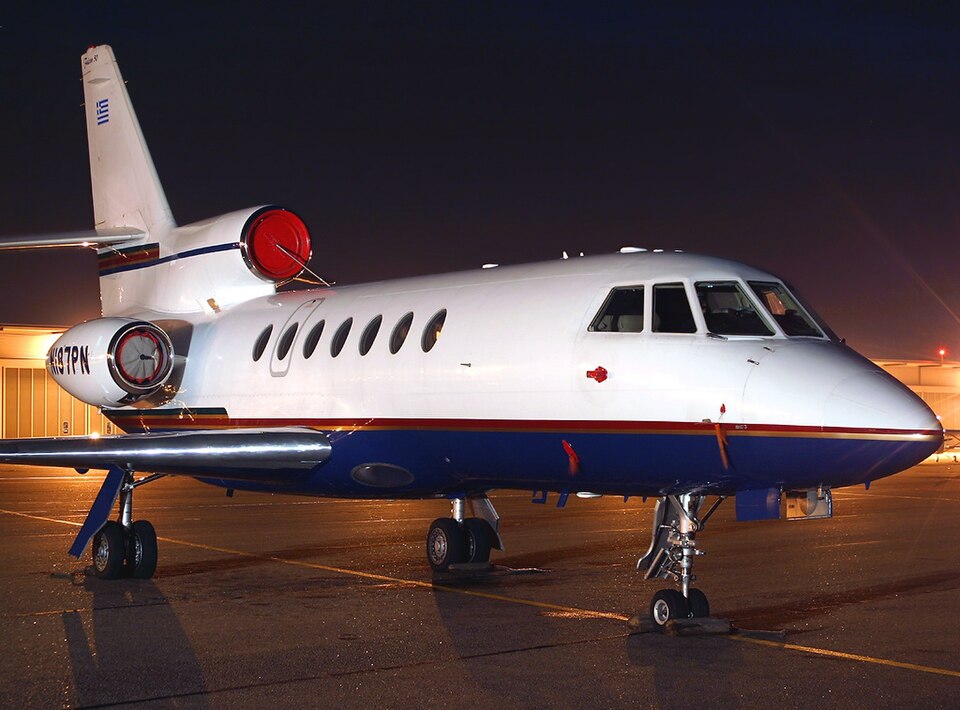

The Falcon 50EX could take off within 1500 meters and land within 700 meters. The aircraft was fitted with the ADC 80 air data computer. Operators could also use the High Mach blended winglets as retrofit.
| Engine | Honeywell TFE 731-40 turbofan |
| Power | 16.46 kN (3,700 lb) thrust each |
| Rate of climb | 10.433 m/s (2,053.7 ft/min) |
Some of the other features of the Falcon 50 EX include:
- 3 DEEC (Digital Electronic Engine Control)
- An Auxiliary Power Unit (APU) installed as standard equipment
- Advanced autopilot system and digital flight control technology
- Enhanced safety and situational awareness for flight crew.
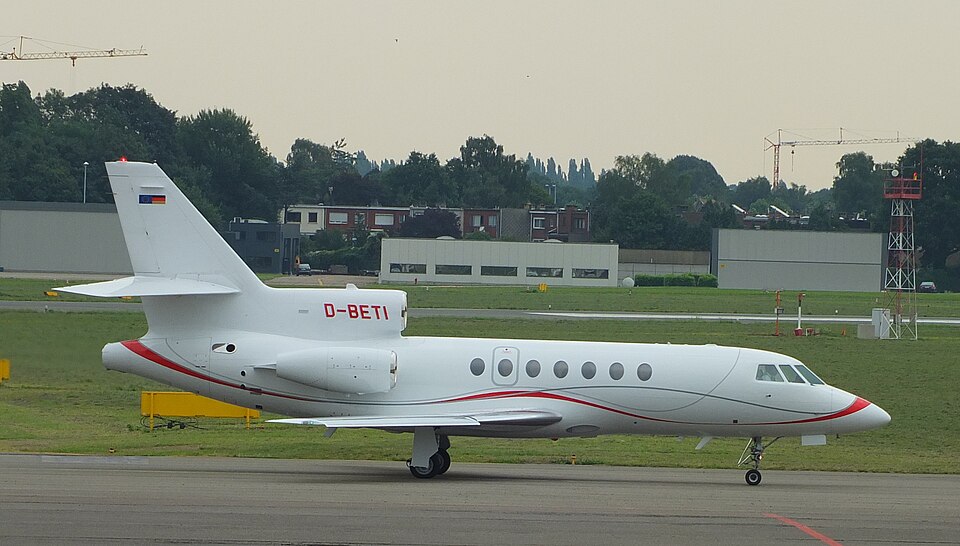

| Specification | Falcon 50 | Falcon 50EX |
|---|---|---|
| Crew / Passengers | Crew: 2 Passengers: 9 | Accommodates up to 12 passengers (typically 9); Cabin ~700 cu ft |
| Cabin Dimensions | Height: 5 ft 9 in; Width: 6 ft 1 in; Length: 23 ft 5 in; Volume: 700 cu ft | Height: 5.8 ft; Width: 6.1 ft; Length: 23.5 ft; Volume: 700 cu ft |
| Range | Normal: 3,057 nm; Max: 3,200 nm | Normal: 3,260 nm; Max: 3,350 nm |
| Service Ceiling | 31,000 ft | 49,000 ft |
| Max Speed | 480 kts | 481 kts (top speed) |
Falcon 50 Suzanna
The Falcon 50 with the codename Suzanne was a one-off. It was a Falcon 50 registered YI-ALE and sent to France for rebuild at Villaroche. During the rebuild, certain changes were made. These included(as reported by The National Interst):
- One launcher for AM.39 Exocet missiles under each wing
- Receiving a complete cockpit of the F.1EQ-5 on the right side
- The registration number was deleted
- Received a pointed nose of the Mirage F.1containing the Cyrano radar


Here’s how the attacks from Susanna later unfolded:
“Following a series of training flights, on the morning of May 17, 1987 Suzanna’s crew received the order to load two Exocets and then transfer to Wanda AB for an operation over the Persian Gulf. Launched early in the evening under protection of a pair each of MiG-23s and MiG-25s, this brought the aircraft to the usual position north of Bahrain, at which the pilot turned left and then handed the commands over to his co-pilot, the one handling the Mirage-controls. After acquiring a suitable target, at 2108-2109 two Exocets were released from ranges of 35 and 24 kilometres. “
Iraq later apologized to the US, as this was an unintentional attack. The nation also compensated the sailors killed during the incident.
Primary operators of the Falcon 50
Some notable military operators of the Falcon 50 include:
- Royal Jordanian Air Force
- Iranian Air Force
- Swiss Air Force
- Royal Moroccan Air Force
- Portuguese Air Force
- Spanish Air Force

.jpg)
How safe is the Falcon 50? A look at the major accidents
The crash of a Falcon 50 that fomented a genocide
On April 6, 1994, a Falcon 50 operated by the government of Rwanda (registered 9XR-NN) crashed after being hit by a missile while on final approach to Kigali Airport – the primary aerodrome of Rwanda. Onboard the aircraft were Rwanda’s president, Juvénal Habyarimana, and Burundian president, Cyprien Ntaryamir, both of whom didn’t survive the crash instigated by Colonel Bagosora, reported the Aviation Safety Network:
“ Through their private communication channel, the conspirators tracked the progress of the president’s Falcon 50 aircraft from the moment it left Dar es Salaam to return to Kigali. As it flew west toward the airport, the conspirators fired two SAMs from an area just east of the runway and toward the northern part of Kanombe Camp. At least one of the missiles struck the left wing and fuselage, causing the plane to crash into the grounds of the president’s Kanombe residence”.
After the death of Juvénal Habyarimana (who intended the power of the nation to be shared between the Hutu population of Rwanda and the Tutsi-led Rwandan Patriotic Front (RPF)), a genocide was perpetrated in Rwanda.
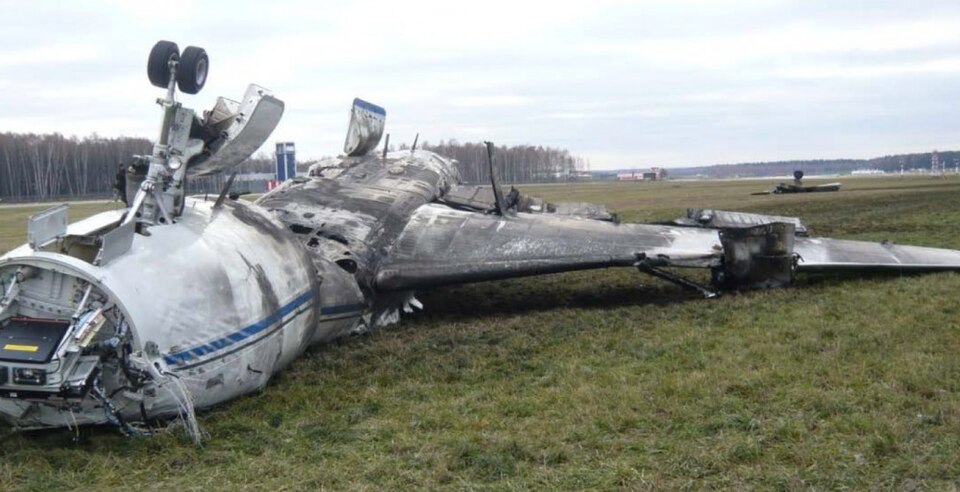

Let’s take a look at the other two major accidents in detail in the table below:
| Date (UTC/local) | Registration | Fatalities (on board) | Probable cause / summary (from investigation reports) |
| 20 Oct 2014 (23:57 MSK) — Vnukovo (Moscow), Russia. | F-GLSA (Dassault Falcon 50EX) | 4 (all occupants) | The aircraft collided during take-off with a snow-clearing vehicle that had entered the runway without clearance: investigations found the snow-plough driver had been under the influence of alcohol |
| 27 Sep 2018 (≈13:46 EDT) — Greenville Downtown Airport (GMU), South Carolina, USA. | N-114TD (Dassault Falcon 50) | 2 (both pilots); 2 passengers seriously injured | Runway overrun on landing (runway excursion) with inability to stop. NTSB found:
|
Falcon 50 Frequently Asked Questions:
1. How much does a Falcon 50 cost?
The production of Falcon 50 stopped in 2006. According to Globalair.com, Falcons of the 19080s to 1990s can cost around $1.5 – $1.8 million. Any aircraft produced in the 1990s can cost upwards of $2 million. The exact cost of a used (Falcon 50) jet depends upon a number of factors such as the Falcon 50’s model, the number of maintenance checks it has undergone, the number of pressurization cycles, etc.
2. Is the Falcon 50 a good plane?
Falcon 50 has a wonderful track record, a low number of accidents, and an affordable price- all of which make it a wonderful plane. Were it not, the military of various nations wouldn’t use it.


3. How many seats does a Falcon 50 have?
As mentioned above, a typical configuration of Falcon 50 accommodates 8 – 9 passengers.
4. How much fuel does a Falcon 50 hold?
A Falcon 50 can hold 8,763 liters of fuel.
5. How far can a Falcon 50 fly?
Falcon 50 can fly nonstop for up to 5695km. This means that the aircraft can fly transocean. It was the first plane with such capability.