When Jonathan Taylor says that we are:
.. hemmed in by nothingness,
dark matter to the left of us,
black holes to the right of us,
a quiet cemetery of starswhere nebulae grow like yew trees,
solar systems like lichen.
he might be doing what only a few science writers can do – wield prose in such an unobtrusive tone that one forgets the distinction between the metaphorical and the literal, as if the often-distinct two ways of using language have bled seamlessly into an artist’s canvass. So much so that when scientists come up with scientifically backup-able sentences, such as that black holes are strong enough to rip whole stars into atom-sized pieces, or that they might delete the universe itself, a reader might feel pedantic. It takes the sheer genius of Kip Thorne, the person behind the physics of the movie Interstellar to say:
Our universe is also endowed
with a marvelous, shadowy side that is warped —
phenomena forged
from warped spacetime.
to get back the poetics. But behind the poetics, the lure, and the symbolism of Black Holes is the threat, albiet far from imminent, that black holes might delete the universe.
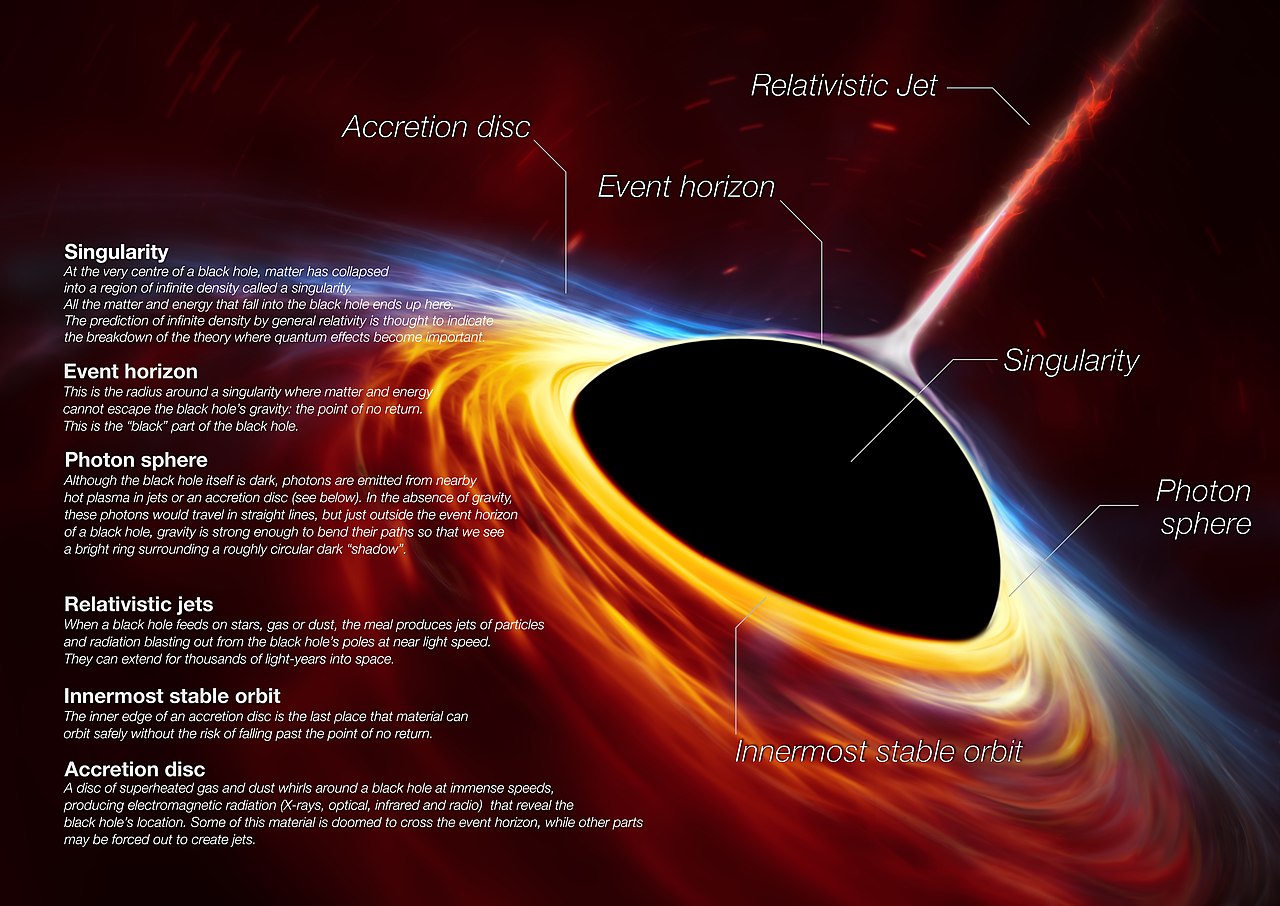
Image: European Southern Observatory – ESO | Wikimedia Commons

Black Holes: Deleting everything around it
A black hole is a concentration of an extraordinary amount of matter in a tiny space – parallels of which would be condensing all of the Earth’s matter into the size of ping pong ball or squeezing all the constituents of the Sun into the size of a small city. The fact that the gravity is almost infinitely strong at the center of a black hole has led people to say: “Black Holes are where God divided by zero“. Anything, ranging from an asteroid to a star, is either sphagettified or pancake detonated inside a black hole, and therefore these objects, which were once contested to have even existed, are perceived as spheres of blackness.
Crossing the event horizon- the border that completely separates black holes from the rest of the universe – would be akin to crossing the edge of a stream that leads into a waterfall. You could swim to safety until you’ve not touched the point of no return. But once you’ve hit the boundary of the black hole waterfall, no matter how fast you try to swim now, the stream will pull you towards certain death. The only way to access the insides of a black hole is to be willing to never return from it.
Hawking radiation gives us cues that black holes radiate their mass away, like a hot pot on a stove losing its water as steam, but in a process so unbelivebly slow that a black hole with a mass of our sun would take as much as 10,000 billion billion billion billion billion billion years to lose 0.0000001% of its mass. Perhaps the lack of vigor of the radiation renders it unobservable with the limits of current scientific technology.[ Science.org argues that this might be the reason why Hawking, who has been bestowed with the Royal Society’s Copley Medal in 2006 and the Presidential Medal of Freedom in 2009, wasn’t awarded the Nobel Prize.]
Nevertheless, when the last star in the universe has been guzzled by the voraciousness of Black Holes, when all stars have been snuffed out for trillions of years, black holes – through Hawking radiation – will become tinier and tinier until they evaporate and disappear. All that’ll be left would be radiation. But the evaporation of black holes poses a greater risk: deleting all information about the universe.
Black Holes: the destroyer of Information
The introductory quote of the novel “Fault in Our Stars” starts with the following:
As the tide washed in, the Dutch Tulip Man faced the ocean: “Conjoinder rejoinder poisoner concealer revelator. Look at it, rising up and rising down, taking everything with it.”
“What’s that?” I asked.
“Water,” the Dutchman said. “Well, and time.”
Adding to water and time – the rejoinders, poisoners, concealers – would be Black Holes, too. When they engulf different objects in their singularity, they level things up and make them the same i.e., they destroy information.
Infinite Black Hole Universes: The Black Hole Bigger Than The Universe
Information is typically understood as a property of the arrangement of particles. Take for instance, the Carbon atoms, which when arranged a certain way, gives you coal, while a different arrangement gives you diamond – the atoms stay the same, it is the information that differs. Throw in a few other atoms arranged differently (and with greater complexity), and we get plants. Change the arrangement of the atoms (make the information more complex), and we get animals. Carl Sagan said it best in “Cosmos“: “The beauty of a living thing is not the atoms that go into it, but the way those atoms are put together.” In other words, if it were not for the information, everything in the world would be practically indistinguishable. Again, to quote Carl’s Cosmos:
“The nitrogen in our DNA, the calcium in our teeth, the iron in our blood, the carbon in our apple pies were made in the interiors of collapsing stars. We are made of starstuff.”
According to the laws of quantum mechanics, information, although can change its shape, is indestructible. For instance, a wildfire might turn a whole forest ashen. While the ashes can never be turned into the forest (consumed by the conflagration), if we were able to carefully collect every single carbon atom in the ash, could pint point all the properties of the smoke and heat radiating from the fire, you could, if not practically, reconstruct the forest theretically. The information of the jungle consumed by the wildfire remains in the universe, albeit in an intelligible form.
It has therefore been said that if we “could somehow measure every single atom and particle and wave of radiation in the universe, you could see and track every bit of information there is“, we would be (hypothetically) able to see the entire history of the universe right back to the Big Bang.
But Black Holes are just the opposite: once they devour objects, the information is lost. It is therefore, one of the greatest concealors there ever was.
Violating the fundamental of the information paradox
If information is lost irretrievably and forever, we would need to scrap out all the laws of physics that we know of and start devising a new way of doing science from scratch.
However, there is also the possibility that information is not really lost (after the death of a black hole) but stays hidden. There is the possibility that a little part of the black hole splits off and forms a baby universe, which houses the information lost from us. We wouldn’t be able to access the information, nor observe or interact with it, but it would be consistent with the laws of information as we know it.

In the 1990s, Hawking and Kip Thorne had a wager with theoretical physicist John Preskill. Hawking and Kip believed that quantum mechanics would ultimately need to be amended to take Hawking radiation into account, while Preskill felt that information would somehow be preserved, and quantum mechanics as we know it in its present form, would be intact. In 1997, a theoretical physicist at the Institute for Advanced Study in Princeton, proposed an idea that would have an outcome on Hawking’s bet, reported Nature:
“Maldacena suggested that the Universe — including the black holes it contains — is a type of hologram, a higher-dimensional projection of events that occur on a flat surface. Everything that happens on the flat world can be described by pure quantum mechanics, and so preserves information.”
Hawking conceded the bet in 2004.
Storing information in the event horizon
Black Holes store information, but in a different way altogether, much like how we would turn information in books and turn them into an e-book. While the two things (the book and the e-book) look completely different, their content (which is encoded and memorized in different ways in different forms) is the same. If information that a black hole supposedly gobbles without a trace is actually stored on the boundary of a black hole, i.e., its event horizon. And understanding this way, also urges us to change the way we understand reality.
According to Paul Sutter, a cosmologist, “when we add a single bit of information to a black hole, its surface area increases by exactly one Planck unit”(one Planck Unit being approximately 10^-35 meters, and is the smallest possible measurable distance).
The information of every 3-D object (planets, asteroids, comets, stars) that falls into a black hole is stored on its event horizon, meaning that three-dimensional stuff is encoded on a flat surface. In other words, it works like a hologram – a flat piece of plastic that encodes a three-dimensional image. It has also been said that several versions of its information might be stored like a hologram— some inside the event horizon, some outside it.
Dr. Jeff Forshaw, from the University of Manchester, explains how the whole system might work:
“Imagine everything that falls into a black hole. You could describe it with a long binary sequence of ones and zeros, or bits. And if you’ve got an algorithm that decodes that, it’ll tell you what fell in. The information is the smallest binary string of bits that is sufficient to completely tell you about the thing that fell in, whether it’s a book or a bunch of quantum bits or, you know, a star collapsing,”
Holographic principle: In a nutshell
Theoretical physicist Leonard Susskind first suggested the holographic principle in the 1990s. When Susskind showed that a number of laws of physics can be described mathematically using two dimensions (instead of the three we experience), it led to physicists wondering if the Holographic Principle could be applied to objects that dwarfed the size of a black hole, perhaps the observable universe itself:
” Some believe that, just like black holes, our universe also has an event horizon, a region beyond which information exists but we cannot access it. This would happen because the universe is constantly expanding, and there is a region where the expansion is faster than the speed of light, which means that no information coming from there will ever reach us, and we will never be able to observe what happens beyond that point. Just like with black holes!”
If such a proposition were to be reified, it would mean that what we see and experience in the observable universe is “a hologram projected from information located on the surface of this ever-expanding boundary“.

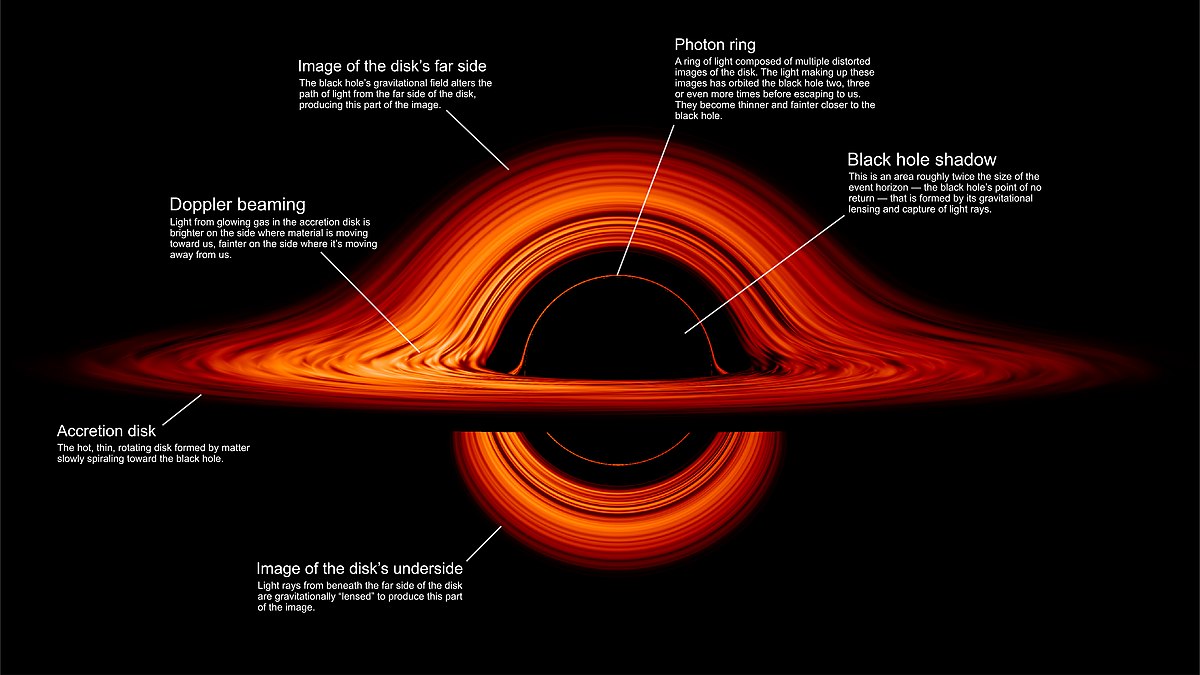
After the first-ever image of a Black Hole was released in 2019, a remastered image of the black hole was published. This new image helped us understand how photons behave under the black hole’s gravitational influence to generate a photon ring. After analyzing the symmetry observed in the photon ring, some scientists have theorized that the photon ring was central to the holographic principle (and not the event horizon). So when Jonathan Taylor said:
Telescopes decipher inscriptions
carved black on black:
like Ebeneezer gazing at his future
we find our own names there.
we might be tempted to ask him, were our names (and perhaps we) are holographic too?