Every part of the observable universe has a distinct “time” and “space”. But space isn’t a fixed stage and time ticks differently in every part of space. The relativeness of these two building blocks of the universe can be captured in John Wheeler’s dictum “Spacetime tells matter how to move; matter tells spacetime how to curve.” Stars, planets, and other astronomical objects sag spacetime. All the warps warps and dips gravity. But something extraordinarily different happens when Black holes take center stage: They do not just bend the stage of spacetime, they act like trap doors. Black holes form veritable ‘no-go’ zones where the laws of space and time as we know them change. So what happens when you fall into the abyss that is a Black hole?
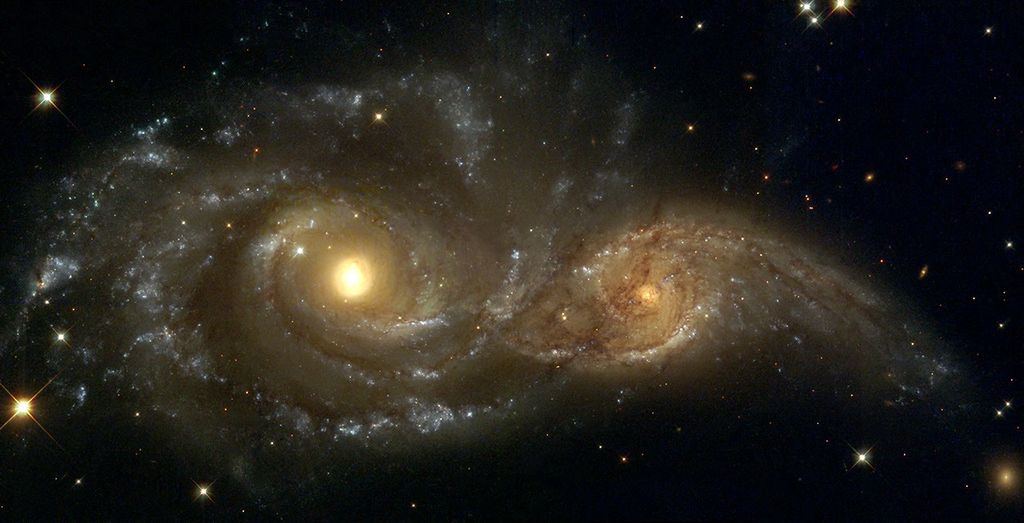
To learn about what happens when you fall into a black hole, you must know some basics of what a black hole is
Most black holes form when in the final throes of massive stars, their insides implode at nearly a quarter of the speed of light. The violent death of such stars ultimately crams so much mass in such a tiny region of space that it leads to the creation of dense enough to the known laws of the universe. To imagine the density of a black hole, one should envisage ten times the mass of the sun packed within the radius of a small city, reported astronomy.com:
“Using the Schwarzschild radius calculation, a black hole the size of Earth would have a radius of less than one inch, making it about as big as a ping pong ball. The Sun, on the other hand, would have a radius of just under two miles.”
Image: NASA
If you look directly at a black hole it looks like… nothing. The space under their control is blocked by an invisible, one-way border called the event horizon. The event horizon shields what happens inside a black hole from the rest of the universe. Inside this one-way border that is the Event Horizon is space deformed to such a staggering scale that not even light can escape it. With nothing escaping to transfer information from inside the BH, we can only infer how these strange objects behave after analyzing their effect on matter. The photograph above is a testament to this fact.
Here are a few things to keep in mind if we are to know more about what happens if you fall into a black hole, as reported by kurzgesagt:
-
Things can orbit black holes just as they can orbit the sun or a planet.
-
Many black holes have discs of matter orbiting outside the event horizon.
-
This matter can become incredibly hot as close orbits can speed this matter up to half the speed of light, and tiny amounts of friction and collisions between particles heat them to a billion degrees, making the space around these black holes, ironically, incredibly bright.
You’d freeze in time and be sphagettified if you fell into a Black Hole
Gravity is so strong near Black Holes that not only matter but even light is forced to orbit around it. If you hovered periliously close outside the event horizon (at the photon sphere) and tried to have a sneak peak, you’d see yourself! And that too, in all directions. You’d be aghast to see the back of your own head in front of you. This is because light from your back would travel around the black hole to your eyes.
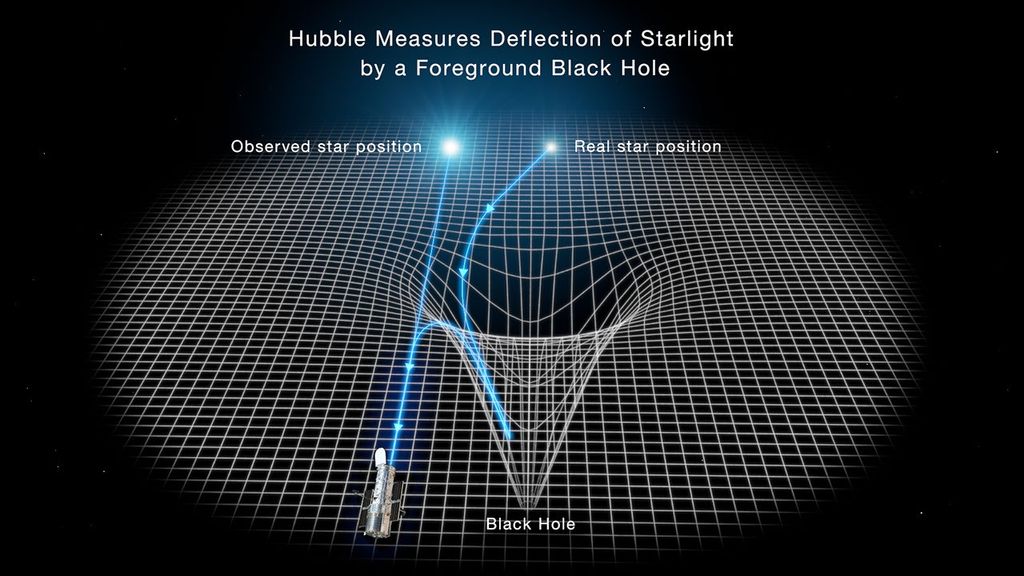
Image: NASA
As you fall, you’re frozen in time for the rest of the universe
The stronger the gravity, the slower time passes. Any observer watching you from a distance will watch you approach the black hole in slow motion. And as you hit the event horizon, you’ll have frozen in time, taking almost infinite time to fall into the black hole. If you chose to fly away from the black hole, however, you might find that eons have passed for the rest of the universe. [This has been exemplified in the movie Interstellar.] In other words, a Black Hole allows the possibility of a one-way time-travel trip to the future where the people around you (and perhaps some of their descendants too) have perished.
Sphagettification
A painful death by ‘spaghettification’ awaits anyone who has the extraordinary fortune of falling into the Event Horizon of a Black Hole. [Even the closest Black Hole to the Earth- Gaia BH1 – is approximately 1,560 light-years away]. “Sphagettification” was a term that was coined by Stephen Hawking [in his book “A Brief History of Time.” used the phrase “stretched like spaghetti,” hence the name], and has been defined by Royal Museums Greenwich in the following way:
“spaghettification is the tidal effect caused by strong gravitational fields. When falling towards a black hole, for example, an object is stretched in the direction of the black hole (and compressed perpendicular to it as it falls). In effect, the object can be distorted into a long, thin version of its undistorted shape, as though being stretched like spaghetti.”
If we are to take the words of physicists like Michio Kaku, “spaghettification becomes so severe that even the atoms of your body get pulled apart and eventually disintegrate“. But getting sphagettified isn’t the only way to look at the demise from falling into a Black Hole. According to NASA, “Astronomers have also theorized stars could look like they were squeezed like a tube of toothpaste when they’re stretched by the gravity of black holes“. You need not worry about the threat of sphagettification if you fall into a really large black hole, though.
Pancake detonation in extremely large black holes
If you go to the center of a galaxy and find a supermassive black hole (Such as Sagittarius A (Sgr A)**, located at the center of our Milky Way galaxy and 26,000 light-years away), you might be able cross the event horizon. And what’s more, you won’t be sphagettified either. Instead you’d be “pancake detonated”.
Just as gravity close to a black hole can stretch things out like turning an object into a noddle, it can also flatten objects into the shape of a pancake. This phenomenon known as “pancake detonation” occurs primarily in supermassive black holes. AS NASA puts it “stars that get too close to these black holes will be flattened and compressed by tidal forces. This short-lived “pancake” distortion is followed by an explosive release of thermonuclear energy“.
While the distant observer would see you freeze in motion and fade as you approach the Black Hole, your perspective would be rather different. You’d find the void of the black hole rise up as a dearth of light envelopes you. You’re inexorably headed to the center of the black hole: it is almost as if no other direction ever existed. The faster you try to curl up in some any other direction, the quicker you’re greeted to the center of the BH. If you’re looking to maximize the time you all, all you need to do is “nothing”.
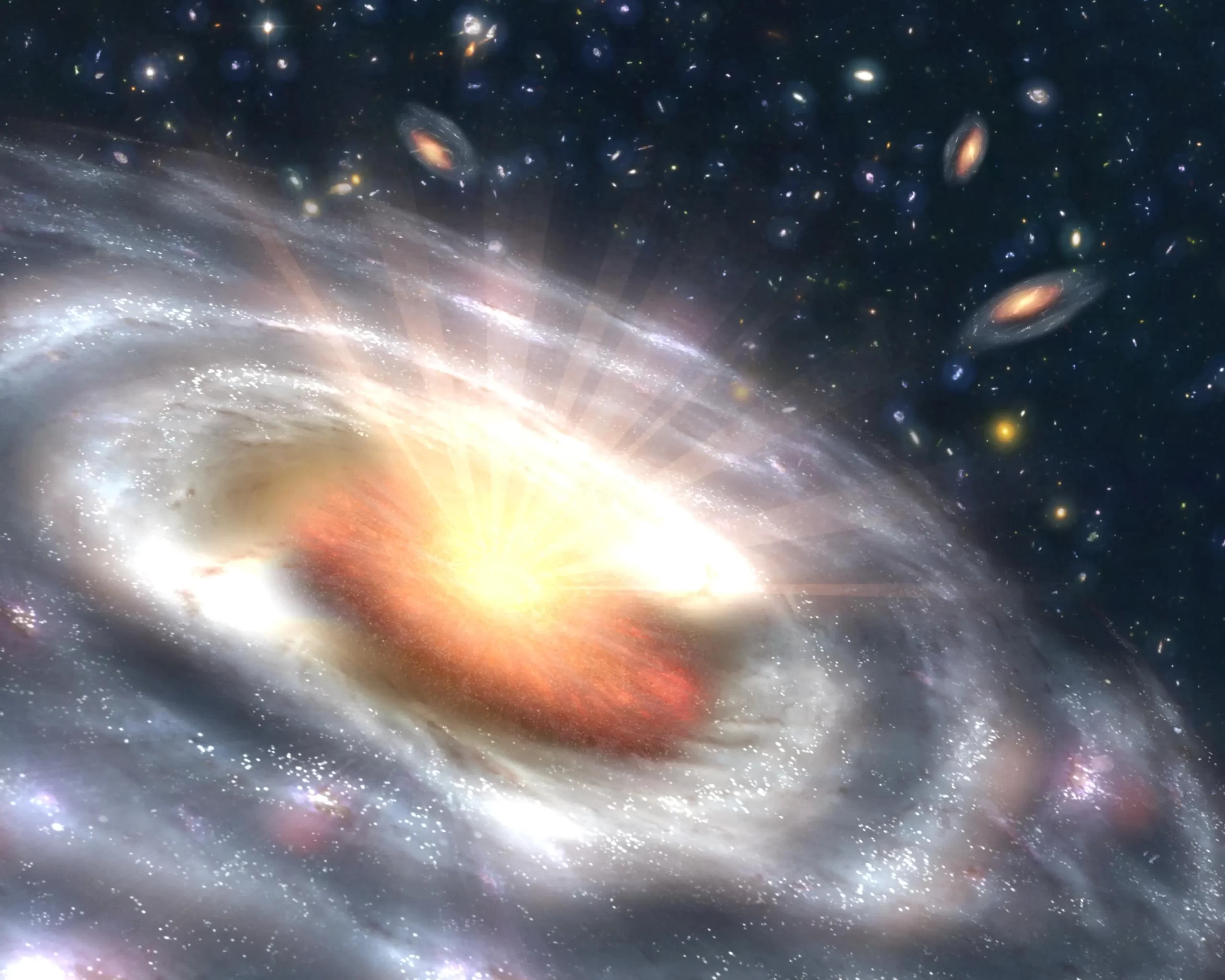
Image:NASA
Eventually to the singularity – the great leveler
It is the law of the Balck Hole that everything that comes too close to it should transform into black hole matter, concentrated at the singularity. While it might be the case that Alice Oswald’s remark about the “democratic dew gives equal weight to everything” is true, one can’t ignore the democratic way in which singularity makes everything equal.
The singularity is where Einstein’s equations don’t work. One has to note that the singularity “may be either a physical structure or a purely mathematical one, but right now astronomers don’t know which is true. ”
Here are a few quick notes on singularities, though:
- The curvature of space becomes infinite and so does the density
- It has no surface or size, something like a divide-by-zero error in the universe.
- Singularities might not even exist or be completely different things.
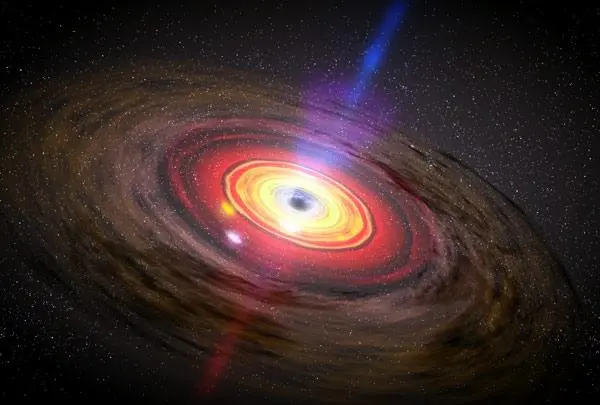
Image: NASA
Black Holes resemble fundamental particles in some ways: they only possess three properties viz. mass, spin, and electric charge. Every black hole might have a different mass and different spin rate, but if we were to “put the singularities into a magical physics museum, they would be identical, like electrons“. As black holes are remnants of dying stars that were spinning extremely quickly in their last moments, all black holes in the universe should be spinning right now- some even spin at a speed that is 90% the speed of light.
This implies that singularities of rotating black holes would make them “ringularities” i.e., a black hole that is swell outwards. This rotation causes space to drag as well. This creates a region called the “Ergosphere”- a rushing whirlpool of spacetime around spinning black holes.
But worry not, you will be recycled out of a black hole if you fall into it
According to the equations of quantum field theory, the vacuum of space is a bubble of quantum fluctuations, which create matter and antimatter pairs of particles from nothing. Laurence Krauss’ excellent book “A Universe from Nothing” explores this whole concept as he remarks in his book: “nothing is unstable“. However, these particle pairs only exist for an infinitesimal amount of time before annihilating. When such a particle-antiparticle pair is formed just outside the event horizon of a black hole, one of these particles can fall in, stopping the normal annihilation that would follow. The other, escaping particle would be Hawking radiation.
Over eons, black holes will shrink and radiate away. Practically, Hawking radiation is not stuff that fell into the black hole but new stuff, stealing mass from it. But how long will it take for the Black Hole to evaporate through Hawking radiation? University of Colorado Boulders posits the following scenario:
” For astronomical black holes, the evaporation time is prodigiously long — about times the age of the Universe for a solar mass black hole. However, the evaporation time is shorter for smaller black holes (evaporation time is proportional to ), and black holes with masses less than about (the mass of a small mountain) can evaporate in less than the age of the Universe. The Hawking temperature of such mini black holes is high: a black hole has a temperature of about , equivalent to the rest mass energy of a proton. The gravitational pull of such a mini black hole would be about gee at a distance of metre.”
Conclusion
For a black hole with mass equivalent to that of a sun, it would take 10,000 billion, billion, billion, billion, billion, billion years to lose 0.0000001% of its mass. So just in the chance that you fell into a black hole, remember it would take almost forever for your shapgettified, singularized, pankcake detonated body be turned back to the outside universe in the form of Hawking radiation.