The night sky seems like a canvas that is dotted brilliantly, and rather densely with stars. This prompted James Ulysses to come up with one of the most unforgettable line “The heaventree of stars hung with humid nightblue fruit“. If one zooms out of the vantage point of the Earth, and has a cosmic vision of the world, we’d see that vast stretches of the universe are devoid of stars or galaxies. Perhaps the heaventree of humid nightblueness hangs with starry fruits. This is despite recent estimates showing the number of galaxies in the observable universe to be around 20 trillion. The trillion mark also necessitates an update in Carl Sagan’s phrase “billions and billions” (while referring to the number of starts) in his wonderful “Cosmos”.
Despite this staggering number (of galaxies), galaxies only house a small fraction (15%) of all atoms in the universe. The rest of the atoms drift in the “humid night blue fruits” that is the intergalactic medium. Intergalactic space is the closest mirror we have to an absolute vacuum – it has a density of merely one hydrogen atom per cubic meter. Nonetheless, this is 10 to 100 times denser than the average density of the Universe. Gases emitted from galaxies funnel fresh material into the intergalactic medium, where we can find the first two elements of the universe: hydrogen and helium.
It is these two elements that flow into galaxies and form the primary building blocks of new stars. But much more powerful than the objects we have discussed so far are Quasars, which are, for comparison purposes, as small as a grain of sand in comparison to the Amazon river that is a galaxy. Quasars are even powerful enough to kill a galaxy and shine with the power of a trillion stars. Let’s dive deeper into quasars, which quite possibly hold galaxies by the scruff of the neck.
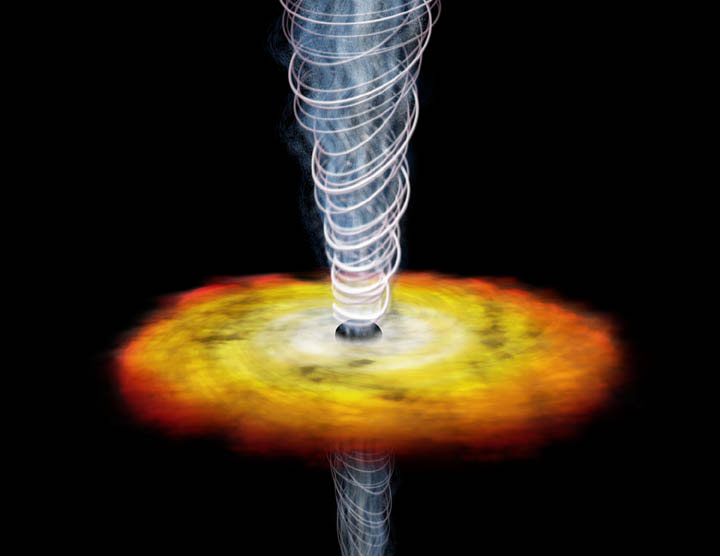
Image:NASA | Wikimedia Commons
Loud, Mysterious Radio waves discovered in the 1950s
In the 1950s, astronomers discovered mysterious loud radio-waves having properties such as:
- Traveled at one-third the speed of light
- Emitted high-energy X-rays
- They flickered but were tiny, dot-like, like stars
This prompted scientists to call these newly discovered objects “quasi-stellar radio sources,” or “quasars”. Their incredible speed also prompted scientists to infer that the expansion of the universe was moving them away from the Earth. However, none of these were discovered in close proximities like any other star.
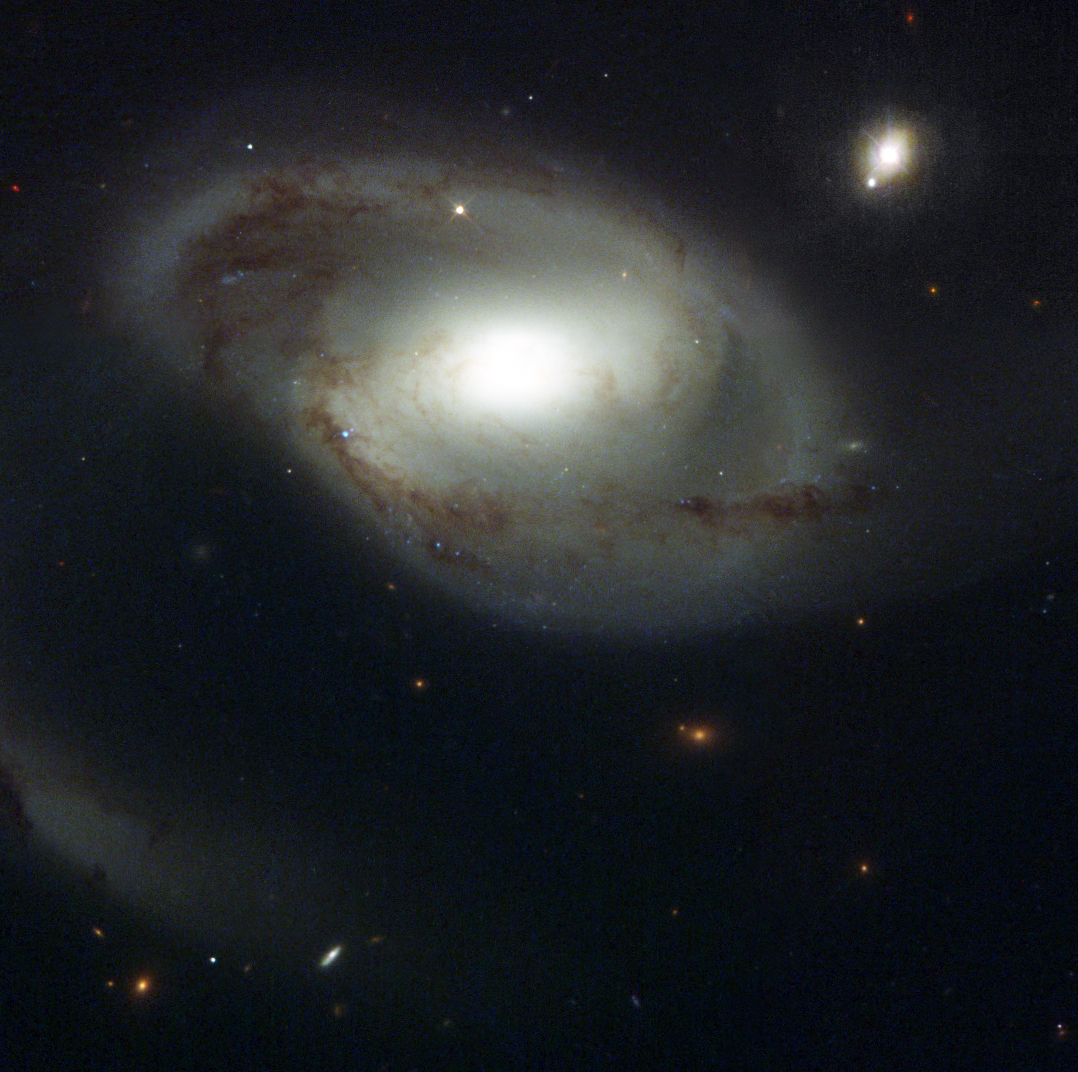
Image: Wikimedia Commons
It was later discovered that quasars were, in fact, active cores of galaxies billions of light-years away! And for objects so far away to have shone so brilliantly, they had to be a thousandfold brighter than a galaxy like the Milky Way. We must also not lose sight of the fact that if quasars are so far distant, they are also pointing towards the past of the universe. Scientific consensus has it that the number of quasars in the universe peaked almost 10 billion years ago – a time when the Solar System was at the first flush of its formation.
The Incredible Power of Quasars comes from Black Holes
Galaxies have only gotten brighter with time- after all, the merger of galaxies (such as the inevitable one between Milky Way and Andromeda in the future) leads to galaxies brightening up. It would have been impossible for a star to be as bright as a quasar -one of the reasons why these mysterious objects were called “quasi-stellar“.
There’s only one mechanism that generates such extraordinary radiation associated with a quasar is the feeding of supermassive black holes. While a lot of light hasn’t been shed on how SMBHs are formed, every galaxy’s center houses one. But how can the idea of a black hole (whose eventual, abysmal snare no object can escape) that is light-less, and that of a quasar (which shines a thousand times brighter than a galaxy) be juxtaposed?

Image:Wikimedia Commons
It is not a black hole that powers a quasar
On its own, black hole is like one of those poems of Azita Arkandani:
The darkness drifted.
The darkness knew no time.
Reaching for infinity, only knowing beyond.
Infinite Black Hole Universes: The Black Hole Bigger Than The Universe
The singularity a black hole houses is a conundrum that needs to be fixed, and what lies inside a black hole is forever shielded fromus. We’ve not even detected Hawking radiation that might emanate from a Balck Hole’s decay. So a black hole can’t provide the luminosity associated with a quasar, but the violent forces acting upon particles about to enter a black hole do, reports NASA:
“Quasars occur when immense amounts of matter fall into a supermassive black hole, spiraling around it in the form of a disk before entering. This “accretion disk” is subjected to extreme gravitational and frictional forces, causing the gas and dust to heat up to millions of degrees and become luminous, blasting out dazzling jets of material into the universe. Together, the jets and glowing disk outshine their host galaxies.”
As surrounding materials (such as stars, planets, and other astronomical bodies) head toward a black hole, angular momentum spirals it into the shape of a disc (called an accretion disk). Gravitational and frictional forces at work in accretion disc cause matter to speed up almost to the speed of light and produce the brightest objects we see in the universe. As some scientists put it, “quasars are extremely hot “storms” caused by a supermassive black hole that is actively devouring matter at the center of a galaxy, i.e. an “active galactic nucleus” (AGN)” – the core of the galaxy releasing energy greater than all its stars combined.
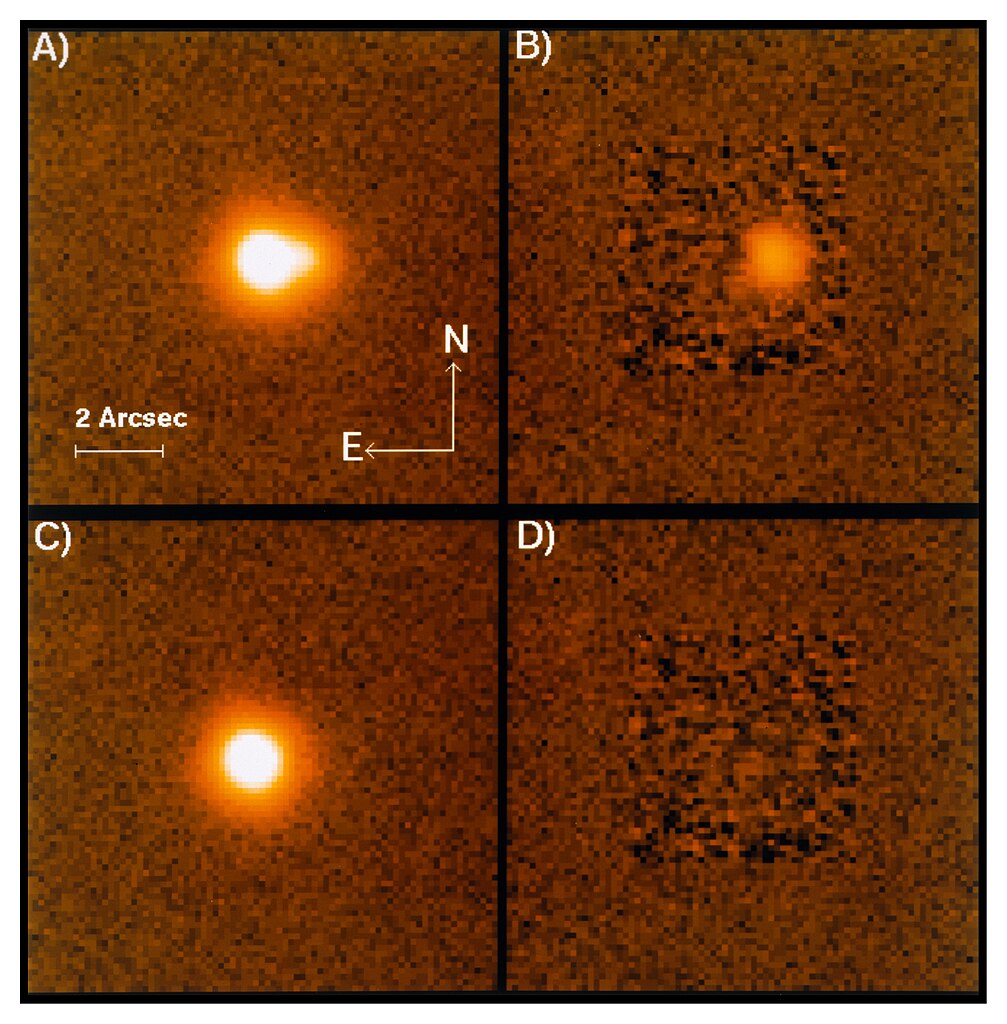
Image: Wikimedia Commons
Quasars’ hunger only grows with the eating
Quasars are guzzlers: they gobble 10^26 kilograms of gas per minute! At the zenith of the formation of quasars (i.e., ten billion years ago), the intergalactic medium was much less dispersed (the universe was much smaller back then), providing quasars with much greater material to devour. The brightest quasars act as launching pads of beams of matter, forming “plumes of matter that grow to hundreds of thousands of light-years in size. It’s almost unfathomable in scale — a tiny spot in a galaxy carving out patches of the universe hundreds of thousands of light-years long“.
A quasar would ultimately self-destruct. After all, as the supermassive black hole devours more of the objects around it, the galaxy that houses it would itself be wiped out.
How Quasars Kill Galaxies
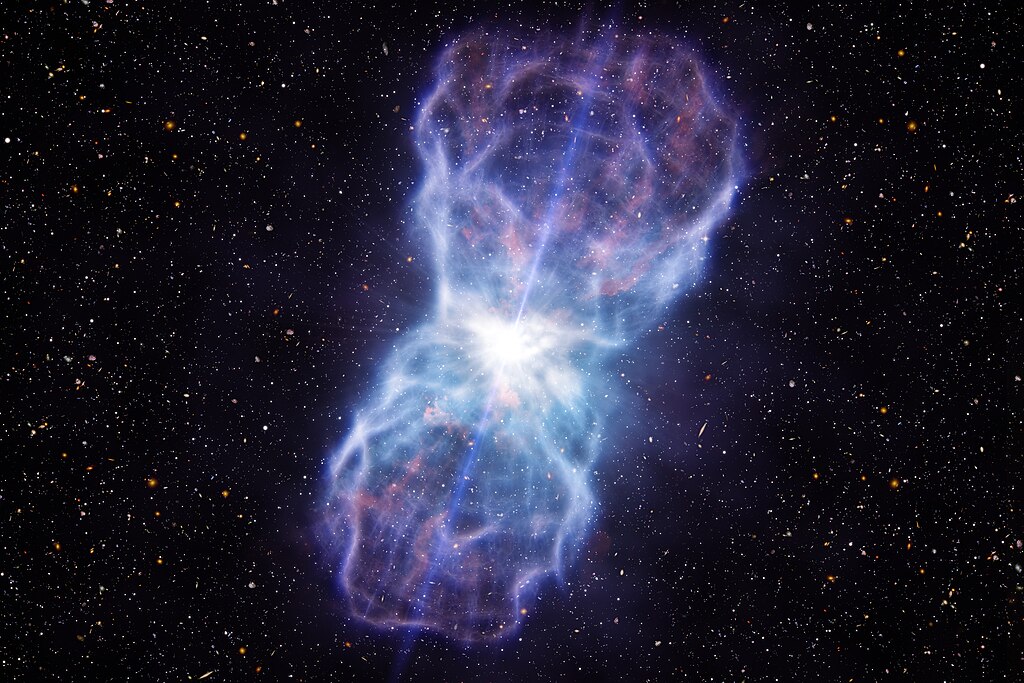
Image: Wikimedia Commons
Shards of what used to be a galaxy would still be there after a quasar loses all of its vigor. Quasars would also drive away all the materials to form a star out of the galaxy. Whatever gases are left (which can act as raw materials for star formation) are so energetic (thanks to the heat of the quasar) that they would resist any gravitational force needed to clump together to form stars. Is this the fate, the death by a quasar, something that Milky Way will have too?
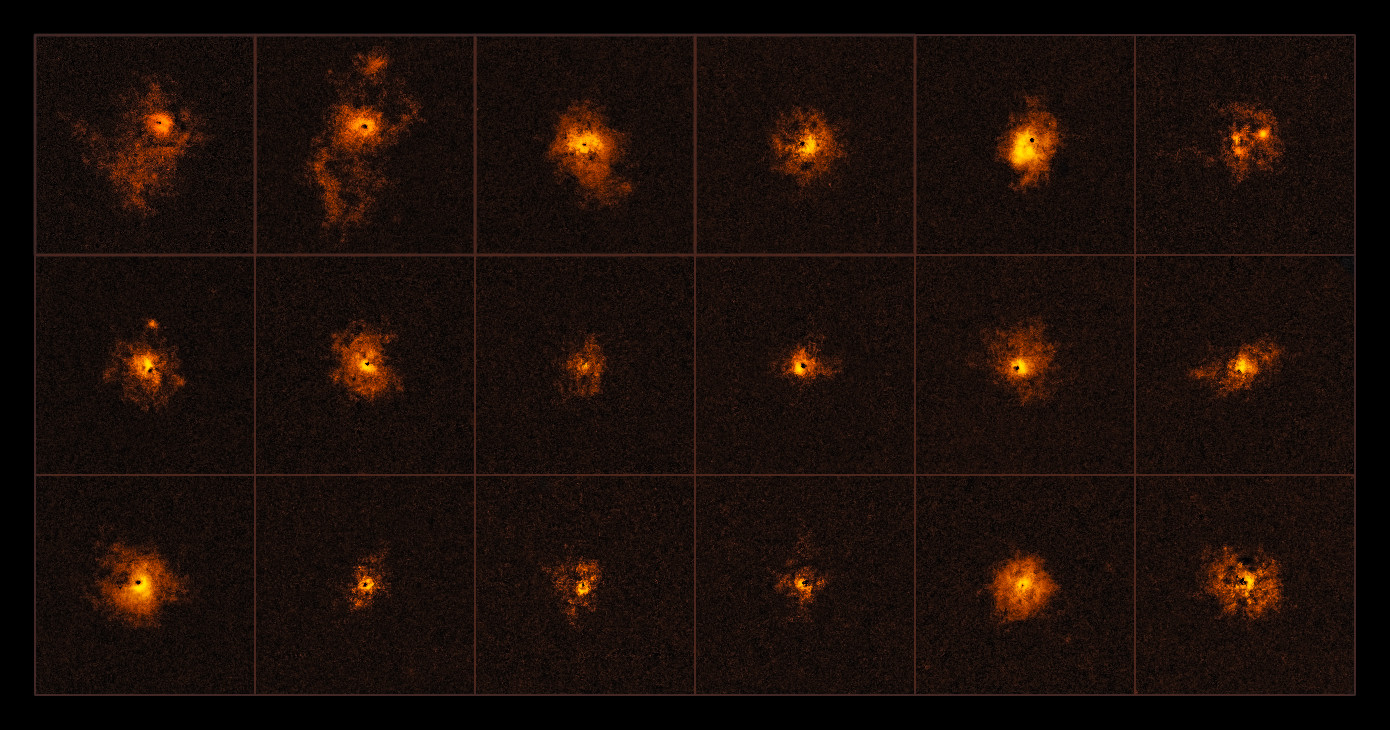
Image:Wikimedia Commons
Whether Sagitarrius A, the supermassive black hole at the center of the Milky Way, was a quasar (or whether it will turn into one) is something we don’t quite know. Some posit the possibility of Milky Way having been a quasar once (allowing Sagittarius A* to have grown to 4 million times the Sun’s mass). There’s also the possibility that after the merger of Andromeda and Milky Way (which will cause their SMBHs to merge too), we’ll have a quasar in the future. Only time will tell.

Image: Wikimedia Commons