Nepal Airlines Corporation, formerly known as Royal Nepal Airlines Corporation, was set up in July 1958 with a Douglas DC-3 Dakota aircraft as the flag carrier of Nepal. In 2006, the airline dropped “Royal” from its name following Nepal’s transition from a monarchy to a republic. Each of those transitions left its imprint on the aircraft’s exterior, making the airline’s livery history a compressed visual record of Nepal’s own transformation.
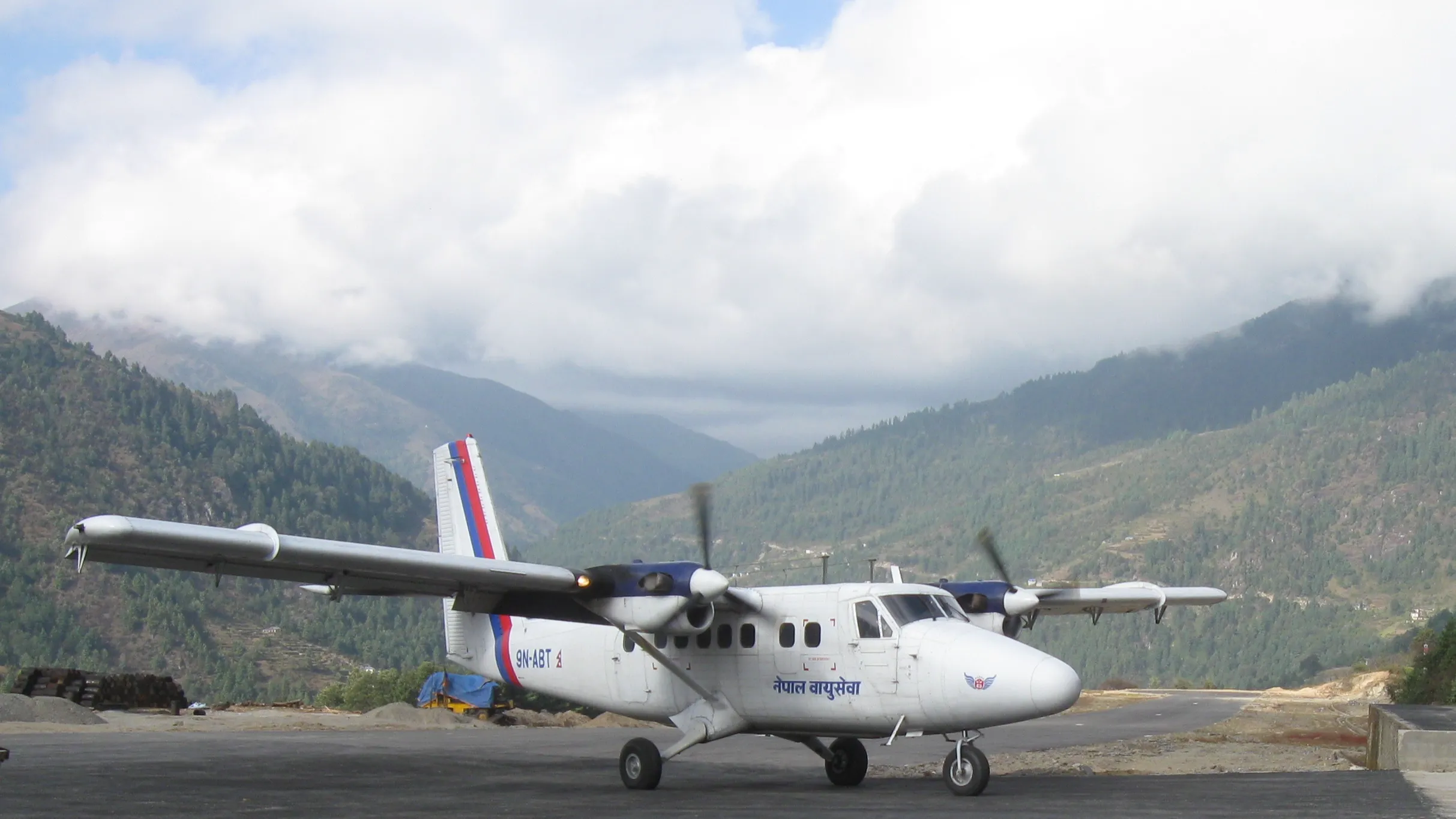
Royal Nepal Airlines and Its Early Markings
Nepal Airlines (RA) had humble beginnings, starting on July 1, 1958, as the Royal Nepal Airlines Corporation; on July 3, 1958, staffed by 97 employees, the new airline began flying a single Douglas DC-3 Dakota aircraft, with the first towns connected being Simara, Biratnagar, Pokhara, and Bhairahawa.
The 28-seater Dakota, NAC’s very first aircraft, became an icon of Nepal’s aviation history; in many parts of the Kingdom, people’s initial encounter with the modern world was the DC-3, long before cars arrived, and the last of these planes flew into the sunset in 1973.
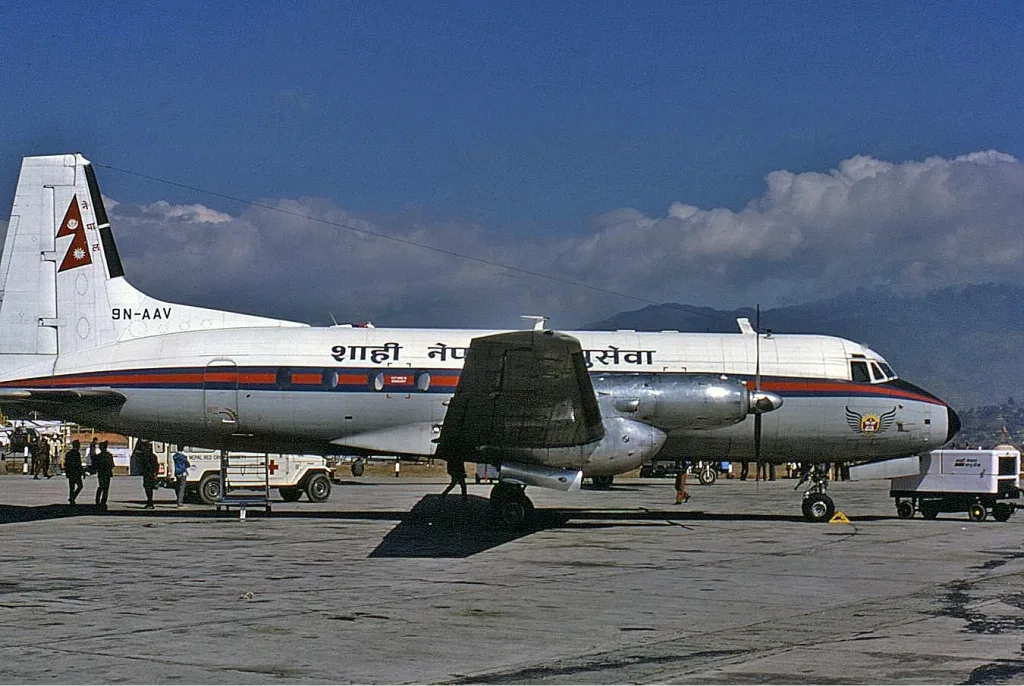
Nepal’s geopolitical situation produced a strange, politically mixed fleet, typically financed through aid programmes from the country of manufacture; seven more DC-3s were added to the fleet between 1959 and 1964, while China supplied a couple of AN-2 Fong Shee aircraft which did not enter scheduled service. In those formative years, the airline’s markings bore the visual grammar of royal patronage — the Akash Bhairav symbol, a Hindu deity regarded as the protector of the sky, was prominently featured alongside the national colours of red and blue that derived from Nepal’s unique non-rectangular flag.
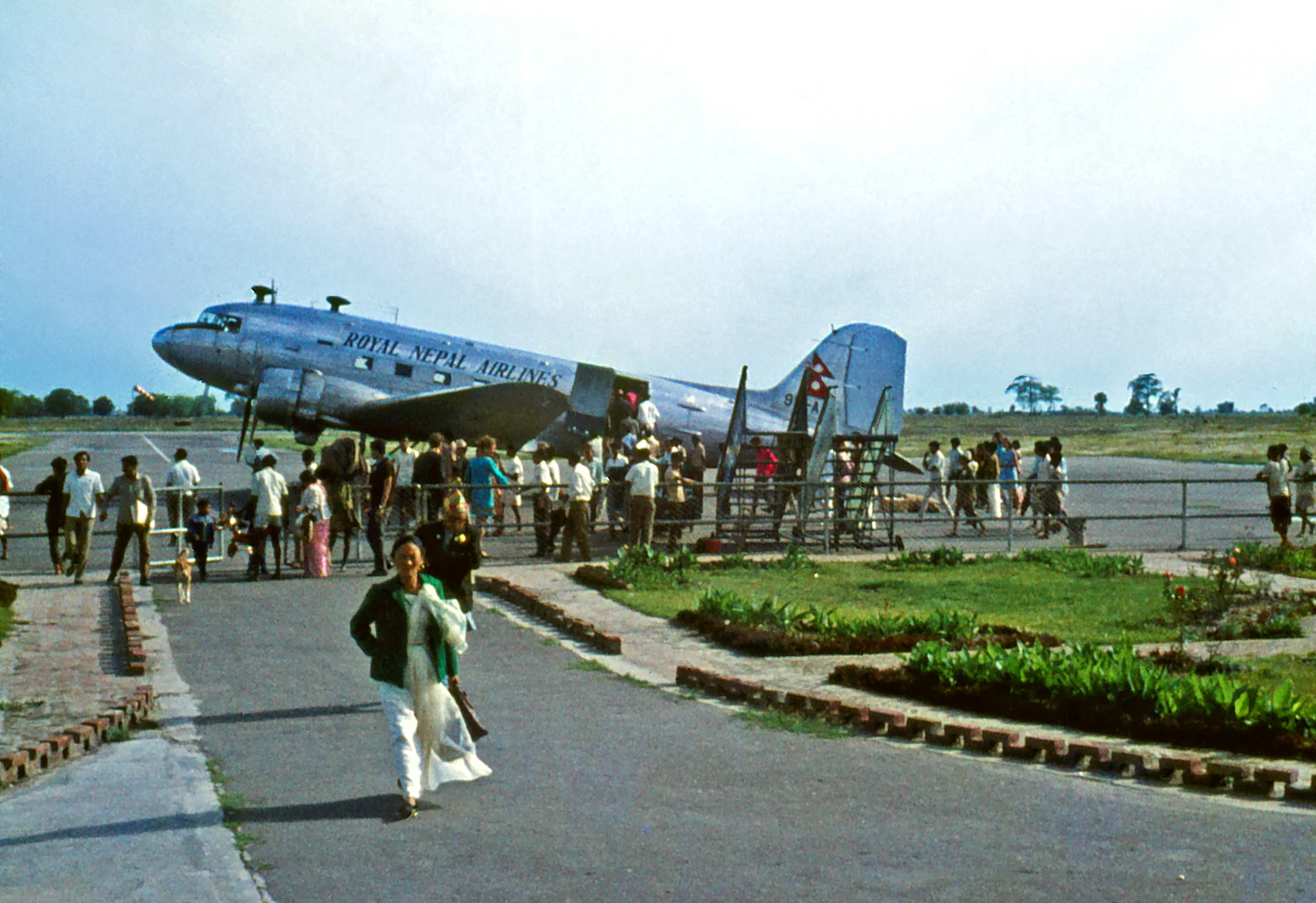
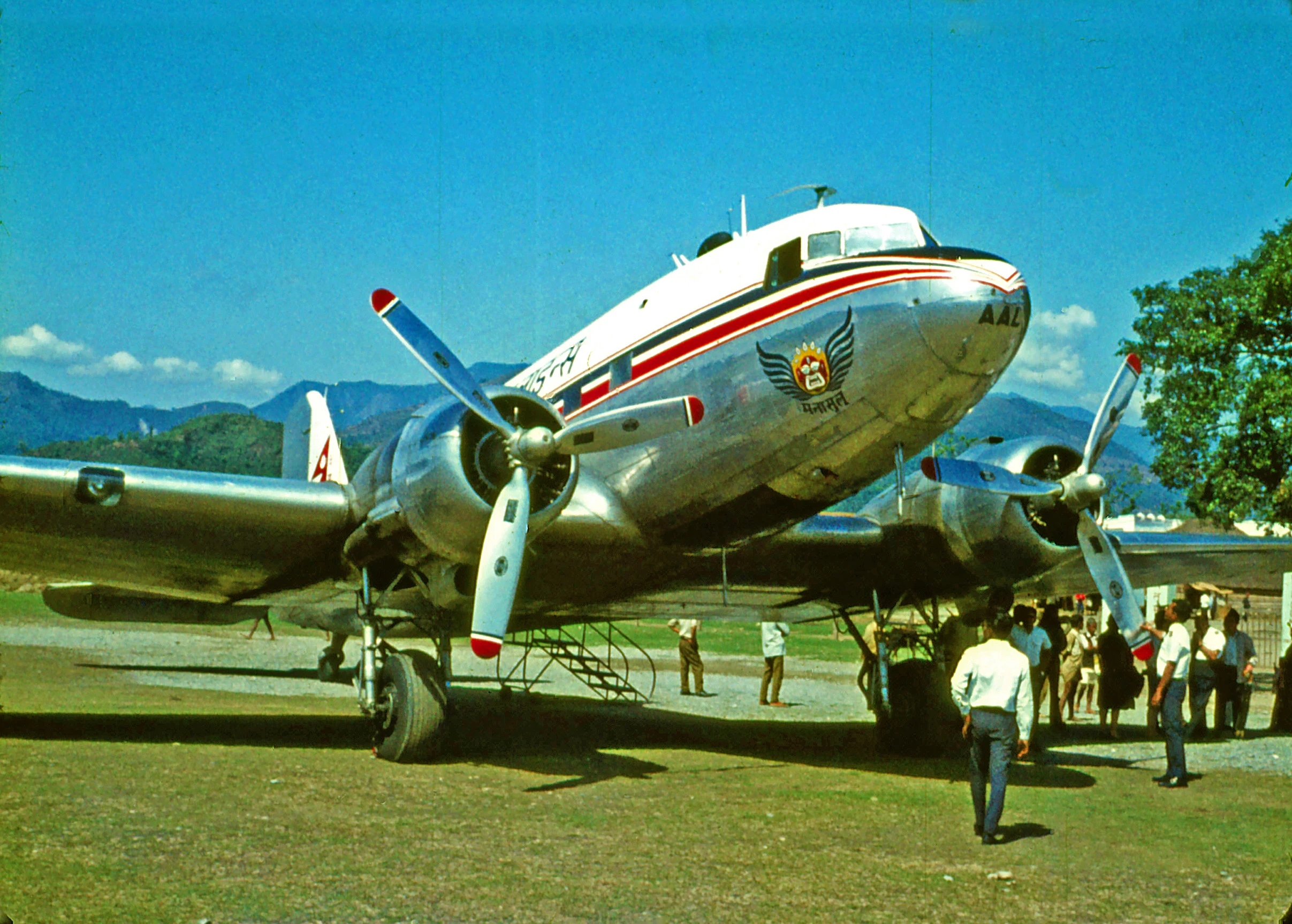
If you look at the photos of Nepal Airlines’ DC-3s below, you can see that in some aircraft, such as the one registered 9N-AAC, the upper portion of the fuselage was painted predominantly white with red and blue hues marking the distinction with the lower section of the fuselage that was not colored and had its metallic shine. In others, you can see that the aircraft doesn’t have any paint, barring the name of the airline just above the window. Irrespective of this, in both the design types, you can see the distinct triangular flag of Nepal in the empennage.
In 1966, a turboprop Fokker F27 was added to the airline’s fleet; in 1970, RNAC acquired its first Hawker Siddeley HS-748 (which maintained the same hues as the one in DC-3), followed by Twin Otters in 1971 and Boeing 727s in 1972.
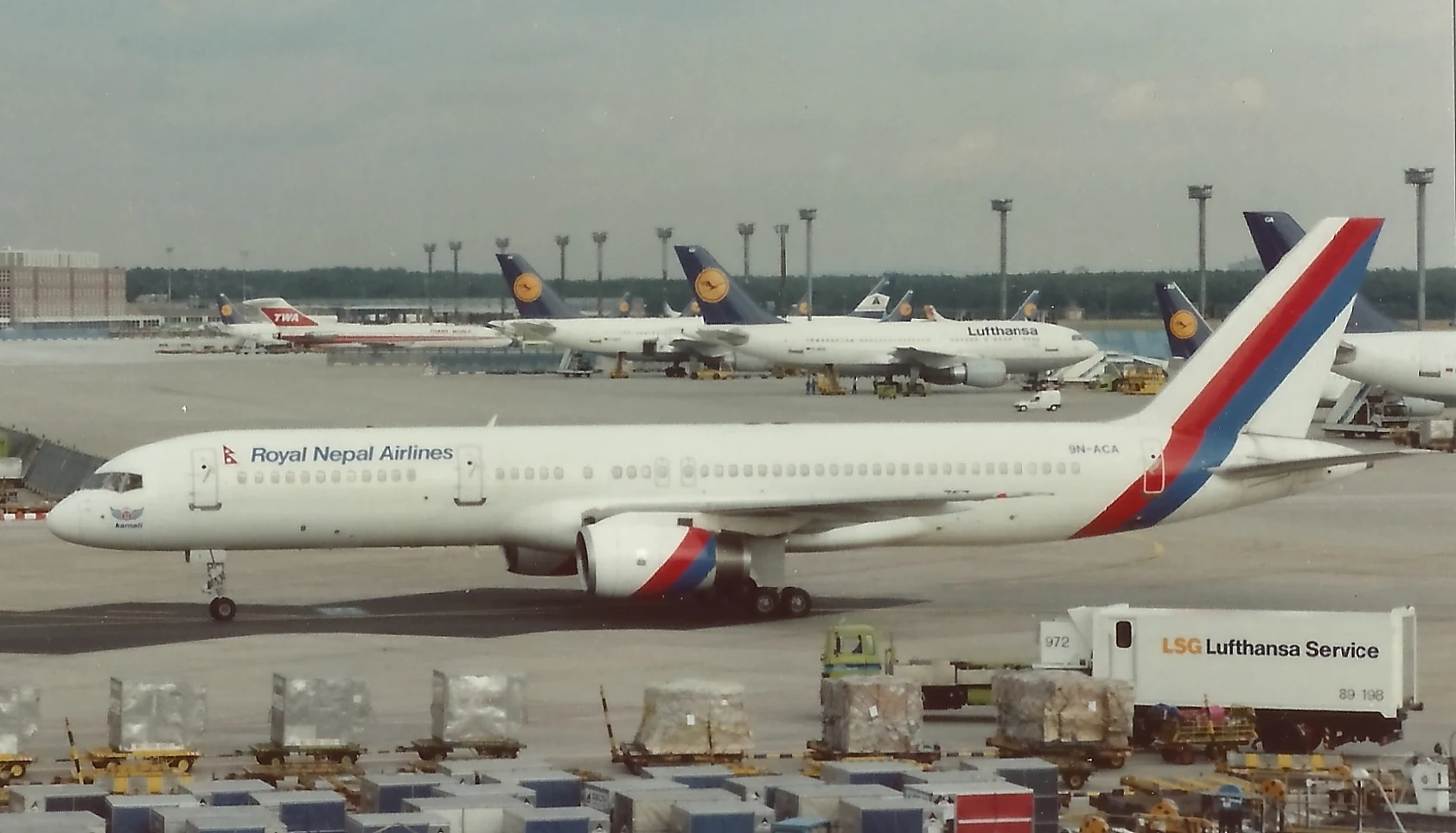
The 1987 Livery had Red and Blue Stripes
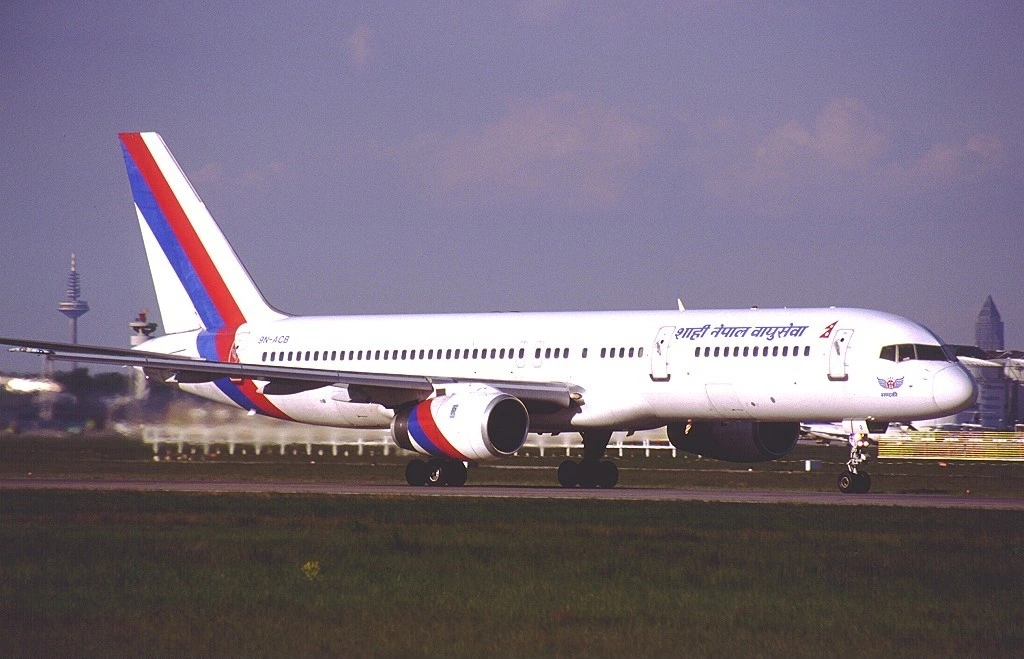
The livery that would define Nepal Airlines for the better part of three decades was introduced in 1987, coinciding with the delivery of the Boeing 757 fleet. The 1987 livery featured red and blue stripes on the aircraft’s tail and the name “Nepal Airlines” in blue; it also portrayed Nepal’s nationality, religion, and national colours, with the symbol of Akash Bhairav — a Hindu deity regarded as protector of the sky — retained as a central design element. The red and bue hues could be seen across the engines of the aircraft as well.
Akash Bhairav, often depicted in Buddhist iconography as a large blue head with a fierce face, huge silver eyes, and a crown of skulls and serpents, was the presiding deity of Kathmandu’s aviation identity; the deity head is said to reside on a silver throne carried by lions, accompanied by Bhimsen and Bhadrakali on either side. The retention of this figure on the aircraft was not merely ornamental — it served as a spiritual guarantor of safe passage, embedding religious meaning directly into the airline’s corporate identity.
At Nepal Airlines’ peak in the late 1980s, the carrier earned $54.3 million in foreign currency, becoming Nepal’s largest source of foreign currency. The Boeing 757 jets that carried that 1987 livery also flew to destinations as far as Frankfurt, Hong Kong, and London, making the scheme the most internationally visible iteration of Nepal Airlines’ branding up to that point. The livery remained largely unchanged for over 25 years, even as the airline’s name changed in 2006.
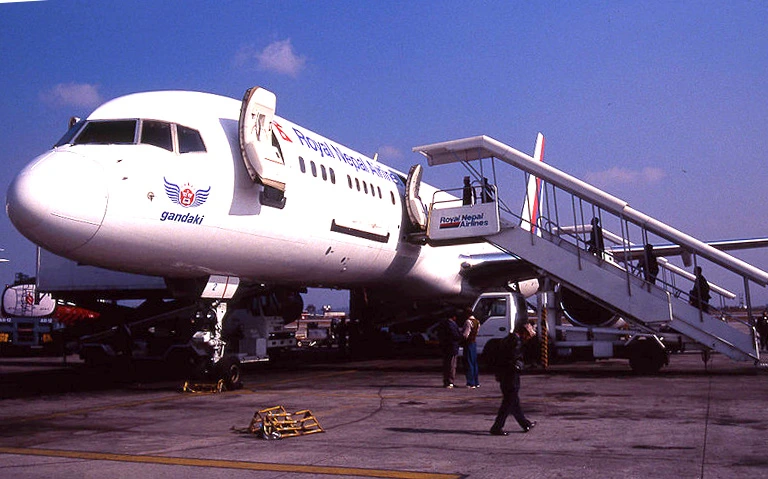
One distinction the livery had from the one in the DC-3 was the absence of the Nepalese flag in the tail. Nepal Airlines painted the fuselage fully white barring the name of the airline painted in blue colors just above the windows. Above the windows on the either side of the plane, the flag was painted adjacent to the name (in Romanized Script on one side and Devanagari script on the other). Aakash Bhairav was painted beneath the cockpit window.
“Royal” was Dropped from Nepal Airlines’ Name in 2006
In 2006, the airline dropped “Royal” from its name following Nepal’s transition from a monarchy to a republic. Nepal Airlines was formed on July 1, 1958, and started operations on July 3, 1958 as RNAC (Royal Nepal Airlines); the carrier was renamed to its current name in 2006. The renaming was politically mandated after the Nepali parliament curtailed the powers of the monarchy, and the word “Royal” could no longer figure in a national institution’s branding.
The name of the airline was changed from Royal Nepal Airlines to Nepal Airlines in 2006 after the king’s powers were curtailed by the parliament. While the name changed, the core visual identity — the red and blue stripes, the Akash Bhairav motif, the basic colour palette drawn from Nepal’s national flag — remained intact for several more years. The 2006 transition thus represented a textual rather than graphic rebrand, with only the wordmark updated on existing aircraft.
A National Competition and A New Design Language in 2013 and 2014
The most substantive visual overhaul in Nepal Airlines’ history was initiated in 2013, when Nepal Airlines Corporation invited designers from across the country to submit proposals for a new livery. A total of 62 designs were submitted by 31 artists, among which the design of Bishwas Pokharel was selected by a five-member expert team comprising Lalit Bikram Shah, Madan Chitrakar, Swasti Rajbhandari, Nabin Joshi, and Ganesh Bahadur Chand.
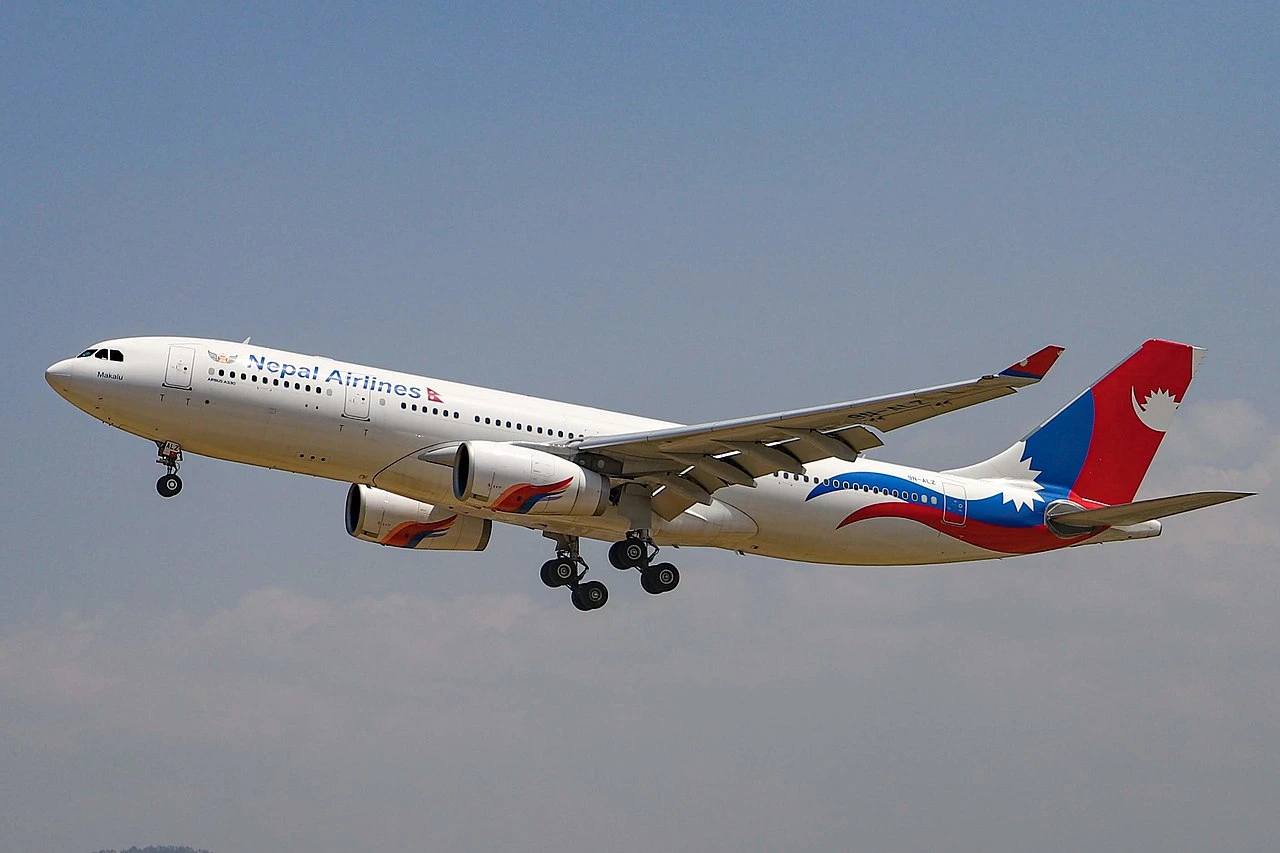
The new design reflects the national identity of Nepal; the wave in the design consists of three basic elements, and the NAC’s name is placed on the body with a larger font face so that it looks strikingly elegant and bold. The new livery was set to replace the old one gradually, as the airline was acquiring six aircraft from China within four months and two aircraft from Airbus within 2016 for domestic and international flights; the new aircraft would carry the new livery that reflects colours of the Nepali flag, culture, nationality, and also retains the image of Akash Bhairav.
Nepal Airlines introduced its current livery in 2014; created by local designer Bishwas Pokharel, the colour scheme reflects the country’s national identity, with a stylised Nepalese flag placed on the tail while the red and blue stripes on the engines symbolise a bird’s wings. The key design elements of the 2014 livery can be summarised as follows:
- A stylised representation of the Nepali flag on the tail fin, incorporating the distinctive crimson red field and blue border
- Red and blue engine stripes intended to evoke the image of outstretched wings in flight
- A bolder, cleaner typographic treatment of the “Nepal Airlines” wordmark along the fuselage
- Retention of the Akash Bhairav symbol, preserving continuity with the airline’s decades-long iconographic heritage
- A white fuselage base that allowed the national colours to read with clarity at altitude
Nepal Airlines’ current livery features the Nepalese flag shaped as a tail wing made of the sun and moon with the national colours of red and blue. The choice to anchor the livery so explicitly in the nation’s flag aligned Nepal Airlines with a broader global trend among flag carriers, where overt national symbolism functions as a form of soft-power projection.
The Boeing 757 was Nepal Airlines’ Most Visible Canvas
The Boeing 757 served as the longest-running canvas for Nepal Airlines’ corporate identity. Royal Nepal Airlines was flying directly from Nepal to Hong Kong by 1988 using a Boeing 757; the carrier connected 38 domestic and 10 international destinations at that time and also started Frankfurt service in cooperation with Lufthansa in October 1987.
The 757’s long, narrow fuselage gave the airline’s stripe design its most proportionally coherent expression, with the horizontal red and blue lines running the full length of the aircraft in a way that emphasised velocity and national pride simultaneously.
Community commentary on aviation forums such as Airliners.net captured the public reception of the transition from the 757-era livery to the 2014 scheme. Aviation enthusiasts on Airliners.net commented that the new livery was a vast improvement, though some felt that just “a little re-styling” of the original design “would not have harmed the airline,” and that “the engine livery layout is a true misser.” The debate illustrated the perennial tension in airline rebranding between those who favor evolutionary refinement and those who prefer clean breaks with the past.
The Airbus Era: Livery Applied to a New Wide-Body Fleet
The new 2014 livery was painted onto new Chinese Xian MA60 and Y12e aircraft acquired by the corporation, marking the beginning of what was supposed to be a new era for Nepal Airlines. [One has to note that these Chinese aircraft have become financially troubling for the carrier]. The livery found its most prestigious application, however, on the airline’s Airbus fleet. Nepal Airlines operates two Airbus A330-200 aircraft: one registered as 9N-ALY and known as “Annapurna,” and the other registered as 9N-ALZ and known as “Makalu.”
The wide-body Airbus A330-200 offered a substantially larger canvas than any previous aircraft in the fleet, and the 2014 livery’s design scaled effectively to accommodate it. The Nepali flag motif on the tail fin, in particular, reads with considerable presence on the A330’s generous vertical stabiliser. One also has to note that the acquisition of the A330 led to the biggest aviation corruption in Nepal.
The A320 aircraft in the fleet, registered as 9N-AKW (“Sagarmatha”) and 9N-AKX (“Lumbini”), carry the same livery on narrow-body fuselages. Nepal Airlines Corporation currently has two Airbus A320s in service, registered as 9N-AKW named “Sagarmatha” and 9N-AKX named “Lumbini,” operating from its main base at Tribhuvan International Airport.

.jpg)
.jpg)
.jpg)


