Hong Kong Airport Opens HK$12.9 Billion Terminal 2 Targeting 120 Million Passengers

Hong Kong International Airport (HKG) opened the departure facilities of its new Terminal 2 (T2) on May 27, 2026, part of a HK$141 billion (~US$18 billion) Three-Runway System (3RS) expansion designed to increase annual capacity to 120 million passengers and 10 million tonnes of cargo. The Airport Authority Hong Kong (AAHK) timed the commissioning deliberately to coincide with the onset of the summer travel peak, with 15 airlines beginning phased check-in relocations to the new building through mid-June 2026.

The launch positions HKIA squarely against two of Asia’s most formidable aviation rivals. Singapore Changi International Airport (SIN) set an all-time passenger record of 70 million in 2025 and broke ground on a fifth terminal in May 2025, while Dubai is pressing ahead with a $35 billion expansion of Al Maktoum International Airport (DWC) that will eventually accommodate 260 million passengers annually. HKIA, which handled 61 million passengers in 2025, now seeks to close that gap — and T2 is its opening gambit.
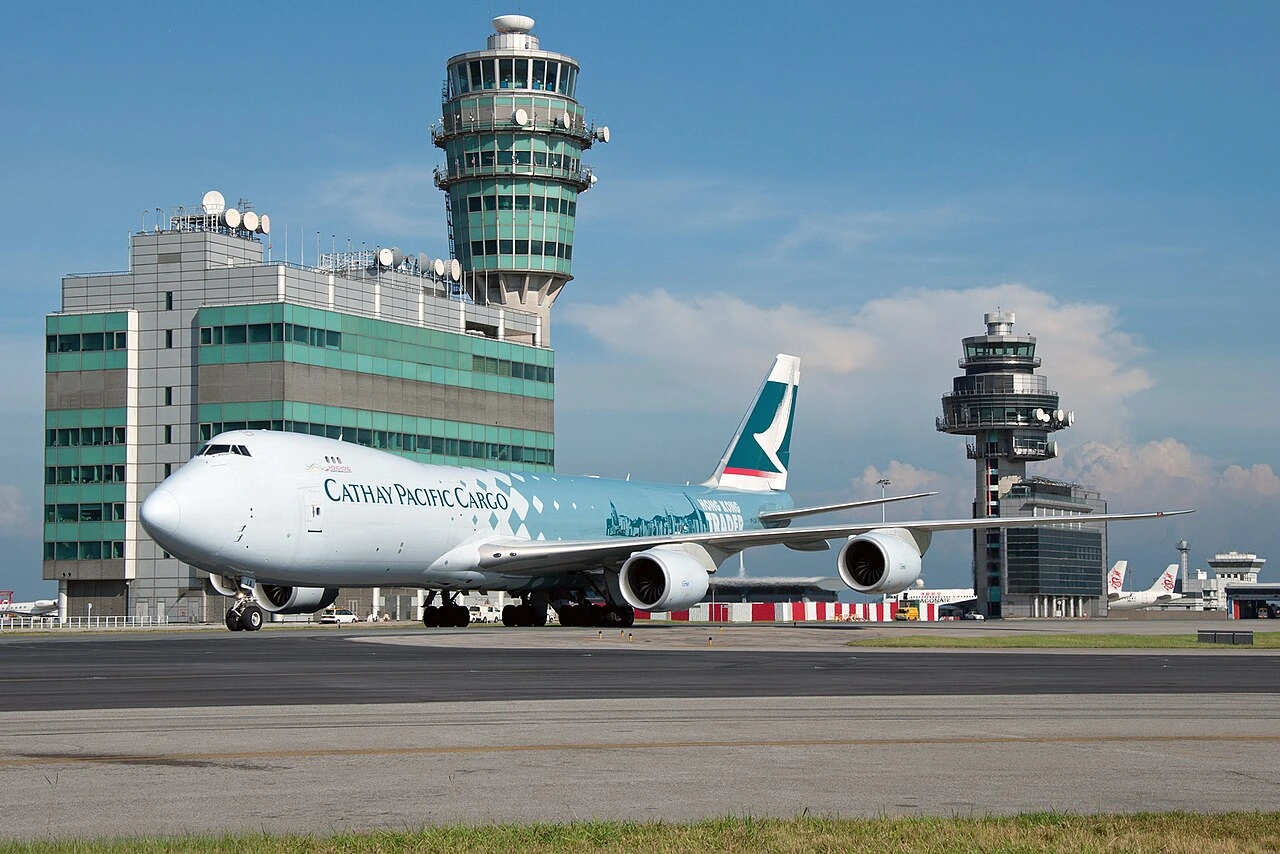
Photo: THOMAS K | Wikimedia Commons

HKIA Built Its New Terminal in Five Years

The expanded Terminal 2 is not a greenfield project but a comprehensive redevelopment of the airport’s existing second terminal, which previously served only a limited check-in function. AECOM, serving as lead consultant and project manager, doubled the size of the original building, with T2 ultimately designed to handle up to 50 million passengers per annum when fully operational. The structure now spans 300,000 square metres and is built to serve both departing and arriving passengers, though arrival facilities will not commence operations until 2027.

Construction of the wider 3RS programme began in August 2016, with 650 hectares of land reclaimed from the sea. The three-runway system itself went into full simultaneous commercial operations on November 28, 2024, making T2’s departure-hall commissioning the first major passenger-capacity unlock since that milestone. The phased approach to T2 served coach services from September 2025, then departure facilities from May 2026, and is set for arrivals in 2027, and a full concourse of 27 gates in 2027.

What Passengers Will Find Inside Terminal 2

T2 is positioned as a leisure-focused terminal, designed with a distinctly youthful aesthetic. The departure hall, split into eight aisles designated P through W, offers a broad range of self-service options alongside hybrid-staffed counters.

Key facilities in the T2 departure hall include:

  • 160 hybrid check-in counters across eight aisles (P–W), with ultra-low platform designs to ease baggage handling
  • 68 express self-bag-drop counters and 58 smart check-in kiosks concentrated in self-service zones at Aisles R, S, T, and U
  • 20 e-Security Gates at the entrance to the restricted area, all equipped with facial recognition technology
  • 15 smart security screening channels inside the restricted area, where passengers may keep laptops and liquids under 100ml in carry-on luggage during screening
  • 35 e-Channels and 60 counters for departing passengers at immigration clearance
  • A food court in the departures hall featuring eight catering outlets, four of which operate around the clock, and 12 retail shops

Source: Human Resources Online / AAHK press release

The terminal introduces what the airport describes as its “Flight Token” biometric system, which allows passengers whose faces have been scanned prior to security screening to pass through without presenting a passport or boarding pass at subsequent checkpoints.

In tandem with T2’s opening, AAHK lowered the minimum age for facial recognition use at e-Security Gates from 11 to seven, applying across both T1 and T2. T2 connects to Terminal 1 (T1) via an air-conditioned footbridge and the airport’s Automated People Mover (APM), while the Airport Express station serves both buildings from the same platform.
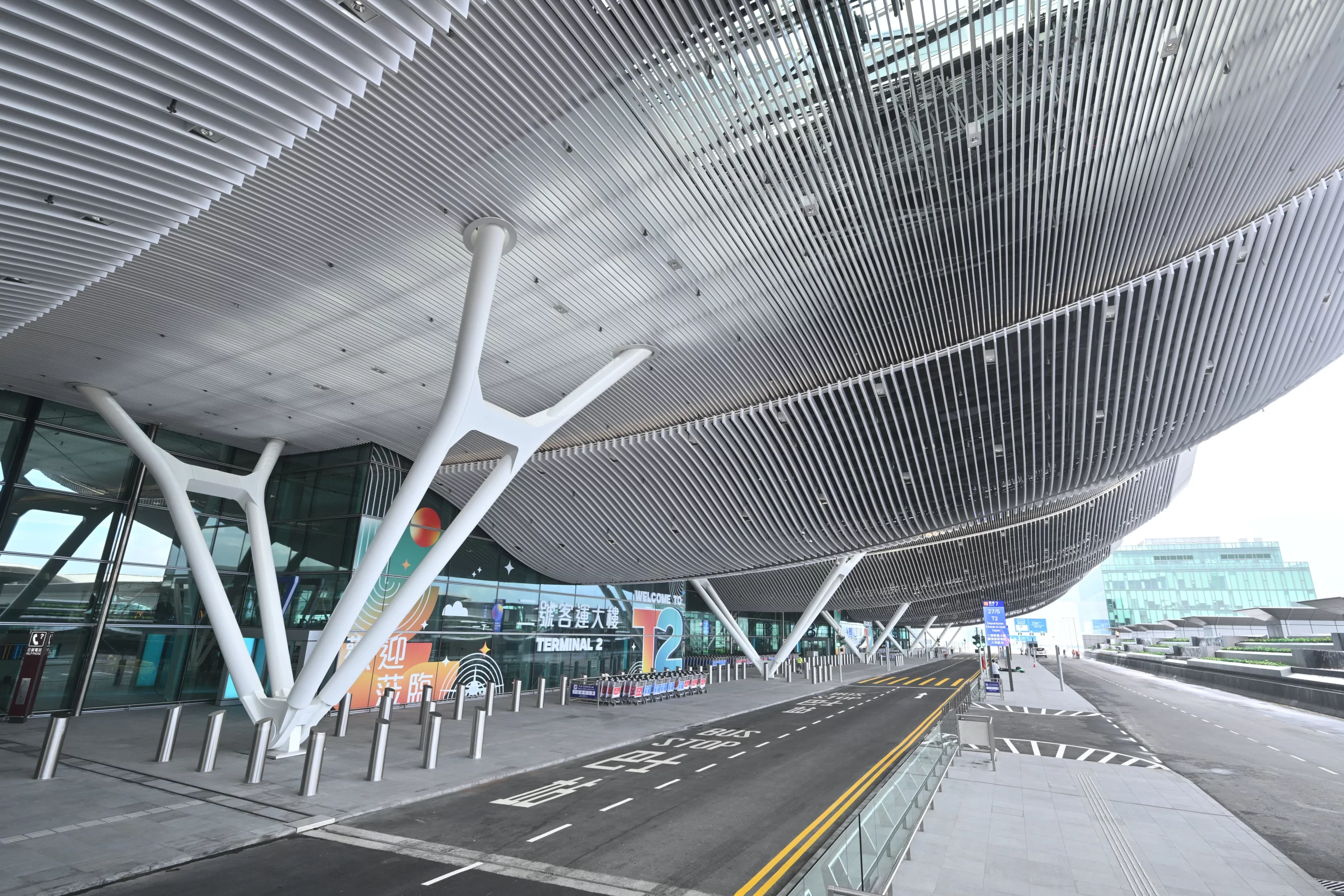
Photo: Hong Kong Airport

What the Ceremony Revealed about HKG’s Ambition

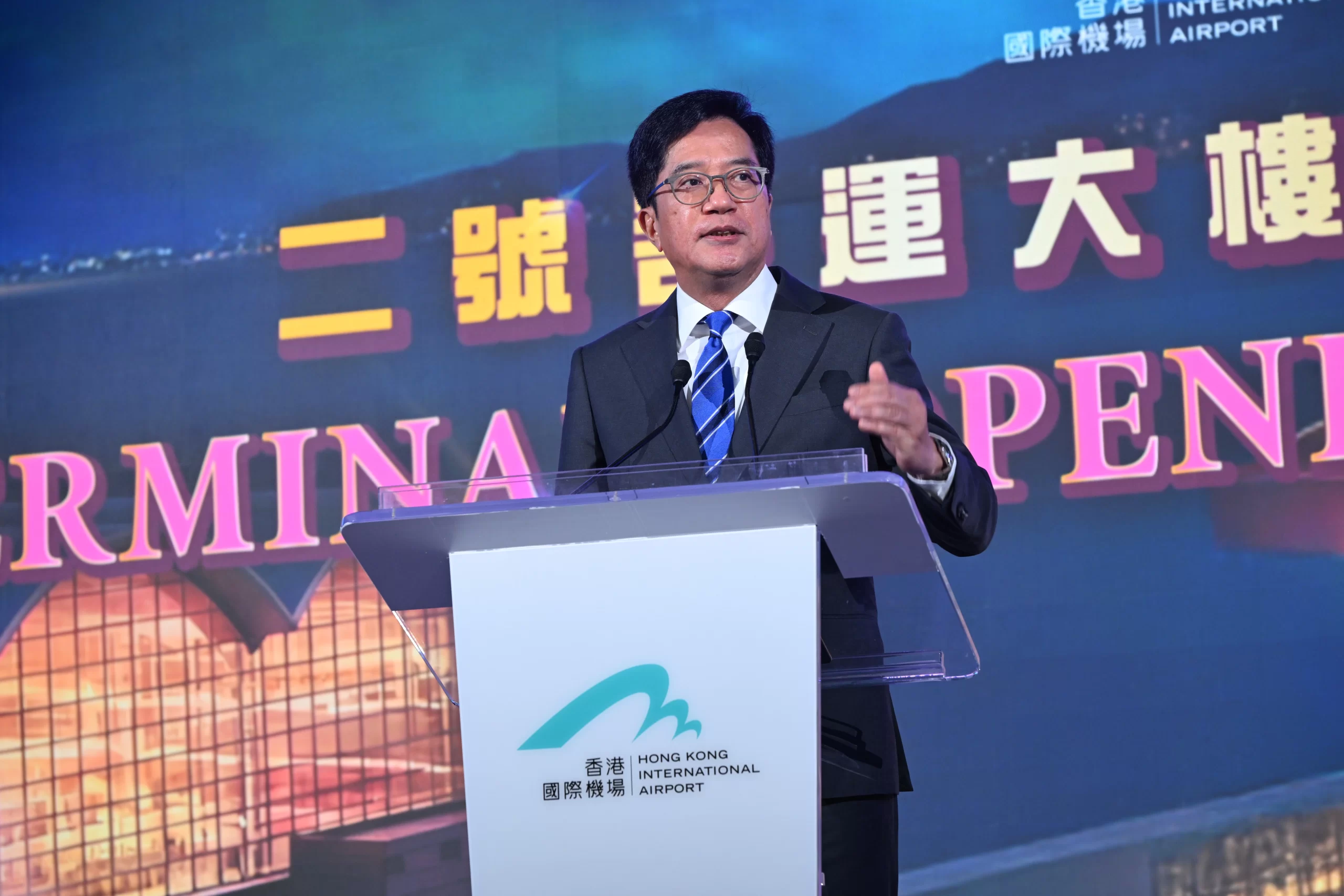
The opening ceremony was held on May 22, 2026, drawing approximately 1,500 guests from government, aviation, cargo, and ground-handling sectors. The event was officiated by AAHK Chairman Fred Lam, Acting Financial Secretary Michael Wong, Secretary for Transport and Logistics Mable Chan, Secretary for Labour and Welfare Chris Sun, and AAHK CEO Vivian Cheung, among other senior officials.

Speaking at the ceremony, Fred Lam stated:

“The opening of T2 is another milestone of HKIA’s development. Positioned as a terminal for leisure travel, T2’s design prioritises efficiency and passenger comfort. We attend to every detail, leveraging technology extensively to enable efficient self-check-in, self-bag drop and smooth immigration clearance. We believe T2 would be popular among passengers, in particular young travellers. The airy interiors, the clean and floating lines of its streamline design make T2 a timeless architecture, while the dynamic and 3D contents on the LED panels around T2 create a vibe that generates a sense of excitement as passengers embark on their journeys.”

Acting Financial Secretary Michael Wong added, as quoted by Travel Trade Journal:

“The remarkable achievements of HKIA have been hard-earned, and we will continue to strive in the future.”

The ceremony ran alongside the HKIA Reception 2026, where 40 business partners showcased innovations before the venue was converted into the HKIA Expo and Career Fair on May 23 and 24, advertising over 4,400 airport vacancies.

Photo: Hong Kong Airport

The 15 Airlines Relocating to T2

AAHK confirmed that 15 airlines, predominantly short-haul and regional operators, will relocate their check-in services from T1 to T2 in phases. Passengers checking in at T2 will continue to use T1 boarding gates via the APM connection until the T2 concourse opens in 2027.

The relocation schedule is as follows:

  • May 27, 2026 — Hong Kong Airlines (HX) becomes the first carrier to relocate all check-in counters to T2, operating from Aisle Q
  • June 3, 2026 — Greater Bay Airlines (HB) begins check-in operations at T2
  • June 10, 2026 — HK Express (UO) completes its move to T2
  • By mid-June 2026 — All remaining carriers, including selected Cathay Pacific (CX) flights, complete relocation

Source: Aerotime

AAHK expects T2 to handle approximately eight million passenger journeys during its first year of operations, with early estimates from Time Out Hong Kong suggesting T2 could accommodate up to 15 million passengers by end-2026 as capacity scales. The split between T1 for long-haul and full-service operations and T2 for leisure and regional travel is a deliberate operational strategy to redistribute passenger flows and reduce congestion.

How HKG Compares with Changi and Al Maktoum

T2’s opening must be read against a backdrop of accelerating infrastructure investment across Asia and the Gulf. The competitive dynamics are stark.

Singapore Changi International Airport (SIN) recorded nearly 70 million passengers in 2025, surpassing its own pre-pandemic record of 68.3 million set in 2019. Changi has won Skytrax’s “World’s Best Airport” award 13 times, most recently in 2025. Singapore broke ground on its fifth terminal (T5) in May 2025, a $10 billion project designed to add 50 million passengers of annual capacity and push Changi’s total to 140 million passengers per year when operational in the mid-2030s. T5’s design incorporates automation, artificial intelligence, autonomous vehicles, and robotics, and the entire structure will be fully electrified.

In a pointed acknowledgement of the competitive threat, Singapore Prime Minister Lawrence Wong, speaking at the T5 groundbreaking, warned:

“Some have announced plans for mega airports that can handle more than 100 million passengers a year. So they are narrowing the gap with Singapore. Increasingly, flights that would have passed through Changi may no longer be needed.”

Dubai’s Al Maktoum International Airport (DWC) tells a different story of ambition at a different scale entirely. Dubai International Airport (DXB) handled a record 95.2 million passengers in 2025 and is targeting 99.5 million for 2026, approaching its physical limits. The $35 billion Phase Two expansion of DWC envisions a facility with five runways and ultimate capacity of 260 million passengers annually, making it the largest airport in the world by capacity. By 2032, when DWC is expected to handle 150 million passengers, all commercial operations including the entire Emirates (EK) and flydubai (FZ) fleets will shift to the new site.

HKIA’s target of 120 million passengers annually — achievable within roughly a decade if the 3RS reaches full utilisation — is credible but falls considerably short of both rivals’ long-range ambitions. What HKIA offers in counter is geography: the airport sits within five flight hours of half the world’s population, and the Greater Bay Area, encompassing Shenzhen Bao’an International Airport (SZX) and Guangzhou Baiyun International Airport (CAN), generates substantial feeder traffic that neither Changi nor Dubai can readily replicate.

Photo: Hong Kong Airport

Cathay Pacific And the Carrier Ecosystem Backing T2

No discussion of HKIA’s expansion is complete without examining Cathay Pacific Airways (CX), the airport’s flag carrier and principal long-haul operator. Cathay Group reported passenger growth of more than 24% year-on-year in March 2026, while its low-cost subsidiary HK Express carried more than 750,000 passengers during the same month. Cathay has committed to HK$100 billion (~US$12.8 billion) in investment over seven years as part of a broader fleet and network expansion aligned with the 3RS programme.

At the commissioning of the three-runway system in November 2024, Cathay Group CEO Ronald Lam said:

“The introduction of the three-runway system will be a landmark moment for Hong Kong, one that ushers in a new era of possibilities for our home hub and its aviation industry.”

T2, however, does not primarily serve Cathay. Selected CX flights will relocate check-in to T2, but the terminal’s character is shaped by regional and leisure carriers — Hong Kong Airlines (HX), HK Express (UO), and Greater Bay Airlines (HB) — whose route networks concentrate on Southeast Asia, mainland China, and Northeast Asia. Hong Kong Tourism Board data shows mainland China accounted for more than 11 million visitor arrivals in the first quarter of 2026 alone, and T2’s leisure-first positioning directly targets that demographic.

HKIA handled 61 million total passengers in 2025, a 15% year-on-year increase, while cargo throughput exceeded 5 million tonnes. The airport’s long-term target, to be reached by approximately 2035, is 120 million passengers and 10 million tonnes of cargo annually — a figure that requires both the completed T2 concourse (due 2027) and the full utilization of all three runways.

Photo: Hong Kong Airport

Hong Kong’s T2 Arrivals, The Concourse, And the Road To 2035

T2’s May 2026 commissioning covers only departure facilities. Arrival facilities are scheduled to begin operations in 2027, in line with traffic demand. The full airside concourse, a Y-shaped structure designed by architects Aedas with 27 boarding gates including seven multi-aircraft ramp stands, is also due in 2027. Once linked to T2 via an airside APM, the concourse will allow passengers to check in, clear security and immigration, and board — all without crossing to T1.

The expanded T2 is ultimately designed to process up to 50 million passengers per annum, according to AECOM’s project documentation. Alongside T1 and the new infield concourse, HKIA’s full buildout under the 3RS programme will support 120 million passengers a year by the mid-2030s, at which point the airport will rank among the world’s few mega-hubs. Whether that capacity translates into competitive parity with Changi or Dubai will depend as much on airline route decisions, cargo strategy, and transit passenger preferences as on infrastructure alone.
Hong Kong International Airport (HKG) opened its on May 27, 2026 — part of a HK$141 billion expansion targeting 120 million passengers annually. , it is Hong Kong’s boldest infrastructure bid to close the gap on Singapore Changi’s record-breaking 70 million passengers and counter Dubai’s $35 billion Al Maktoum mega-hub — which is on course to handle 260 million passengers at full build-out.

Leave a Comment

Your email address will not be published. Required fields are marked *

Scroll to Top