The Boeing E-6B Mercury is not the fastest aircraft in the U.S. military, not the most heavily armed, and not the most recognisable. Despite this, many consider this to be the most consequential by strategic measure. Operating under the codename TACAMO, an acronym for “Take Charge and Move Out,” the E-6B is the United States’ airborne nuclear command post: the aircraft that keeps the President and Secretary of Defense connected to every leg of America’s nuclear triad:
- Ohio-class ballistic missile submarines (SSBNs)
- Minuteman III intercontinental ballistic missile (ICBM) silos
- nuclear-capable strategic bombers
— even if every ground-based command and communications infrastructure on earth has been vaporised.
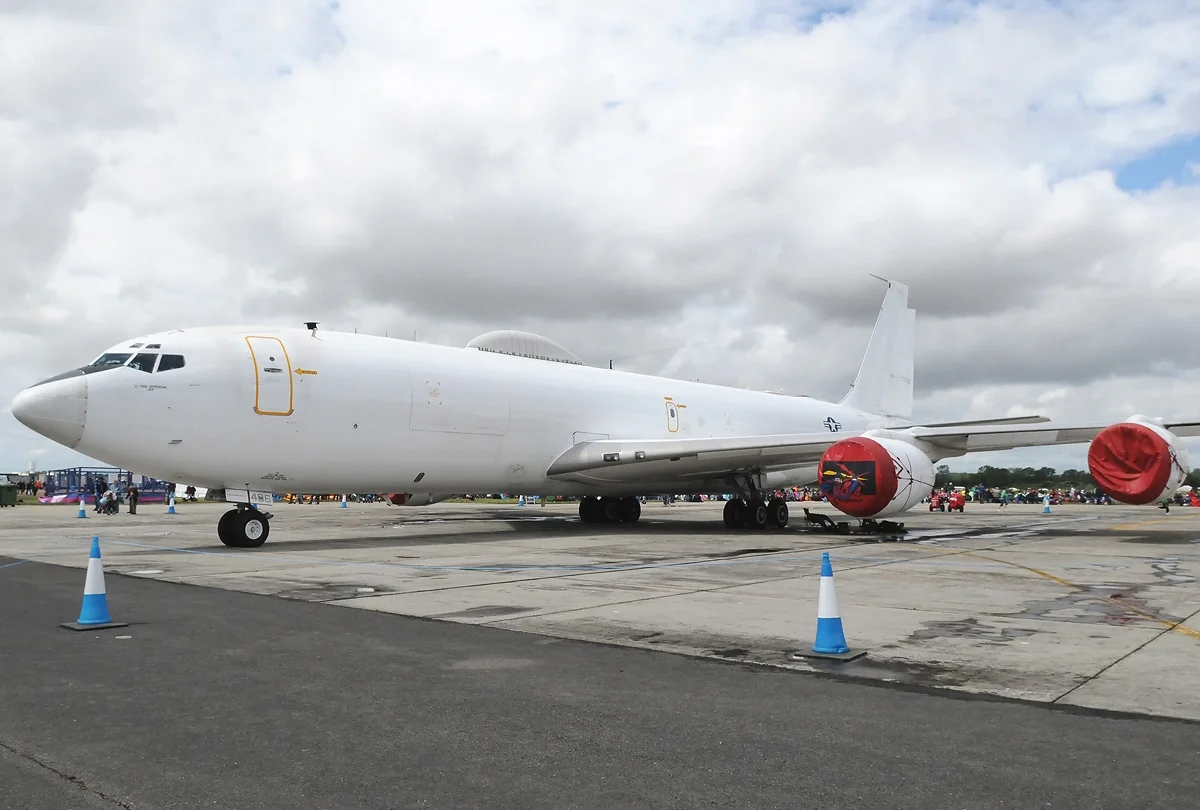
Boeing E-6B Mercury was Built from the Commercial Boeing 707
The engineering lineage of the E-6B Mercury traces directly to the world’s first commercially successful jet airliner. The E-6B is derived from the Boeing 707-320 airframe, making the E-6B the final Boeing 707 derivative ever built.
In 1983, the U.S. Navy awarded Boeing a full-scale development contract for a militarised version of the 707-320 to replace the aging Lockheed EC-130Q fleet in the TACAMO mission. The prototype E-6A rolled out on December 18, 1986, completed its maiden flight on February 19, 1987, and production deliveries to the Navy ran from 1989 to 1992.
The militarization from commercial airliner to nuclear command post required extensive modifications. Some say that the most operationally significant was the replacement of the original Pratt & Whitney JT3D turbofans with four CFM International CFM56-2A-2 high-bypass turbofans. This improved fuel efficiency and gave the aircraft its 72-hour continuous endurance capability with in-flight refueling.
The aircraft also received electromagnetic pulse (EMP) hardening throughout its systems, an ultra-high frequency radio for access to the survivable MILSTAR satellite communications network, and an advanced 737 Next Generation commercial off-the-shelf cockpit to reduce pilot training costs while maintaining operational compatibility. All 16 E-6A aircraft were subsequently upgraded to the dual-mission E-6B standard. The modification of the entire fleet was completed in 2003.
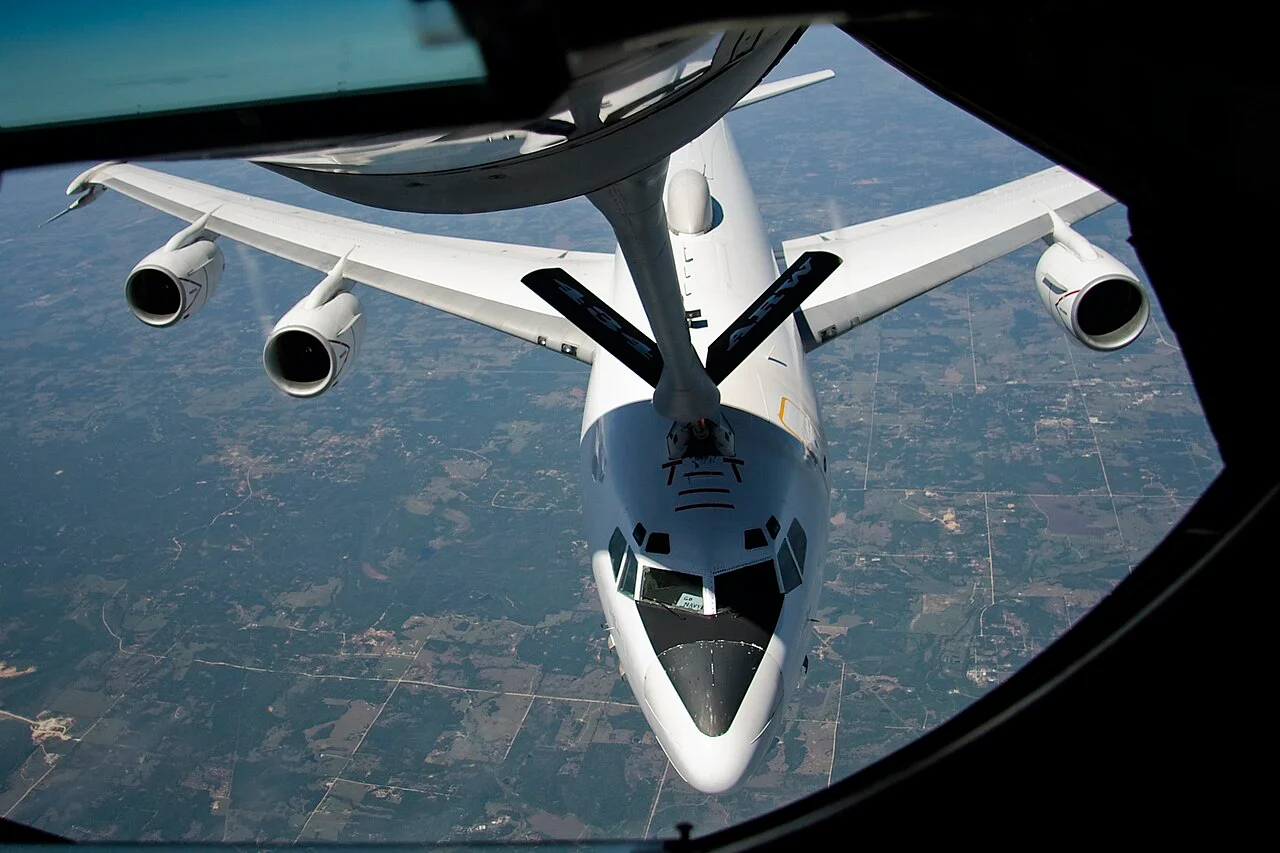
What A Five-Mile Wire Antenna Hanging from a Banking Aircraft Actually Does
The E-6B’s operational concept is simultaneously simple in principle and extraordinary in engineering execution. The system’s core physics problem is communicating with ballistic missile submarines operating at operational depth — where radio frequencies above roughly 30 kHz cannot penetrate seawater.
The solution, developed in the 1960s, is Very Low Frequency (VLF) radio transmission at frequencies between 14 and 60 kHz, which can penetrate seawater to a depth sufficient for submarine reception. The challenge is that VLF wavelengths range from 6.2 to 62 miles.
James Marinero’s analysis in Substack draws on declassified NAVAIR technical data, documents that the aircraft carries two trailing wire antennas wound on reels:
- a Long Trailing Wire Antenna (LTWA) extending approximately 26,000 feet — nearly five miles
- a Shorter Trailing Wire Antenna (STWA) of approximately 4,000 feet, which together form a dipole antenna of sufficient electrical length to radiate VLF signals at combat-effective power levels.
The transmitter operates at a power level (up to 200 kilowatts) that ensures seawater penetration and a global coverage. During transmission, the pilot enters a steep, continuous orbit known as a “TACAMO bank” near the aircraft’s stall speed, which causes the trailing wires to hang nearly vertically below the aircraft.
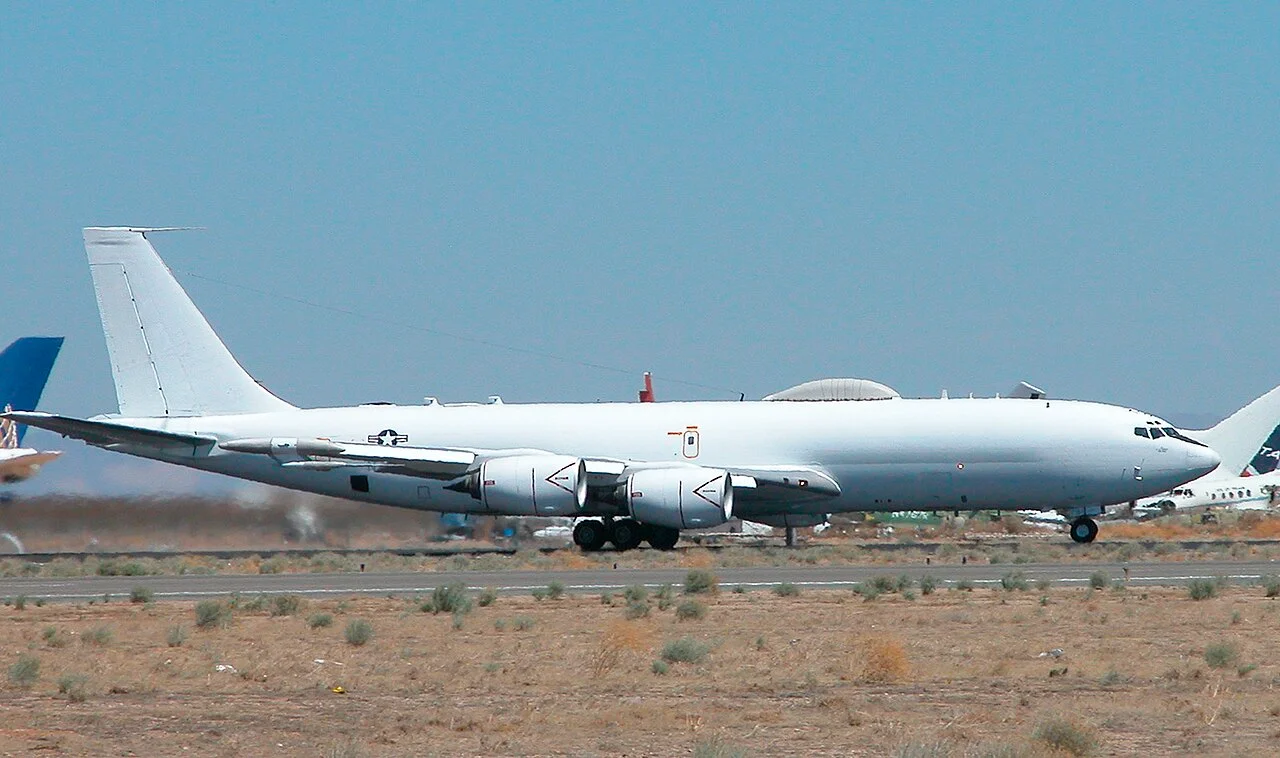
The E-6B Can Remotely Launch Land-Based ICBMs
The E-6B’s dual-mission E-6B standard added a capability that the original E-6A TACAMO aircraft did not possess: the ability to remotely command the launch of land-based Minuteman III ICBMs from their silos through the Airborne Launch Control System (ALCS).
The E-6B was conceived as a replacement for the U.S. Air Force’s EC-135 Airborne Command Post fleet — the “Looking Glass” aircraft that had maintained a continuous 24-hour airborne presence over the United States since 1961 — as the EC-135s aged out of service.
By consolidating both the Navy’s TACAMO submarine communications mission and the Air Force’s ALCS land-based ICBM command post mission into a single aircraft, the E-6B became the sole aerial platform capable of ordering launches across two legs of the nuclear triad simultaneously. A crew of 22 performs four distinct mission sets aboard the E-6B including:
- all ICBM and ALCS-related tests
- Strategic Command and Control System operations
- Plans and Targeting
- TACAMO submarine communications relay.
The Lexington Institute’s strategic assessment of the E-6 TACAMO identifies the consequential asymmetry in nuclear deterrence that the E-6B resolves: submarines carry over half of the U.S. nuclear warhead arsenal, but their communication link is the most technically fragile element of the entire triad: without an assured TACAMO relay, the strongest leg of the nuclear triad becomes its most vulnerable.
The E-6B is the insurance policy that ensures the submarine fleet remains a credible deterrent even after a first strike destroys all ground-based communications infrastructure.
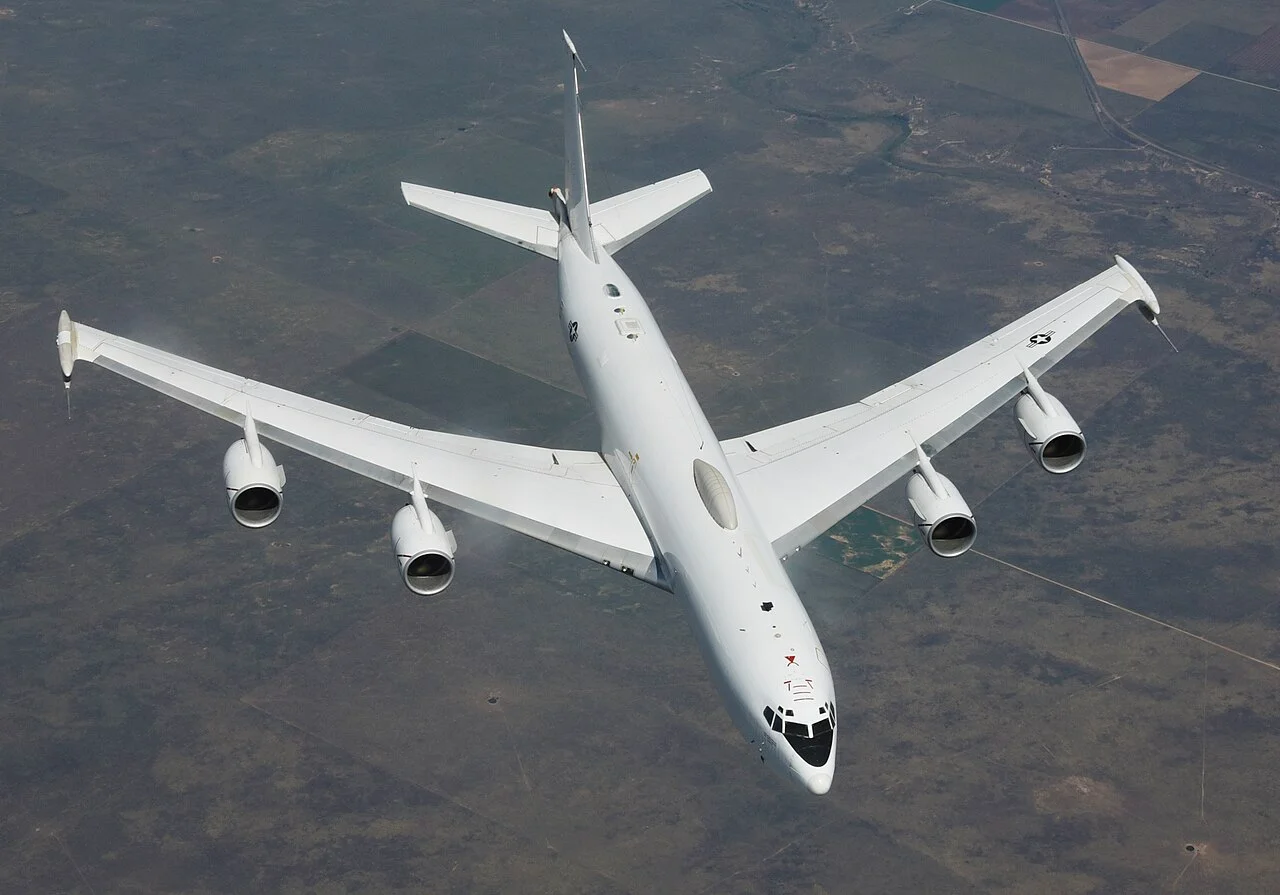
E-6B In Active Operations
U.S. Strategic Command’s December 2025 social media post, reproduced by Aerospace Global News in its January 2026 upgrade analysis, documented E-6B TACAMO aircraft exercising nuclear command, control and communications capabilities near Pituffik Space Base, Greenland, simultaneously communicating with ballistic missile submarines in both the Atlantic and Pacific Oceans.
Two aircraft maintain constant alert posture — one over the Atlantic and one over the Pacific — while additional aircraft sit on 15-minute ground alert at Tinker Air Force Base, Oklahoma, home of Strategic Communications Wing One and its three squadrons:
- the “Ironmen” of Fleet Air Reconnaissance Squadron VQ-3
- the “Shadows” of Fleet Air Reconnaissance Squadron VQ-4
- the “Roughnecks” of Fleet Air Reconnaissance Squadron VQ-7
E-6B aircraft was also observed flying the characteristic circular “TACAMO bank” patterns over the Gulf region during the Iran conflict period. This also coincided with the deployment of USS Gerald R. Ford’s carrier strike group to the eastern Mediterranean.
Future of the E-6B
In January 2026, Collins Aerospace — a subsidiary of RTX — was awarded a USD 20.3 million contract to produce three high-power transmit set modernisation (HPTS-M) kits for the E-6B, replacing older transmitters and radios to ensure continuous, reliable VLF connectivity in the most severe crisis scenarios imaginable.
The contract was awarded as the Department of Defense confirmed Collins Aerospace as “the only known qualified, responsible source” capable of fulfilling the requirement.
The E-6B is simultaneously being upgraded and replaced. NAVAIR’s official E-6B product page confirms the fleet averages nearly 35 years in service, with the final aircraft delivered December 1, 2006, after a production run of 16 units that began in 1989.
Northrop Grumman Corp. accepted its first overhauled E-6B under an Integrated Modification and Maintenance Contract at its Aircraft Maintenance and Fabrication Center in Lake Charles, Louisiana in June 2023, with multiple additional aircraft to follow by 2027. In October 2024, the U.S. Navy formally designated the eventual replacement aircraft the E-130J — a derivative of Lockheed Martin’s C-130J-30 Super Hercules — with nine systems planned by 2028 and the E-6B expected to fulfil its TACAMO role into the 2030s during the transition.

_JP7180547.jpg)
